Group vs 1:1 Tutoring for GCSE Bengali
Group vs 1:1 tutoring GCSE Bengali explained: compare feedback, speaking practice, cost and group size to choose support that fits your needs and goals.
Choosing a tutor can feel like choosing the answer before you have seen the question. A group may offer conversation, energy and a lower cost per student. One-to-one tuition may offer privacy, individual feedback and lessons built around your precise gaps.
If you are comparing group vs 1:1 tutoring GCSE Bengali, neither option is automatically better. One-to-one tuition usually suits students with specific weaknesses, limited confidence or an urgent need for personalised feedback. A small group often suits students who learn through discussion, need regular speaking practice and benefit from seeing how other people respond.
The better choice is the one that matches your current needs, your exam specification and the quality of the tutor, not simply the format printed on the advert.
The quick decision checklist
Choose one-to-one GCSE Bengali tutoring if you:
- have a clear weakness in speaking, writing, listening or reading;
- feel uncomfortable making mistakes in front of other students;
- need lessons adjusted to your pace;
- are preparing independently and need help understanding the specification;
- have limited time before the examination;
- need detailed correction of pronunciation, grammar or written accuracy.
Choose small-group GCSE Bengali tutoring if you:
- want more opportunities for discussion and spontaneous speaking;
- learn well by hearing other students' answers;
- need the structure and accountability of a regular class;
- have broadly similar needs to the other students;
- are comfortable asking questions in a group;
- want tuition that is usually more economical than individual lessons.
A trial lesson is useful in either case. Pay attention to how much you speak, how specific the feedback is and whether the lesson clearly connects to your actual examination.
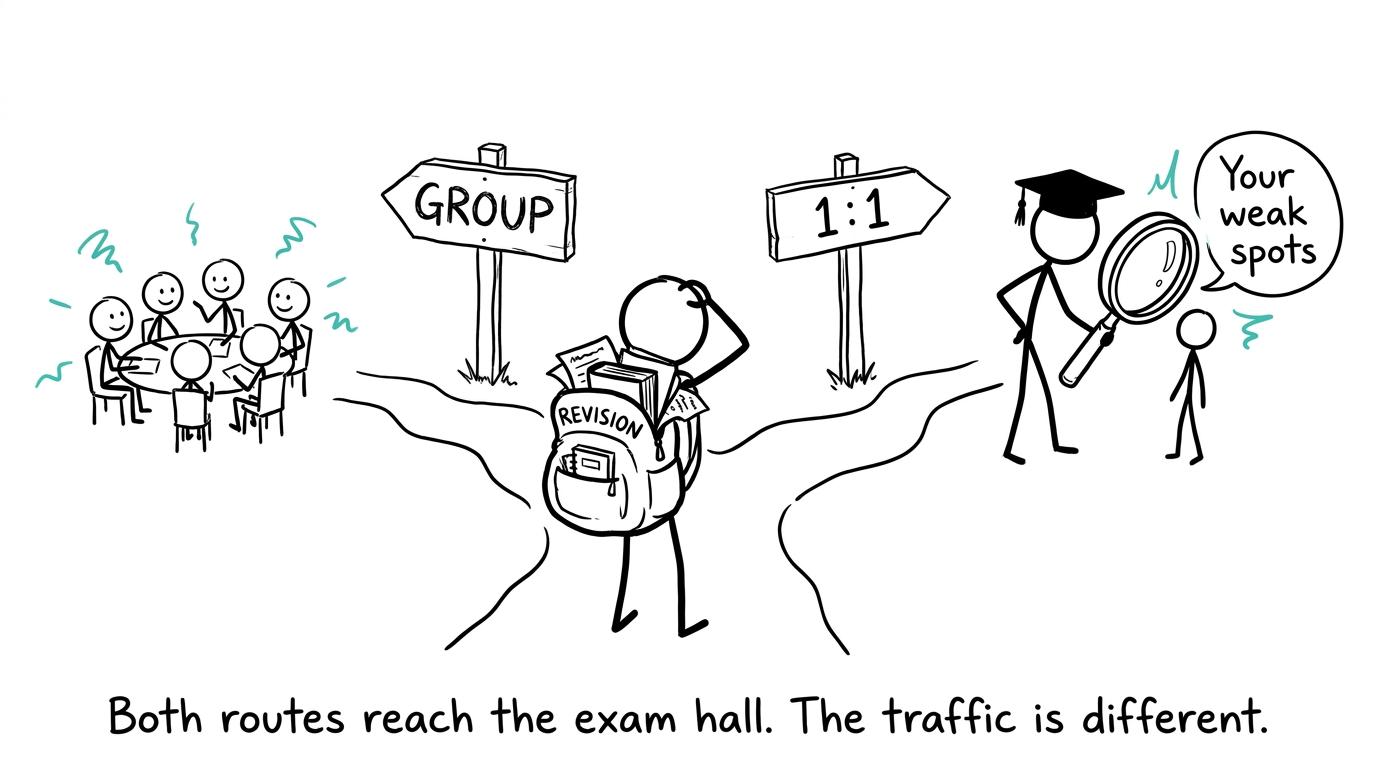 A student choosing between group and one-to-one tuition
Understand what GCSE Bengali actually assesses
Tutoring works best when it is aligned with the qualification being taken. For the current AQA GCSE Bengali specification, students are assessed in four areas: listening, speaking, reading and writing. Each contributes approximately one quarter of the qualification.
AQA offers foundation tier, covering grades 1-5, and higher tier, covering grades 4-9. Students take all four components at the same tier and in the same examination series. That matters because a tutor should not teach Bengali merely as a general language course. Lessons should prepare you for the demands, timings and response formats of your tier.
Before enrolling, ask the tutor:
- Which GCSE Bengali specification do you teach?
- Do you teach both foundation and higher tier?
- How do you prepare students for the role-play, photo card and conversation?
- Will you mark writing against the relevant assessment criteria?
- Do you use official sample materials and past papers?
- How will you identify and monitor my weakest component?
Students taking an International GCSE or another qualification should check their own specification carefully. The assessment structure may be substantially different, so never assume that a course labelled “GCSE Bengali” matches your examination.
The real advantages of one-to-one tutoring
Feedback belongs entirely to you
In an individual lesson, the tutor can pause whenever your pronunciation, vocabulary choice or sentence structure needs attention. That makes one-to-one support particularly valuable when your difficulties are narrow but persistent.
You may understand spoken Bengali at home, for example, while finding formal writing difficult. Another student may write accurately but hesitate during spontaneous conversation. Those students do not need identical lessons. Individual tuition can spend less time on secure skills and more time on the component where marks are being lost.
The pace can change immediately
A one-to-one tutor does not need to wait for a group to finish. If you grasp a task quickly, the lesson can move forward. If you need to revisit a grammar pattern or unpack a reading passage, the tutor can slow down without creating pressure.
This flexibility is useful for students who begin GCSE Bengali preparation later than their peers or who have learned Bengali mainly through family conversation rather than formal reading and writing.
It can feel safer for hesitant speakers
Speaking improves through speaking, but embarrassment can make students avoid exactly the practice they need. A calm individual setting may make it easier to attempt longer answers, ask basic questions and accept correction.
The limitation is equally important: one-to-one lessons provide only one regular conversation partner. A strong tutor should therefore vary questioning, pace and topic rather than allowing every conversation to become predictable.
The real advantages of group tutoring
You hear more than one possible answer
Languages rarely have only one sensible response. In a good group, students hear different vocabulary, opinions and ways of developing an answer. That can make their own language less rehearsed and more flexible.
Group work is especially useful for role-play, discussion and follow-up questions. Students can take turns as speaker, listener and observer, noticing effective habits as well as common errors.
There is useful social pressure
A group creates a small commitment. You arrive knowing that other people will participate, complete tasks and notice whether you contribute. For some students, that makes consistent practice easier.
This only works when the atmosphere is supportive. A session dominated by one confident speaker can leave quieter students watching rather than learning. Ask how the tutor distributes speaking time and whether every student receives individual feedback.
Small groups can provide strong value
Education Endowment Foundation research indicates that both one-to-one and small-group tuition can support progress when provision is targeted and connected to classroom learning. It defines small-group tuition as support for two to five pupils and notes that effectiveness tends to fall when groups become too large.
That evidence covers tutoring generally rather than GCSE Bengali specifically, so it should not be treated as a guaranteed result. The practical principle is still useful: a focused group of students with similar needs is very different from a crowded online class with little personal interaction.
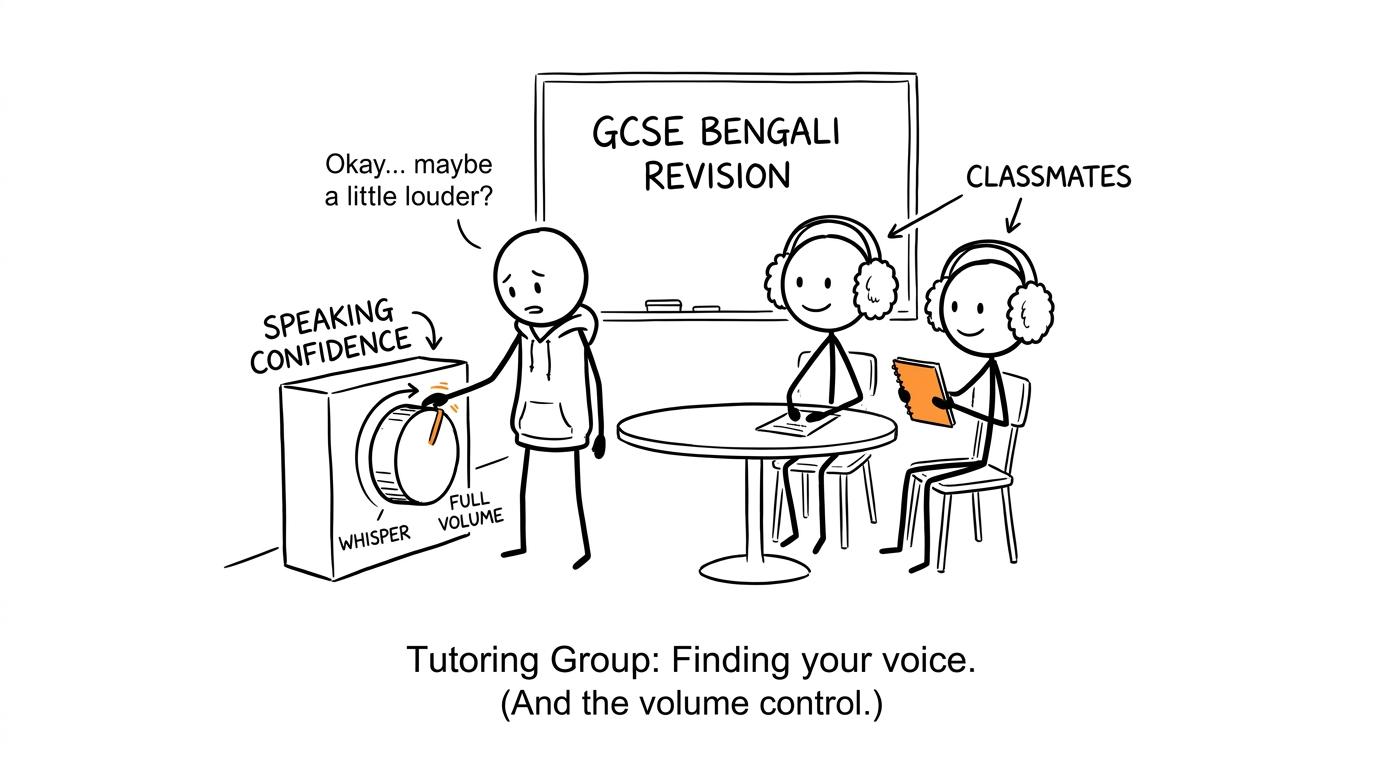 A student discovering their speaking confidence in a small group
Group vs 1:1 tutoring GCSE Bengali compared
| Factor | Small-group tutoring | One-to-one tutoring |
|---|---|---|
| Personal feedback | Shared across the group | Focused entirely on one student |
| Speaking variety | Several voices and responses | One consistent conversation partner |
| Lesson pace | Set around the group | Adjusted immediately to the student |
| Confidence | Helpful for collaborative learners | Safer for students worried about mistakes |
| Targeting weak areas | Best when students have similar gaps | Strong for unusual or specific gaps |
| Accountability | Encouragement from peers | Direct accountability to the tutor |
| Typical cost structure | Cost is shared between students | Usually the more expensive format |
| Best use | Regular practice and interaction | Diagnosis, correction and rapid intervention |
The table describes tendencies, not guarantees. An excellent group tutor may provide more useful feedback than a weak individual tutor. Tutor knowledge, preparation and consistency matter more than the label alone.
Match the format to your weakest component
Speaking and listening
A small group can be excellent for spontaneous interaction because you hear different accents, speeds and answers. It may suit a student who already speaks confidently but needs more variety and examination practice.
One-to-one tuition is often better when pronunciation, hesitation or anxiety requires close attention. The tutor can identify repeated patterns and ask follow-up questions at exactly the right level.
Reading
Either format can work. A group allows students to compare interpretations and explain clues to one another. Individual tuition is stronger when difficulties arise from a specific issue, such as vocabulary range, reading speed or moving between Bengali and English.
Writing
Writing often benefits from individual feedback. General advice such as “use more detail” is rarely enough. Students need to know which sentences communicate clearly, where accuracy breaks down and how well the response addresses every task requirement.
A group can still be effective if the tutor marks work between sessions and uses shared lesson time to discuss anonymous patterns. Ask to see how written work will be corrected before committing.
Look at teaching quality before lesson format
The format is visible. Teaching quality is harder to see, but it is more important.
A worthwhile GCSE Bengali tutor should:
- understand the relevant exam specification and tier;
- diagnose needs rather than teaching every student identically;
- balance all four language skills;
- give precise, usable feedback;
- make the student produce language rather than simply listen;
- revisit errors to check that they have been corrected;
- use assessment materials appropriately;
- explain how progress will be measured.
Be cautious if a tutor promises a particular grade, relies entirely on memorised model answers or cannot explain how lessons correspond to the assessment objectives. Tutoring should improve adaptable language skills, not create dependence on scripts that may not fit the examination task.
Protect the rest of your GCSE revision timetable
Many students considering Bengali tuition are also balancing GCSE maths, English, sciences and other subjects. A theoretically perfect tutoring arrangement is not useful if travel, homework and additional sessions consume the time needed elsewhere.
Create one timetable covering every subject. MathsGenie’s guide to building a GCSE maths revision timetable can help you organise focused sessions around fixed commitments such as Bengali tuition.
For maths, begin by using the GCSE Maths revision hub and a short diagnostic process to find your weakest GCSE topics. That follows the same principle as good tutoring: diagnose first, then spend time where it can make a difference.
If you are short on time, Edexcel GCSE Maths mini tests offer focused practice without requiring a full-paper session. As examinations approach, move into Edexcel GCSE Maths past papers or AQA GCSE Maths past papers, depending on your board.
The important idea is balance. Bengali tutoring should occupy a defined place in your week, while maths revision continues through lessons, practice questions, marking and re-testing.
A blended option may be better than choosing one forever
The decision does not have to be permanent. Some students benefit from weekly group lessons supported by occasional one-to-one sessions before a speaking assessment or after a disappointing mock result.
Another sensible pattern is to begin individually, identify and repair the largest gaps, then move into a small group for regular conversation and examination practice. The reverse can also work: start in a group, then add a short block of individual lessons when your remaining weaknesses become clearer.
Review the arrangement after several sessions. Ask:
- Am I speaking and writing more accurately?
- Do I understand my recurring mistakes?
- Is feedback specific enough to act on?
- Are lessons covering my weakest component?
- Can I see progress in timed or assessed work?
If the answer remains no, changing tutor may be more useful than merely changing format.
Common mistakes when choosing GCSE Bengali tutoring
Choosing only by price
Cost matters, but the cheapest lesson is poor value if you rarely participate. Compare the amount of active practice and individual feedback, not only the advertised session price.
Ignoring group size
“Group tuition” could mean three students or a large online audience. Ask for the maximum class size and how speaking time is allocated.
Assuming a fluent speaker understands the exam
Fluency and examination teaching are different skills. A tutor should understand the specification, assessment tasks and mark criteria as well as the language itself.
Practising only comfortable skills
Students who enjoy conversation may avoid writing. Strong readers may postpone speaking. Your tuition should give extra attention to the weakest assessed area rather than repeatedly confirming what you can already do.
Letting tutoring replace independent practice
A lesson is a source of feedback, not a substitute for revision. Between sessions, retrieve vocabulary, complete writing, listen actively and correct previous errors. The same discipline applies in maths: use revision lessons and short daily practice, then test performance with papers and mark schemes.
Which tutoring option is better?
Choose one-to-one tutoring when your needs are specific, your confidence is low or rapid personal feedback matters most. Choose a small group when you want varied conversation, peer learning, regular accountability and a more affordable structure.
Then look beyond the label. Check the tutor’s specification knowledge, the amount of active practice, the quality of feedback and whether progress is being measured. The best arrangement is not the one that feels most impressive. It is the one that repeatedly turns weaknesses into skills.
Keep the rest of your revision just as deliberate. Use MathsGenie’s free revision lessons and practice questions to repair maths gaps, mini tests to check recall, and GCSE predicted papers and past papers to build examination confidence. Mark every attempt, use the mark schemes and video solutions, and let each mistake decide what you practise next.