

Group Study for Maths: Does It Work?
Group study for maths: does it work? Learn when it helps, when it wastes time, and how to run focused GCSE or A Level revision sessions.

A parent hears laughter from the kitchen. Four exercise books are open, several biscuits have disappeared, and the planned algebra session appears to have become a conversation about everything except algebra.
It raises a fair question: group study for maths, does it work?
Yes, it can. Group revision is useful when students solve questions independently, explain methods, compare answers and correct mistakes. It becomes ineffective when the meeting has no topic, no time limit or no individual practice. The deciding factor is not whether friends revise together. It is whether the session has a structure.
The short answer
A productive maths revision group usually has:
- two to four students;
- one specific topic or paper section;
- a clear start and finish time;
- silent individual question practice;
- explanations without copying;
- answers checked against a mark scheme;
- an agreed next step for each student.
Group study should support independent revision, not replace it. You still need quiet time to discover what you can do without hints, particularly before a GCSE or A Level exam.
Why group study can help with maths
Maths can create an illusion of understanding. A method looks obvious while somebody else is demonstrating it. The difficulty often appears when the page is blank and you must choose the first step yourself.
A good group interrupts that illusion in several useful ways.
Explaining exposes gaps
Suppose one student can complete a quadratic equation but cannot explain why a particular method works. Teaching the steps to somebody else forces that student to organise the method clearly. Their partner can ask the small question that a video or textbook cannot anticipate: “Why did you factorise there?”
That conversation is valuable because it tests reasoning, not just recognition. However, an explanation only counts as revision if everyone then attempts a question without help.
Different mistakes become shared warnings
One student forgets a negative sign. Another rounds too early. A third uses the right formula but substitutes a value incorrectly. When the group checks work carefully, each mistake becomes a warning for everybody.
This is especially helpful when using GCSE past papers or A Level past papers. The mark scheme shows what earns credit, while discussion helps students understand why an answer lost marks.
A meeting creates accountability
“I will revise geometry sometime this week” is easy to postpone. “We are meeting on Wednesday to complete a geometry mini test” is concrete.
That commitment can help students begin, but attendance is not the same as progress. The group must produce evidence: attempted questions, corrections and a short list of topics requiring more work.
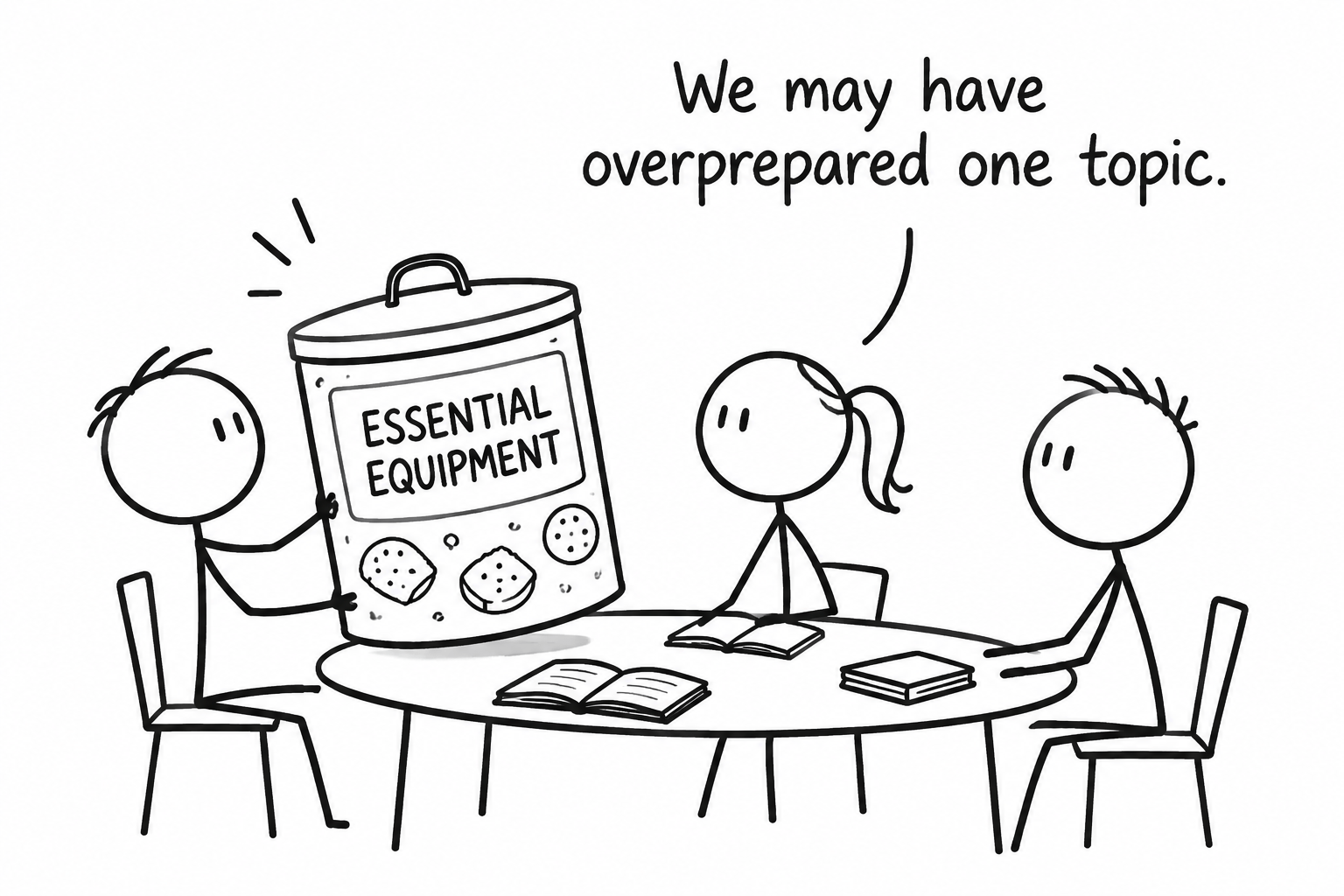 A revision group discovers that its largest shared resource is a biscuit tin
A practical structure for group maths revision
Use this plan for a focused session of roughly one hour. It works for both GCSE revision and A Level revision, although the questions should match the correct specification and tier.
| Time | Activity |
|---|---|
| First 555 minutes | Name the topic and agree what success will look like. |
| Next 101010 minutes | Recall formulas, facts or method steps without notes. |
| Next 202020 minutes | Attempt the same practice questions independently and in silence. |
| Next 151515 minutes | Compare methods, explain differences and check the mark scheme. |
| Final 101010 minutes | Correct errors and choose individual follow-up work. |
The silent section matters. If students collaborate from the first line, the quickest person can end up doing the thinking for everyone else.
For GCSE students, the group can select questions from the MathsGenie GCSE revision resources, taking care to use material suitable for foundation or higher tier. A Level students can choose a focused lesson from the MathsGenie A Level revision section. Revision lessons, practice questions and video solutions give the meeting a clearer purpose than an unspecific plan to “do some maths”.
If arranging topics, solo sessions and group meetings already feels like another revision task, use the MathsGenie Revision Planner to build the schedule rather than repeatedly redrawing it by hand.
What students should do before, during and after
A useful study technique is easier to follow when responsibilities are clear.
Before the meeting
Choose one narrow objective. “Revise algebra” is too broad. Better objectives include completing simultaneous equations questions, reviewing circle theorems or correcting the probability section of a paper.
Each student should arrive having attempted something. This prevents the session becoming a lesson delivered by the strongest member and gives the group real questions to discuss.
During the meeting
Keep phones away unless they are being used as timers or to access revision materials. Work independently before comparing answers. When someone is stuck, ask them to describe what they know and identify a possible first step instead of immediately showing the whole solution.
Use mark schemes carefully. They are not merely answer sheets. They help students see which stages earn marks and where notation or reasoning needs to be clearer. Where a solution remains confusing, a MathsGenie video solution can model the method before students retry the question unaided.
After the meeting
Every student should leave with an individual list containing:
- one method they can now explain;
- one mistake they need to avoid;
- one topic requiring independent practice;
- one date for checking whether the learning has lasted.
That final check is important. Getting a question right immediately after discussing it may reflect short-term familiarity. Retrying a similar question later gives a more honest picture.
How group study fits into revision planning
Group work is one part of a revision timetable, not the timetable itself. Most students need a mixture of:
- independent topic practice;
- timed papers;
- correction and reflection;
- short recall sessions;
- occasional group meetings for explanation and comparison.
The balance depends on the student. Someone who avoids difficult questions may benefit from accountability. Someone who is easily distracted may learn more in a short, tightly managed meeting followed by substantial solo practice.
A sensible weekly plan gives group sessions a job. For example, students might identify weaknesses independently, discuss one weakness together, then return to individual questions later in the week. The MathsGenie revision guide can act as the starting point, with topic resources and papers supplying the actual work.
Parents can help without supervising every calculation. Ask what topic the group will cover, what resource they will use and what each student should have completed by the end. Those three questions reveal whether the meeting is planned or merely social.
When group study does not work
Group study is unlikely to help when:
- the group is too large to keep focused;
- one student supplies every answer;
- members are working at very different stages without separate tasks;
- conversation replaces written practice;
- nobody checks the answers;
- meetings consume time needed for independent revision;
- students copy polished solutions without attempting questions first.
There is no virtue in preserving a method that is not producing work. Shorten the session, reduce the group or move the difficult practice into quiet study time.
Common group revision mistakes
Choosing a subject rather than an objective
“Maths” is not a session plan. Select a precise skill, question set or paper section so that everyone knows when the task is complete.
Confusing confidence with competence
A lively explanation can feel persuasive. Test it by closing the notes and completing a fresh question independently.
Letting the strongest student become the teacher
Explanation can help that student, but the others also need to think. Rotate who explains, asks questions and checks the mark scheme.
Spending too long planning
Colour-coded timetables can become a form of avoidance. Decide the topic, duration and resource, then begin. Planning should direct practice rather than replace it.
Ignoring individual weaknesses
Friends do not necessarily need the same revision. After the shared section, each person should choose follow-up questions based on their own errors.
Turn a useful meeting into a repeatable plan
A focused group can make maths less isolating, but the real progress happens when discussion leads to independent practice and that practice appears consistently in the week. Knowing the structure is the first step; following it before fixed exam dates is the part that requires a schedule.
You have seen how to combine a one-hour group session with solo questions, corrections and later checks. Now build your schedule in the MathsGenie Revision Planner.















