

Grade 6 GCSE Arabic Sixth Form Entry Guide
Grade 6 GCSE Arabic sixth form guidance: check course entry rules, what else matters and how to protect your maths options before applying.
A results sheet can make one number feel larger than everything around it. If that number is a grade 6 in Arabic, the immediate question is often whether it opens the sixth-form door you want.
The short answer to grade 6 GCSE Arabic sixth form concerns is reassuring: a grade 6 is commonly sufficient for general sixth-form entry and may meet the subject requirement for A Level Arabic, but it does not guarantee admission. Your sixth form or college sets its own general and subject-specific requirements. It may also consider your GCSE Maths and English grades, your overall results and whether the course is available.
So do not ask only, “Is grade 6 good?” Ask the more useful question: “Does it meet the published requirement for my exact course?”
The quick sixth-form entry checklist
Before accepting advice from friends, social media or last year's applicants, check these points:
- Find the current entry requirements for your chosen sixth form or college.
- Check the general requirement for joining its Level 3 or A Level programme.
- Check the separate requirement for every subject you want to take.
- Confirm whether A Level Arabic is actually offered.
- Look for additional GCSE Maths or English requirements.
- Ask whether predicted grades or final results determine your offer.
- Contact admissions if the wording is unclear or your result is close to the threshold.
- Keep a realistic alternative subject or provider in reserve.
The distinction between general and subject-specific entry requirements matters. Meeting one does not automatically mean meeting the other.
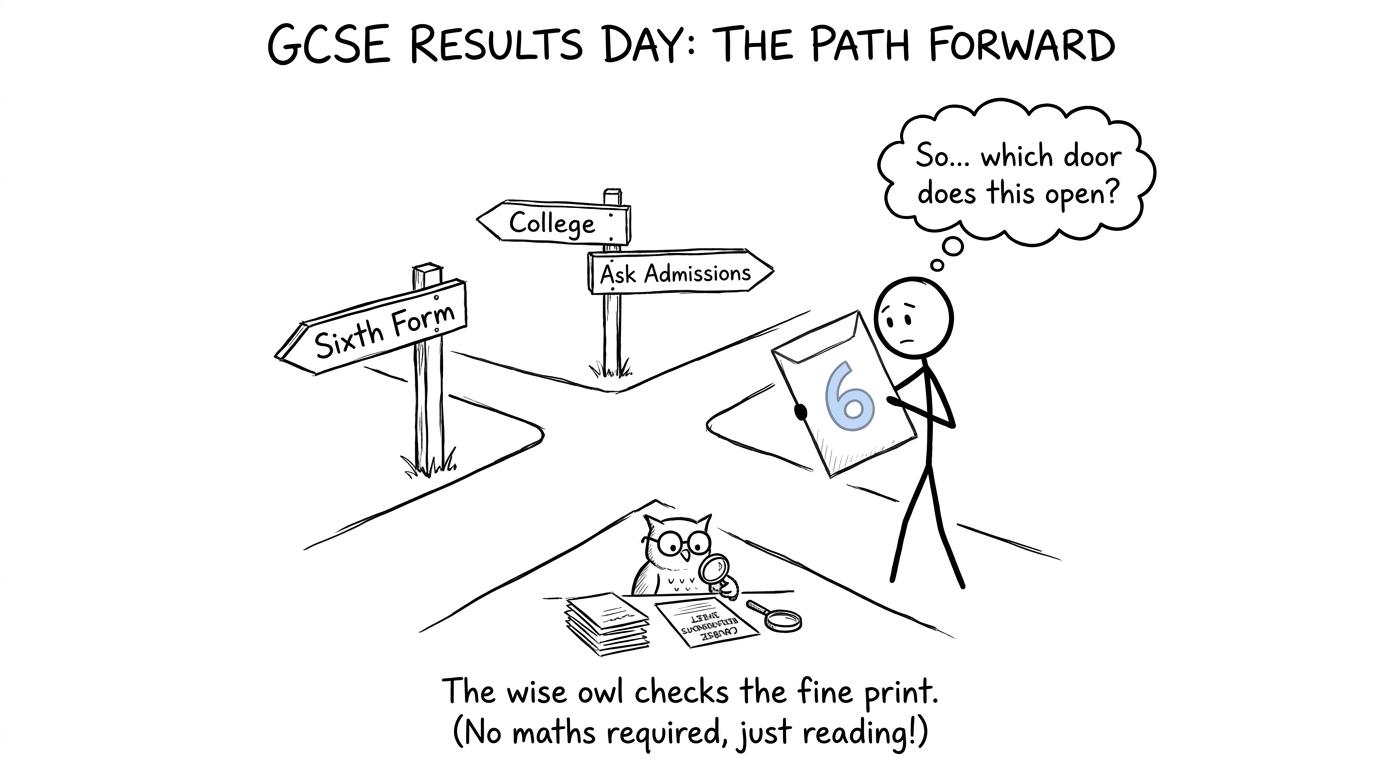 A student checks which sixth-form door a grade 6 opens
Is a grade 6 in GCSE Arabic good?
Yes. A grade 6 is a strong GCSE result and sits comfortably above a standard pass. In Pearson Edexcel GCSE Arabic, a grade 6 must come from the higher tier because foundation tier normally awards grades 111 to 555, while higher tier normally awards grades 444 to 999.
It demonstrates a meaningful level of achievement across the assessed language skills. However, “good” and “enough” are different judgements.
A result can be good in its own right but still fall below a selective provider's requirement. Equally, it can be more than sufficient for another provider. Current national careers guidance says that students normally need at least five GCSEs at grades 999 to 444 for A Levels, with a grade 6 commonly expected in subjects they want to continue. It also tells applicants to check the exact rules with their chosen school or college.
That final sentence does most of the work. There is no single UK-wide sixth-form admissions rule saying that every grade 6 must be accepted.
When grade 6 is likely to be enough
A grade 6 in GCSE Arabic is likely to clear the academic threshold when the provider:
- requires grade 6 in the subject being continued;
- requires grade 5 or above in GCSE Arabic;
- applies a general entry rule without setting a higher Arabic threshold; or
- considers the whole GCSE profile alongside subject grades.
Published requirements vary substantially. Some sixth forms use grade 5 for Arabic, many use grade 6 for subjects continued at A Level, and more selective providers may expect grade 7 in modern foreign languages or in all chosen A Level subjects.
This variation is not a contradiction. Schools and colleges control their own admissions criteria within the relevant admissions framework. Their requirements may reflect course difficulty, prior outcomes, staffing, capacity and demand.
An offer can also be conditional. Predicted grades may help you secure the offer, but your place may depend on the grades you receive in August. Read the conditions rather than assuming the offer is final.
When grade 6 might not be enough
There are several situations in which a grade 6 in Arabic may not secure the course you want.
The provider requires grade 7
Some sixth forms set a higher threshold for languages. If the published Arabic or modern foreign languages requirement is grade 7, a grade 6 is technically below it even though it remains a strong result.
Contact admissions rather than assuming that an exception will or will not be made. Ask whether there is a waiting list, departmental assessment, review process or alternative route. Treat any flexibility as a possibility, not an entitlement.
Your overall GCSE profile misses the general requirement
A sixth form may require a particular number of GCSEs at grades 999 to 444, several grades at 666 or above, or a specified average attainment score. You could meet the Arabic requirement while missing the wider threshold.
The reverse can also happen: your overall profile may be strong, but one chosen subject may have a higher individual requirement.
Maths or English is below the required grade
GCSE Arabic does not replace GCSE Maths or English in an admissions policy. Many Level 3 programmes specify minimum grades in both subjects, while individual A Levels may set higher requirements.
For example, courses containing substantial mathematical content may expect a stronger GCSE Maths result. A student considering A Level Maths, Physics, Chemistry, Computer Science, Economics or Psychology should check each subject separately. The Arabic grade may help the overall profile, but it cannot compensate automatically for a missed subject requirement.
If maths is the uncertain part of your application, begin with the free GCSE Maths revision hub and compare your current performance with the entry grade your chosen course actually asks for.
A Level Arabic is not offered
Pearson provides an A Level Arabic qualification, but that does not mean every school or college teaches it. Availability depends on the provider. Some students may need to consider another institution, a consortium arrangement or a different subject combination.
Confirm who teaches the course, where lessons take place and whether the option fits your timetable. A qualification being nationally available is not the same as a local course being available.
What to check on the course page
Admissions pages can look simple while hiding important distinctions. Search for all of the following:
- General entry criteria: the minimum profile for joining the sixth form.
- Subject entry criteria: the grade needed for A Level Arabic or another chosen subject.
- Maths and English conditions: these may sit outside the subject table.
- Oversubscription rules: meeting the minimum may not guarantee a place when demand is high.
- Residency or external-applicant rules: these can affect how places are allocated.
- Application and results deadlines: missing one can matter as much as missing a grade.
- Conditional-offer wording: check whether the decision uses predictions or achieved results.
Save a copy or screenshot of the current requirements. Pages can be updated between an open evening and results day, and the rules for one entry year should not be assumed to apply to another.
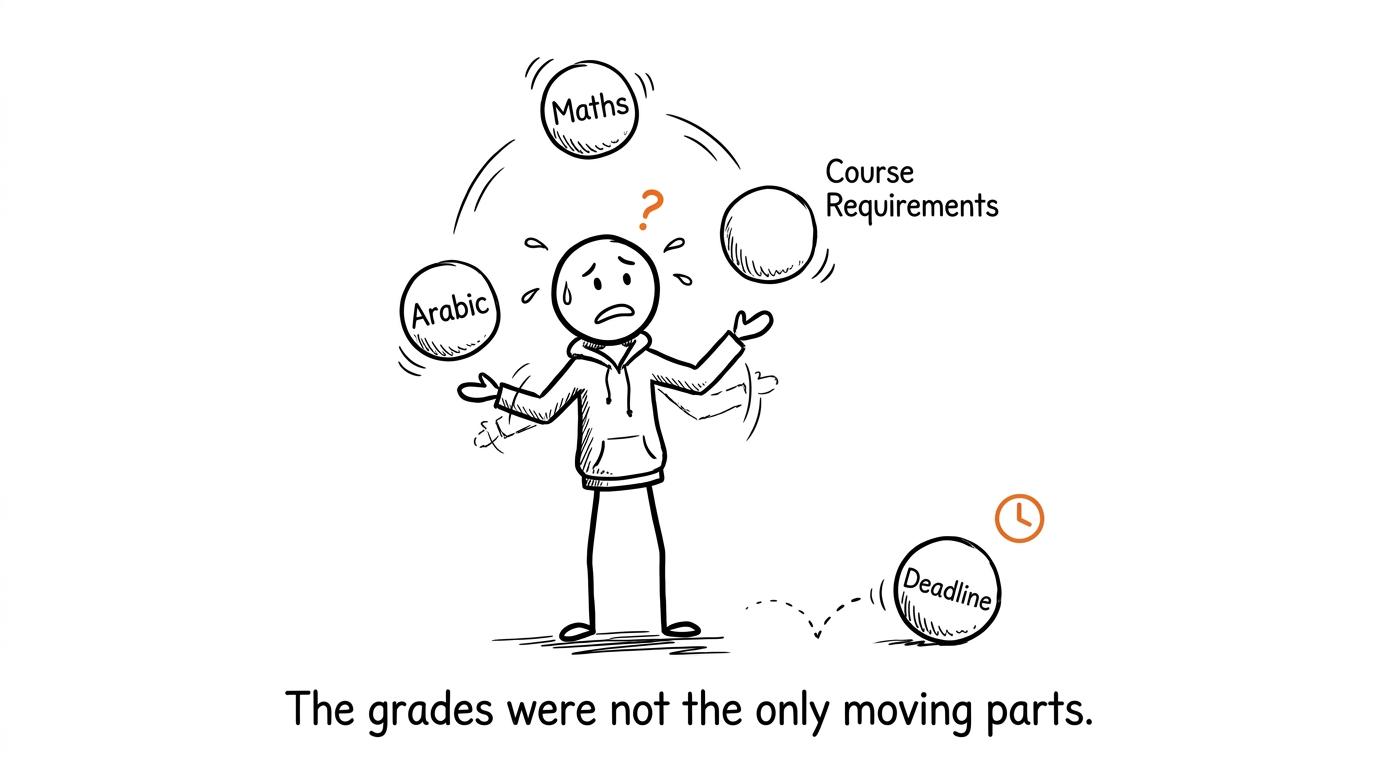 A student juggles subjects, requirements and a deadline
Your Arabic grade and your maths choices
For a student preparing for maths exams, the most important insight is that admissions decisions are usually a collection of thresholds, not a verdict based on one grade.
Suppose Arabic is one of your strongest subjects, but your intended course requires a particular GCSE Maths grade. Your next revision decision should be guided by the gap that can still change your options. Spending every evening polishing an already secure subject may feel productive, while avoiding the weaker subject quietly limits your choices.
Use evidence instead. Complete a suitable paper from the GCSE past papers collection, mark it carefully and identify where marks were lost. If you are unsure how to turn a paper into useful revision, follow the guide to using GCSE past papers properly.
Then divide mistakes into three useful groups:
- knowledge gaps, where you did not know the method;
- execution errors, where you knew the method but made a slip;
- exam-technique problems, such as misreading, poor timing or incomplete working.
This is calmer than revising everything. It is also more effective because each lost mark creates a specific next action.
A practical plan before applications and results day
Confirm the requirement in writing
Use the provider's current admissions page first. If anything remains unclear, email admissions with a precise question: state your achieved or predicted Arabic grade and name the exact course.
Avoid asking only whether a grade 6 is “good enough”. Ask whether it satisfies both the general entry criteria and the subject-specific condition for your proposed programme.
Protect the grades that affect your offer
List your intended subjects and place the required GCSE grade beside each one. This reveals where revision has the greatest practical value.
MathsGenie's revision planner can help turn those priorities into manageable sessions. If you need a broader structure, the GCSE one-month maths revision plan explains how to combine topic work, retrieval and timed practice.
Build evidence from real questions
Use revision lessons when you cannot start a question, practice questions when the method is uncertain, and mark schemes or video solutions when you need to see exactly where marks are awarded.
Near the exams, Edexcel GCSE Maths predicted papers can provide fresh mixed practice. They should complement real past papers, not replace them. Your aim is not to guess the paper. It is to test whether your knowledge survives unfamiliar wording and time pressure.
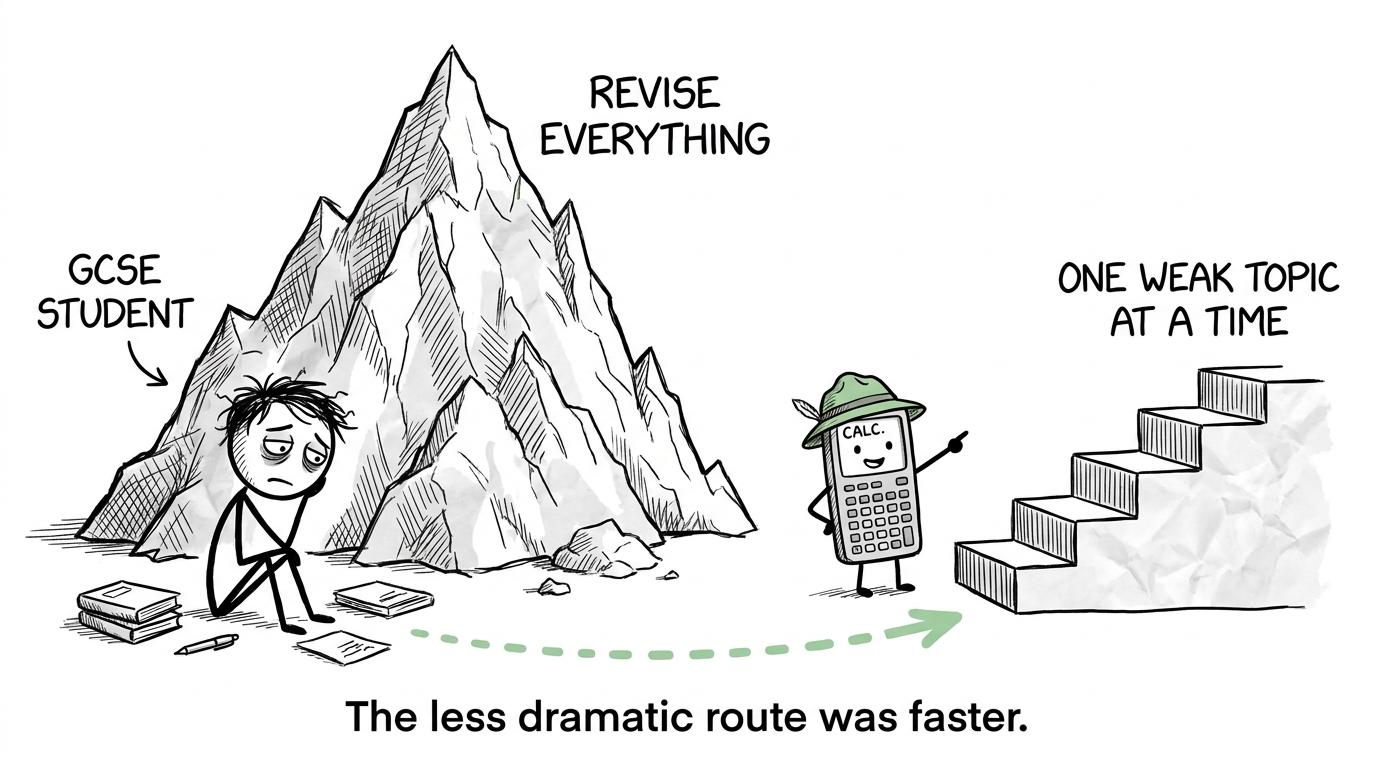 A student chooses a small revision staircase instead of a mountain
Common mistakes when judging sixth-form entry
Assuming every sixth form uses the same grades
Entry criteria differ by provider, subject and application year. Advice from someone applying elsewhere may be irrelevant to your course.
Looking only at the Arabic requirement
General entry rules and minimum GCSE Maths or English grades may still apply. Check the complete programme, not one row in a subject table.
Treating the minimum as a guaranteed place
A minimum threshold establishes eligibility. It may not guarantee admission when a course is oversubscribed or spaces are limited.
Relying on an old prospectus
Use the requirements for your intended year of entry. Policies, course availability and subject thresholds can change.
Abandoning the application without asking
If you narrowly miss a requirement, contact the provider promptly and politely. There may be no flexibility, but only the admissions team can give an authoritative answer.
Revising the subjects that already feel comfortable
Comfort can disguise avoidance. Use assessments to find the topics costing marks, then follow a logical sequence such as the best order for learning GCSE Maths topics.
Make the decision using requirements, not anxiety
A grade 6 in GCSE Arabic is a strong result and will satisfy many commonly used sixth-form subject thresholds. But whether it is enough for the course you actually want depends on the provider's current general criteria, the requirement for each chosen subject, your Maths and English grades, course availability and demand.
Check the published rules. Ask admissions when something is unclear. Keep a sensible alternative. Then focus your remaining revision on the grades that can still widen your choices.
For maths, MathsGenie gives you the full improvement loop for free: revision lessons, practice questions, mini tests, mark schemes, video solutions, past papers, predicted papers and a revision planner. Start at the GCSE Maths revision page, choose the weakness that matters most, and make your next session specific enough to finish today.










