

Grade 5 GCSE Arabic Sixth Form Entry Guide
Grade 5 GCSE Arabic sixth form entry explained: check general and subject requirements, maths grades, course choices and next steps before results day.
A single grade can feel as if it is carrying your entire future. You look at a predicted result, open a sixth-form prospectus and wonder whether one number closes the door.
The short answer to grade 5 GCSE Arabic sixth form entry questions is reassuring: a grade 5 is a strong pass and may contribute towards the general GCSE profile required by many sixth forms and colleges. It can even meet the stated requirement for A Level Arabic at some providers. But it is not automatically enough for every institution or course. Your overall results, English and maths grades, subject-specific conditions and the provider's treatment of community-language GCSEs all matter.
The useful question is therefore not simply, "Is grade 5 good?" It is, "Does my complete GCSE profile meet the published requirements for the course I actually want?"
Your quick sixth-form entry checklist
Before making decisions, check all of the following:
- the general entry requirement for the sixth form or college
- the minimum number of GCSEs required at grades 444, 555 or 666 and above
- any compulsory grade in GCSE English Language or Literature
- the compulsory GCSE maths grade
- subject-specific requirements for each A Level or Level 3 course
- whether GCSE Arabic counts towards the provider's entry total
- whether A Level Arabic is available and, if so, its required grade
- whether meeting the minimum guarantees entry or only makes you eligible for consideration
Use the current admissions policy or prospectus for your intended year of entry. Requirements differ between institutions and can change.
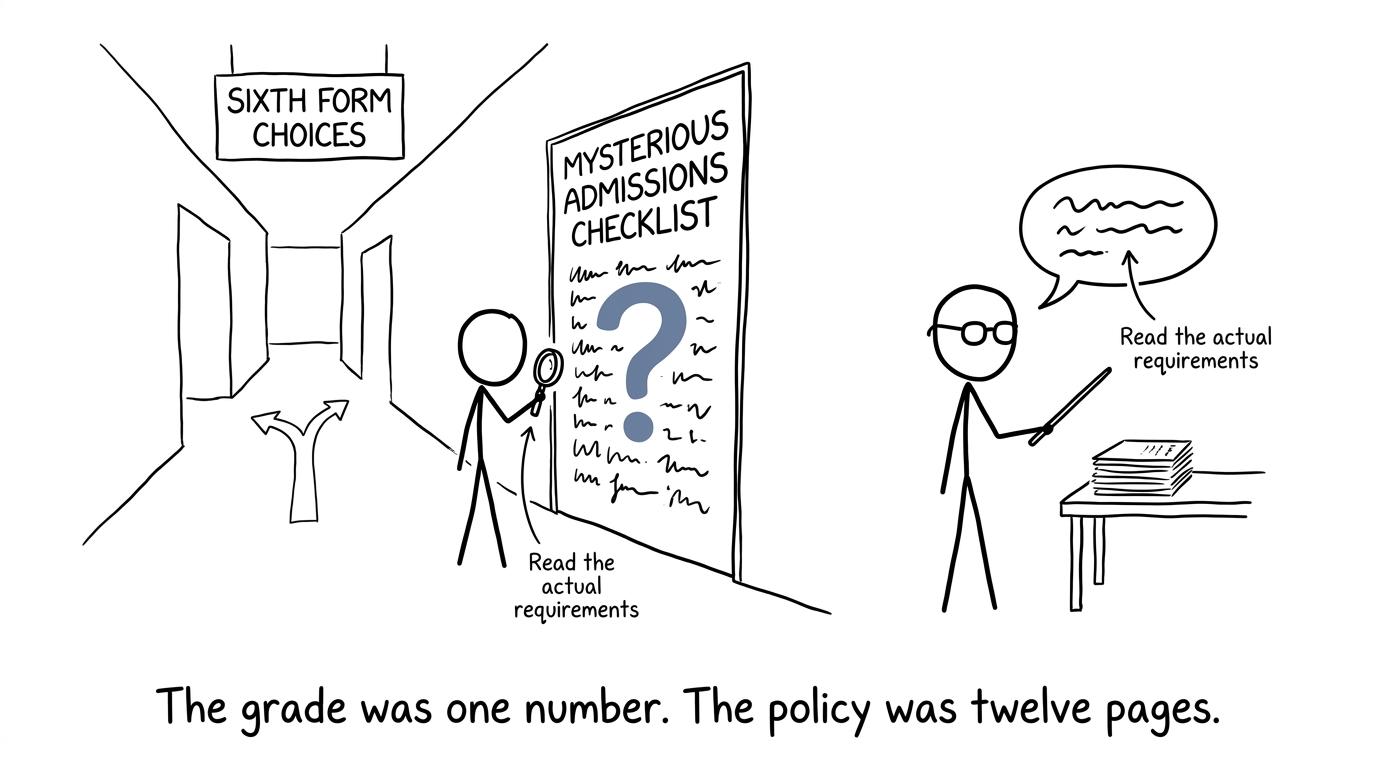 A student discovers that one grade is shorter than the admissions policy
Is a grade 5 in GCSE Arabic a good result?
Yes. In England, GCSEs are graded from 999 to 111, with 999 being the highest numbered grade. Grade 444 is commonly described as a standard pass, while grade 555 is described as a strong pass.
For Pearson Edexcel GCSE Arabic, the qualification uses the full 999 to 111 scale. Foundation tier makes grades 111 to 555 available, while Higher tier principally makes grades 444 to 999 available, with a possible grade 333 in the narrow safety-net range below grade 444. A grade 555 is therefore the highest available Foundation result, although the same grade can also be awarded on Higher tier.
That tells you what the grade means academically. It does not establish a universal admissions rule. Sixth forms set their own general and subject-specific criteria.
When grade 5 GCSE Arabic may be enough for sixth form
A grade 555 in Arabic may be enough when your chosen provider:
- asks for several GCSEs at grade 444 or 555 and above
- accepts GCSE Arabic as one of those qualifications
- does not require a higher grade in every subject you plan to continue
- has separate English and maths requirements that you also meet
- offers a Level 3 programme compatible with your overall profile
Current sixth-form policies illustrate how different these rules can be. Some providers ask for five GCSEs at grade 555 or above, often including English and maths. Others accept a mixture of grades 444 and 555 but require several grade 666s for an A Level pathway. More selective institutions may calculate an average across a student's best GCSE results.
Where an average grade is used, the principle is usually:
average grade=sum of included GCSE grade numbersnumber of included GCSEs\text{average grade} = \frac{\text{sum of included GCSE grade numbers}}{\text{number of included GCSEs}}average grade=number of included GCSEssum of included GCSE grade numbersDo not calculate this until you have checked which subjects the institution includes. Some count the best eight results; others use a different number or apply additional conditions.
When a grade 5 may not be enough
The same Arabic result can be accepted in one application and insufficient in another. That is not a judgement about the value of the language. It reflects different admissions policies.
You want to study A Level Arabic
Some sixth forms explicitly accept grade 555 in GCSE Arabic for A Level Arabic. Others require grade 666 in the GCSE subject being continued, particularly for language A Levels. A provider may also assess speaking, writing or prior experience where applicants have different language backgrounds.
Check the specific A Level Arabic course page rather than relying only on the general entry section. A general offer of a sixth-form place does not necessarily mean that every subject combination is available to you.
Your chosen course has a higher maths requirement
If you want A Level Mathematics, a grade 555 in Arabic cannot compensate for missing the required GCSE maths grade. Published requirements commonly ask for grade 666 or 777 in GCSE Mathematics, while Further Mathematics may require grade 777, 888 or higher depending on the institution.
Science, economics, computer science and psychology courses may also specify a particular maths grade. That is why students preparing for maths exams should treat their maths result as a separate gateway rather than assuming that the total number of GCSE passes tells the whole story.
Begin by choosing your board and tier on the GCSE Maths Revision hub. Students following AQA can use the AQA GCSE Maths revision resources, while OCR students can follow the OCR GCSE Maths revision pathway.
The provider does not count every language qualification
Some sixth forms state that a community-language GCSE, a qualification taken outside school or a native-language GCSE will not count towards their general admissions total. Other providers do count it.
Never assume. Ask the admissions team a precise question: "Will my GCSE Arabic result count as one of the GCSEs used for general entry?" If the answer matters to your eligibility, request written confirmation.
Your overall GCSE profile misses the threshold
Admissions decisions normally consider more than one result. A grade 555 in Arabic is useful, but you may still need a stated number of other GCSEs, compulsory passes in English and maths, or higher grades in the subjects you want to take.
Meeting minimum requirements can also make you eligible without guaranteeing your preferred combination, particularly where courses are full or additional admissions conditions apply.
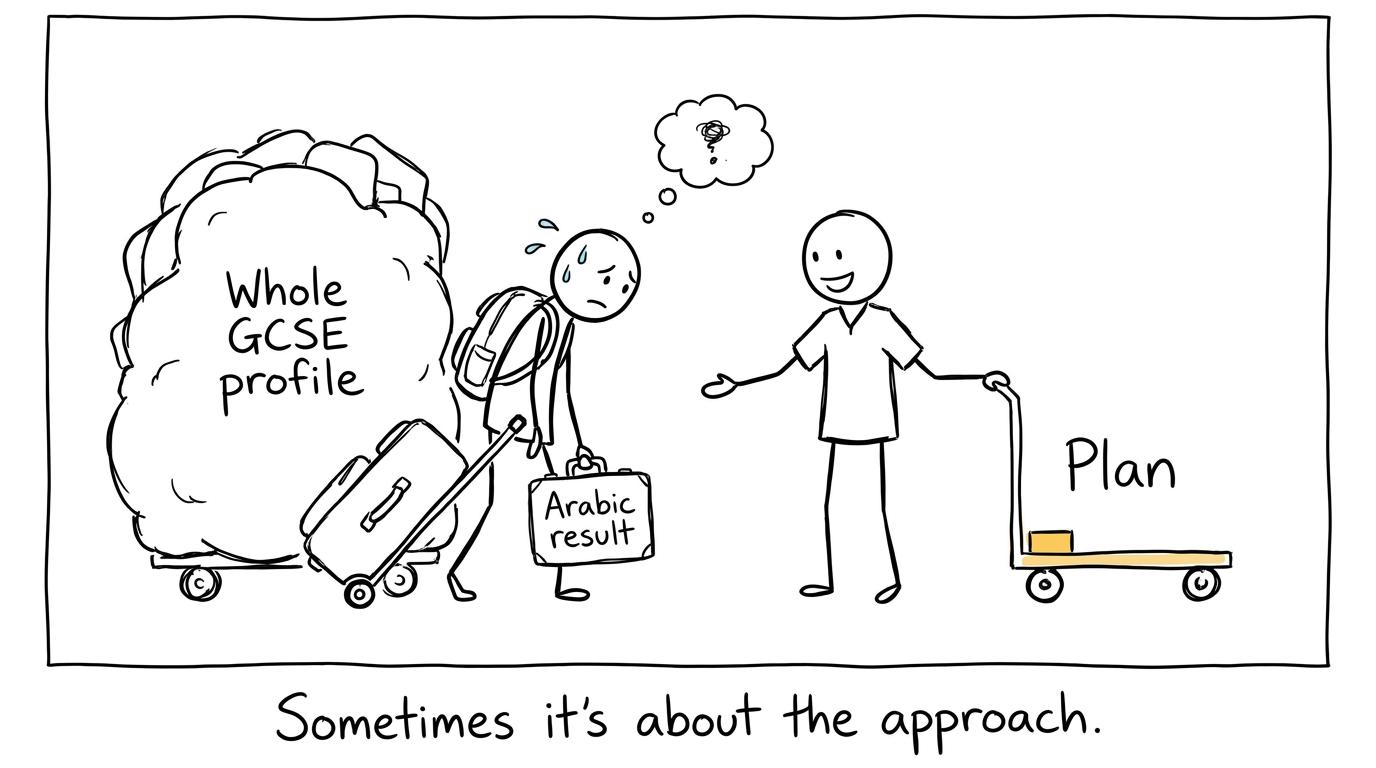 A student carries an Arabic result alongside the much larger whole GCSE profile
Match your result to the course you actually want
Start with the destination and work backwards. Write down your preferred sixth form, your three intended subjects and one realistic alternative route.
For each choice, record:
- general entry grades
- English requirement
- maths requirement
- required grade in each chosen subject
- whether GCSE Arabic is included in the admissions calculation
- any portfolio, audition, interview or assessment condition
This separates three questions that students often accidentally combine:
- Can I enter the institution?
- Can I take my chosen programme?
- Can I take each individual subject?
You might satisfy the first condition but miss the requirement for A Level Mathematics. Alternatively, you might qualify for a Level 3 vocational programme even if a particular A Level combination is unavailable. Colleges may also offer Level 2 routes, GCSE resits or alternative subject combinations.
Protect the maths grade that your next step needs
Your Arabic grade and maths revision are not competing stories. One recognises language knowledge; the other may unlock courses with explicit numerical requirements.
A sensible revision cycle is:
- identify your weakest maths topics
- use a revision lesson to rebuild the method
- complete practice questions without copying a solution
- mark your work and identify lost marks
- retest the topic under time pressure
- move into full past papers once the main gaps are smaller
Short tests are useful when a full paper feels too large. The Edexcel GCSE Maths mini tests provide focused timed practice, while Edexcel GCSE predicted papers can support final preparation. Predicted papers should complement official past papers, not replace them.
If revision currently feels unstructured, follow the GCSE one-month maths revision plan. The goal is not to spend every evening doing random questions. It is to find where marks are leaking and repair those skills deliberately.
What to do before and after results day
Before results day, save the latest entry requirements and contact admissions if the wording about Arabic is unclear. Conditional offers are useful, but the published policy for your entry year is the document that matters.
Prepare three plans:
- Preferred plan: your first-choice institution and subjects
- Adjusted plan: the same institution with an alternative subject combination
- Alternative plan: another provider or course with requirements matching your likely profile
After receiving your results, compare them with every condition rather than focusing on Arabic alone. If you narrowly miss a requirement, speak to the provider. Some institutions consider applicants individually, but discretion should never be assumed.
If GCSE maths is the result preventing progression, ask whether a resit or another programme is available. The GCSE maths resit revision plan explains how to diagnose lost marks and rebuild preparation around your board and tier.
Common mistakes when judging sixth-form eligibility
Treating grade 5 as a universal entry rule
Grade 555 is a strong pass, not a national promise of sixth-form admission. Every provider publishes its own criteria.
Reading only the general requirements
The general threshold gets you through the first gate. Individual A Levels may demand higher grades in maths, English, science or the subject being continued.
Assuming GCSE Arabic will definitely count
Policies on community languages and qualifications taken outside school vary. Confirm the rule directly with admissions.
Looking at one grade instead of the whole profile
Your application may depend on the number of qualifying GCSEs, an average grade and several subject-specific conditions. Arabic is one part of that picture.
Revising maths without using feedback
Completing paper after paper can create effort without improvement. The productive sequence is attempt, mark, repair and retest. The guide to using GCSE past papers properly shows how to turn each lost mark into a specific next action.
Make the next decision from evidence, not fear
A grade 555 in GCSE Arabic is a good result and can support a sixth-form application. Whether it is enough depends on the institution, the course, your other GCSEs and the exact requirements for English and maths. If you want A Level Arabic, check its subject-specific threshold. If you want mathematics, science, economics or another numerate course, give the required GCSE maths grade equal attention.
Your next action is simple: open the current prospectus, compare every condition with your predicted profile and ask admissions to clarify anything ambiguous. Then return to the part you can still influence.
Use MathsGenie as your free maths revision base. Choose targeted revision lessons and practice questions, check your work with mark schemes and video solutions, build speed through mini tests, and finish with past papers and predicted papers. A sixth-form decision may involve many conditions, but today's revision only needs one clear next step.










