GCSE to A-Level English Language Jump Explained
GCSE to A-level English Language jump: discover how much harder the course is, what changes after GCSE, and how to prepare alongside maths revision.
The unsettling part of choosing an A Level is not knowing whether the next step is a staircase or a cliff. English Language can feel particularly uncertain because the GCSE rarely reveals the full shape of the subject that follows.
The GCSE to A-level English Language jump is substantial, but manageable. At GCSE, you mainly demonstrate reading, analysis and effective writing. At A Level, you study language more like a linguist: applying precise terminology, interpreting spoken and written data, evaluating theories and conducting independent research. It is not simply harder GCSE analysis. It is a broader, more technical subject.
For students preparing for maths exams as well, the important question is practical: can you manage that transition without allowing a new A Level to consume your revision time? Yes, if you understand the changes early and build the right habits.
The jump at a glance
Here is the short version:
- GCSE English Language develops core communication skills. You interpret texts, analyse writers' choices, compare viewpoints and produce writing for different purposes.
- A Level introduces linguistic study. You examine how language works across speech, writing, digital communication and different social contexts.
- Terminology becomes much more precise. Identifying a metaphor is no longer enough; you may analyse grammar, morphology, phonology, semantics, pragmatics and discourse.
- Theory matters. You must understand debates about language, identity, power, diversity, change and acquisition.
- Independence increases. A Level study includes sustained reading and an independent language investigation.
- Your GCSE skills still matter. Clear argument, careful evidence and accurate writing remain essential.
The jump is therefore less about suddenly becoming a brilliant writer and more about learning a new analytical framework.
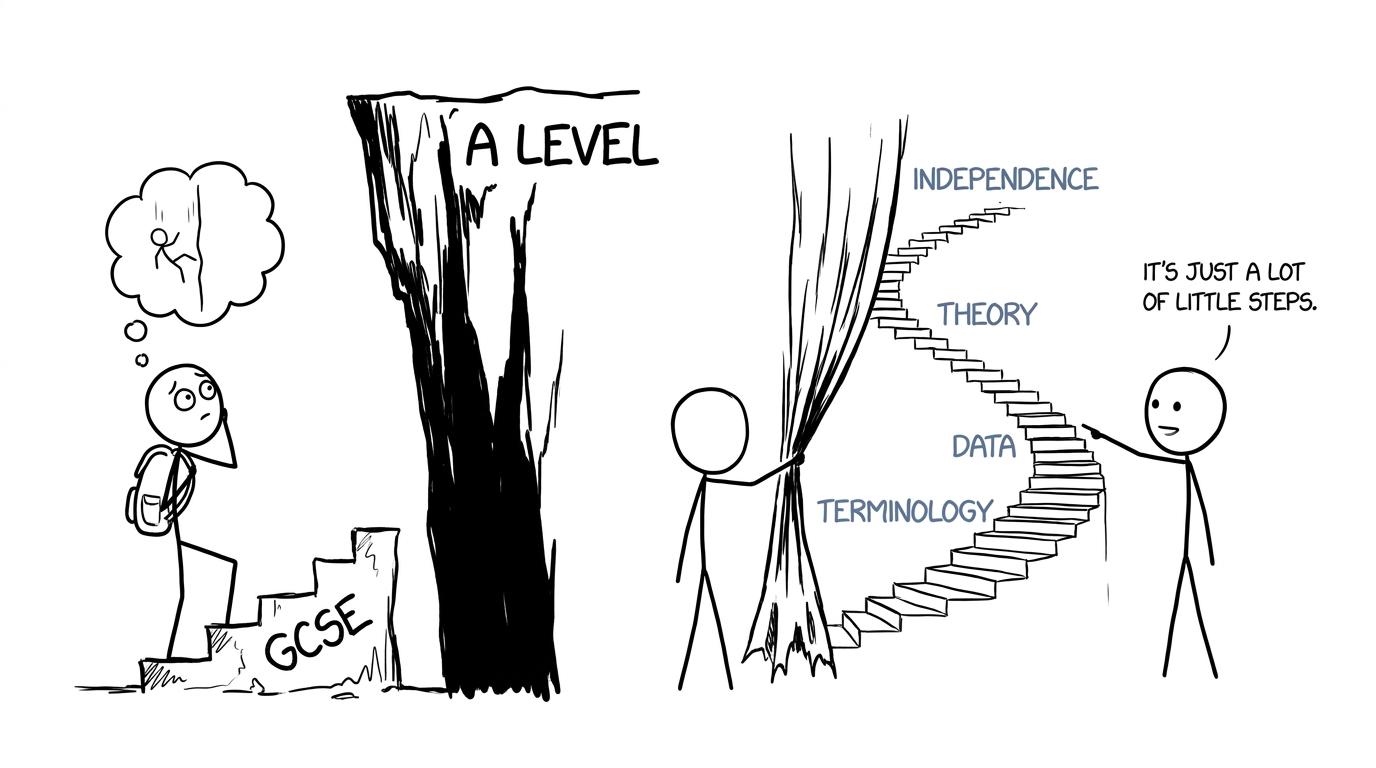 A student discovers that the A Level cliff is really a staircase of manageable steps
What GCSE English Language actually prepares you for
Across GCSE English Language specifications, the nationally defined assessment objectives divide the qualification equally between reading and writing, with each carrying 50%50\%50% of the marks. Spoken Language is reported separately and does not contribute to the final GCSE grade.
The precise papers vary between AQA, Pearson Edexcel, OCR and Eduqas. However, students are generally expected to:
- understand explicit and implicit information;
- analyse language and structure;
- compare ideas and perspectives;
- evaluate texts critically;
- adapt writing to audience, purpose and form;
- organise ideas coherently;
- use accurate spelling, punctuation and grammar.
These skills do not disappear at A Level. They become the foundation on which more technical knowledge is built.
A student who can select evidence precisely, sustain an argument and explain how context shapes meaning already has useful tools. The difficulty is that A Level asks that student to use those tools on a wider range of language data and with greater conceptual precision.
How much harder is A-Level English Language?
There is no honest numerical conversion between GCSE grades 9-1 and A Level grades A*-E. A grade at one qualification does not automatically translate into a particular grade at the other, and sixth-form entry requirements vary by school or college.
A better way to measure the difficulty is to examine what changes.
| Area | GCSE English Language | A-Level English Language |
|---|---|---|
| Main focus | Reading, analysis and effective writing | Systematic study of language and linguistics |
| Texts | Mainly written fiction and non-fiction, depending on the board | Written, spoken, digital and multimodal language data |
| Terminology | Literary, structural and grammatical terms | Detailed linguistic terminology across multiple language levels |
| Context | Audience, purpose, form and viewpoint | Social, historical, geographical, technological and individual contexts |
| Knowledge | Transferable reading and writing methods | Concepts, theories, debates and research findings |
| Independence | Guided preparation for defined exam tasks | Wider reading, data collection and independent investigation |
| Comparison | Connections between texts and perspectives | Connections informed by linguistic concepts and methods |
The biggest jump is conceptual. At GCSE, you might discuss how a writer's word choice creates tension. At A Level, you could be expected to classify that language accurately, connect it to context and evaluate what it suggests about a wider language issue.
That requires more knowledge, but also a different kind of caution. Language data is evidence. You should not make a sweeping claim about an entire social group because of one transcript, article or online exchange.
The new knowledge you meet at A Level
Official A Level subject content requires students to study several interconnected levels of language. Course labels and assessment arrangements differ between specifications, but the common disciplinary foundation includes:
- phonetics, phonology and prosodics: speech sounds, pronunciation, stress, rhythm and intonation;
- lexis and semantics: vocabulary and meaning;
- grammar and morphology: structures at sentence, clause, phrase and word level;
- pragmatics: how context influences implied meaning;
- discourse: how extended communication is organised;
- language variation: historical, regional, social and individual varieties of English;
- language and identity: how language can construct or express identity.
Depending on the specification, you may also investigate areas such as child language development, language change, language diversity, power, gender and technology.
This is why success at GCSE does not make the A Level effortless. A strong GCSE response can be thoughtful without containing detailed linguistic classification or theoretical evaluation. At A Level, those are central parts of the course.
Why maths students may be better prepared than they think
Students who enjoy maths sometimes assume English Language will demand an entirely different kind of mind. A Level English Language certainly requires extended writing, but parts of the discipline feel surprisingly familiar.
You observe data. You identify patterns. You test whether a claim is supported. You distinguish correlation from explanation. You choose terminology carefully. Most importantly, you show the route from evidence to conclusion rather than jumping straight to an answer.
That is close to the discipline developed through GCSE Maths revision lessons and questions. In both subjects, a convincing answer is not merely a final judgement. The method must be visible.
The habits are transferable too. Maths Genie encourages students to attempt questions, check solutions, diagnose errors and retest. The same loop can support English Language:
- analyse a short piece of language data;
- compare your response with teacher feedback or assessment guidance;
- identify one weak analytical habit;
- improve the response;
- revisit the skill using different data.
How to prepare before starting the course
Strengthen grammar without memorising isolated labels
Learn how sentences and words are constructed, but always connect terminology to meaning. Knowing a label is useful only when you can explain what that feature does in a particular context.
Begin with word classes, phrases, clauses, sentence functions and common grammatical patterns. Accuracy matters more than collecting obscure terminology.
Read beyond fiction extracts
A Level language data can come from many places. Regularly examine speeches, interviews, advertisements, opinion writing, online communication and transcripts. Ask:
- Who produced this language?
- Who is receiving it?
- What relationship exists between participants?
- What does the mode allow or restrict?
- Which patterns are genuinely supported by the evidence?
This turns everyday language into material for analysis.
Become comfortable with spoken language
Speech is not untidy writing. Transcripts may record pauses, interruptions, overlaps, fillers and changes in intonation because those features help reveal how interaction works.
Listening closely to real conversations or public interviews can help you notice turn-taking, accommodation and the ways speakers manage relationships. Respect privacy and follow your teacher's guidance before recording or collecting any language data.
Practise qualified conclusions
At A Level, strong analysis often avoids absolute claims. Language varies according to many interacting factors, so phrases such as “this may suggest” or “within this data” can be more accurate than claiming that everyone in a group speaks in one fixed way.
This is not timid writing. It is disciplined reasoning.
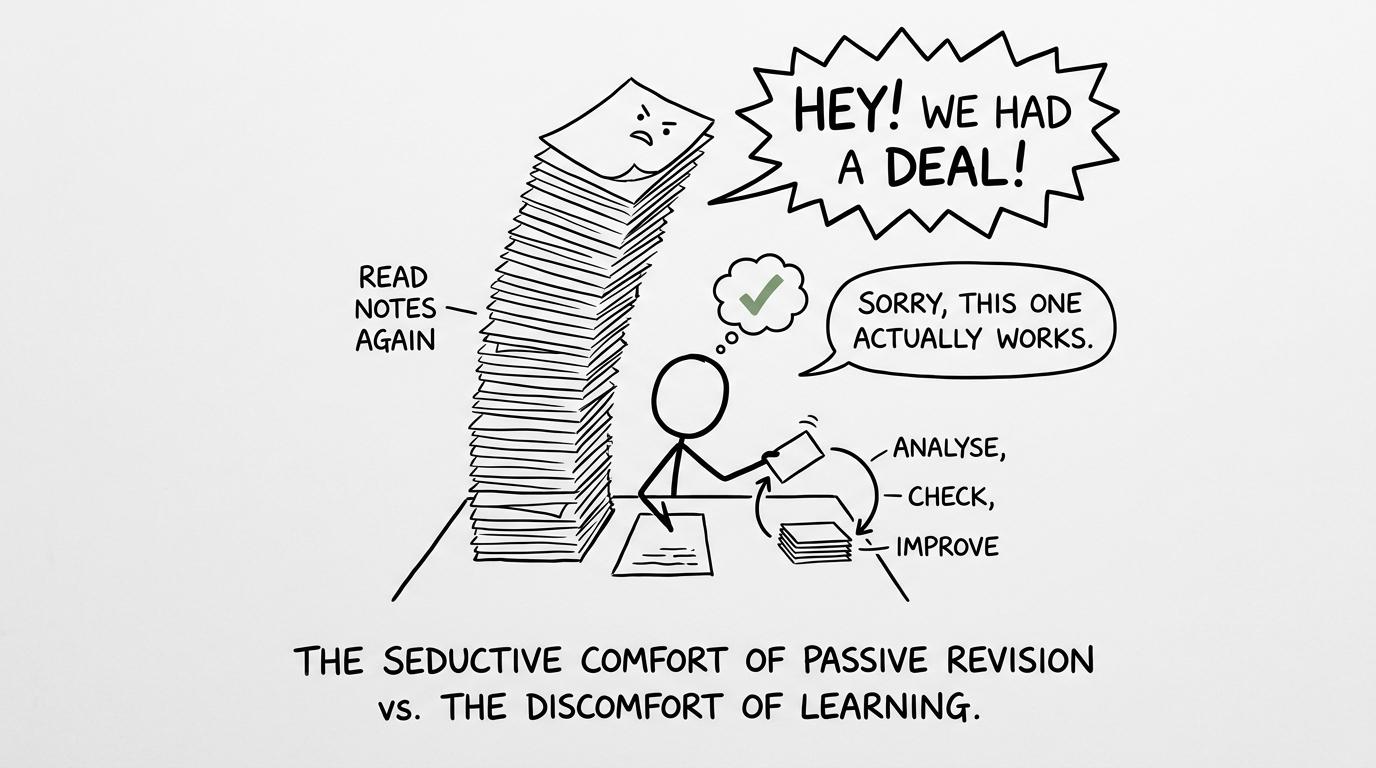 A giant pile of reread notes competes unsuccessfully with a small active revision loop
Managing English alongside GCSE maths revision
The transition deserves preparation, but your immediate GCSE exams still come first. Do not spend the final months of Year 11 trying to teach yourself an entire A Level specification while current marks are available to secure.
Use the Maths Genie revision planner to protect regular maths sessions, then add one short English transition activity each week after your GCSE workload is under control.
A balanced routine might include:
- one short grammar or linguistic terminology session;
- one brief analysis of real language data;
- scheduled GCSE maths topic practice;
- one timed maths paper or mini test;
- immediate review using mark schemes and solutions.
If you study Edexcel maths, the Edexcel GCSE Maths revision hub combines lessons, worksheets and exam-style questions. Students following OCR can use the OCR GCSE Maths revision hub, while AQA students can build timing with AQA GCSE Maths past papers.
The principle is simple: do not let curiosity about September steal preparation from the exams directly in front of you.
A practical preparation checklist
Before beginning A Level English Language, aim to be able to:
- identify basic grammatical structures accurately;
- analyse evidence rather than list features;
- distinguish observation from interpretation;
- connect language choices to context;
- compare texts without writing about them separately;
- organise an extended argument clearly;
- adapt your writing to audience and purpose;
- keep a vocabulary or terminology log;
- read the specification for your chosen exam board;
- plan independent work without waiting for every task to be broken down.
Check the exact specification used by your school or college. AQA, OCR and Eduqas assessment structures are not interchangeable, and the qualifications offered can vary between centres. Do not revise from a random online list without confirming your board.
Common mistakes when preparing for the step up
Assuming it is English Literature without set books
English Language is not simply another route into literary interpretation. It studies language as data and introduces concepts and methods associated with linguistics.
Learning terminology as a decorative vocabulary list
Using an advanced label does not automatically improve analysis. Every term should help you explain a meaningful pattern.
Making broad claims from tiny samples
One extract cannot prove how all teenagers, politicians or social media users communicate. Keep conclusions proportionate to the evidence.
Ignoring the independent workload
A Level requires more reading, note organisation and independent investigation than GCSE. Leaving every task until a deadline makes the course feel steeper than it needs to be.
Abandoning GCSE priorities too early
Your grade 9-1 exams remain the immediate goal. Keep using GCSE predicted papers, practice questions, mark schemes and video solutions to prepare for maths. Transition reading should complement that work, not replace it.
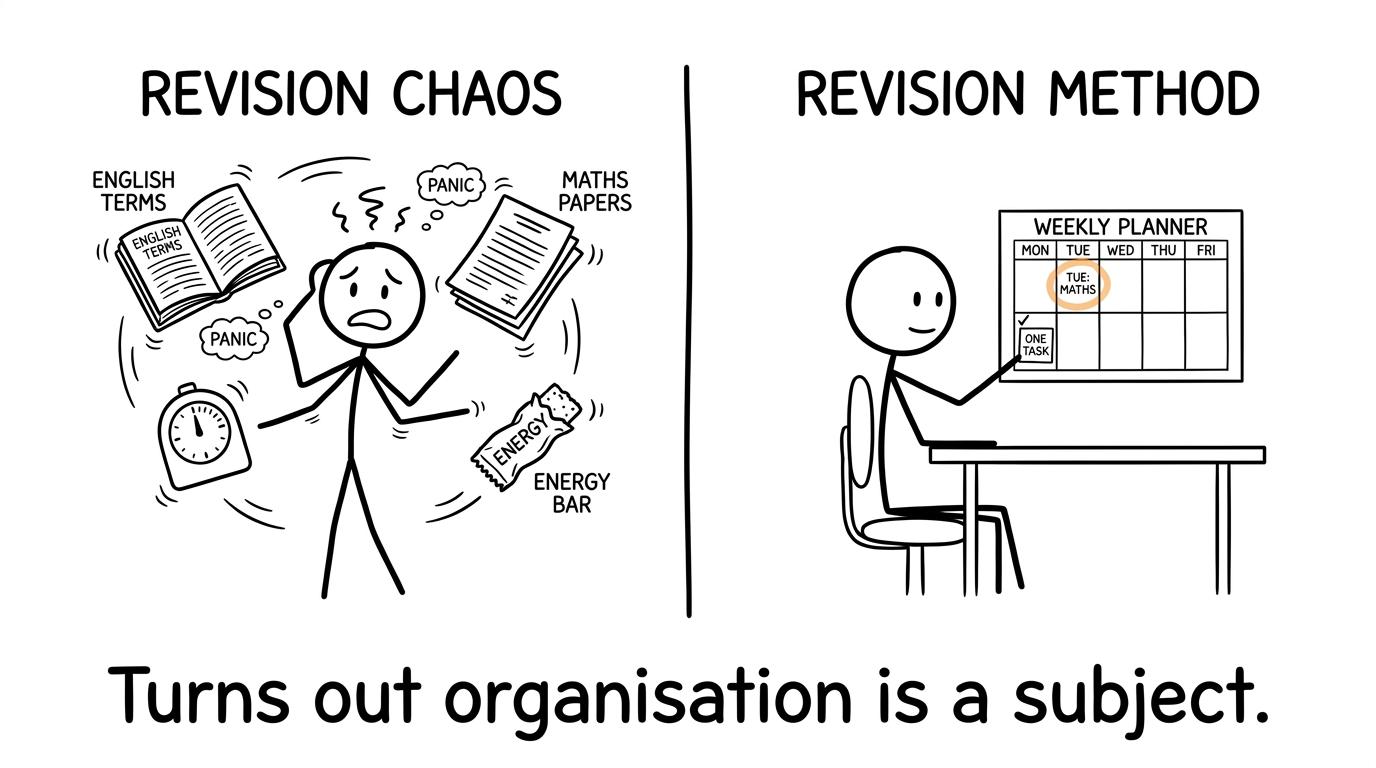 One student juggles every revision task while another calmly uses a weekly calendar
The jump is real, but it has handholds
The GCSE to A-level English Language jump feels large because the identity of the subject changes. Familiar reading and writing skills remain, but they are joined by linguistic terminology, language theory, data analysis and independent research.
You do not need to arrive knowing the whole course. You need secure GCSE communication skills, curiosity about how language works and a willingness to revise actively. Build those qualities gradually while keeping your present exams in view.
For maths, make Maths Genie your revision base. Use the free revision lessons and practice questions to repair weak topics, mini tests to check recall, past papers to build timing, and predicted papers to rehearse unfamiliar questions. Mark every attempt carefully, use video solutions when a method is unclear, and let each mistake tell you what to do next.
A Level may be the next staircase. For now, take the step in front of you.