GCSE to A-Level Arabic Jump: How Hard Is It?
GCSE to A-level Arabic jump explained: compare papers, skills and workload, with a practical preparation plan that protects your GCSE maths revision.
A subject can feel comfortable at GCSE because you know its routines. Then you open an A-level paper and the familiar ground seems to move: texts are denser, answers need analysis, and knowing the language is no longer enough on its own.
The GCSE to A-level Arabic jump is substantial. GCSE Arabic rewards communication across listening, speaking, reading and writing, usually within recognisable everyday themes. The current Pearson Edexcel A level moves towards extended translation, independent research, cultural knowledge and critical writing about literature or film. It also removes the separately assessed speaking component.
That does not make the step unmanageable. It means preparation must change. You need to build formal Arabic, analytical thinking and exam stamina while protecting enough time for GCSE maths and your other subjects.
The jump at a glance
Here is the short version:
- GCSE Arabic assesses listening, speaking, reading and writing across four equally weighted papers.
- GCSE has foundation and higher tiers, with grades awarded on the grades 9-1 scale.
- The equivalent regulated A level currently available in England is Pearson Edexcel Arabic.
- A-level Arabic is untiered and graded from A* to E.
- It consists of three written examinations assessing listening, reading and writing.
- Students study four broad cultural and social themes, complete independent research, and study either two literary texts or one literary text and one film.
- The greatest change is not simply harder vocabulary. It is the move from personal communication to evidence-based interpretation and analysis.
If you are comparing qualifications, check the exact course with your school. Pearson Edexcel International GCSE and International A Level Arabic are separate qualifications with different assessment structures.
How GCSE Arabic is assessed
Pearson Edexcel GCSE Arabic has four externally assessed components: listening, speaking, reading and writing. Each contributes 25%25\%25% of the qualification, so success depends on balanced language skills rather than one particularly strong area.
The content is organised around five themes:
- identity and culture
- local area, holiday and travel
- school
- future aspirations, study and work
- the international and global dimension
These themes encourage students to communicate opinions and information about familiar experiences while understanding relevant Arabic-speaking communities. Higher-tier tasks require more developed language, stronger grammatical control and greater independence than foundation tasks, but both tiers retain the same broad GCSE purpose: effective communication.
GCSE Arabic therefore provides a useful foundation. You practise translation in both directions, respond to written and spoken material, and learn to express ideas clearly. However, a strong GCSE grade should be viewed as permission to begin the next stage, not proof that the next stage will feel automatic.
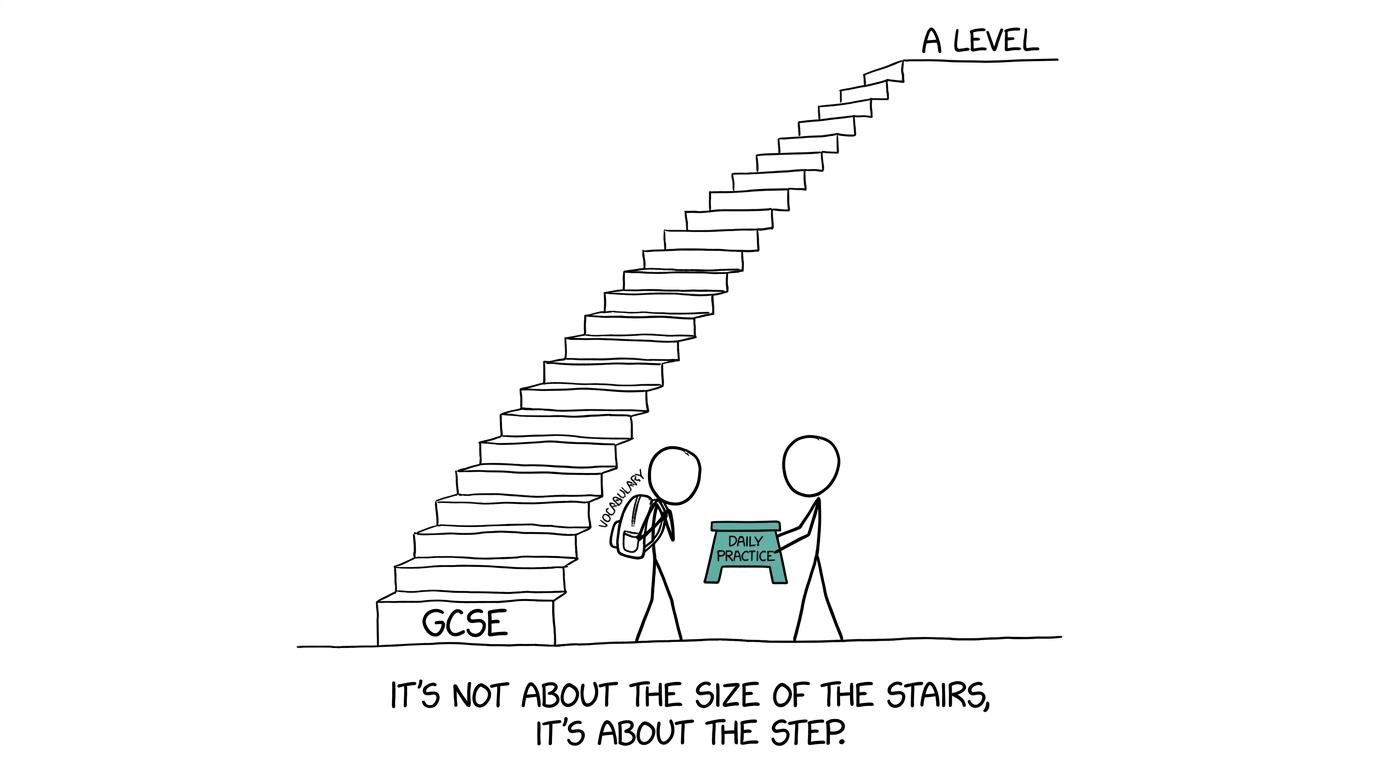 A student facing the staircase from GCSE to A level with daily practice making the climb manageable
What changes at A-level Arabic?
The current Pearson Edexcel A level in Arabic has three externally examined papers. Unlike GCSE, there is no separately assessed speaking paper.
Paper 1: translation, reading and research
Paper 1 lasts 2 hours 30 minutes, carries 80 marks and contributes 40%40\%40% of the qualification. It includes:
- translation from Arabic into English
- reading comprehension
- an extended Arabic response based on independent research
The research must relate to one of the specified research subjects and focus on one Arabic-speaking country. In the examination, you must combine what you discovered independently with an unseen source. You cannot take research notes or a dictionary into the paper.
This is a major intellectual step. Remembered facts alone are not enough; you must select relevant evidence, respond to the exact question and write accurately under time pressure.
Paper 2: translation and critical essays
Paper 2 lasts 2 hours 40 minutes, carries 110 marks and contributes 30%30\%30%. Students translate an unseen passage from English into Arabic and write two extended responses about prescribed works.
You study either:
- two literary texts, or
- one literary text and one film.
You cannot choose two films. The essay questions require critical analysis rather than a retelling of the plot. Responses are expected to be approximately 270 to 320 words each, making planning, argument and precise references essential.
Paper 3: listening, reading and writing
Paper 3 lasts 2 hours 15 minutes, carries 60 marks and contributes the remaining 30%30\%30%. It combines listening comprehension with a task in which students summarise and respond to spoken and written sources connected by a common sub-theme.
At GCSE, you may often collect marks by identifying details. At A level, you must process information from different sources, distinguish key ideas from supporting material and produce a concise response in accurate Arabic.
How much harder is A-level Arabic really?
There is no reliable universal multiplier for difficulty. The size of the jump depends on your formal Arabic, reading habits, grammatical control and experience of extended writing. A fluent home speaker may find listening relatively accessible while still finding formal composition or literary analysis demanding. A classroom learner may have a different balance of strengths.
The jump is best understood through four changes.
The language becomes less predictable
GCSE themes provide a relatively clear vocabulary framework. At A level, unseen materials can include political, artistic, historical and social ideas. You need enough vocabulary to infer meaning when you do not recognise every word.
Translation also becomes less mechanical. A strong answer preserves meaning, tone and natural expression rather than replacing each word individually.
Writing becomes argumentative
A GCSE response can earn marks by communicating experiences and opinions accurately. A-level essays need a sustained judgement supported by precise evidence from a text, film or research topic.
You must be able to form a line of reasoning, organise paragraphs and evaluate how a writer or director presents an idea. This resembles the move from performing a familiar calculation to solving a multi-step maths problem: the individual skills still matter, but choosing and connecting them becomes the real test.
Cultural knowledge becomes assessable knowledge
At A level, the Arabic-speaking world is not merely the setting for language practice. Society, political culture and artistic culture become part of what you must understand.
That requires regular engagement with reliable Arabic material. Last-minute vocabulary learning cannot replace months of reading, listening and note-making.
Exams demand greater stamina
All three papers last more than two hours. The challenge is maintaining concentration while moving between comprehension, translation, source handling and extended writing.
You may recognise this from timed maths papers. Knowing a method at home is different from applying it accurately after a long examination. MathsGenie's guide to using past papers properly explains a useful cross-subject cycle: complete the task, mark it, identify the weakness, repair it and retest.
How to prepare for the step up
Preparation should begin with a diagnosis, not a heroic timetable.
Strengthen formal Arabic now
Keep a record of errors in spelling, agreement, verb forms, sentence structure and translation. Do not write “grammar” as the problem. Record the exact pattern that needs attention.
Read formal Arabic regularly and notice how arguments are introduced, developed and qualified. If most of your Arabic comes from conversation, give particular attention to the difference between everyday dialect and the standard written language expected in examinations.
Practise analysis before Year 12
After reading an article or watching a suitable film scene, ask:
- What viewpoint is being presented?
- What evidence supports that interpretation?
- How does the language or presentation influence the audience?
- What alternative interpretation could be considered?
You do not need to write a full essay every day. One carefully constructed analytical paragraph is more useful than several pages of plot summary.
Build translation as a separate skill
Translate short, varied passages in both directions. Afterwards, check meaning, grammar and natural phrasing separately. A sentence can be grammatically possible while still sounding awkward or changing the source's emphasis.
Keep a bank of useful structures rather than isolated words. This helps you write with greater flexibility and reduces dependence on memorised GCSE phrases.
Start research habits early
A-level research requires selection and judgement. Practise collecting concise notes under headings, recording where information came from and separating evidence from your own interpretation.
The goal is not to accumulate everything. It is to retrieve the most relevant evidence when a question forces you to make a decision.
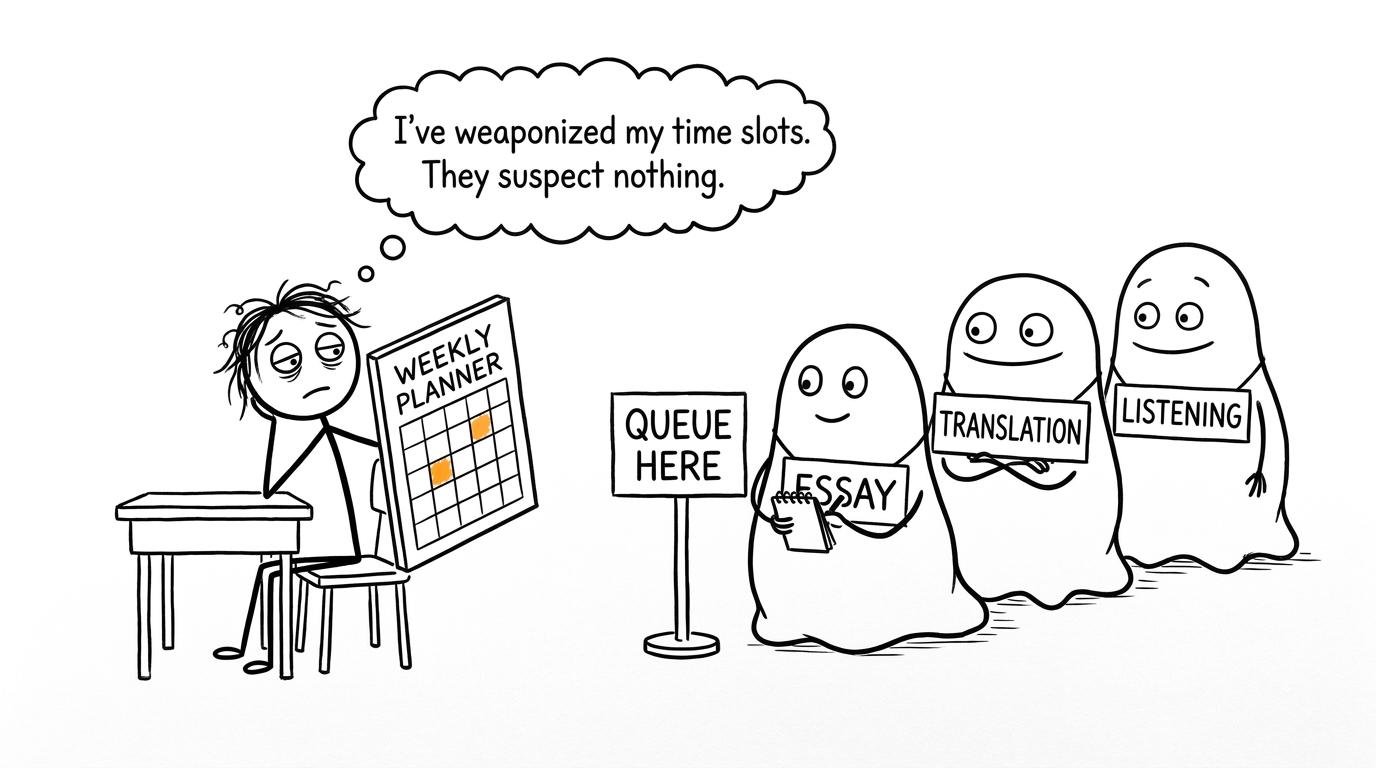 A student calmly controlling essay, translation and listening monsters with a weekly planner
Balance Arabic preparation with GCSE maths
If your maths examinations are approaching, do not allow future A-level preparation to crowd out the qualification in front of you. Arabic maintenance can be short and regular while maths receives the larger revision blocks it currently needs.
A workable weekly pattern might include brief Arabic reading, vocabulary retrieval and one analytical paragraph alongside planned maths sessions. The GCSE maths revision timetable can help you build a realistic structure around school and other subjects.
For maths, begin at the GCSE maths revision hub, choose your exam board and work at the correct foundation or higher tier. MathsGenie covers Edexcel, AQA, OCR, Eduqas, WJEC and CCEA resources, while Arabic availability is much more limited and should be checked directly with your school.
Use the same disciplined loop in both subjects:
- identify one precise weakness
- review the underlying knowledge
- complete focused practice
- check the relevant mark scheme or teacher feedback
- record the correction
- retest it later
Short assessments can make this manageable. For example, Edexcel GCSE maths mini tests provide focused timed practice without consuming an entire evening. Closer to the examinations, move into Edexcel GCSE maths past papers or the corresponding page for your board.
If you need a broader schedule, the one-month GCSE maths revision plan shows how to combine retrieval, topic repair and paper practice. The principle transfers well to Arabic, even though the subject content is different.
Common mistakes when judging the jump
Assuming a high GCSE grade guarantees an easy A level
A high grade is encouraging, but the A level assesses new forms of performance. Research writing and critical essays require deliberate practice even when your core language is strong.
Believing fluent speech is enough
Everyday fluency can be a considerable advantage, especially for comprehension. It does not automatically provide formal grammar, accurate spelling, translation technique or literary analysis.
Memorising essays
A memorised response may contain impressive language but fail to answer the actual question. Learn evidence, analytical vocabulary and flexible paragraph structures instead.
Retelling a text or film
Narrative summary shows knowledge of events. It does not, by itself, explain how meaning is created or support a critical judgement. Each paragraph should advance your answer.
Preparing for the wrong qualification
GCSE Arabic, International GCSE Arabic, regulated A-level Arabic and International A Level Arabic do not share identical papers. Confirm the board, specification code and assessment structure before buying resources or choosing practice papers.
Is the step worth taking?
A-level Arabic is a serious academic language qualification. It asks you to move beyond familiar communication and towards formal expression, cultural understanding, independent research and sustained analysis. That is why the jump feels large, and why preparation based only on vocabulary lists is unlikely to be enough.
The best response is steady preparation rather than anxiety. Strengthen formal Arabic, read beyond GCSE themes, practise translation and learn how to build an argument. Meanwhile, keep your immediate GCSE priorities visible.
For maths, MathsGenie gives you a clear route from revision lessons and practice questions to mini tests, past papers, predicted papers, mark schemes and video solutions. Start with the MathsGenie GCSE revision platform, repair one weakness at a time, and let consistent practice make both your current exams and the next academic step feel less uncertain.