

GCSE Remark Deadline 2026: How Long Do You Have?
GCSE remark deadline 2026 explained: check AQA, Edexcel, OCR and Eduqas dates, school cut-offs, consent rules and what to do after results day.
Results day can turn on a surprisingly small distance: the gap between the grade you received and the grade boundary you hoped to cross. If you are considering a review, the GCSE remark deadline for the June 2026 series is 24 September 2026 across AQA, Pearson Edexcel, OCR and Eduqas. GCSE results day is Thursday 20 August 2026, giving just over a month, but your school may set an earlier internal deadline.
The important move is simple: speak to your teacher or exams officer as soon as possible. Do not treat 24 September as your personal submission date.
GCSE remark deadline checklist
- Confirm your exam board and paper or component.
- Check your mark against the current GCSE grade boundaries.
- Ask your teacher whether seeing the marked script would help.
- Request your school's internal deadline and fee information.
- Read and sign the candidate consent form if you proceed.
- Remember that your mark and grade can rise, remain unchanged or fall.
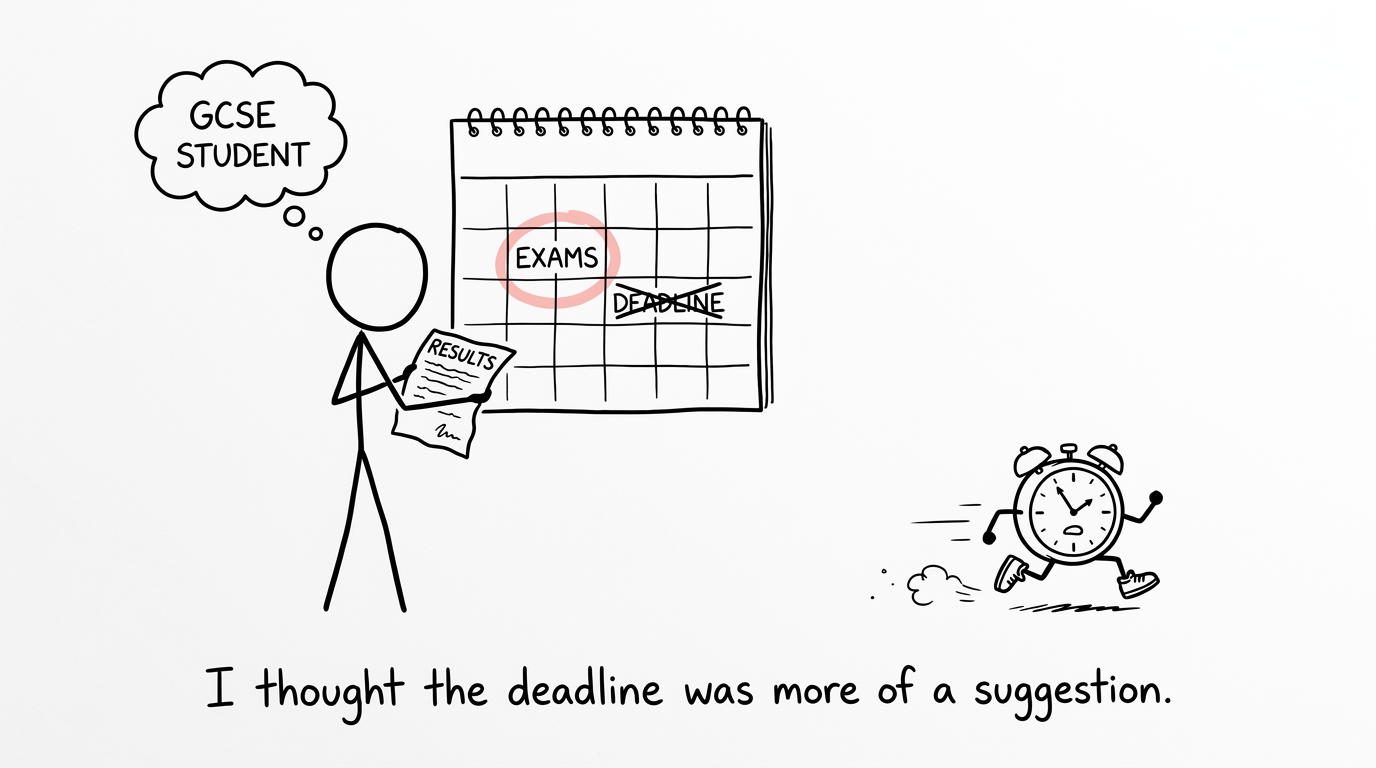 A student watches an exam deadline sprint away on a calendar
GCSE re-mark request deadlines by exam board
The official term is usually review of marking, not re-mark. A reviewer checks whether the original examiner applied the mark scheme correctly; the paper is not automatically marked again from scratch.
The following dates apply to standard reviews of marking for GCSE examinations taken in summer 2026.
| Exam board | GCSE results day | Board deadline for review requests | What students should do |
|---|---|---|---|
| AQA | 20 August 2026 | 24 September 2026 | Contact your school immediately and ask for its internal cut-off. |
| Pearson Edexcel | 20 August 2026 | 24 September 2026 | Discuss the script and grade boundary with your maths teacher. |
| OCR | 20 August 2026 | 24 September 2026 | Ask your exams officer which paper should be reviewed. |
| Eduqas | 20 August 2026 | 24 September 2026 | Give written consent through your school or college. |
These are deadlines for the exam board to receive the request. Schools need time to discuss the result, obtain consent, collect any payment and submit the application, so an internal deadline may be several days or weeks earlier.
What to do before requesting a review
First, establish how close you are to the next grade. MathsGenie lists board-specific boundaries, including Edexcel GCSE Maths grade boundaries and OCR GCSE Maths grade boundaries. A small boundary gap does not prove that marking is wrong, but it tells you what mark movement would be required.
Next, ask whether your teacher can inspect a copy of the script. They can compare your responses with the mark scheme and identify a credible marking concern. MathsGenie's guidance on using GCSE mark schemes explains why method marks and the precise wording of a scheme matter.
For most students, the school or college submits the request. Written consent must be obtained after results are published because the final mark may go down, stay the same or go up. Private candidates may have different arrangements and should contact their entering centre or awarding body promptly.
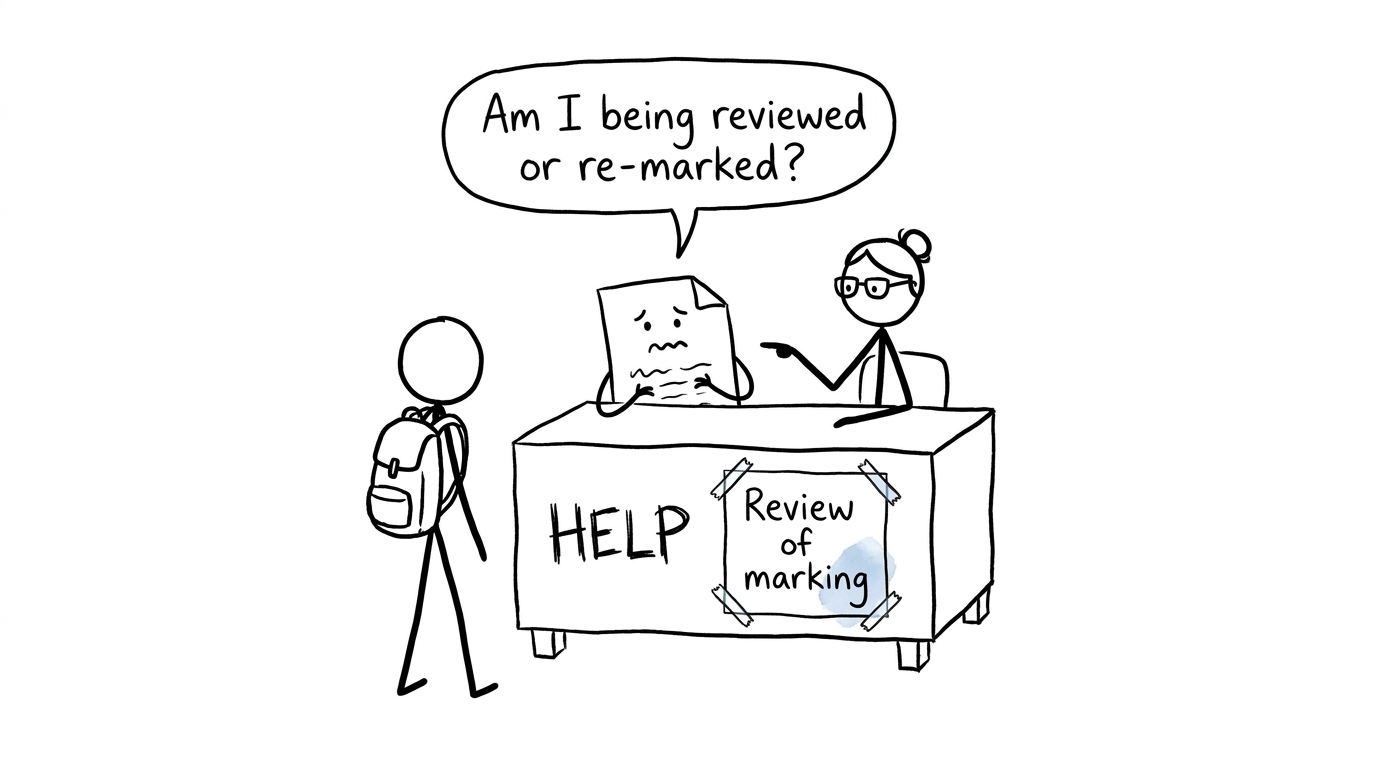 An exam paper asks whether it is being reviewed or re-marked
Common mistakes with remark deadlines
Waiting until 24 September
That is the awarding body's deadline, not necessarily your school's. Ask for the internal cut-off on results day.
Assuming a near miss guarantees another grade
Being one mark below a boundary does not establish a marking error. Ask a teacher to examine the evidence.
Believing the grade cannot fall
There is no grade protection for an individual review of marking. Your signed consent confirms that you understand the possible outcomes.
Requesting the wrong service
A clerical re-check looks for administrative issues such as incorrect totalling. A review of marking checks whether the mark scheme was applied correctly. Ask your exams officer which service fits the concern.
Act early, then focus on the next step
A result can feel final before it truly is. Yet the useful response is neither panic nor blind optimism. It is evidence, a conversation and a decision made before your centre's deadline.
Start with the MathsGenie GCSE Maths revision hub, then use GCSE Maths past papers, mark schemes and video solutions to understand where marks are earned. If a resit becomes the better route, revision lessons, practice questions, mini tests and GCSE predicted papers give you a clear way forward. For guidance related to checking marking evidence, read MathsGenie's GCSE mark scheme guidance and speak to your exams officer without delay.











