GCSE Media Studies Weak Topic: A Practical Fix
GCSE media studies weak topic? Diagnose the gap, rebuild knowledge, practise exam responses and retest it with this focused, practical revision plan today.
A topic can start to feel impossible long before it actually is. You meet it in a lesson, misunderstand one part, lose marks in a mock and quietly decide that it is simply not your topic.
But a GCSE media studies weak topic is rarely one enormous problem. It is usually a smaller gap repeated several times: uncertain terminology, weak knowledge of a set product, unsupported analysis or an answer that does not address the command word.
The practical answer is not to avoid the topic or reread the entire textbook. Diagnose the precise gap, rebuild one small part, answer a relevant exam question, mark it honestly and retest it later. That turns a vague weakness into a sequence of manageable actions.
Your weak-topic repair checklist
Use this process whenever one area keeps costing you marks:
- Identify the exact product, concept or question type causing trouble.
- Decide whether the problem is knowledge, analysis or exam technique.
- Check your specification and class materials before revising.
- Relearn one small section rather than the whole unit.
- retrieve the knowledge without notes.
- Apply it to a short, relevant exam question.
- Compare your response with the mark scheme.
- Record one specific correction.
- Reattempt the skill on another day.
- Keep testing it alongside stronger topics.
This resembles the feedback loop used in effective maths revision. MathsGenie’s guide to finding your weakest GCSE topics explains why evidence from questions is more useful than relying on how confident a topic feels.
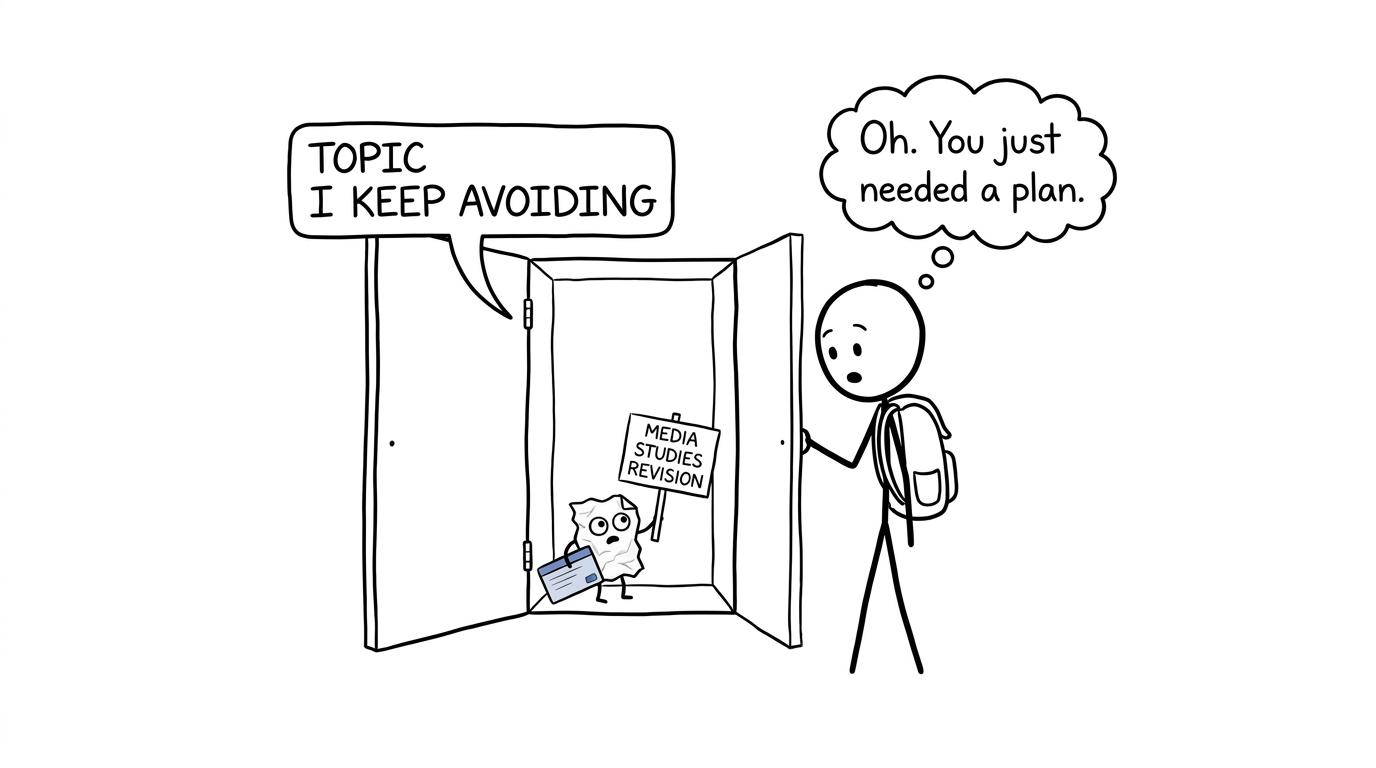 A student discovers that an avoided revision topic only needed a plan
Define the weakness before trying to fix it
“Media industries” is too broad to be a useful diagnosis. So are “newspapers”, “representation” and “I am bad at essays”. Each label hides several different skills.
Make the weakness narrow enough to practise. It might be:
- recalling ownership information about a set product;
- explaining how regulation affects an industry;
- analysing how camera work creates meaning;
- connecting representation to social or historical context;
- comparing two products rather than discussing them separately;
- selecting evidence from an unseen source;
- reaching a judgement in an extended response;
- using media terminology accurately.
Look at marked classwork, mock papers and teacher feedback. For each lost mark, write down what prevented you from earning it. If you cannot tell, ask your teacher to help you classify the problem.
A useful diagnosis should finish the sentence: “I lose marks here because...” For example, “I know the set product, but I describe its features without analysing their effect.” That is far more actionable than “I always get media language wrong.”
Work out which assessment skill is failing
GCSE Media Studies specifications differ in their products, paper structures and question formats. However, the regulated assessment objectives distinguish three broad areas:
- AO1: knowledge and understanding of the theoretical framework and relevant contexts;
- AO2: analysis of media products, including making judgements and drawing conclusions;
- AO3: creating media products for an intended audience.
Across the regulated qualification, these are weighted at approximately 30%30\%30%, 40%40\%40% and 30%30\%30% respectively. Your own exam board specification remains the authority for how they appear in particular components.
This distinction matters because different weaknesses require different repairs.
When the problem is knowledge
You may recognise a term when reading notes but be unable to explain it without help. Perhaps you confuse media language with representation, forget contextual information or cannot recall details about a set product.
Reduce the material to short prompts. Put the notes away and retrieve definitions, facts and examples from memory. Then check what you missed. Copying a page can make the material look familiar without proving that you can recall it in an exam.
When the problem is analysis
You may know the facts but stop at description. An analytical response explains how evidence creates meaning, constructs a representation, appeals to an audience or connects with context.
Practise building links between precise evidence and an interpretation. Ask:
- What detail have I selected?
- Which media concept helps explain it?
- What meaning or response could it create?
- Why is that interpretation relevant to the question?
Analysis is not made stronger by adding terminology at random. The term must help you explain the evidence.
When the problem is exam technique
Sometimes the knowledge is present, but the answer does not respond to the task. You might overlook a command word, spend too long on a low-tariff question, omit a comparison or write an extended response without a conclusion.
Study the wording of questions from your own board. AQA, OCR and Eduqas do not necessarily organise their assessments in the same way, so do not rely on a generic essay structure without checking it against your specification, teacher guidance and mark schemes.
Build a small repair session
Trying to conquer the entire weak topic in one evening creates an attractive form of avoidance: plenty of activity, little evidence of improvement. A focused session is better.
Start with a short diagnostic
Answer one relevant question without notes. It can be a brief knowledge question, an analytical paragraph or a plan for an extended response. The purpose is to reveal the current gap, not to produce perfect work.
Mark it using the available mark scheme and any teacher guidance. Do not look only at the total. Identify the missing ingredient: accurate knowledge, product evidence, explanation, context, comparison or judgement.
The same principle applies in maths. MathsGenie’s article on using past papers properly treats a paper as assessment and the correction afterwards as the real revision.
Relearn only what the evidence exposed
If your diagnostic shows that you cannot explain audience targeting, revise that concept and its connection to the relevant set product. Do not automatically revisit every audience theory and every product in the course.
Use your school notes, specification, endorsed materials and teacher resources. Check that the set products are current for your examination series because prescribed material can vary by specification and may change over time.
Retrieve before applying
Close the notes. Write or say everything you can remember about the small area you have just revised. Check it, fill the gaps and repeat.
Then apply the knowledge to a fresh question. Retrieval checks whether the information is available; application checks whether you can use it when the wording changes. You need both.
Maths students can see this structure in action through MathsGenie’s GCSE maths revision hub, where lessons lead into practice questions, papers, mark schemes and solutions. The subject content is different, but the learning sequence transfers well.
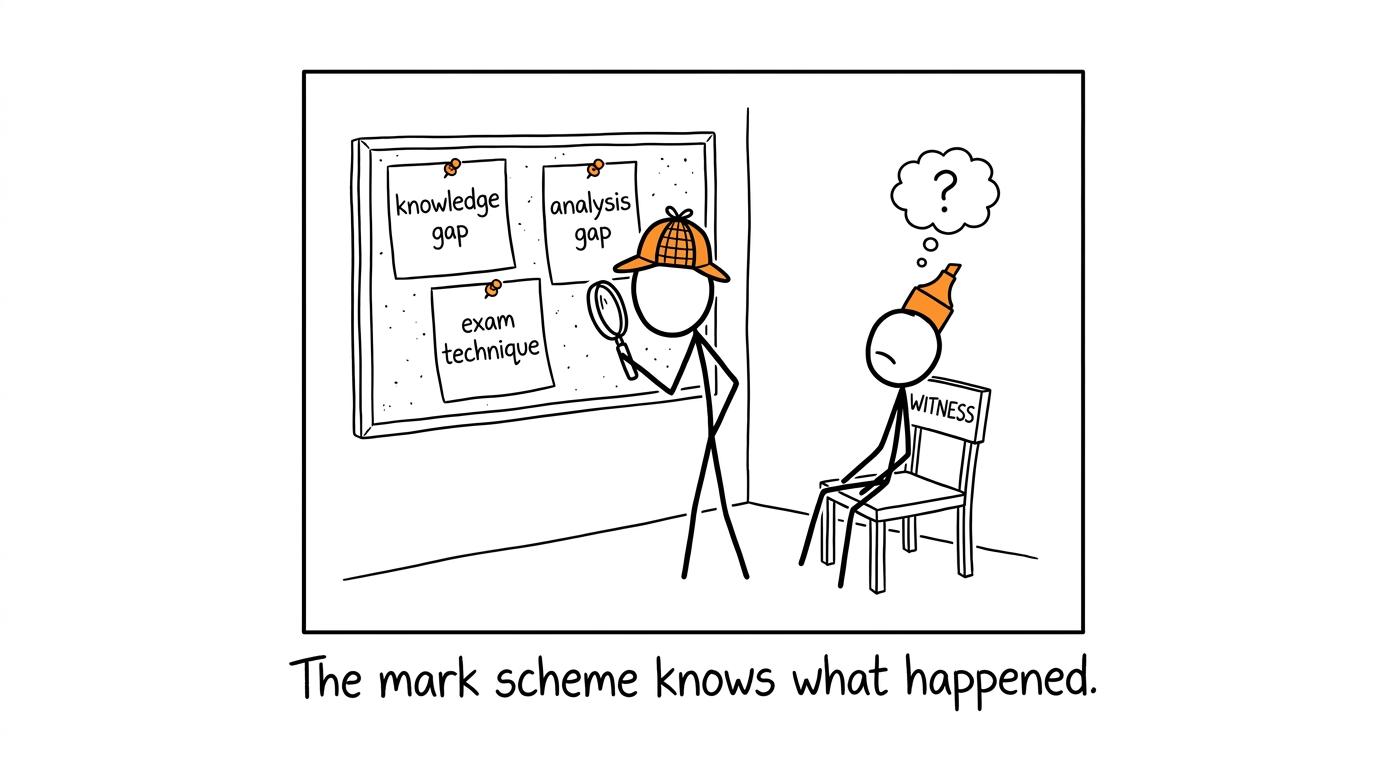 A revision detective investigates knowledge, analysis and exam-technique clues
Use the mark scheme as a translator
A mark scheme tells you what an examiner can reward. It should not be used as a model answer to memorise word for word.
When reviewing a response, compare these elements:
- Did you answer the precise question?
- Was your knowledge accurate and relevant?
- Did you use specific evidence from the product or source?
- Did you explain rather than merely identify?
- Did you include context where the question required it?
- Did you compare throughout if comparison was requested?
- Did your judgement follow from the evidence?
Create an error log with four short entries: the question, the weakness, what was missing and the next action. “Bad essay” is not useful. “I gave product details but did not connect them to the representation of age” gives you something concrete to practise.
Revisit the topic until the improvement survives
A corrected answer can create false confidence because the solution is still fresh. Real progress means producing a better response later, without copying the correction.
Return to the topic over several days. A simple pattern is:
- first session: diagnose, relearn and correct;
- next session: retrieve key knowledge without notes;
- later session: answer a different question under time pressure;
- following week: include the topic in mixed revision.
The final mixed stage matters. The exam will not announce your weak topic several days in advance. You must recognise which knowledge and concepts to use among questions covering different products and parts of the framework.
For a transferable model, read MathsGenie’s guide to stopping forgotten GCSE content. You can also use Edexcel GCSE maths mini tests to practise the same diagnose-and-retest habit in your maths revision.
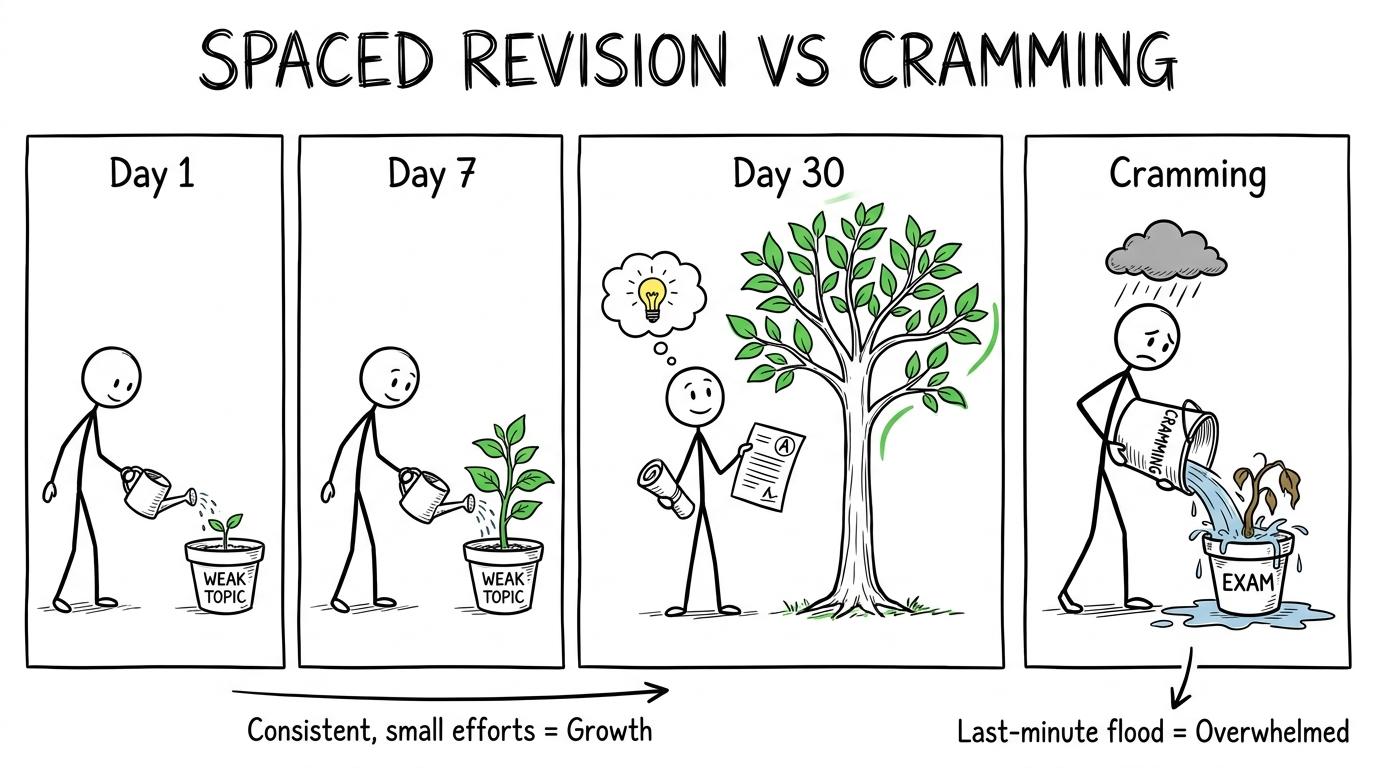 A weak-topic plant grows through spaced revision while cramming goes badly
Common mistakes when repairing a weak topic
Revising the topic you enjoy instead
Comfortable revision feels productive because answers come quickly. Begin with the weakness while your concentration is strongest, then finish with a more secure area if you need momentum.
Rereading without testing yourself
Recognition is not recall. Cover the notes and produce the knowledge before checking it. If nothing has to come from memory, the session offers little evidence that exam performance will change.
Memorising one perfect paragraph
The examination may alter the product, source, command word or focus. Memorise accurate knowledge and flexible analytical habits, not a paragraph that only fits one question.
Treating every error as a content gap
A weak answer may come from misreading the question, failing to compare, using vague evidence or running out of time. More notes will not automatically repair those problems.
Ignoring the specification
Use resources for your board and current course. AQA Close Study Products, OCR set products and Eduqas set products are not interchangeable. Confirm the exact component and material with your teacher.
Doing another question without correcting the first
More practice is only useful when feedback changes the next attempt. Mark, diagnose and write a specific correction before moving on.
Turn one repaired topic into a wider revision system
Once this process works for Media Studies, use it elsewhere. MathsGenie provides a natural home for applying the same discipline to GCSE maths: diagnose with a question, learn the method, practise it, check the mark scheme and retest.
Choose resources that match your board. The AQA GCSE maths past papers and OCR GCSE maths past papers provide board-specific practice, while the guide to revising without wasting time shows how to keep each session focused.
A weak topic is not a permanent label. It is information. It tells you where the next useful piece of work is waiting.
Choose one Media Studies question today, identify the smallest reason you lose marks and complete one repair cycle. Then bring the same method to MathsGenie: use the free revision lessons, practice questions and video solutions to rebuild individual maths skills, past papers and mark schemes to diagnose performance, and mini tests or predicted papers to prove that the improvement lasts.