

GCSE Maths Reform: What It Means for Year 8 Now
GCSE maths reform: what it means for a child in Year 8 now. Understand the timetable, likely specification and practical steps you can take as a parent.
Policy baseline: November 2025. This article follows a child in Year 8 during the 2025-26 academic year, normally taking GCSEs in summer 2029. Review the dates each autumn before applying this advice to a new Year 8 cohort. Applies to England.
If your child is in Year 8 in 2025-26, they are expected to sit the current GCSE Maths specification in summer 2029, before the announced replacement qualifications reach their first exams. For parents searching for “GCSE maths reform what it means for a child in year 8 now”, that is the useful starting point: continue supporting the maths your child is learning today.
The nuance is that a new national curriculum and new GCSE qualifications have different implementation dates. A headline about changes arriving in 2028 does not mean every child taking an exam after 2028 will sit a replacement GCSE.
Imagine a parent reading that headline after checking their child's homework. The immediate question is reasonable: are we preparing for the wrong exam? The published timetable gives this family a practical answer.
The answer at a glance
For the Year 8 cohort defined above:
- Expected GCSE exams: summer 2029, assuming normal progression through school.
- Expected specification: the current GCSE Maths qualification offered by the school's exam board.
- What to do now: follow school teaching, strengthen foundations and address specific gaps.
- What to check: the school's exam board and any later official transition announcements.
These conclusions concern England's reforms. Families in Wales, Northern Ireland or Scotland should check the arrangements applying to their own qualification system.
Which GCSE reform year group is affected?
The Department for Education's November 2025 response to the Curriculum and Assessment Review sets out separate milestones:
| Milestone | Published timetable |
|---|---|
| Revised national curriculum published | Spring 2027 |
| Revised national curriculum first taught | September 2028 |
| First phase of updated GCSEs first taught | September 2029 |
| Second phase of updated GCSEs first taught | September 2030 |
| First exams for those phases | Summers 2031 and 2032 respectively |
The government describes the GCSE programme as phased. The timetable should therefore not be read as confirmation that every subject changes in September 2029.
For our hypothetical parent, the decisive comparison is straightforward. Their child would normally enter Year 10 in September 2027 and finish Year 11 in summer 2029. That is before the first teaching of the announced replacement GCSEs.
On this timetable, the current specification is the appropriate basis for preparation. A school beginning GCSE content earlier does not, by itself, change the qualification its pupils will enter.
The phrase “Year 8 now” also needs an annual reset. A child in Year 8 in 2026-27 would normally take GCSEs in summer 2030. A child in Year 8 in 2027-28 would normally take them in summer 2031, making subject-specific transition decisions more relevant.
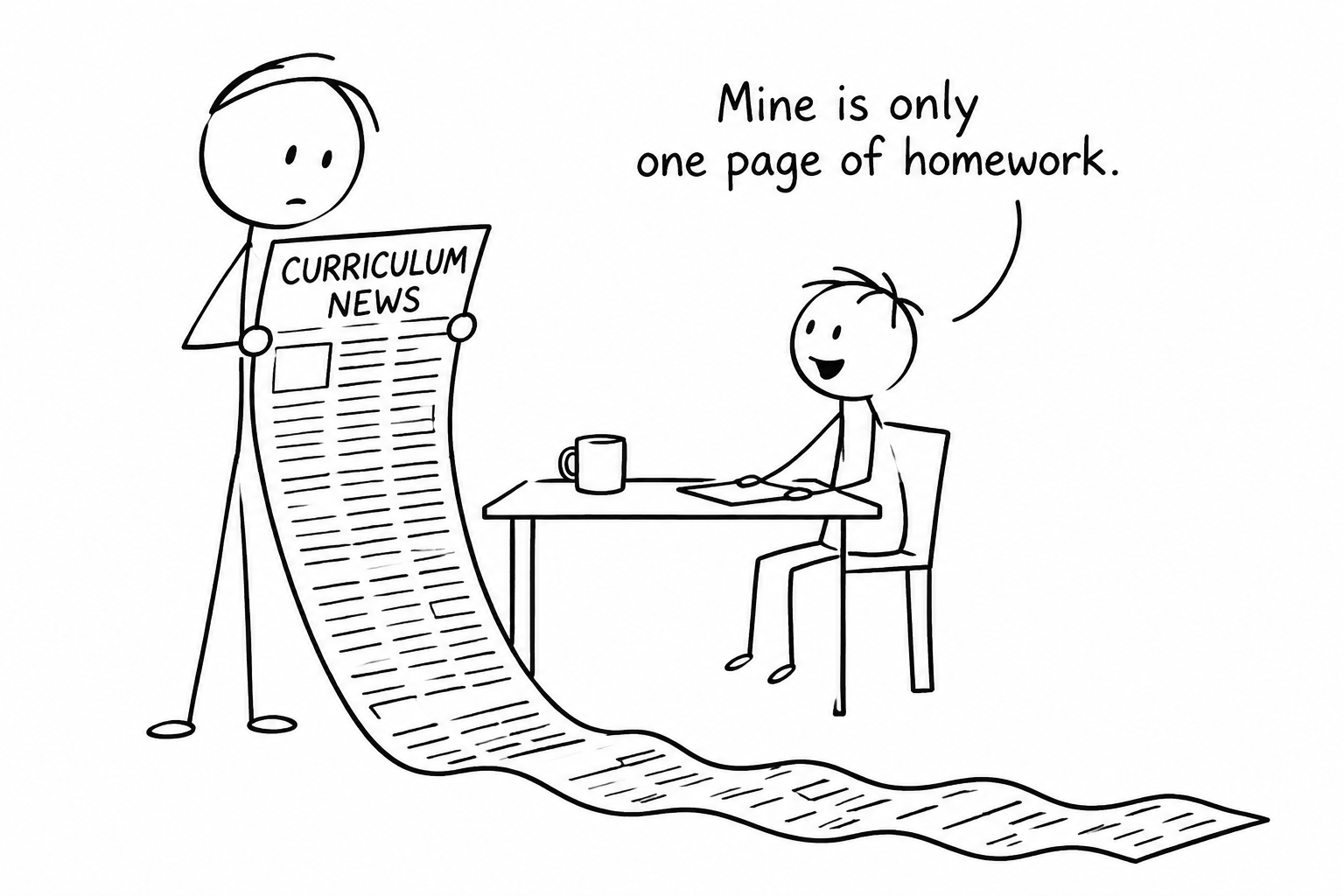 A parent wrestles with an enormous curriculum newspaper while their child calmly points out that the homework is only one page.
What the GCSE maths changes do and do not establish
Three kinds of publication serve different purposes. The Curriculum and Assessment Review makes recommendations. The DfE's response sets out the government's intended programme. Ofqual's rules and decisions establish assessment requirements within its responsibilities.
That distinction matters when a recommendation becomes a headline. A proposed change is not automatically an approved exam arrangement for your child.
A specification sets out the qualification's content and assessment requirements. Your school's exam board determines which particular specification your child follows. The reform timetable alone cannot tell you whether that will be Edexcel, AQA, OCR or another appropriate board.
Nor does continuing with the current specification guarantee that every assessment detail remains unchanged. Formula-sheet arrangements, for example, need checking against Ofqual's decisions for the relevant exam year. Do not assume that support announced for one series automatically applies to summer 2029.
The sensible position is stable preparation with occasional checks, rather than treating either “everything changes” or “nothing can change” as settled fact.
A practical plan for the rest of Year 8
Back at the kitchen table, the parent does not need to turn a policy timetable into a GCSE revision timetable. They need a manageable way to support current learning.
Ask the school three specific questions
Ask which GCSE Maths specification the school currently expects this cohort to follow, which topics would benefit from extra practice, and when parents should expect further information about qualification arrangements.
Those questions produce more useful answers than asking whether the school is “ready for reform”. They connect policy to your child's actual classroom experience.
Choose one gap at a time
Use recent homework or teacher feedback to identify a precise difficulty. “Fractions” may still be too broad: the problem could be equivalent fractions, calculation or interpreting a question.
Useful foundations include fractions, percentages, ratio and the connections between fractions, decimals and percentages. These linked examples use Edexcel topic pages; follow your school's guidance when choosing resources.
Use a short practice cycle
As a practical starting point, try two short sessions each week. Revisit the method, let your child attempt a few questions independently, then check the answers together. Return to the same skill the following week before moving on.
Ask, “Where did the method stop making sense?” That gives you something specific to discuss with their teacher. Keep a brief note of recurring errors rather than collecting more worksheets without reviewing them.
Start with the school-identified gap in Maths Genie Lessons for the current specification so you can put this Year 8 practice cycle into action.
Common mistakes parents can avoid
Confusing curriculum dates with exam dates. September 2028 is the announced start for teaching the revised national curriculum, not the first examination of every replacement GCSE.
Buying replacement-specification materials prematurely. For this cohort, resources should match the qualification the school expects to enter. A “new curriculum” label does not establish suitability.
Turning Year 8 into an extended exam season. Targeted practice can support classroom learning without introducing full GCSE papers before your child has been taught much of their content.
Reading an old article as advice for a new cohort. Check both the publication's policy date and the academic year it calls “Year 8”. Recalculate the expected exam summer before using its conclusion.
Turn reassurance into a routine
Your goal is to help your child reach GCSE Maths with secure foundations and preparation matched to their qualification. Knowing the reform timetable answers the immediate worry; following a small practice routine addresses what happens next. Start your child's next targeted practice session with Maths Genie Lessons for the current specification.















