

GCSE Maths Reform: What Year 5 Parents Need to Know
GCSE maths reform: what it means for a child in Year 5 now, which course they are likely to sit, the confirmed timeline and what parents should do today.
Updated: 3 November 2026
A child in Year 5 in England now is likely to take a reformed GCSE Maths qualification, not today’s specification. That is the clearest answer to GCSE maths reform: what it means for a child in Year 5 now.
Assuming they progress through school in the usual way, a Year 5 pupil in the 2026-27 academic year will start Year 7 in September 2028, begin Year 10 in September 2031 and sit GCSE examinations in summer 2033. The Department for Education plans to introduce the full revised national curriculum from September 2028 and update GCSEs for first teaching in phases from 2029 and 2030.
The important nuance is that the final GCSE Maths specification your child will follow is not yet available. Its detailed content, assessment structure and exam-board version cannot be named with certainty today.
The answer at a glance
For a Year 5 child in England now:
- they are likely to encounter the revised national curriculum from the beginning of secondary school in September 2028;
- they are likely to study a reformed GCSE Maths specification before examinations in summer 2033;
- the final curriculum is expected to be published in spring 2027;
- their eventual exam board could be Edexcel, AQA, OCR or another approved awarding organisation chosen by their school;
- parents do not need to buy future GCSE textbooks or predict individual topics now;
- secure arithmetic, fractions, mathematical vocabulary and problem-solving habits remain the most useful preparation.
This article concerns reforms in England. Education and qualifications are devolved, so families in Wales, Scotland and Northern Ireland should follow information from their own education authorities and schools.
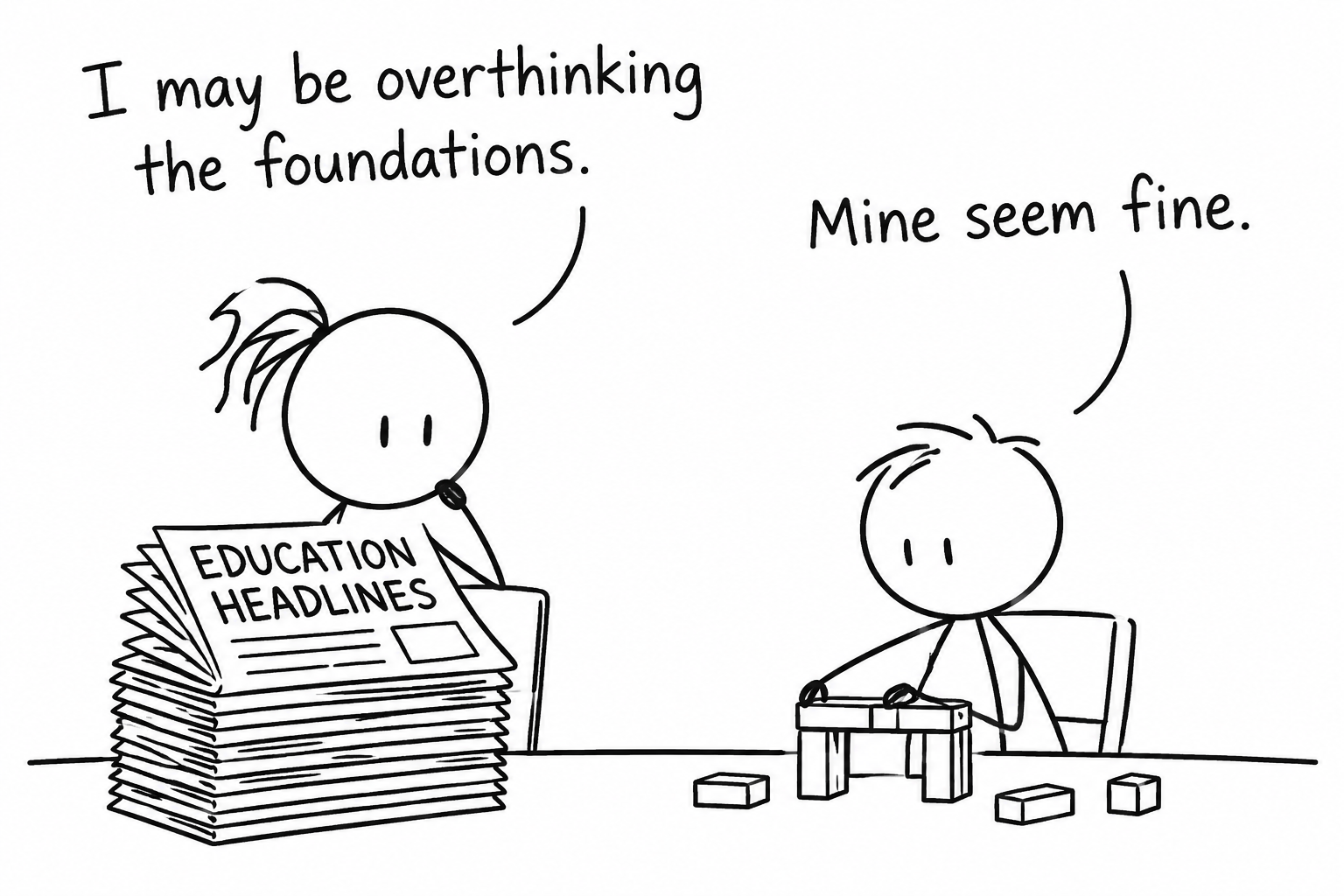 A parent buried beneath education headlines while their child calmly builds strong foundations
Which GCSE specification will a Year 5 child sit?
The most accurate answer is: a revised specification that has not yet been finalised.
The Curriculum and Assessment Review Final Report was published in November 2025. The government’s response accepted a programme of curriculum and qualification reform, with the revised national curriculum planned for first teaching from September 2028. Updated GCSEs are intended to follow in two phases, beginning in 2029 and 2030.
A child currently in Year 5 reaches Year 7 in September 2028. They should therefore be among the first secondary cohorts taught under the revised national curriculum throughout Key Stage 3. By the time they begin the usual GCSE years, all planned phases of updated GCSEs should already have entered first teaching.
That does not tell you whether the certificate will say Edexcel, AQA, OCR or Eduqas. Schools choose awarding organisations, often several years after a child enters secondary school. Nor does it tell us the final number of papers, the precise topic weightings or what reference material may be provided. Those details depend on later subject content, Ofqual requirements and awarding-organisation specifications.
The sensible conclusion is firm but limited: your child is likely to sit the reformed GCSE, but nobody can responsibly name its complete specification yet.
What the confirmed GCSE Maths changes mean
The government has committed to refreshing the curriculum and updating qualifications while retaining rigorous assessment. Its response to the review also says it will work with Ofqual and awarding organisations to reduce total GCSE examination time across a typical student’s subjects.
That is not the same as confirming that GCSE Maths will become easy, lose examinations or abandon grades 9-1. It also does not confirm the removal of foundation and higher tiers. Until formal subject content and regulatory decisions are published, claims about particular topics disappearing or individual papers changing should be treated cautiously.
One useful way to think about reform is to separate three layers:
The national curriculum
This describes the broad knowledge and skills schools should teach. The revised version is expected to be published in spring 2027 and implemented from September 2028.
GCSE subject content and regulation
The Department for Education sets subject content in England, while Ofqual regulates qualification and assessment requirements. These decisions shape what every approved specification must cover.
The exam-board specification
Awarding organisations then produce their own specifications and assessments within those requirements. Your child’s secondary school will decide which one to teach.
Headlines often collapse all three layers into one. Parents hear that “the GCSE has changed” when the detailed papers and mark schemes may still be years from publication.
What parents should do now
Picture a parent looking at a Year 5 exercise book after reading several reform headlines. There is an understandable temptation to jump ahead, find a GCSE textbook and start preparing for every possible change.
The better response is quieter. Build the foundations that make later change manageable.
Check fluency without creating pressure
Notice whether your child can recall multiplication facts, use place value accurately and select sensible written or mental methods. Fluency matters because working memory is limited. A child who must reconstruct every multiplication fact has less attention available for a multi-step problem.
Do not turn every car journey or meal into a test. Short, regular practice is usually more sustainable than occasional long sessions.
Strengthen fractions, decimals and percentages
These ideas connect primary arithmetic to ratio, probability, algebra and many later GCSE topics. Useful Year 5 conversations include comparing fractions, explaining equivalent fractions and finding simple fractions of quantities.
If you need to refresh your own understanding, Maths Genie’s guide to converting fractions, decimals and percentages explains the connections clearly. The AQA fractions, decimals and percentages resources show how those foundations later develop at GCSE.
Ask for explanations, not just answers
Try questions such as:
- “How did you decide which operation to use?”
- “Can you show that another way?”
- “Does your answer look reasonable?”
- “Where did the first mistake happen?”
These prompts develop reasoning without pretending to know the future specification. They also make mistakes useful. A corrected method is more valuable than an unexplained correct answer.
Follow the school’s sequence
Your child’s teacher knows what has already been taught and which methods the class uses. If something seems insecure, ask what to practise rather than introducing an unrelated secondary topic.
For context rather than acceleration, you can look at the sequence in Maths Genie’s current Edexcel GCSE Maths Lessons. It shows how number foundations eventually support ratio and algebra, but a Year 5 child should not be expected to work through a GCSE course independently.
Review the position once a year
Check official announcements after the revised curriculum is published, when your child starts secondary school and when the school explains its GCSE options. There is little benefit in checking speculative headlines every week.
A practical plan is therefore simple: support current schoolwork, revisit weak foundations briefly, ask your child to explain methods and wait for confirmed specifications before buying course-specific materials.
When you want to see how today’s foundations lead into secondary maths, start with Maths Genie Lessons for the current specification rather than trying to construct a future GCSE course yourself.
What not to do because of GCSE reform
Do not rush into advanced algebra
Working years ahead can create gaps rather than remove them. Algebra becomes easier when number sense, negative numbers, fractions and proportional reasoning are secure.
Do not choose an exam board now
That decision belongs to the secondary school. Even if a nearby school currently teaches Edexcel or AQA, it may review its choice before your child begins GCSE study.
Do not treat the current curriculum as wasted learning
Specifications change, but mathematical understanding accumulates. Existing resources remain useful when they teach underlying ideas accurately. The OCR fractions revision guide, for example, demonstrates skills that are valuable well beyond one set of examination papers.
Do not use GCSE papers as a Year 5 assessment
A low mark on unfamiliar secondary content tells you very little about a primary pupil’s long-term potential. Age-appropriate classwork and teacher feedback are much better evidence of what needs attention now.
Common mistakes parents make
The first mistake is confusing a planned reform with a published specification. A government timetable can tell us which cohort is likely to be affected, but it cannot reveal paper structures that have not been finalised.
The second is reacting to uncertainty with more work. Extra worksheets do not automatically produce stronger understanding. If a child can calculate but cannot explain why a method works, another page of nearly identical questions may simply rehearse the weakness.
The third is focusing only on speed. Accuracy and recall help, but GCSE Maths also rewards choosing methods, connecting ideas and communicating reasoning.
Finally, avoid attaching anxiety to the word “reform”. For your child, the revised curriculum will not feel like an old course being taken away. It will simply be the curriculum they meet when they arrive at secondary school.
Start with what is useful now
You now know the likely timeline: revised secondary curriculum from your child’s Year 7, followed by a reformed GCSE before their expected examinations in 2033. The remaining gap is not finding a secret future specification. It is helping your child build secure knowledge while official details emerge.
Start with Maths Genie Lessons for the current specification.















