GCSE ICT Early Entry: Is It a Good Idea?
GCSE ICT early entry can free Year 11 time, but only if the qualification, workload and effect on maths revision suit you. Check the trade-offs.
The promise sounds attractive: finish one qualification in Year 10, enter Year 11 with one less subject to worry about, and create more room for maths, English and science. Yet GCSE ICT early entry is only a good idea when the course is clearly identified, you are genuinely ready for its assessment and the preparation will not weaken your core GCSE subjects.
There is an important detail to establish first. In England, the old GCSE ICT qualification was not reformed alongside the current grades 999 to 111 GCSEs. A school using the phrase “GCSE ICT” may actually mean GCSE Computer Science or a vocational qualification in information technology or digital skills. Wales offers GCSE Digital Technology through WJEC, while Northern Ireland has CCEA GCSE Digital Technology. Before agreeing to early entry, ask for the exact qualification title, awarding body, specification and assessment dates.
The short decision checklist
Early entry may make sense if you can answer yes to most of these questions:
- Do you know the qualification's exact title and awarding body?
- Have you completed nearly all the required content and assessed work?
- Are your teacher's judgement and recent assessment results consistently secure?
- Can you prepare without reducing essential maths, English or science revision?
- Do you understand the examination, coursework or non-exam assessment structure?
- Would finishing early create a useful Year 11 plan rather than simply an empty timetable slot?
- Have your school and family explained what happens if the first result is disappointing?
A “no” does not automatically rule early entry out. It identifies the conversation you need to have before making the decision.
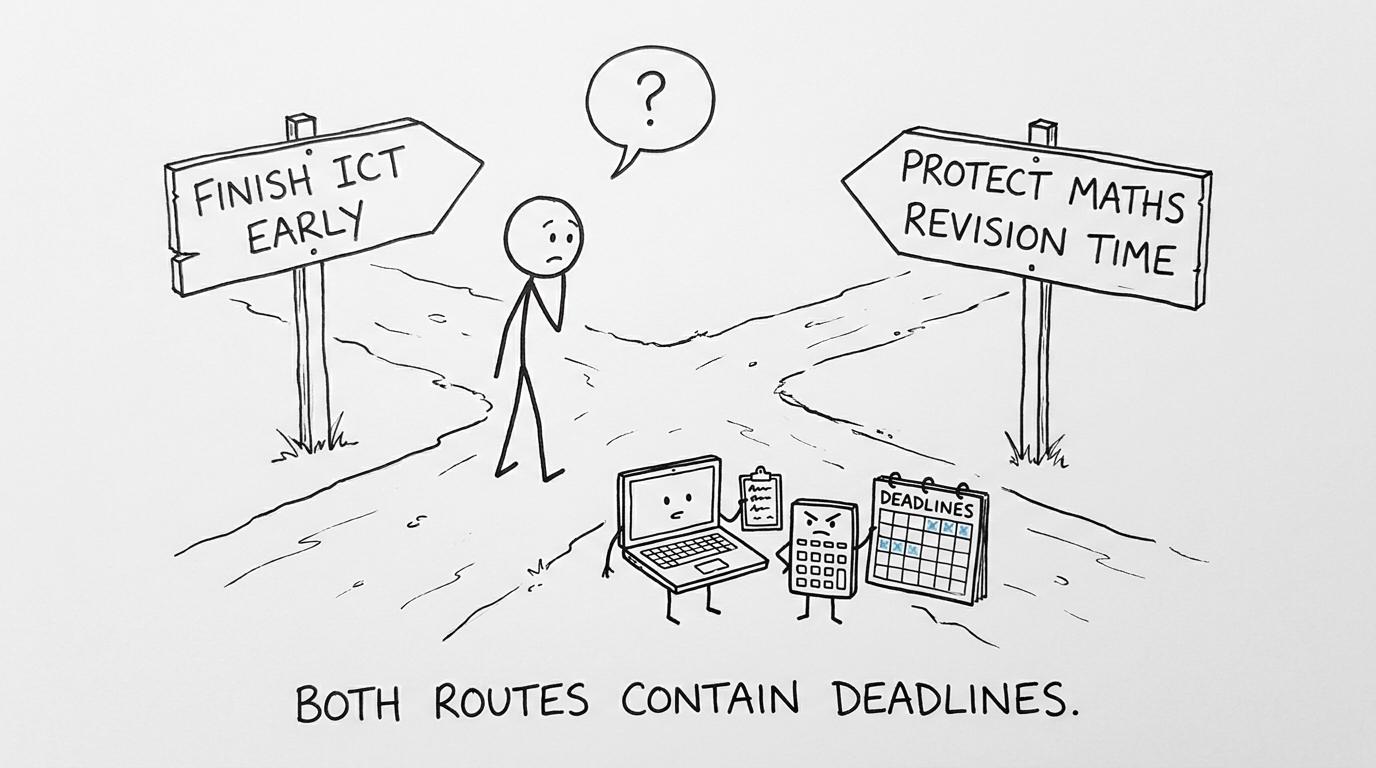 A student choosing between early ICT completion and protecting maths revision time
First, find out what qualification you are taking
The label matters because ICT, Computer Science and Digital Technology are not interchangeable.
GCSE Computer Science generally places greater emphasis on computational thinking, algorithms, programming, data and computer systems. Digital Technology qualifications may combine technical knowledge with practical digital production, multimedia, data handling or controlled assessment. Vocational IT qualifications can have another assessment model entirely.
Ask your school for:
- the full qualification name and code;
- the awarding body;
- the current specification;
- the proportion assessed by examinations and non-exam assessment;
- the certification date;
- whether the qualification is approved for your cohort and location;
- the school's policy on retakes and early entry.
This is especially important across the UK. WJEC's Digital Technology qualification is designed for learners in Wales, while CCEA's qualification in Northern Ireland offers multimedia and programming routes. Availability, grading and assessment arrangements can differ. Do not assume that advice written for an English school applies unchanged in Wales or Northern Ireland.
When GCSE ICT early entry can work well
You are already performing securely
Early entry should recognise readiness, not attempt to manufacture it. Strong classroom performance, completed controlled work and success on unfamiliar questions provide better evidence than confidence alone.
A student who remembers model answers but struggles when a question changes context may need more time. A student who can explain concepts, apply them independently and complete assessment tasks accurately has a stronger case.
It creates protected time in Year 11
The real benefit is not collecting a certificate sooner. It is what the freed time allows you to do next.
For a student preparing for maths, that time might support regular topic practice, intervention sessions or timed papers. The GCSE Maths Revision hub organises free lessons, questions and papers by exam board, while the GCSE maths topic list by board and tier can help turn the extra time into a specific plan.
Without that plan, “more time next year” can become a vague promise. Free periods have a habit of disappearing into homework, forgotten deadlines and whichever subject feels most urgent that evening.
The assessment calendar is favourable
An early entry can reduce pressure if its examination or submission deadline sits comfortably away from major mocks and other assessments. It can increase pressure if several deadlines arrive together.
Write every known mock, examination and coursework deadline on one calendar. Then assess the total weekly demand:
T=I+M+O+RT = I + M + O + RT=I+M+O+RHere, III is ICT or digital qualification preparation, MMM is maths revision, OOO is work for other subjects and RRR is realistic rest and recovery time. If the proposed plan only fits by pretending that R=0R=0R=0, it is not a sustainable plan.
A structured GCSE maths revision timetable can show whether the available hours genuinely cover your priorities.
When early entry may be the wrong decision
It competes with core-subject foundations
Year 10 maths is not merely preparation for a distant examination. Topics often build on one another. Weak algebra can later affect graphs, formulae and problem-solving; insecure number skills can continue to cost marks across both foundation and higher tier papers.
If early ICT preparation removes the time needed to repair these foundations, the trade-off may be poor. Use a short assessment or mini test to find out rather than guessing. MathsGenie's Edexcel GCSE Maths mini tests are useful for focused checks, while students following other specifications can start from the AQA GCSE Maths revision hub or OCR GCSE Maths revision hub.
You are being entered because you are “probably ready”
Potential is not the same as present readiness. Ask what evidence supports the recommendation. Useful evidence includes completed specification coverage, secure mock performance, strong practical work and the ability to meet deadlines without intensive prompting.
Also ask what grade your teacher considers realistic now and what improvement might be possible with another year. There is no universal threshold at which early entry becomes correct. The decision depends on the course, the student and the opportunity cost.
The course contains substantial assessed work
Practical assignments can look manageable because they are divided into stages. But planning, producing evidence, testing, evaluating and responding to feedback can create a considerable workload.
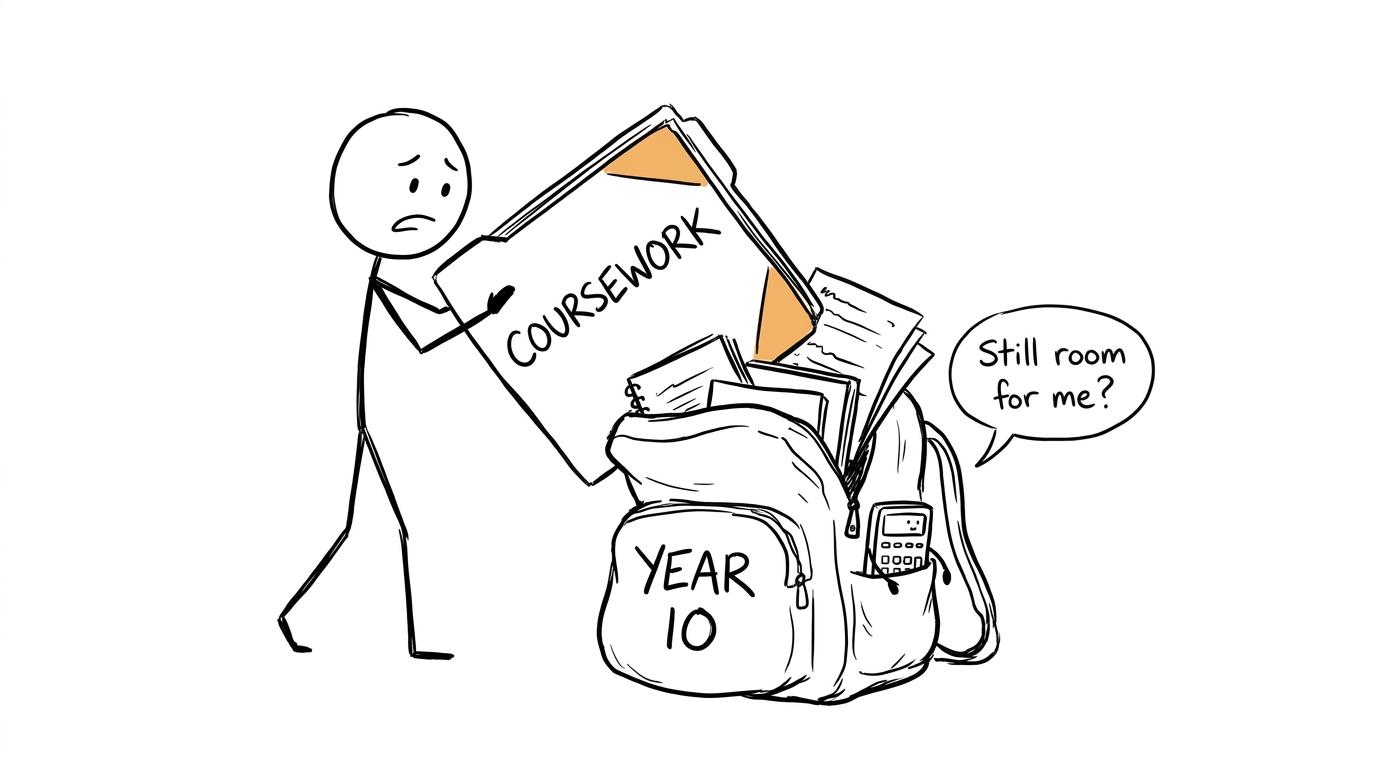 A student trying to fit coursework into an already crowded Year 10 school bag
Check what remains, not just what has been started. A project that is “mostly done” may still require the most demanding tasks: refinement, documentation and evaluation. Your teacher should be able to explain the remaining supervised time and the rules governing assistance.
You do not know what replaces the subject afterwards
Finishing early is valuable only if the released curriculum time is used purposefully. Possibilities might include supervised revision, another qualification, enrichment or continued digital learning, but arrangements are school-specific.
Ask for the Year 11 plan in concrete terms. If the answer is uncertain, do not count those hours as guaranteed maths revision time.
Understand the first-entry issue
In England, current Department for Education accountability guidance generally applies a first-entry policy when a pupil takes more than one qualification in the same subject with the same discount code. This concerns which result counts in the school's performance measures. The detailed treatment can depend on the qualification, dates and circumstances, including movement between schools.
That does not mean an early result can never be improved or used differently by a student. It does mean you should not rely on a casual promise that a later attempt will simply replace the first result everywhere.
Ask the examinations officer to explain:
- whether the proposed qualification is affected by first-entry or discounting rules;
- what would count for school accountability;
- whether a retake is available;
- how certificates and applications would show the results;
- whether changing awarding body would alter anything.
Rules and approved qualifications can change. The examinations officer should check the current official guidance for your cohort rather than relying on an arrangement used several years ago.
Protecting maths revision if you enter early
Early entry should not produce a dramatic revision sprint followed by months of neglecting maths. A small maintenance routine is safer.
Keep one or two short maths sessions each week during the busiest ICT period. Use one session for a weak topic and another for mixed retrieval. After the early assessment, increase paper practice gradually rather than trying to compensate with a sudden Year 11 rescue plan.
A sensible sequence is:
- diagnose weak topics with a mini test or paper section;
- revisit the method through a revision lesson;
- answer practice questions without notes;
- mark them and record the exact error;
- retest the skill later;
- move towards full timed papers.
The guide to when to start GCSE past papers explains how to build from shorter tasks to complete papers. Edexcel students can then use Edexcel GCSE Maths past papers with mark schemes and worked solutions.
Common mistakes when deciding
Treating “early” as automatically impressive
Colleges and employers care about the qualification and result, not merely the age at which it was taken. Readiness and balance matter more than speed.
Comparing yourself with another student
Two students can share a class but have different maths gaps, workloads, support and future plans. Someone else's successful early entry is not evidence that yours will work.
Ignoring the exact specification
Advice about old GCSE ICT may be irrelevant to a current Digital Technology, Computer Science or vocational IT course. Check the title, code and assessment model.
Planning only until the early examination
The better question is not “Can I survive this term?” It is “Does this improve my complete Key Stage 4 plan?” Include Year 11 use of time, retake arrangements and core-subject revision.
Assuming predicted papers predict everything
Predicted papers are useful practice, not a promise about what will appear. Whether revising ICT or maths, combine them with specification coverage, topic questions and past papers.
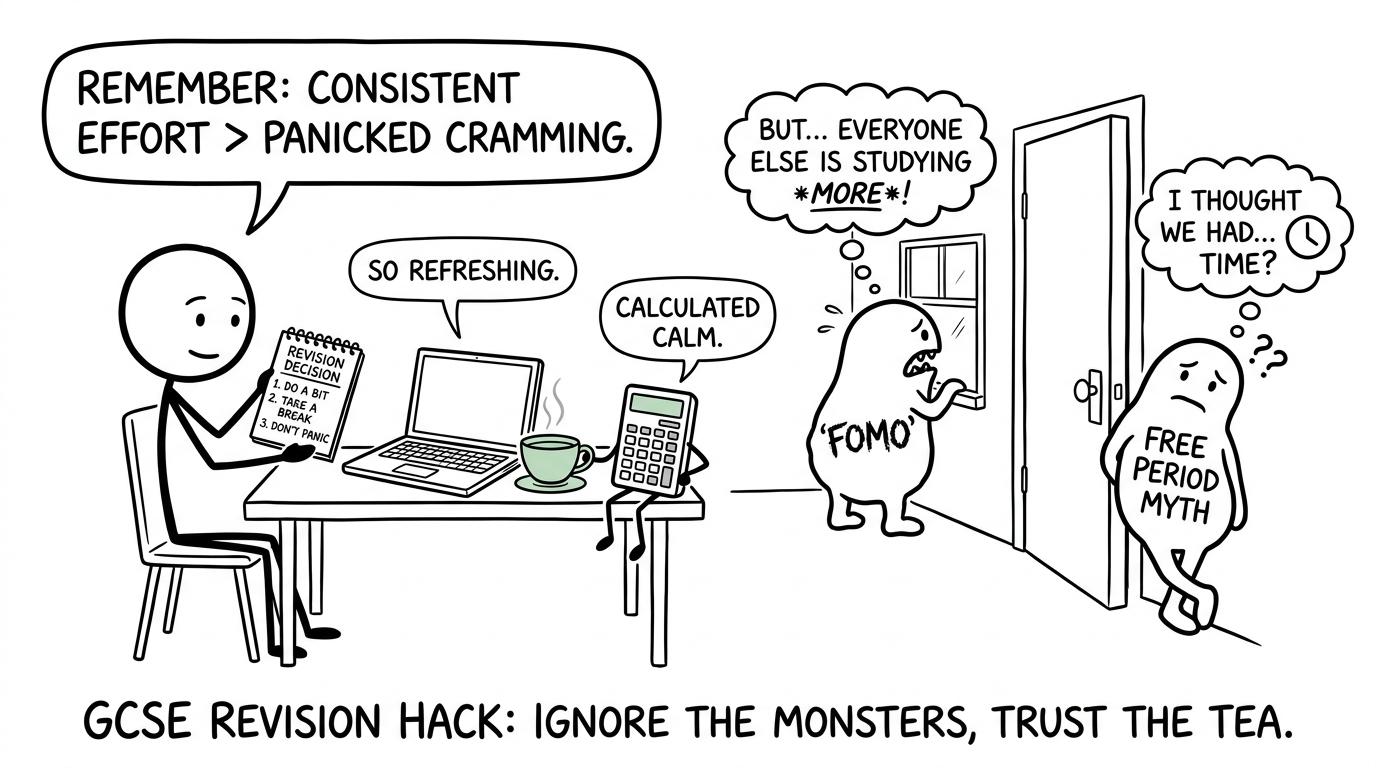 A calm student uses a checklist while revision myths wait outside
Make the decision with evidence
GCSE ICT early entry can be sensible when the qualification is correctly identified, the course is nearly complete, current performance is secure and the released Year 11 time has a clear purpose. It is less convincing when it depends on rushed assessed work, uncertain retake assumptions or sacrificing the maths foundations that still need attention.
Before agreeing, speak to the subject teacher, examinations officer and the person responsible for your timetable. Ask for evidence, dates and the Year 11 plan. Then make the decision based on your whole GCSE programme, not the appealing idea of finishing one subject first.
Whatever you decide, keep maths moving. Start with MathsGenie's free GCSE revision lessons and practice questions, check progress using mini tests, and build examination confidence with past papers, predicted papers, mark schemes and video solutions. A good decision does not merely remove pressure today; it leaves you better prepared for the examinations that remain.