

GCSE German Foundation vs Higher: What Changes?
GCSE German foundation vs higher explained: compare grades, vocabulary, grammar, task length and exam risk, then choose the tier that fits your evidence.
A tier decision can feel like a judgement on your ability. It is not. The real question behind GCSE German foundation vs higher is practical: which paper gives you the best opportunity to demonstrate what you know?
Foundation targets grades 111 to 555, while Higher targets grades 444 to 999, with a narrow grade 333 safety net for students who fall just below grade 444. But the difference goes beyond the grade range. Higher includes a larger vocabulary requirement, more complex grammar, longer assessments and tasks demanding greater inference, spontaneity and independence.
The right tier is therefore not the most impressive-sounding one. It is the one supported by your performance across listening, speaking, reading and writing.
GCSE German Foundation vs Higher at a glance
For the reformed GCSE German specifications first taught from September 202420242024 and first assessed in summer 202620262026, the central differences are:
- Foundation tier: grades 111 to 555 are available.
- Higher tier: grades 444 to 999 are normally available, plus a narrow grade 333 safety net.
- You must take all four assessments at the same tier.
- Listening, speaking, reading and writing each contribute 25%25\%25% of the qualification.
- Foundation content uses more limited linguistic complexity.
- Higher requires additional vocabulary and grammar.
- Higher assessments generally contain longer, less predictable and more demanding material.
- A grade 444 or 555 has the same value whichever tier you take.
- Your GCSE certificate does not display your tier of entry.
Exact question formats and timings vary between AQA, Pearson Edexcel and Eduqas, so your own specification and sample assessment materials should always be the final reference.
| Feature | Foundation tier | Higher tier |
|---|---|---|
| Main grade range | Grades 111 to 555 | Grades 444 to 999 |
| Vocabulary framework | Around 1,2001,2001,200 prescribed word families or lexical items | Foundation vocabulary plus approximately 500500500 more |
| Language complexity | More limited and familiar | Broader, more complex and less predictable |
| Speaking assessment | Usually 777 to 999 minutes | Usually 101010 to 121212 minutes |
| Reading and listening | Shorter material with more accessible demands | Longer material with more inference and detail |
| Writing | Shorter, more structured responses | Longer and more independent responses |
| Main risk | Maximum grade is 555 | Missing the grade 444 threshold can lead to grade 333 or U |
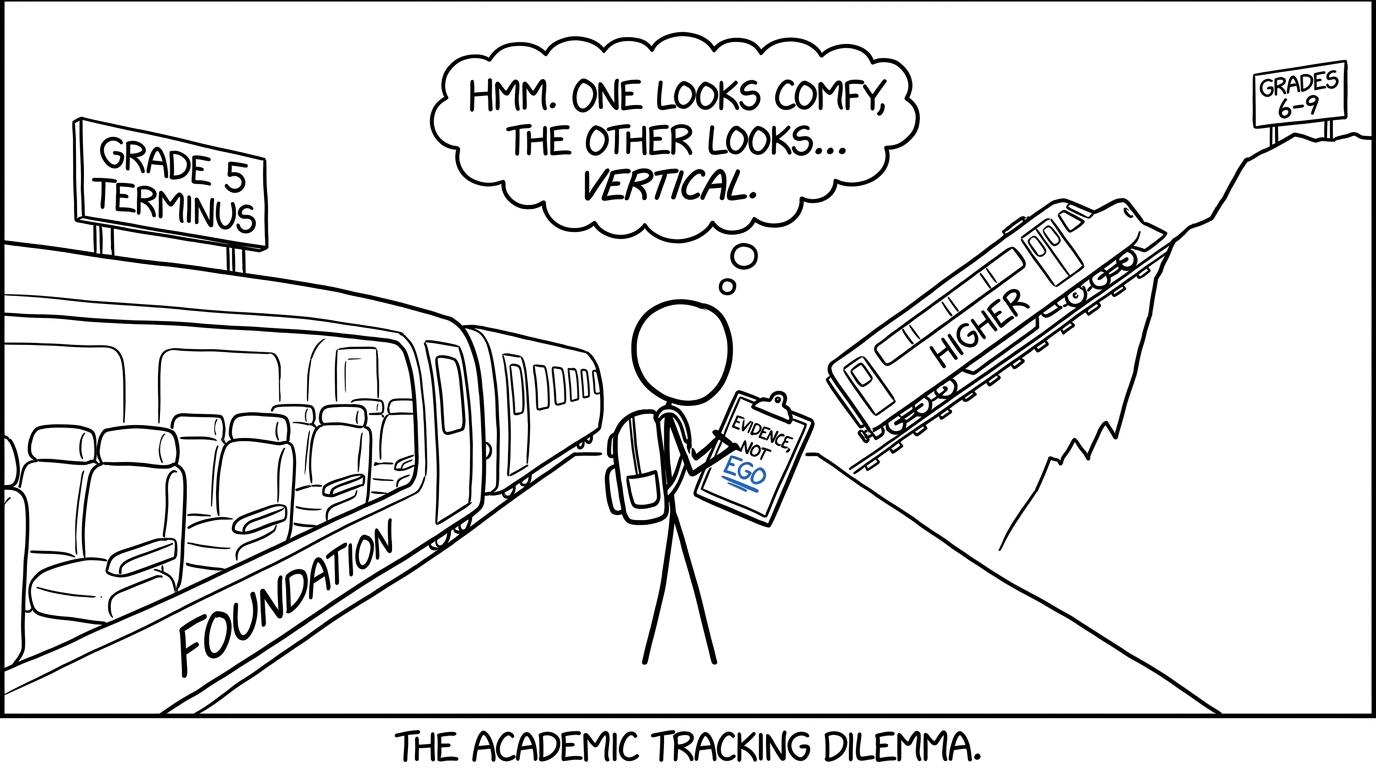 A student choosing between Foundation and Higher trains using evidence rather than ego
The grade range changes your opportunity and your risk
Foundation tier places a ceiling at grade 555. If your evidence suggests that grades 666 to 999 are realistic, Foundation cannot deliver them, regardless of how high your raw mark is.
Higher removes that ceiling but introduces a lower-end risk. It normally awards grades 444 to 999. A grade 333 may be awarded within a narrow safety-net range below the grade 444 boundary, but students falling below that range receive U rather than grades 111 or 222.
This creates the central tiering trade-off:
- Foundation offers access to the full grade range below grade 666 and a more accessible route to grades 444 and 555.
- Higher offers access to grades 666 to 999, but weaker performances carry more risk.
Importantly, Ofqual requires a grade 444 or 555 achieved on Foundation to represent the same standard as that grade on Higher. Higher is not an easier way to obtain a grade 555, and Foundation does not produce a lesser grade 555.
That principle will feel familiar to students using the GCSE Maths Revision hub, where Foundation and Higher papers also overlap around key grades. However, your tier can differ by subject. Taking Higher maths does not automatically mean Higher German is appropriate.
The vocabulary requirement is genuinely different
The reformed German GCSE gives students a clearer vocabulary framework. Foundation students are expected to know approximately 1,2001,2001,200 prescribed word families or lexical items. Higher students learn those words plus around 500500500 additional items, bringing the total to approximately 1,7001,7001,700.
That difference is not just a longer vocabulary list. Higher papers can draw on a wider range of expressions, making texts less repetitive and reducing the chance that every important word will feel immediately familiar.
Both tiers can include some unfamiliar vocabulary. Students must therefore use context, word families, cognates and grammatical clues rather than expecting perfect word-for-word recognition.
A useful revision principle is retrieval before recognition. Seeing a word and thinking “I know that” is weaker than producing its meaning without help. The same distinction appears in maths: recognising a method is not the same as being able to use it. MathsGenie's guide to the best order for learning GCSE maths topics explains how structured recall and practice build dependable knowledge.
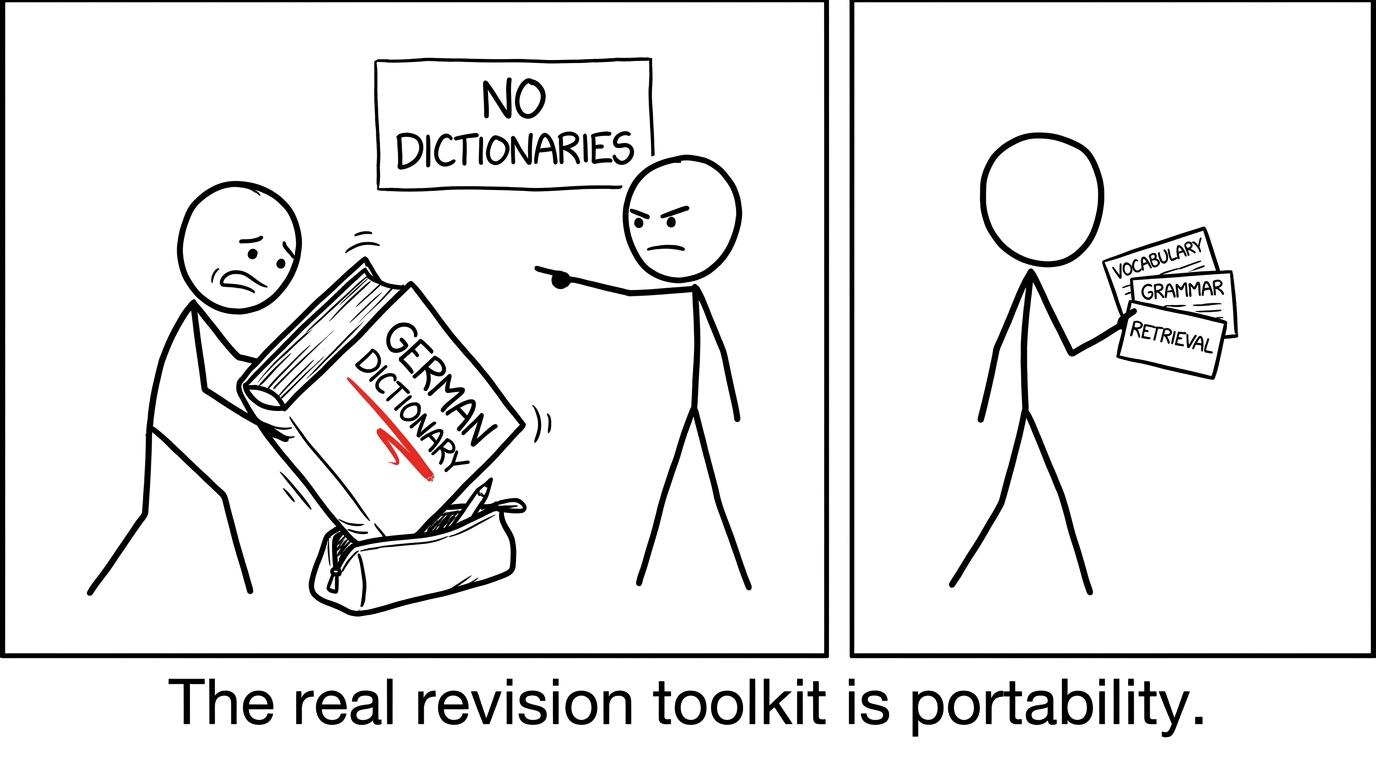 A student discovers that the enormous dictionary cannot enter the exam
Higher demands greater grammatical range
Foundation German still requires accurate grammar. Students need secure control of essential verb forms, word order, cases, agreements and common ways of expressing past, present and future ideas.
Higher tier extends the expected range and complexity. Depending on the specification, this can mean handling more demanding structures, combining time frames, understanding less common forms and producing language with greater independence.
The difference is not that every Higher sentence must be long. A short, controlled sentence can be valuable. The difference is that Higher candidates must understand and produce a broader range of language when the task requires it.
When judging readiness, ask:
- Can you recognise changes in tense while listening at normal exam speed?
- Can you maintain accurate word order when giving a longer answer?
- Can you justify opinions rather than simply state them?
- Can you move between time frames without relying on memorised paragraphs?
- Can you recover when a speaking question is unexpected?
One ambitious phrase cannot compensate for insecure foundations. Complexity earns credit when it communicates clearly.
Listening and reading become less predictable
At both tiers, listening and reading test understanding rather than simple vocabulary matching. Higher material, however, tends to be longer and linguistically denser, with more information to hold in mind.
You may need to identify attitudes, distinguish similar details or infer meaning instead of copying the first recognisable word. Distractors can include a speaker changing their mind, contrasting two people or mentioning something that did not happen.
Higher reading also expects greater comfort with connected passages and translation. The central skill is selective attention: finding the information the question asks for while ignoring nearby details that merely sound relevant.
Do not judge your readiness from untimed vocabulary exercises alone. Use current specimen papers and board-approved practice under realistic conditions. The assessment loop described in how to use past papers properly works across subjects: complete the task, mark it carefully, classify each error, relearn the weakness and retest it.
Speaking is longer and more spontaneous at Higher
Current GCSE German speaking assessments include structured and unprepared elements, although the exact task names and order depend on the exam board. They may involve reading aloud, role play, discussion of visual material and follow-up conversation.
Foundation speaking normally lasts 777 to 999 minutes. Higher normally lasts 101010 to 121212 minutes. The extra time matters because Higher candidates are expected to sustain communication, develop answers and respond to a broader range of language.
Prepared material remains useful, but memorising whole scripts is fragile. A slightly altered question can make a perfect paragraph unusable. Flexible building blocks are safer:
- opinion phrases;
- reasons and justifications;
- time expressions;
- questions;
- repair phrases;
- structures that connect past, present and future ideas.
The goal is not flawless performance. It is comprehensible, relevant communication with enough range and accuracy for the tier.
Writing changes in length, independence and demand
Foundation writing is generally more structured, with shorter responses and clearer prompts. Higher writing expects longer, more developed communication and a greater ability to organise ideas independently.
Both tiers assess whether you answer the task, communicate meaning and apply vocabulary and grammar accurately. Higher responses must usually sustain those qualities for longer while showing more variety.
Translation also becomes more demanding. Higher candidates face a wider vocabulary range and more complicated grammatical decisions. This makes checking particularly important: verb placement, tense, adjective endings and whether every part of the English meaning has been conveyed.
Do not assume that writing far beyond a suggested length automatically earns more marks. Extra language only helps when it remains relevant and controlled.
How should your tier be chosen?
Tier selection is made by your school, but it should be an evidence-based conversation rather than a label applied months in advance.
Useful evidence includes:
- recent assessments using the correct specification;
- performance across all four skills;
- consistency under timed conditions;
- your likely grade rather than your best-ever result;
- whether weaknesses are temporary or persistent;
- how securely you perform on questions around grades 444 and 555.
One strong writing assessment should not outweigh repeated difficulty in listening and speaking. Because all four components are taken at one tier and weighted equally, balance matters.
A sensible approach is to compare several assessments and look for a pattern. Students managing Higher material securely, including its less accessible questions, may benefit from access to grades 666 to 999. Students working around grades 444 or 555 may find Foundation offers a more suitable level of demand without reducing the value of the final grade.
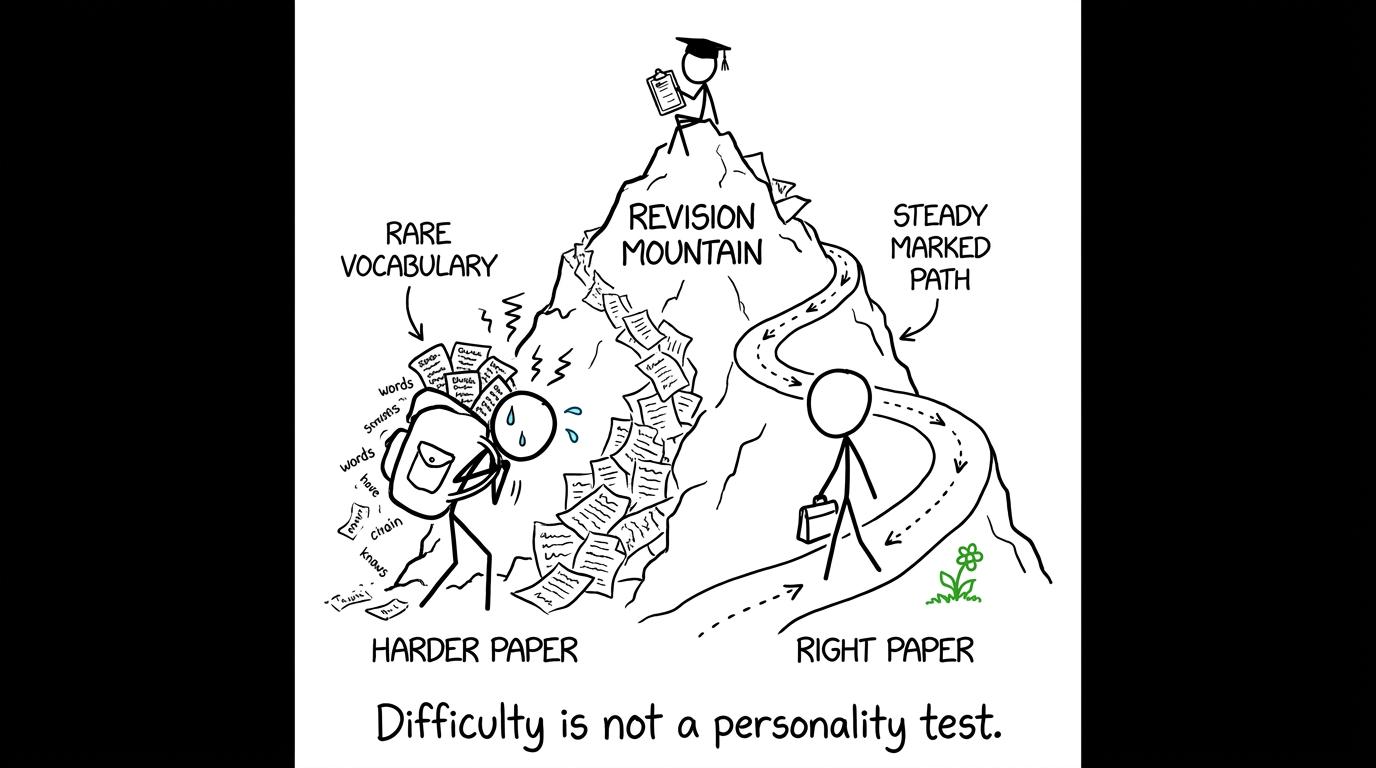 Two students learn that choosing the right paper matters more than choosing the harder one
Do not import your maths tier decision into German
Tier choices are subject-specific. A student may be confident with algebraic reasoning but find spontaneous German conversation difficult. Another may speak German fluently while needing Foundation maths.
Build separate evidence for each subject. For maths, use the Edexcel revision strategy, topic questions and mark schemes to identify your current level. For German, compare your results across all four language skills using current materials from your own board.
When balancing several subjects, timetable realistic sessions rather than allowing one tier decision to consume every evening. Save full mock papers for when you need reliable evidence. MathsGenie's Edexcel predicted papers can provide that final-stage exam practice for maths while shorter German retrieval sessions keep vocabulary active.
Common mistakes when comparing the tiers
Assuming Higher is always the better choice
Higher is appropriate when evidence supports it. It is not a reward for effort or a measure of ambition. The best tier is the one that lets you convert your knowledge into the strongest realistic grade.
Believing a Foundation grade is worth less
A grade 444 or 555 has the same value on either tier, and the certificate does not show the tier taken.
Looking only at writing marks
German combines four equally weighted skills. Tier decisions should reflect listening, speaking, reading and writing rather than your favourite component.
Using old papers without checking the specification
The reformed qualifications were first assessed in summer 202620262026. Older papers can still provide language practice, but their vocabulary framework, speaking tasks and question formats may not match your current course.
Revising only the most difficult material
Higher students still need accurate core vocabulary and grammar. A complicated sentence built on weak fundamentals is less useful than clear German that answers the task.
Choose evidence over anxiety
The meaningful difference between GCSE German Foundation and Higher is not simply that one is harder. The tiers offer different grade ranges, vocabulary demands, grammatical expectations, assessment lengths and levels of independence.
Discuss your recent evidence with your teacher and use current materials for AQA, Pearson Edexcel or Eduqas. Then return your attention to the part you can control: regular retrieval, precise corrections and realistic practice.
For your maths preparation, make MathsGenie your revision base. Use free revision lessons, practice questions, mini tests, past papers, predicted papers, mark schemes and video solutions to turn uncertainty into a clear next step. Your tier is only the paper you enter. Improvement comes from what you practise next.










