GCSE Geography Exam Length: 2026 Board Guide
GCSE geography exam length varies by board. Compare 2026 paper times, total sitting time and a practical plan for managing energy, focus and checks.
The strange thing about an exam timetable is that a small box saying “111 hour 303030 minutes” can hide a much longer experience. You arrive early, wait to enter, sit through instructions, complete the paper and remain at your desk while scripts are collected.
The GCSE geography exam length depends on your exam board and specification. Most papers last between 111 hour and 111 hour 454545 minutes, while the total examination time across the qualification ranges from 333 hours 303030 minutes to 444 hours 454545 minutes for the main specifications considered below.
Those hours are divided across separate exam days. Knowing the length of each paper helps you plan more than timing; it helps you plan concentration, food, sleep and revision around the rest of your GCSE timetable.
The quick exam-length checklist
Before planning exam day, confirm:
- your exam board: AQA, Pearson Edexcel, OCR or Eduqas;
- the exact specification, because Edexcel, OCR and Eduqas offer Geography A and Geography B routes;
- the duration printed on your current timetable;
- whether the examination is in the morning or afternoon;
- your school’s required arrival time;
- whether approved access arrangements affect your personal finishing time.
Do not rely on a friend taking “the same subject”. They may be following another specification with different papers. Unlike GCSE maths, these common GCSE Geography specifications are not divided into foundation and higher tiers, but the board and route still matter.
GCSE geography exam length by exam board
The following durations reflect official specifications and examination information current for the summer 202620262026 series. Pearson and OCR introduced some important timing changes for 202620262026, so older revision videos, paper covers or classroom documents may show shorter times.
| Exam board and specification | Paper lengths | Total official exam time |
|---|---|---|
| AQA Geography | Three papers of 111 hour 303030 minutes | 444 hours 303030 minutes |
| Edexcel Geography A | 111 hour 454545 minutes, then two papers of 111 hour 303030 minutes | 444 hours 454545 minutes |
| Edexcel Geography B | 111 hour 303030 minutes, 111 hour 454545 minutes, then 111 hour 303030 minutes | 444 hours 454545 minutes |
| OCR Geography A | 111 hour, 111 hour, then 111 hour 303030 minutes | 333 hours 303030 minutes |
| OCR Geography B | Three papers of 111 hour 303030 minutes | 444 hours 303030 minutes |
| Eduqas Geography A | Three papers of 111 hour 303030 minutes | 444 hours 303030 minutes |
| Eduqas Geography B | 111 hour 454545 minutes, then two papers of 111 hour 303030 minutes | 444 hours 454545 minutes |
Always treat your candidate timetable and the paper’s front cover as the final instructions. Schools can also set earlier arrival times for registration and seating.
AQA GCSE Geography
AQA Geography has three written papers:
- Paper 111: Living with the Physical Environment: 111 hour 303030 minutes;
- Paper 222: Challenges in the Human Environment: 111 hour 303030 minutes;
- Paper 333: Geographical Applications: 111 hour 303030 minutes.
That produces a total of:
3×90=270 minutes=4 hours 30 minutes. 3 \times 90 = 270\text{ minutes}=4\text{ hours }30\text{ minutes}. 3×90=270 minutes=4 hours 30 minutes.Paper 333 includes issue evaluation and fieldwork, so identical paper lengths do not mean identical experiences. Resource interpretation can make time feel faster than a paper dominated by familiar recall. Students following this specification can organise their preparation through the AQA GCSE Geography revision area.
Edexcel GCSE Geography
Edexcel has separate Geography A and Geography B specifications. From the May/June 202620262026 series, Geography A Paper 111 and Geography B Paper 222 were each extended by 151515 minutes.
For Geography A, the current durations are:
- Paper 111: The Physical Environment: 111 hour 454545 minutes;
- Paper 222: The Human Environment: 111 hour 303030 minutes;
- Paper 333: Geographical Investigations: 111 hour 303030 minutes.
For Geography B, they are:
- Paper 111: Global Geographical Issues: 111 hour 303030 minutes;
- Paper 222: UK Geographical Issues: 111 hour 454545 minutes;
- Paper 333: People and Environment Issues, Making Geographical Decisions: 111 hour 303030 minutes.
Both routes therefore involve 285285285 minutes, or 444 hours 454545 minutes, of official examination time. If you take Geography B, use the current timings and resources in the Edexcel B GCSE Geography revision hub, rather than assuming an older 909090-minute Paper 222 is still representative.
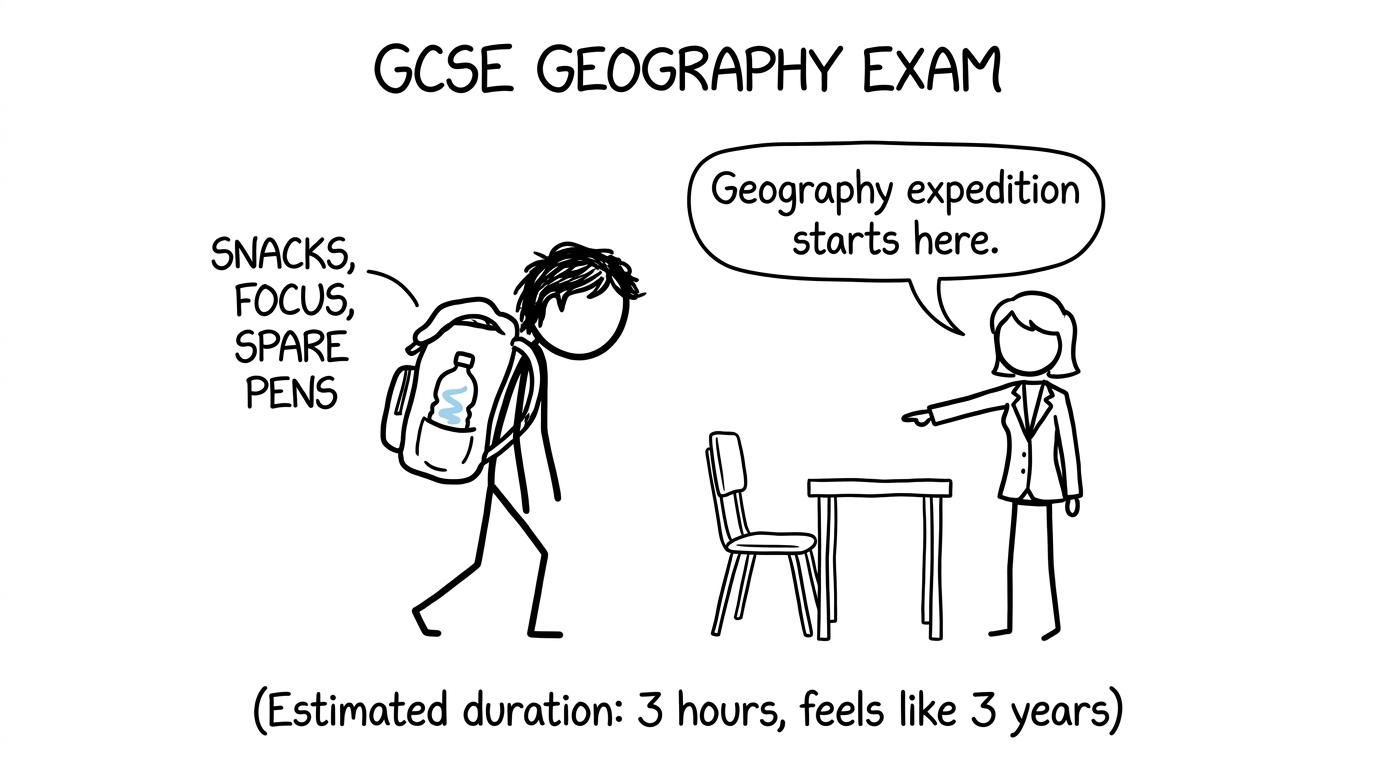 A GCSE student arrives for a geography exam carrying an expedition-sized revision backpack
OCR GCSE Geography
OCR Geography A has the shortest total examination time in this comparison:
- Paper 111: Living in the UK Today: 111 hour;
- Paper 222: The World Around Us: 111 hour;
- Paper 333: Geographical Skills: 111 hour 303030 minutes.
OCR Geography B has three papers lasting 111 hour 303030 minutes each. OCR extended Geography B Papers 111 and 222 by 151515 minutes from June 202620262026, bringing all three to the same duration.
This is precisely why checking the specification code matters. “OCR Geography” alone does not reveal whether you are preparing for a 606060-minute or 909090-minute paper.
Eduqas GCSE Geography
Eduqas Geography A uses three written examinations of 111 hour 303030 minutes, giving 444 hours 303030 minutes overall.
Eduqas Geography B has:
- Component 111: Investigating Geographical Issues: 111 hour 454545 minutes;
- Component 222: Problem Solving Geography: 111 hour 303030 minutes;
- Component 333: Applied Fieldwork Enquiry: 111 hour 303030 minutes.
Its total is therefore 444 hours 454545 minutes. The longer first component includes structured data-response questions and extended writing, so stamina should be part of practice rather than something left for exam day.
How long are you actually sitting in the exam hall?
The official duration begins and ends when the invigilator tells candidates to start and stop. It does not normally include entering the room, finding your seat, listening to notices, completing candidate details or waiting while scripts are collected.
There is no single national amount of extra sitting time because centres organise these stages differently. A sensible planning assumption is that the complete process may occupy roughly 151515 to 303030 minutes beyond the stated paper duration. Follow your school’s instructions rather than treating that estimate as an arrival rule.
For a 909090-minute paper, your exam-day block may therefore feel closer to:
- arrival and waiting;
- approximately 101010 to 202020 minutes of seating and administration;
- 909090 minutes of examination time;
- approximately 555 to 101010 minutes before dismissal.
If you have approved extra time, supervised rest breaks or another access arrangement, your personal session may be longer. Ask your exams officer for your precise arrangements well before the paper.
Plan your energy across the whole session
A long paper is rarely lost through one dramatic mistake. More often, attention leaks away quietly: a rushed resource, a command word missed or ten minutes spent polishing an answer that cannot earn additional marks.
Before the paper
Use your normal routine. Eat something familiar, bring permitted equipment and follow your centre’s rules about water bottles. Arrive at the stated time so that finding the room or checking your seat does not consume the attention you need later.
Avoid attempting a full last-minute content dump. A short check of case-study names, fieldwork methods and command words is more manageable than reopening the entire course.
During the opening minutes
Read the front-cover instructions. Check whether there are optional questions and identify any resource booklet you must use. A beautifully written answer to a question you were not required to attempt is still time taken from the rest of the paper.
You can estimate a broad minutes-per-mark guide using:
minutes per mark=working time in minutesavailable marks. \text{minutes per mark}=\frac{\text{working time in minutes}}{\text{available marks}}. minutes per mark=available marksworking time in minutes.This is a guide, not a rigid law. Resource reading, planning and checking also consume time, while short questions may take less than their proportional allowance.
Through the middle of the exam
Use visible checkpoints. Divide the paper into sections and decide when you should leave each one. If a low-tariff question is consuming too much time, leave space and return later.
The aim is not to feel calm every second. It is to keep making useful decisions even when one question feels unfamiliar.
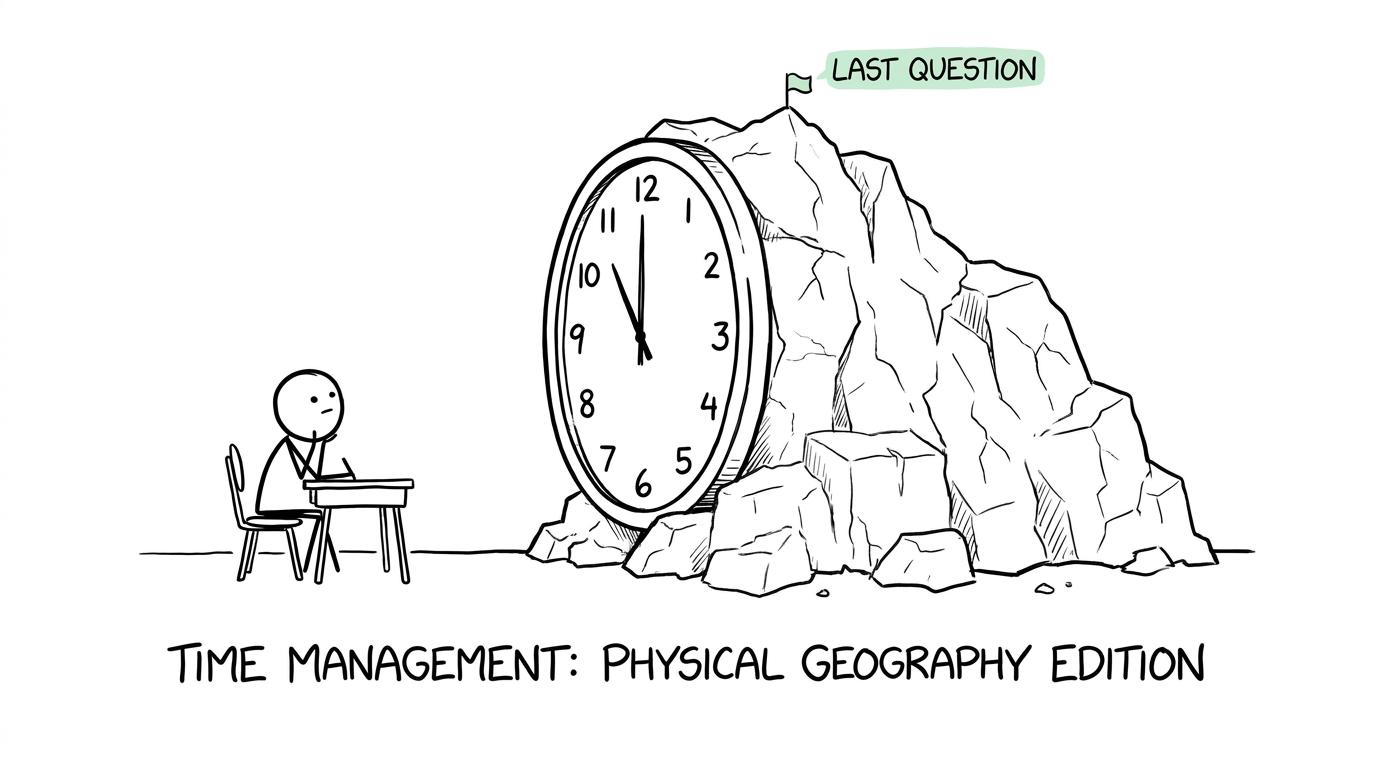 An exam clock moves like a glacier while a student searches for the last geography question
In the final minutes
Checking should be specific. Look for:
- unanswered pages or question parts;
- missed command words;
- evidence from figures, maps or extracts;
- units, scales and calculations;
- extended responses that need a concluding judgement;
- required spelling, punctuation, grammar and specialist terminology where these are assessed.
“Read everything again” is too vague. A short checklist gives your final minutes a job.
Build geography exam stamina without exhausting yourself
You do not need to begin with full papers. Start with one timed section, progress to a longer combination of questions and then complete the whole paper under realistic conditions.
The same approach works across subjects. MathsGenie’s guide to using GCSE past papers properly explains the useful cycle: complete, mark, diagnose, repair and retest. If full papers currently feel overwhelming, the advice on when to start GCSE past papers shows how to build up in phases.
Geography is not maths, but geographical skills still demand numerical accuracy. Scale, percentage change, averages, graphs and data interpretation can all become harder when concentration drops. The free GCSE Maths revision hub can help you repair those underlying skills through revision lessons, questions and short tests.
Common mistakes when planning for geography papers
Using an old exam duration
This is particularly risky for Edexcel and OCR candidates because selected papers changed length from 202620262026. Use a current specification, timetable and paper format.
Revising for the board but not the route
Edexcel A and B, OCR A and B, and Eduqas A and B are not interchangeable labels. Confirm the full specification name and code.
Practising untimed until the real exam
Untimed work develops knowledge, but it does not reveal whether you can interpret resources and organise extended responses for 909090 or 105105105 continuous minutes.
Spending equal time on every question
Question tariffs differ. Let the available marks, command word and complexity guide your time rather than giving every item an identical share.
Treating the finish time as the dismissal time
Scripts must be collected and checked. Do not arrange travel around the exact official finish without allowing for your centre’s procedures.
Make the paper length feel familiar
An exam feels longest when its rhythm is unknown. Once you have sat the correct paper under timed conditions, marked it and repaired the weak sections, the duration becomes less mysterious. It is no longer an abstract block on a timetable. It is a sequence of decisions you have already rehearsed.
Start with the appropriate MathsGenie geography revision page, then use lessons, practice questions, past papers, predicted papers and mark schemes to build knowledge and timing together. For revision across your wider timetable, GCSE predicted papers and resources and the one-month GCSE maths revision plan can help you balance practice without using all your energy on one subject.