GCSE Geography Access Arrangements: Request Guide
GCSE geography access arrangements explained: who to ask, evidence needed, extra time, available support and the approval timeline for UK exams.
The hardest part of an exam should be demonstrating what you know. It should not be reading a crowded resource booklet, writing through pain or racing a clock because of a persistent difficulty.
If you need GCSE geography access arrangements, speak to your school’s SENCo, additional learning needs lead or exams officer as early as possible. Your school or exam centre must identify the appropriate arrangement, gather evidence and make any required application. Students and parents do not normally apply directly to the exam board.
The essential principle is simple: support should remove an access barrier without changing the geographical knowledge, skills or understanding being assessed. Arrangements are individual, evidence-based and usually need to reflect your normal way of working in lessons, tests and mock exams.
Your access arrangements checklist
- Tell your geography teacher and SENCo what makes assessments difficult.
- Explain the effect on your work, rather than requesting a particular arrangement without context.
- Ask which support can be trialled in lessons and internal assessments.
- Attend any assessment arranged by the school.
- Use the agreed support consistently in mock exams.
- Ask the exams officer when the centre will confirm the decision.
- Check the room, equipment, rest-break and timing arrangements before your first paper.
- Tell the school immediately about a new illness, injury or change in your condition.
The process can feel administrative, but its purpose is practical: to work out what lets you show your actual ability.
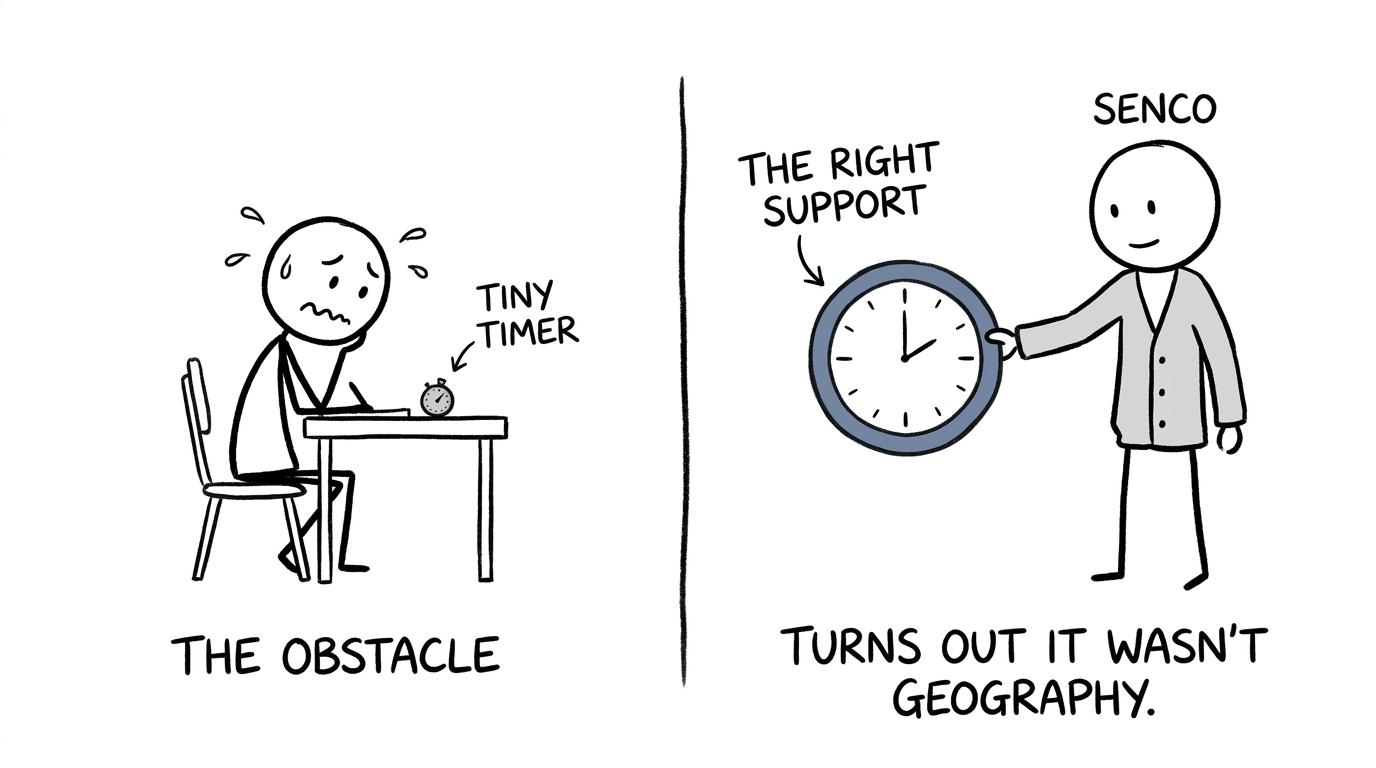 A student discovers that the real obstacle was the exam clock rather than geography
What are GCSE geography access arrangements?
Access arrangements are agreed before an assessment for students with disabilities, special educational needs, learning difficulties or temporary access needs. Depending on the student and the approved evidence, possible arrangements include:
- extra time;
- supervised rest breaks;
- a word processor;
- a reader or computer reader;
- a scribe or speech-recognition technology;
- modified enlarged, Braille or modified-language papers;
- coloured paper or overlays;
- a prompter;
- a practical assistant;
- alternative rooming arrangements.
This is not a menu from which a student simply chooses. The arrangement must respond to an evidenced need and remain compatible with what the assessment is designed to test.
A reasonable adjustment for a disabled student is intended to remove or reduce a substantial disadvantage. It must not lower the standard being assessed or provide an unfair advantage. A diagnosis can be relevant evidence, but it does not automatically produce one particular arrangement. Equally, the evidence required is not identical for every condition or form of support.
The Joint Council for Qualifications, usually called JCQ, publishes the detailed regulations used by centres working with exam boards including AQA, Pearson Edexcel, OCR and Eduqas. The guidance is updated, so your school must use the version applying to your examination series.
Why geography papers need individual consideration
GCSE geography examinations combine several kinds of work. Depending on the specification and paper, you may need to read extended sources, interpret maps and photographs, analyse tables and graphs, perform calculations, select evidence and construct longer evaluative answers.
A student may therefore experience different barriers within the same paper. A visual impairment could affect access to maps and diagrams. A physical condition might make sustained handwriting difficult. A learning difficulty could significantly affect reading speed, while a medical condition might make continuous working unrealistic.
This is why the discussion should begin with the barrier, not with the phrase “extra time”. A reader, modified paper, rest breaks or assistive technology may be more appropriate in some circumstances. The school must also consider whether assistance would interfere with a skill that the question itself is assessing. Support can provide access to the material, but it cannot interpret geographical evidence or construct the answer for you.
The same principle matters in maths. A tool may remove a barrier, but you still need to demonstrate the method. Students preparing for both subjects can use the GCSE Maths revision hub to practise reading data, working with scale, interpreting graphs and managing written exam papers.
How to request access arrangements
Start with the right person
Tell a trusted teacher what is happening, then ask to speak to the SENCo or equivalent member of staff. The exams officer usually manages exam administration, while the SENCo coordinates evidence of need and any specialist assessment.
Describe specific effects. For example, explain whether you struggle to sustain writing, lose your place in dense sources, need breaks because of pain or fatigue, or cannot access standard-size diagrams. Concrete information helps the school investigate the right support.
If you are a private candidate, contact potential exam centres well in advance. Confirm that the centre accepts private candidates who need access arrangements and ask about its evidence requirements, assessment process, fees and internal deadlines before making an entry.
Let the centre build a picture of need
The school may consider teacher observations, classroom support, internal tests, mock scripts, existing plans and relevant reports. For some applications, an appropriately qualified assessor must complete a specialist assessment. Medical, sensory, physical or social, emotional and mental health needs may require different supporting information.
For applications involving 25%25\%25% extra time, current JCQ processes place considerable importance on centre-based evidence. This can include relevant mock or internal assessment scripts showing that extra time was available and used, together with focused observations from teaching staff.
Your job is not to assemble the formal application alone. It is to participate honestly, use trial arrangements properly and explain whether they remove the barrier.
Trial the arrangement in normal work
“Normal way of working” is central to the process. In practice, this means the arrangement should generally reflect the support you ordinarily use where appropriate in lessons, timed assessments and mock exams. An exam-only preference is not the same as established need.
A trial is also useful for you. Extra time can lengthen an already demanding examination. Supervised rest breaks stop the clock but interrupt your flow. A word processor helps some students but can slow others who are not used to typing answers under pressure. The purpose of a trial is to discover what genuinely works.
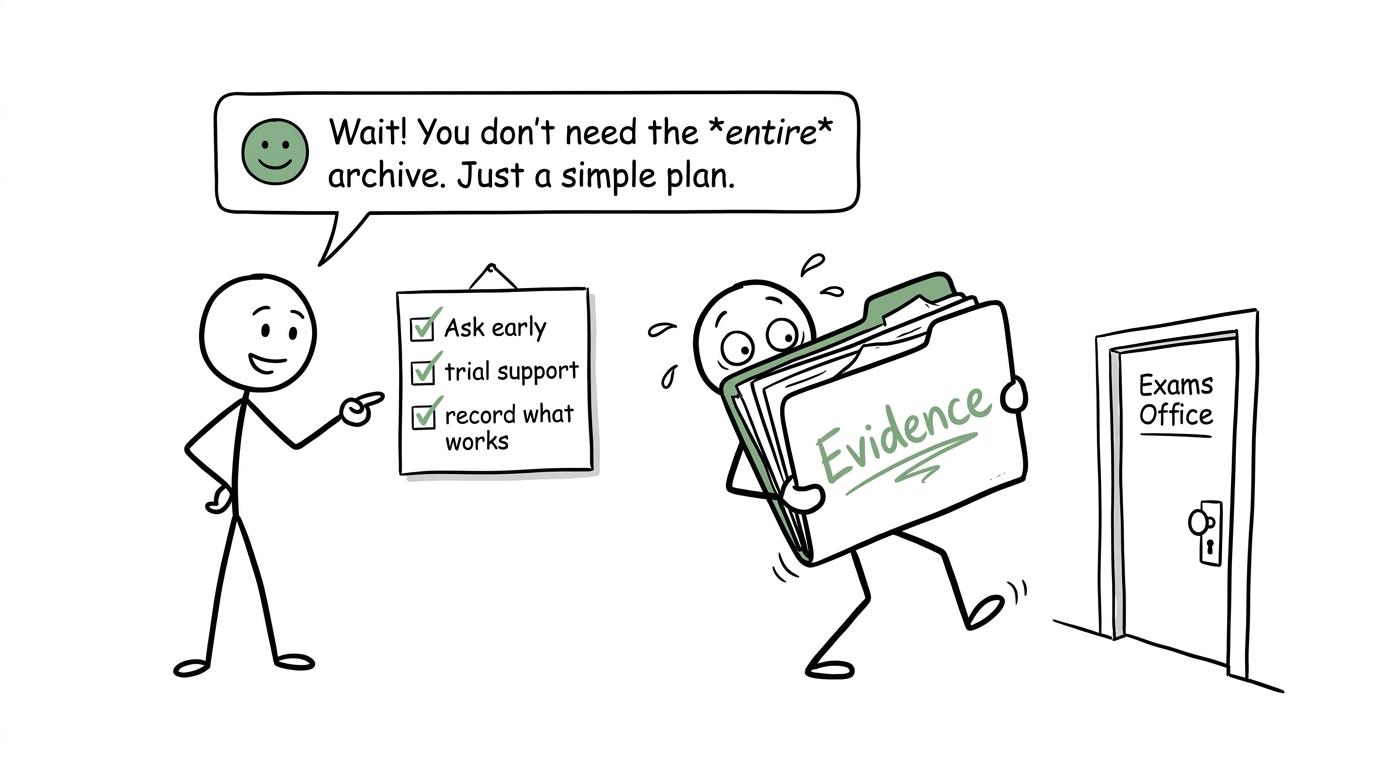 A student learns that requesting support needs a short checklist rather than a mountain of paperwork
Wait for the centre to process and confirm it
Some arrangements must be processed through Access Arrangements Online, the system used by centres for participating awarding bodies. Other arrangements are delegated to the centre and do not need the same online approval, although the centre must still establish need and retain the required records.
Ask for confirmation rather than assuming a conversation has completed the process. Find out:
- which arrangements have been agreed;
- which subjects and assessments they cover;
- whether you will work in another room;
- how rest breaks or extra time will be managed;
- which equipment or software you may use;
- what to do if the arrangement is missing on exam day.
How extended time works in GCSE geography
The most familiar arrangement is 25%25\%25% extra time, but it is not automatic for a diagnosis and it is not the right response to every difficulty. The centre must demonstrate why the candidate needs it and how it reflects their normal way of working.
Where approved, the additional time is added to the examination’s standard duration. Your exams team should tell you the precise finishing time and explain how warnings will be given. You are not required to use every additional minute, but timed practice can help you use the allowance deliberately.
In geography, that might mean protecting enough time to read resource material carefully, plan extended responses, check calculations and return to maps or data. Extra time is most useful when it is attached to a plan, rather than treated as an invitation to write continuously for longer.
Supervised rest breaks work differently. During an authorised break, you normally stop working and remain supervised; the permitted break time is not taken from your working time. The centre decides the practical details in line with the applicable rules. Rest breaks may be appropriate where concentration, fatigue, pain or another condition makes continuous working difficult.
Practise whichever arrangement you receive. Maths students can build controlled exam stamina with GCSE mini tests, then progress to board-matched papers. If you take Pearson Edexcel, the Edexcel GCSE Maths revision centre and Edexcel past papers with mark schemes make it easier to rehearse under the correct conditions.
When should you ask?
Ask as soon as a persistent barrier becomes apparent. Year 101010 is not too early, and waiting until the final weeks of Year 111111 can leave too little time for assessment, trials, evidence and processing.
For the June 2026 series, JCQ’s published final deadlines were 31 January 2026 for ordering modified papers and 21 March 2026 for processing other online access-arrangement applications. These dates illustrate why schools work months ahead. Deadlines for later series must be checked against the current JCQ regulations, and your school may set a much earlier internal deadline.
Modified papers need especially early attention because they must be ordered for the relevant component. If you may need Braille, modified enlarged or modified-language materials, raise this at the beginning of the course where possible.
A new injury, illness or unexpected change after a deadline should still be reported immediately. Centres can respond to temporary needs, but the available solution will depend on the circumstances, evidence, timing and awarding-body rules. Do not wait until the morning of the examination.
Keep revision and access planning connected
An approved arrangement removes a barrier; it does not replace subject preparation. Practise under the conditions you expect to receive so that the room, timing and equipment feel ordinary by exam day.
For maths, use a short cycle:
- learn or revisit one weak topic;
- answer practice questions;
- mark them carefully;
- record the precise error;
- retest the skill;
- move into timed papers.
The GCSE one-month revision plan provides a manageable structure, while the guide to starting GCSE past papers explains how to build stamina gradually. Near the examination, use the GCSE exam-week checklist to confirm both your revision and practical arrangements.
Common mistakes when requesting support
Waiting for the school to notice
Teachers may see that you are struggling without knowing why. Explain the barrier clearly and ask what happens next.
Assuming a diagnosis guarantees extra time
Access arrangements are based on the impact of a difficulty, the evidence required by the regulations and the appropriateness of the proposed support. One diagnosis does not affect every student in the same way.
Using support only in the final exam
If an arrangement is meant to reflect your normal way of working, it should be trialled and used in relevant internal assessments. Regular use also teaches you how to benefit from it.
Missing the centre’s internal deadline
The official JCQ deadline is not necessarily your personal deadline. Schools need time beforehand to assess, gather evidence, order papers and process applications.
Confusing access arrangements with special consideration
Access arrangements are normally planned before an assessment so you can access it. Special consideration concerns a temporary illness, injury or adverse event affecting performance around the time of an assessment. Tell the exams officer promptly if something unexpected occurs.
Forgetting to check the practical details
Approval is only part of the story. Before the first paper, confirm your room, start and finish times, equipment, break procedure and who to contact if something is wrong.
Ask early, then make the support familiar
Requesting GCSE geography access arrangements is not about finding an easier examination. It is about removing an evidenced barrier so that the paper measures your geography rather than the effect of that barrier.
Speak to your SENCo or exams officer now, allow time for assessment and trials, and ask for written confirmation before the examination series. Then rehearse calmly under the agreed conditions.
For the maths papers alongside geography, make MathsGenie’s free GCSE revision resources your next step. Combine revision lessons and practice questions with mini tests, past papers, predicted papers, mark schemes and video solutions. The right arrangement gives you access to the paper; consistent practice helps you turn that access into marks.