GCSE Further Maths Part-Time Job Balance Guide
GCSE Further Maths part-time job balance made practical: plan revision around shifts, protect sleep and use short sessions to keep both commitments steady.
A shift can look harmless when it first appears on the rota. Then travel, getting changed and recovering afterwards consume the evening around it. Suddenly, Further Maths is competing with work, ordinary GCSE revision and sleep.
A realistic GCSE Further Maths part-time job balance starts by accepting one fact: shift days and non-shift days cannot carry the same workload. Use short maintenance sessions around work, protect longer sessions for days off, and agree reduced availability before mocks and examinations. The aim is not to fit revision into every spare minute. It is to give each commitment a clear place so neither quietly takes over.
Your quick balance checklist
- Put school, shifts, travel and sleep into your calendar first.
- Confirm your exact Further Maths qualification and specification.
- Set a small revision minimum for difficult days.
- Schedule demanding new content when your attention is strongest.
- Use shift days for retrieval, marking and short question sets.
- Complete one longer exam-practice session each week.
- Review the rota weekly rather than trusting a fixed timetable.
- Speak early if work begins affecting attendance, health or education.
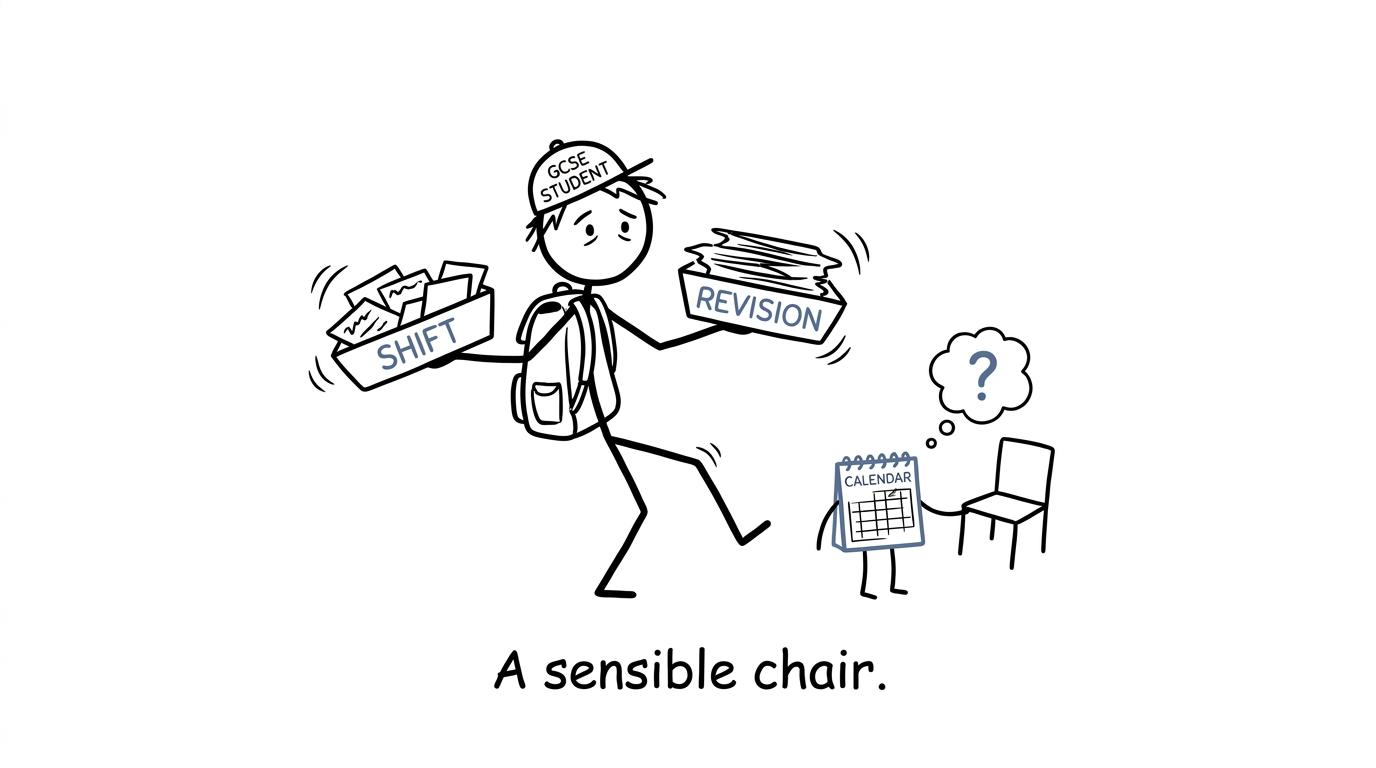 A student balancing work and revision while a calendar offers help
Start with the qualification you are actually taking
Schools often use “GCSE Further Maths” as a convenient label, but the precise qualification may differ. For example, AQA offers an untiered Level 2 Certificate in Further Mathematics, graded on the grades 999-111 scale. Its current specification includes number, algebra, coordinate geometry, calculus, matrix transformations and geometry. Assessment consists of two equally weighted papers: one non-calculator paper and one calculator paper.
Other schools may offer a different Level 2 qualification. Do not build your plan from somebody else’s online checklist until you have checked the qualification title, exam board and specification with your teacher.
If you take AQA, begin with the AQA Further Maths revision hub. Keep your main GCSE knowledge secure through the broader GCSE Maths revision area, because much of Further Maths extends familiar higher-tier algebra, graphs, geometry and trigonometry.
This distinction matters when time is scarce. Revising content that is not on your specification is not harmless extra effort. It displaces something you genuinely need.
Build the week around energy, not empty spaces
A calendar shows when you are free. It does not show when you can think clearly.
A student may technically have an hour after a busy evening shift, but that does not make it a sensible time to learn differentiation or matrix transformations. Meanwhile, a quiet half-hour before a weekend shift might be highly productive. Good planning therefore matches the task to your likely energy.
Divide revision into three types
Deep sessions are for unfamiliar ideas, connected algebraic reasoning and difficult multi-step questions. Place these on non-shift days where possible. A block of roughly 454545-606060 minutes is usually easier to use well than an ambitious evening marathon.
Practice sessions are for strengthening a method you already understand. These can fit into 202020-303030 minutes before work or earlier in the day.
Maintenance sessions keep knowledge active. Use 101010-151515 minutes for recalling key facts, marking yesterday’s questions, reviewing an error log or reattempting one difficult question.
This gives you a flexible rule: deep work needs your best energy, but maintenance can preserve momentum on crowded days.
Calculate your real capacity
Before assigning topics, count the time already committed:
usable revision time=available time−schoolwork−shifts−travel−essential rest.\text{usable revision time}=\text{available time}-\text{schoolwork}-\text{shifts}-\text{travel}-\text{essential rest}.usable revision time=available time−schoolwork−shifts−travel−essential rest.Treat the result as a ceiling, not a target. Leave some capacity unallocated for delayed buses, extra homework, family commitments and rota changes. A timetable filled to 100%100\%100% works only when life behaves perfectly. Life rarely does.
The GCSE maths revision timetable guide can help you turn this capacity into repeatable weekly sessions.
Create a minimum that survives shift work
Many revision plans fail because they describe an ideal day. You need a plan for an ordinary Tuesday when school was tiring and work ran late.
Choose a minimum session small enough to complete consistently. It might contain:
- one previously attempted question;
- a short set on one named skill;
- marking and correcting an existing set;
- a mini test followed by one error note.
A minimum is not the full ambition. It is the floor that stops a busy week becoming a lost week.
On a non-shift day, expand the session: use a revision lesson, complete targeted practice questions and mark the work immediately. On a shift day, complete only the maintenance task if that is all your energy allows. This is not lowering your standards. It is designing a routine that remains usable under pressure.
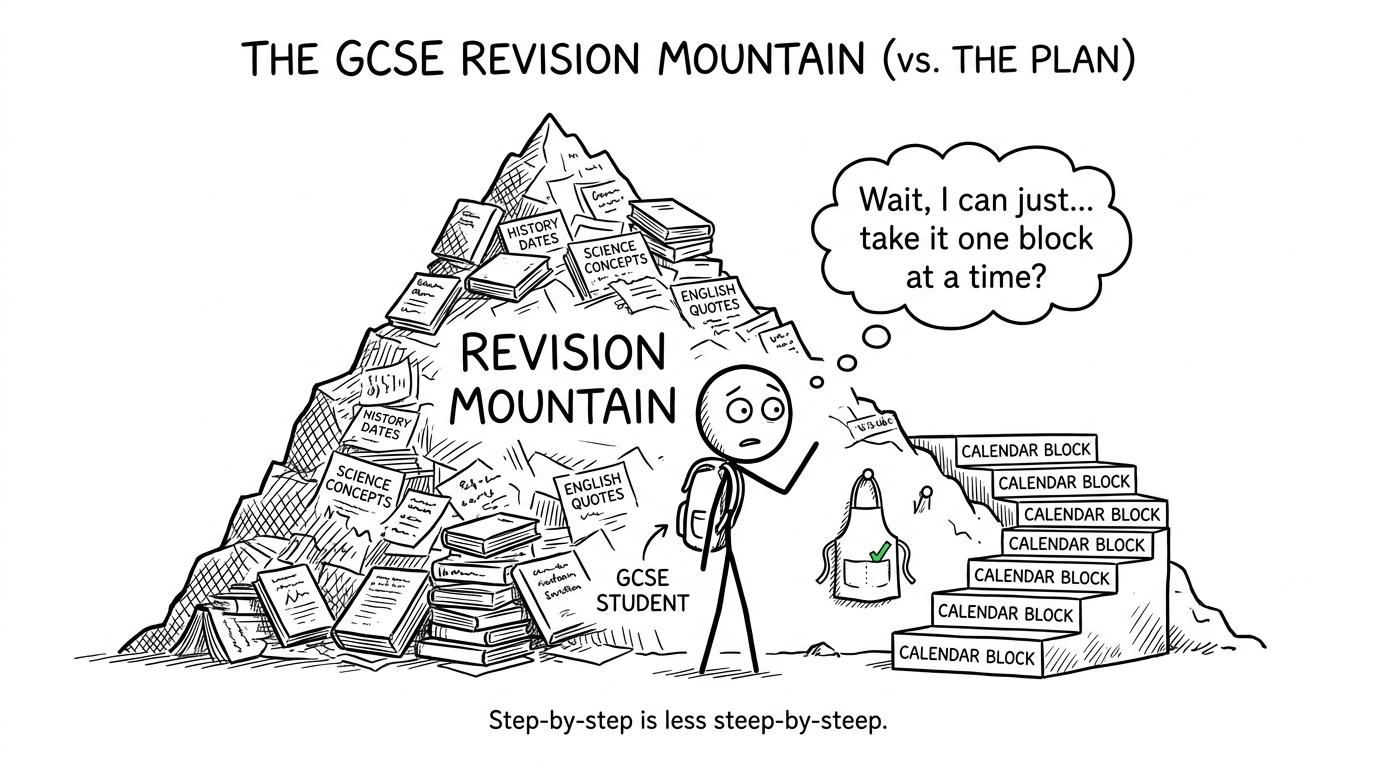 A revision mountain becoming a manageable staircase of calendar blocks
Prioritise Further Maths without neglecting GCSE Maths
Further Maths can feel more interesting because it is newer. That can tempt students to spend an entire evening on calculus while ordinary GCSE weaknesses remain untouched.
A better priority order is:
- urgent school deadlines;
- weak core GCSE Maths knowledge;
- current Further Maths teaching;
- older Further Maths topics that need retrieval;
- timed paper practice.
This order is not permanent. Near a Further Maths assessment, the balance should change. The principle is that revision time follows evidence rather than mood.
Keep a short “marks leak” list. After each question set or paper, record:
- the topic;
- why the mark was lost;
- the next action;
- when you will reattempt it.
Separate a knowledge gap from an execution error. If you cannot start a question, return to the lesson. If your method is sound but your algebra becomes untidy, practise a smaller set slowly. If you run out of time, use a timed section rather than relearning content you already understand.
For a broader diagnostic routine, follow the guide to using GCSE past papers properly.
Use the right task before and after a shift
Revision around work becomes easier when you stop making decisions at the last moment.
Before a shift
If you have reasonable energy, use a short question-based session. Pick one narrow target and stop at the planned time. Beginning a large paper shortly before leaving often creates unnecessary frustration.
After a shift
Choose low-friction tasks: mark completed work, watch a short video solution, organise your error log or prepare tomorrow’s questions. If you are exhausted, stop. Cutting sleep to preserve a perfect revision streak usually makes the following school day harder.
On a day off
Complete the week’s deep session or timed assessment. Use MathsGenie’s past-paper tools to practise under controlled conditions and compare your attempt with the mark scheme. A full paper is valuable, but a carefully marked section is better than a rushed paper that teaches you nothing.
Plan for changing rotas and examination season
A part-time job may not provide the same hours every week, so your plan needs two layers.
The first is a stable weekly rhythm: perhaps two deep sessions, two maintenance sessions and one timed section. The second is a short review when the rota arrives. Move sessions; do not simply delete them.
Look several weeks ahead for mocks, coursework deadlines and examination dates. Ask your employer about reduced availability early. Requests made before a rota is prepared are easier to discuss than cancellations made afterwards. You do not need to promise that work will never be affected. You need a clear, timely conversation about when school must take priority.
In England, children under school-leaving age are subject to restrictions on the times and hours they may work. During term time, the general maximum is 121212 hours per week, with additional daily limits; local by-laws and permit requirements can also apply. Rules differ according to age, school-leaving status and UK nation, so check your local authority’s current guidance and speak to a parent, carer, school or employer if anything seems unclear. Work should not harm your health, wellbeing or education.
If your manager repeatedly schedules hours that appear unsuitable, or work is affecting attendance and learning, do not try to solve it silently through later nights.
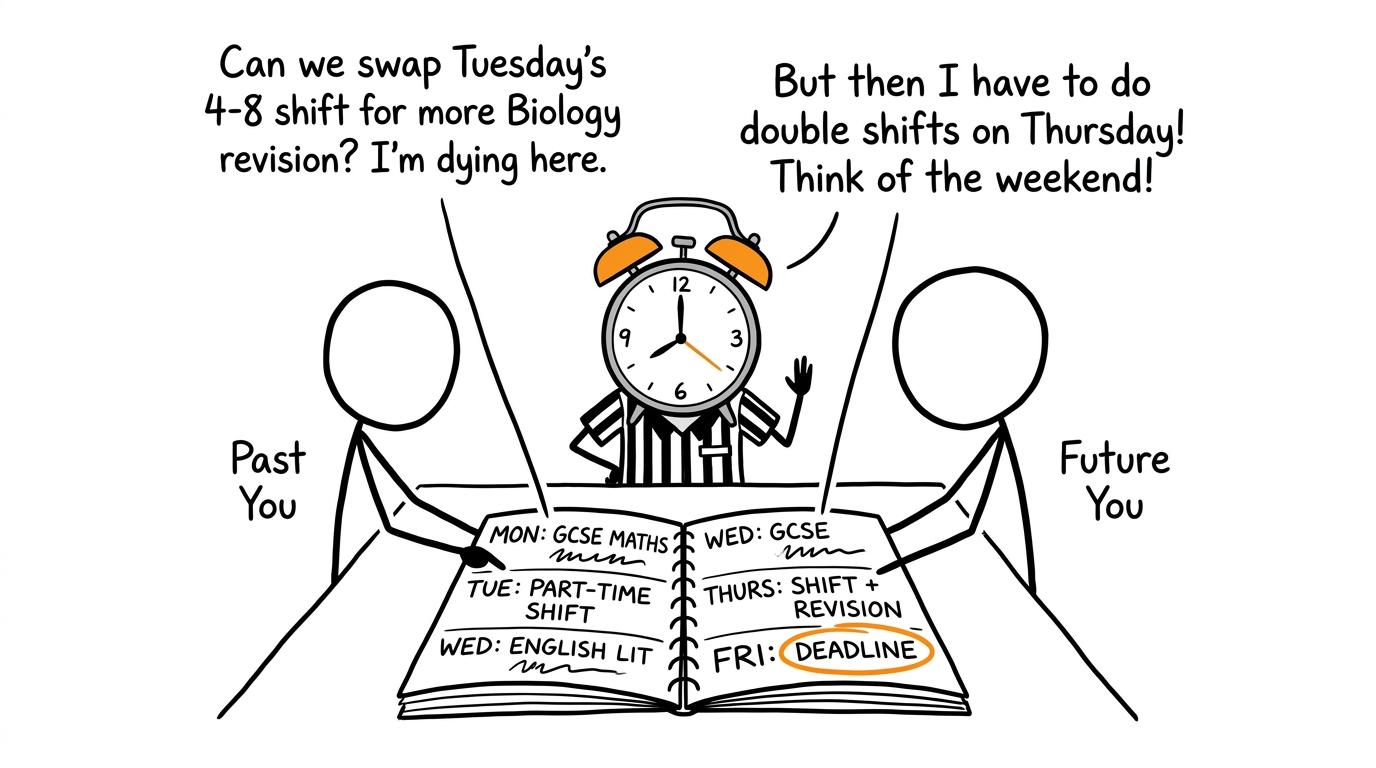 Past You and Future You negotiating over a weekly planner
Turn every session into evidence
Busy students cannot afford revision that merely feels productive. Reading notes and highlighting examples may create familiarity, but examination questions require you to produce a method independently.
Use a simple loop:
- learn or review one method;
- answer questions without copying;
- mark them promptly;
- record the precise error;
- reattempt the question later;
- test the skill in mixed practice.
Mark schemes matter because they reveal where valid reasoning earns marks. Video solutions help when a short written scheme does not explain how one line follows from another. Mini tests are useful on work-heavy weeks because they provide a defined finish line.
As examinations approach, add unseen practice. Predicted papers can provide fresh questions, but they are not forecasts to trust blindly and should not replace specification coverage or real past papers. MathsGenie’s Edexcel GCSE predicted papers can support your core GCSE preparation, while Further Maths practice should match your exact qualification.
Common mistakes when balancing work and revision
Treating every evening as identical
A free evening and a post-shift evening may contain the same clock time but not the same attention. Assign different task types to each.
Scheduling only full papers
Full papers build stamina, but they are difficult to fit around shifts. Use topic questions, mini tests and timed sections between full-paper attempts.
Revising only favourite topics
Comfortable algebra can become an escape from weaker geometry, functions or matrices. Let marked work choose the next topic.
Delaying conversations with an employer
Waiting until examination week makes the problem harder. Share important dates and availability changes as early as possible.
Sacrificing sleep after late shifts
A timetable is not successful if it leaves you unable to concentrate at school. Move the session, shorten it or use your minimum task.
Counting completion instead of correction
Finishing questions is only half the process. The improvement often comes from marking, diagnosing and reattempting them.
Make the balance sustainable
The goal is not a heroic timetable. It is a week you can repeat.
Put shifts and travel in first. Protect sleep. Give difficult Further Maths content your best available attention, and use small maintenance tasks when work has taken most of the day. Review your rota weekly, act on marked evidence and discuss examination availability before it becomes urgent.
MathsGenie keeps that system in one free place. Start with the AQA Further Maths revision hub, then use revision lessons and practice questions to repair gaps. Build speed with mini tests, learn from mark schemes and video solutions, and use past papers or predicted papers when you are ready for timed practice. If the examinations are approaching, the one-month GCSE revision plan can help you organise the final stretch.
Your next step is small: check your rota, choose one weak topic and book one realistic session. A sustainable plan does not ask work or Further Maths to disappear. It ensures both know their place.