GCSE Further Maths Exam Length: Real Sitting Time
GCSE further maths exam length explained by exam board, with paper timings, calculator rules and a practical exam-day plan to manage energy, pace and focus.
The strange thing about a long maths exam is that time rarely feels consistent. The opening minutes can disappear while you settle your nerves; the middle may feel steady; the final ten can vanish almost instantly. Knowing the GCSE further maths exam length removes one uncertainty before you enter the hall.
For the widely taken AQA Level 2 Certificate in Further Mathematics, you sit two papers of 111 hour 454545 minutes each. Paper 111 is non-calculator and Paper 222 allows a calculator, giving a total assessed time of:
2×105=210 minutes=3 hours 30 minutes2 \times 105 = 210\text{ minutes} = 3\text{ hours }30\text{ minutes}2×105=210 minutes=3 hours 30 minutesThat is the short answer. But “GCSE Further Maths” is also used informally for several different qualifications, so your exact sitting time depends on the exam board and course named on your entry.
Exam length at a glance
For the current assessment arrangements, the main qualifications commonly described as GCSE Further Maths or Additional Maths have these timings:
| Qualification | Papers | Time per paper | Total exam time |
|---|---|---|---|
| AQA Level 222 Certificate in Further Mathematics | 222 | 111 hour 454545 minutes | 333 hours 303030 minutes |
| Pearson Edexcel Level 222 Extended Mathematics Certificate | 222 | 111 hour 151515 minutes | 222 hours 303030 minutes |
| OCR Level 333 FSMQ Additional Mathematics | 111 | 222 hours | 222 hours |
| Eduqas Level 222 Certificate in Additional Mathematics, current legacy assessment | 111 | 222 hours 303030 minutes | 222 hours 303030 minutes |
A useful checklist before planning your revision is:
- confirm the qualification’s exact name and exam board;
- check how many papers you sit;
- identify which papers permit a calculator;
- practise using the official duration rather than a generic GCSE timer;
- check your school’s examination timetable for dates, sessions and arrival instructions.
This matters because AQA Further Mathematics, OCR Additional Mathematics and Edexcel Extended Mathematics are not interchangeable names for one national paper. They have different assessment structures and, in OCR’s case, a different qualification level.
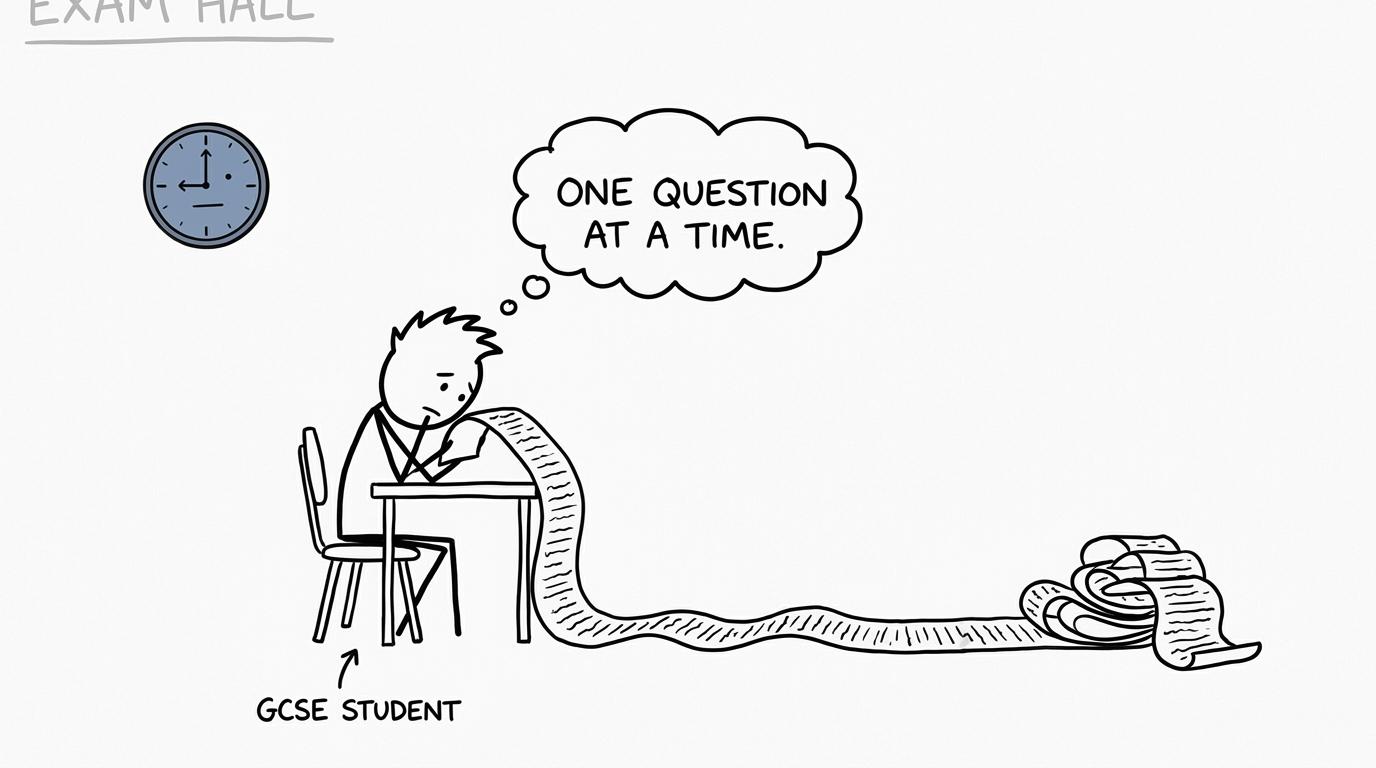 A student calmly facing a comically long exam paper one question at a time
AQA GCSE Further Maths exam length
Most students using this search phrase mean AQA’s Level 222 Certificate in Further Mathematics. Although it is often called “GCSE Further Maths” in schools, its official title is not GCSE Mathematics.
The assessment consists of:
- Paper 111: 111 hour 454545 minutes, 808080 marks, non-calculator;
- Paper 222: 111 hour 454545 minutes, 808080 marks, calculator allowed;
- weighting: each paper contributes 50%50\%50% of the qualification.
Both papers can assess content from across the specification. Paper 111 is not simply an easier algebra paper, and Paper 222 is not automatically more difficult because a calculator is available.
You can become familiar with the format using AQA GCSE Further Maths past papers. The page brings together papers, mark schemes and worked solutions where available, making it easier to practise the correct paper rather than an approximate substitute.
What 111 hour 454545 minutes feels like
A duration of 105105105 minutes is long enough to reward patience but short enough that one stubborn question can disrupt your rhythm. A sensible personal structure is:
| Stage | Approximate time | Purpose |
|---|---|---|
| Settle and begin | First 555 minutes | Read instructions and establish a calm working rhythm |
| Main pass | Next 707070 minutes | Complete questions you can progress through reliably |
| Return pass | Next 202020 minutes | Revisit questions you skipped or only partly completed |
| Final check | Last 101010 minutes | Check signs, notation, calculator entries and unanswered parts |
This is not an exam-board rule. It is a pacing framework to test during practice. If your natural speed differs, adjust it using evidence from marked papers.
AQA gives 808080 marks in 105105105 minutes, so the average time available per mark is:
10580=1.3125 minutes per mark\frac{105}{80} = 1.3125\text{ minutes per mark}80105=1.3125 minutes per markThat average is a guide, not a command. Some short questions should take much less time, leaving room for longer problems that require several connected steps.
How other Further Maths qualifications compare
Pearson Edexcel Level 222 Extended Mathematics
Pearson Edexcel’s Level 222 Extended Mathematics Certificate has two externally examined papers. Each lasts 111 hour 151515 minutes and carries 606060 marks. Paper 111 is non-calculator, while Paper 222 permits a calculator.
The average pace is therefore:
7560=1.25 minutes per mark\frac{75}{60} = 1.25\text{ minutes per mark}6075=1.25 minutes per markThe qualification was first assessed in the May/June 202520252025 series. If your school says you are taking “Edexcel Further Maths”, check whether this is the precise qualification name on your timetable.
OCR FSMQ Additional Mathematics
OCR’s Additional Mathematics course is a Level 333 Free Standing Mathematics Qualification, rather than a GCSE or Level 222 certificate. It is assessed through one calculator paper lasting 222 hours, worth 100100100 marks.
Its average pace is:
120100=1.2 minutes per mark\frac{120}{100} = 1.2\text{ minutes per mark}100120=1.2 minutes per markThe single-paper structure changes the stamina challenge. There is no second paper in which to recover from an unsettled performance, but there is also only one examination sitting to prepare for.
Eduqas Level 222 Additional Mathematics
Under the legacy Eduqas assessment used in 202620262026, students sit one calculator paper lasting 222 hours 303030 minutes and worth 100100100 marks. That is the longest uninterrupted sitting in this comparison.
Eduqas is moving to a new unit-based WJEC Level 222 Additional Mathematics specification for teaching from 202620262026 and award from 202720272027. Under that structure, students complete two mandatory units and one optional unit, with each examination lasting 505050 minutes. Students affected by the transition should follow their school’s entry information rather than assuming the legacy format applies.
Your real exam-day time commitment
The printed paper duration is not the whole morning or afternoon. You may need to arrive early, find your seat, listen to instructions and wait while materials are checked. The exact arrangements depend on your centre, so follow the arrival time given by your school.
The official duration begins when the examination is started. Unless your centre tells you otherwise, do not assume that a separate reading period will be added. Reading the instructions, checking the paper and deciding where to begin all use part of your permitted time.
Your practical commitment therefore has three parts:
- before the paper: travel, arrival, registration and settling;
- during the paper: the complete official duration without a normal break;
- after the paper: collection of scripts and dismissal by the invigilator.
If you have an approved access arrangement, such as extra time or supervised rest breaks, your personal timetable may be different. Confirm it with your school’s examinations officer before exam day.
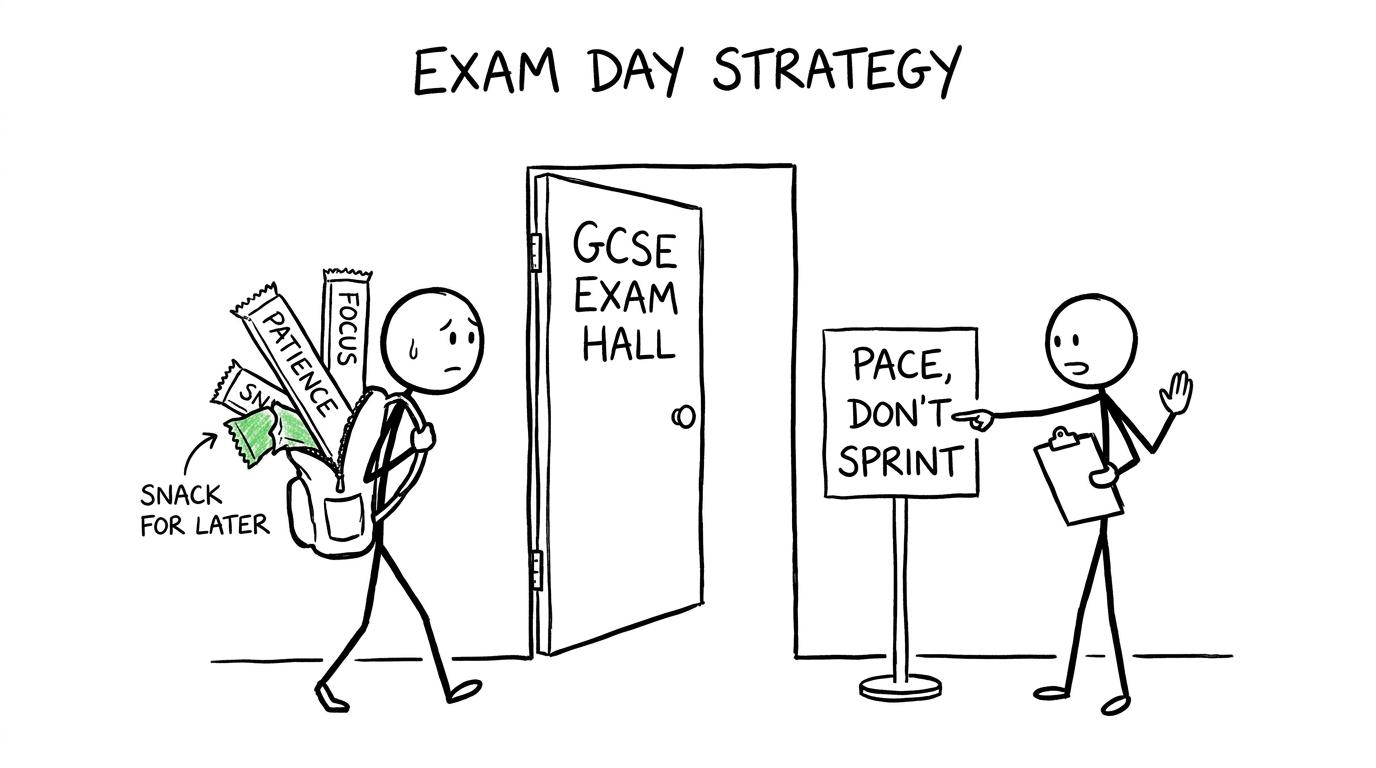 A student carrying focus and patience into an exam hall
How to plan energy across the paper
Long exams are not won by concentrating at maximum intensity from the first second. A sprint feels productive until it leaves you rereading the same line halfway through.
Start deliberately. Write clearly, show algebraic stages and avoid spending excessive time making early answers look perfect. If you cannot make meaningful progress, leave enough working space, mark the question and return later.
During the middle section, use visible checkpoints. For an AQA paper, you might compare your position when 454545, 757575 and 959595 minutes have passed. Do not demand that a particular question number must be reached, because paper difficulty is uneven. Instead ask whether your remaining marks and remaining time still look balanced.
Protect the final minutes. Checking is most valuable when it is specific:
- look for omitted question parts;
- check negative signs and inequality symbols;
- confirm that exact values have not been replaced unnecessarily by rounded decimals;
- check that sketches and coordinates are labelled;
- on calculator papers, reconsider entries that produced implausible answers.
Train for the sitting, not just the syllabus
Knowing every method is different from retrieving those methods after 909090 minutes of concentrated work. Stamina must be practised gradually.
Begin with topic work through the GCSE Maths revision hub, particularly where Further Maths depends on secure higher-tier algebra, graphs and trigonometry. Use GCSE mini tests for short, timed checks before moving to complete Further Maths papers.
Then practise the real duration. Sit an appropriate paper without notes or interruptions and use only the equipment permitted. Afterwards, mark it carefully. The guide to using GCSE past papers properly explains how to turn each lost mark into a revision action rather than merely recording a score.
Your ordinary GCSE Mathematics preparation still matters. The AQA GCSE Maths past-paper collection can strengthen the higher-tier fluency that Further Maths expects you to use confidently. A realistic GCSE maths revision timetable can help you balance this work with your other subjects.
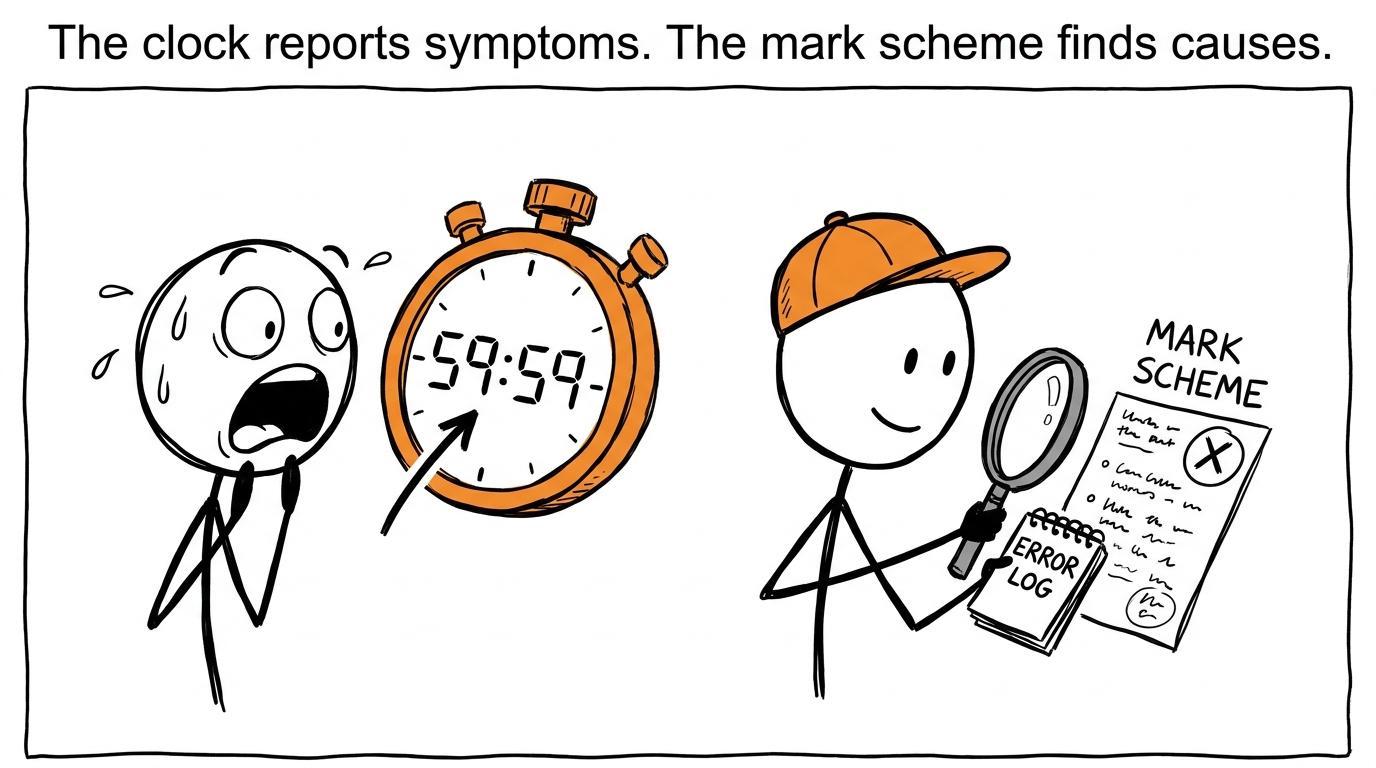 One student watches the clock while another investigates mistakes with a mark scheme
Common mistakes when preparing for the exam length
Practising with the wrong board’s timing
A generic 909090-minute session does not fully prepare you for an AQA paper lasting 105105105 minutes or a single Eduqas sitting lasting 150150150 minutes. Match your timer to the qualification printed on your entry.
Treating average time per mark as a rigid limit
Marks are not evenly distributed by difficulty. Use the average to notice serious overinvestment, not to abandon a productive multi-step solution at an arbitrary second.
Completing papers without reviewing them
A timed paper measures your current performance. Improvement happens when you use the mark scheme, identify why marks were lost and practise the weak skill again. Timing data alone cannot tell you whether the cause was knowledge, accuracy or decision-making.
Forgetting the calculator split
AQA and Edexcel both include a non-calculator paper. Practising every question with a calculator can hide weaknesses in arithmetic, exact values and algebraic manipulation.
Saving stamina practice until the final week
Full papers feel less intimidating when you build towards them. Use short question sets, then half papers, then complete sittings. The aim is familiarity, not exhaustion.
Make the clock feel familiar
The clock becomes threatening when it represents an unknown. Once you have completed several correctly timed papers, it becomes information: a signal to continue, move on or return.
Start with the AQA Further Maths paper collection if that is your qualification. Use MathsGenie’s free revision lessons and practice questions to repair weak topics, then return to past papers with mark schemes and video solutions. Mini tests can sharpen retrieval between longer sessions, while the revision planner helps fit Further Maths around the rest of your GCSE timetable.
Predicted papers can add fresh exam-style practice when they match your course, but they should complement rather than replace official papers. And if Further Maths is preparing you for the next stage, the free A Level Maths revision hub is ready when you are.
You cannot make the examination shorter. You can make it feel known, one paper, one checkpoint and one carefully earned mark at a time.