GCSE Further Maths at a Different Exam Centre
GCSE Further Maths different exam centre options explained, including private entries, fees, deadlines, access arrangements and practical revision advice.
A school timetable can quietly decide which qualifications seem available to you. If Further Maths is missing from the options list, it is easy to assume the decision has already been made. It has not.
You can usually arrange to sit GCSE Further Maths at a different exam centre, provided an approved centre agrees to enter you as a private candidate. The exam board will not accept an entry directly from you, so the centre must complete the official entry. You will normally pay its examination and administration fees yourself.
The important part is to identify the exact qualification, find a suitable centre early and make sure your school and the external centre know about all your examination entries.
The short answer and your checklist
If your school does not offer GCSE Further Maths, follow this route:
- Ask your school whether it would make an exam-only entry for you.
- Confirm the exact qualification, exam board and specification code.
- Check that the qualification is available to private candidates.
- Find an approved centre willing to accept you.
- Ask about fees, internal deadlines and identification requirements.
- Tell the centre about your other GCSE entries and possible timetable clashes.
- Discuss access arrangements when you first enquire, not shortly before the exam.
- Check your statement of entry carefully.
- Prepare with specification-matched lessons, questions and past papers.
The process is administrative rather than mathematical. Still, it rewards the same habit that helps in algebra: define the problem precisely before trying to solve it.
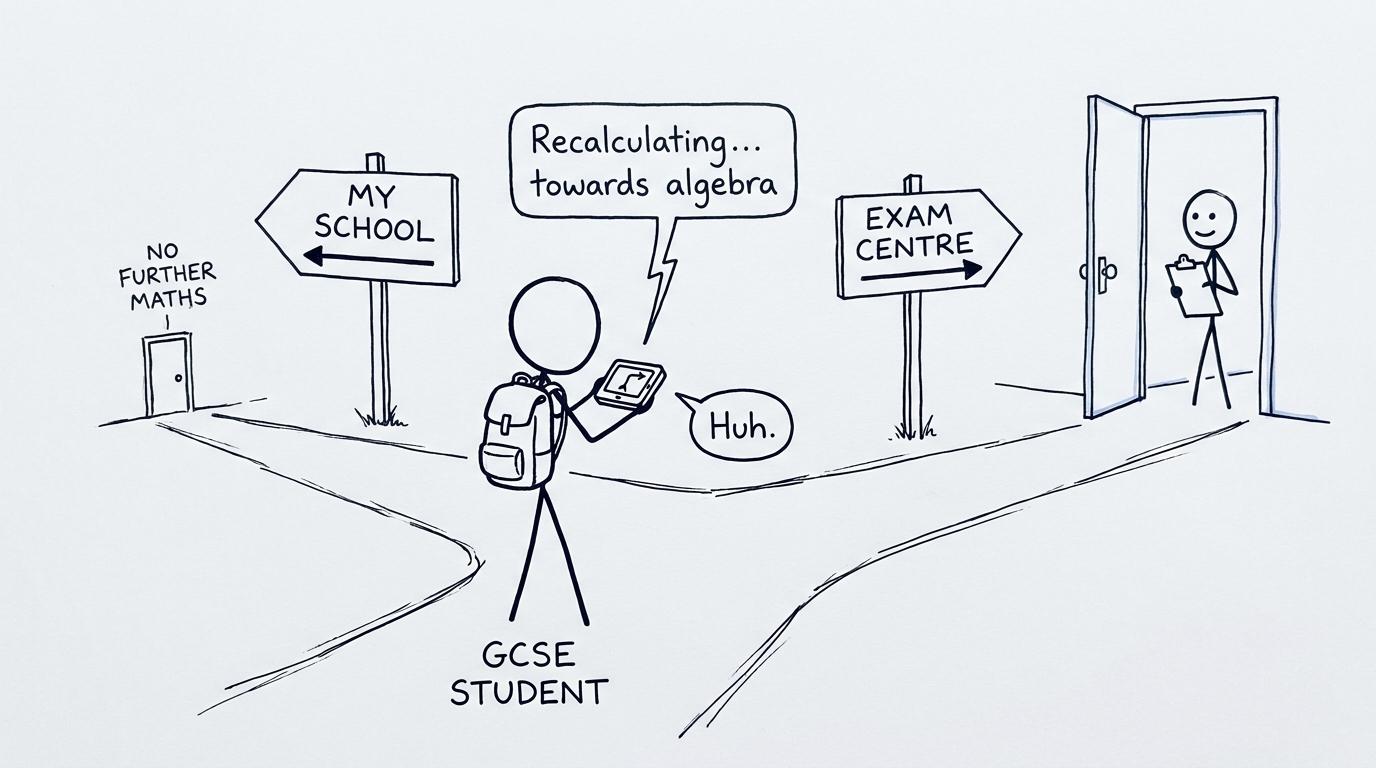 A student choosing a route from a school without Further Maths to an external exam centre
First, identify which Further Maths qualification you mean
“GCSE Further Maths” is often used informally for the AQA Level 2 Certificate in Further Mathematics, specification 8365. It is not technically an ordinary GCSE, although it is a Level 2 qualification taken by many GCSE-age students.
AQA describes it as an untiered qualification intended for learners who have, or are expected to achieve, grades 777, 888 or 999 in GCSE Mathematics and may progress to A Level Mathematics or Further Mathematics. Its content includes number, algebra, coordinate geometry, calculus, matrix transformations and geometry.
The assessment consists of two papers in the same summer series:
- Paper 1 is non-calculator, worth 808080 marks and lasts one hour and 454545 minutes.
- Paper 2 allows a calculator, is worth 808080 marks and also lasts one hour and 454545 minutes.
- Each paper contributes 50%50\%50% of the qualification.
AQA currently lists this specification as available to private candidates. You can explore the course through the AQA GCSE Further Maths revision hub.
Other qualifications may be described by schools as Further Maths or Additional Maths. OCR, Pearson Edexcel and WJEC Eduqas do not necessarily use the same title, content, assessment structure or entry code. Do not ask a centre simply for “Further Maths”. Give it the full qualification title, awarding organisation, specification code and examination series.
Ask your school before looking elsewhere
Your first conversation should be with your maths teacher, head of maths or exams officer. A school that does not teach the course may still be willing to make an exam-only entry, although it is not obliged to do so.
Ask clear questions:
- Does the school offer any Level 2 Further Maths or Additional Maths qualification?
- Would it enter a self-taught student for AQA specification
8365? - Would there be an entry or administration fee?
- Can the school provide any teaching support or supervised practice?
- Are there concerns about clashes with your existing GCSE timetable?
This is usually simpler than using another centre because your school already holds your candidate details, knows your normal way of working and manages your other examinations. A calm, specific request is more useful than arguing that another school offers the subject.
If the answer is no, ask the exams officer to confirm your Unique Candidate Identifier, usually called a UCI, and the details of your existing entries. You may need to supply these to the external centre.
How to arrange a GCSE Further Maths different exam centre entry
You become a private candidate for this qualification if you sit it at an approved centre without being taught there as one of its enrolled students. You can remain an ordinary internal candidate for your other GCSEs at your own school.
Find centres that accept private candidates
The Joint Council for Qualifications maintains a search facility for centres that have said they accept private candidates. Its list is a starting point, not a guarantee that every listed centre offers every subject.
You can also contact local secondary schools, sixth-form colleges, further education colleges and specialist private-candidate centres. Ask for the exams officer rather than sending a general enquiry to reception.
Contact several centres. A centre may be approved by AQA but choose not to accept external entries, or it may accept private candidates for GCSE Mathematics without offering the Level 2 Further Mathematics specification.
Send a precise enquiry
Your message should include:
- your full name and date of birth;
- the qualification title and code;
- the awarding organisation;
- the intended summer examination series;
- your current school and other GCSE entries;
- whether you already have a UCI;
- any access arrangements you use;
- a request for the total fee and the centre's internal deadline.
A useful question is: “Do you accept private candidates for the AQA Level 2 Certificate in Further Mathematics, specification 8365, and can you enter me for both papers in the summer series?”
Both papers must be taken in the same series, so confirmation for only one component is not enough.
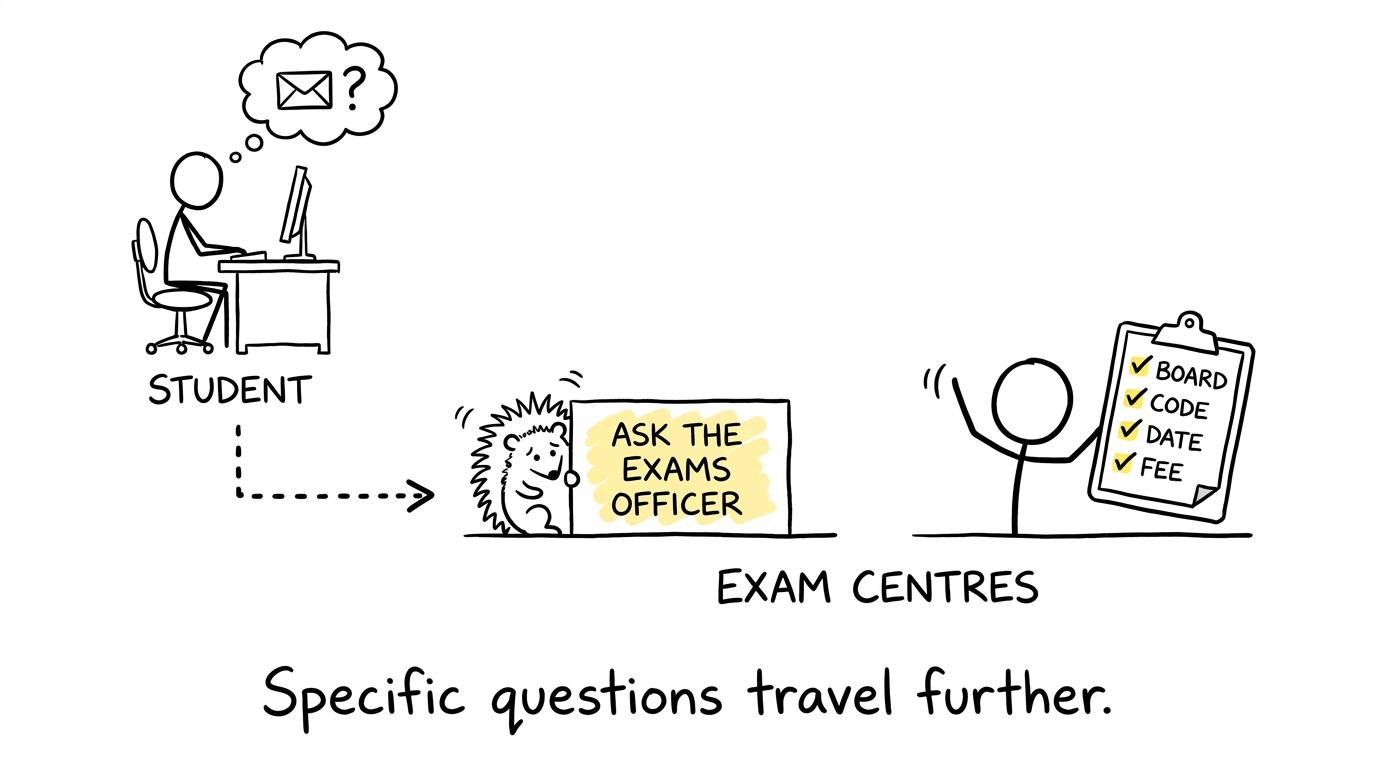 A student sending precise questions to several exam centres
Confirm costs and deadlines in writing
Private-candidate fees are set by individual centres. The total may include the awarding organisation's entry fee, centre administration, invigilation and additional support. Because charges vary, obtain a written total rather than relying on an old price found online.
Centres can also set internal deadlines earlier than the awarding organisation's final entry deadline. Late entries may cost more, and a centre may stop accepting candidates when its rooms are full. Begin contacting centres during the autumn before a summer examination wherever possible.
Do not treat payment alone as confirmation. Ask for written acceptance and later check your official statement of entry.
Coordinate the external entry with your school
Sitting examinations at two centres creates an extra layer of communication. Tell both exams officers that you have entries elsewhere and give each centre a copy of the relevant timetable when it becomes available.
This matters because two papers could be scheduled in the same session. JCQ rules allow centres to manage genuine examination clashes under controlled conditions, but the arrangements must be made by the centres. You cannot solve a clash by arriving late, changing the date yourself or choosing which paper to miss.
In some circumstances, centres can request a transferred-candidate arrangement so that an examination entered by one centre is hosted by another approved centre. That is a formal centre-led process, not an informal change of venue. Ask the exams officers whether it is relevant rather than assuming that you can move a paper after entry.
Keep the same UCI where required and check that your name, date of birth, qualification code and paper entries are correct. If anything looks wrong, contact the entering centre immediately.
Arrange access requirements early
Extra time, a reader, a scribe, supervised rest breaks or the use of a word processor do not automatically follow you from your school to another centre.
The centre entering you is responsible for processing and implementing approved access arrangements for that examination. It may need evidence, an assessment and information showing your normal way of working. Modified papers can also have earlier ordering deadlines.
Raise this in your first enquiry. Ask:
- whether the centre can provide the required arrangement;
- which evidence it needs from your school;
- whether an assessment is required;
- what its internal deadline is;
- whether additional charges apply.
Your school's SENCo may be able to share relevant evidence, but the external centre must decide and process the arrangement in line with the current rules.
Prepare independently without guessing the course
Once the entry is secure, revision needs structure. Further Maths is not simply a collection of harder GCSE questions. It introduces distinct content, including calculus and matrices, while demanding confident algebra.
Start by comparing the specification with your present knowledge. The GCSE Maths topics by exam board and tier guide can help you identify which Higher GCSE foundations should already feel secure. If those foundations need work, use the AQA GCSE Maths revision area alongside your Further Maths preparation.
A sensible weekly cycle is:
- learn one small part of the specification;
- complete focused practice questions;
- mark the work and record errors;
- revisit the topic after a few days;
- add timed paper practice once the content is familiar.
Use the free MathsGenie revision planner to balance Further Maths with your main GCSE subjects. Then move into AQA Further Maths past papers and mark schemes, making sure you practise both calculator and non-calculator conditions.
A mark is useful feedback only when it changes what you do next. The guide to using GCSE past papers properly explains how to turn each lost mark into targeted revision rather than repeatedly sitting papers without repairing weaknesses. If you need a longer structure, adapt the one-month GCSE maths revision plan around your confirmed examination dates.
What happens on the examination day?
Your external centre should tell you where to report, when to arrive, which identification to bring and what equipment is permitted. Check whether its two papers are held at the same site.
Plan the journey in advance and allow generous time. Bring the required photo identification, pens and permitted equipment. For the calculator paper, use a calculator that meets examination rules and that you already know how to operate.
Results, certificates and post-results services are normally handled through the centre that entered you. Before the examinations, ask how results will be released and whether certificates must be collected or can be posted.
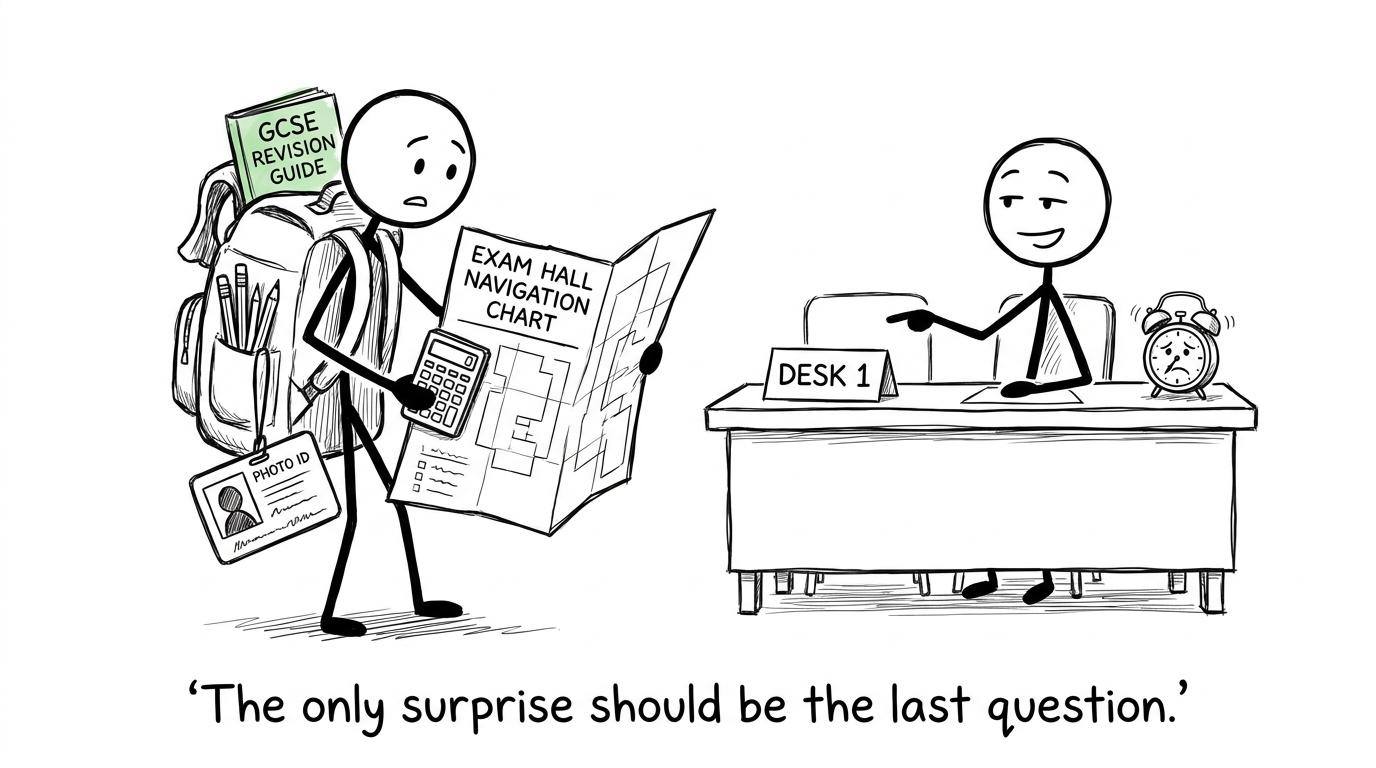 A well-prepared private candidate arriving early for an examination
Common mistakes when booking another exam centre
Using an informal qualification name
“Further Maths GCSE” may not tell the centre which paper you need. Always provide the awarding organisation, exact title and specification code.
Waiting for the exam board's final deadline
A centre's own deadline can be earlier, and places may fill. Start the search well in advance and ask for the internal deadline.
Assuming your school must enter you
Schools and colleges are not required to accept every additional qualification or private candidate. Ask politely, then prepare an external-centre plan if necessary.
Forgetting to disclose other entries
Two centres need to know about your complete timetable. Hidden entries can make timetable clashes and candidate records harder to manage.
Leaving access arrangements until spring
Evidence and applications take time. Discuss support before paying the entry fee and obtain written confirmation of what the centre can provide.
Revising before confirming the specification
Different Further Maths and Additional Maths qualifications are not interchangeable. A past paper from the wrong board can create confidence in content you will not actually sit.
A different building does not change the goal
Sitting Further Maths elsewhere can feel more complicated because the organisation is visible: emails, codes, fees, identification and journeys. At school, much of that happens quietly in the background.
But the route is manageable. Confirm the qualification. Ask your school first. Find an approved centre early. Coordinate both timetables. Then make revision the ordinary, repeatable part of the process.
MathsGenie can be your free revision base throughout that journey. Use the Further Maths revision lessons and practice questions to learn each topic, mini tests to check retention, and past papers with mark schemes and video solutions to build examination confidence. Once the desk is booked, the next step is simple: open the AQA Further Maths revision hub, choose one topic and begin.