GCSE French vs Spanish Grade Boundaries Compared
GCSE French vs Spanish grade boundaries vary by board and year. Compare 2025 evidence, understand the 2026 reset and choose a safer target mark.
The unsettling thing about grade boundaries is that they can make a subject choice feel like a gamble. One friend says Spanish is easier. Someone else produces an old French boundary and insists the opposite. Yet the evidence behind GCSE French vs Spanish grade boundaries gives a calmer answer: neither language consistently has more generous boundaries.
In summer 202520252025, Spanish generally had lower Higher tier boundaries with AQA, while French had lower boundaries for several higher grades with Pearson Edexcel. Eduqas produced a mixed picture. More importantly, the reformed language GCSEs are being awarded for the first time in summer 202620262026, so boundaries from the outgoing specifications cannot reliably predict the new ones.
The useful question is therefore not simply, “Which boundary is lower?” It is, “What level of performance gives me a safe margin above my target grade?”
The short answer at a glance
Before comparing French and Spanish, keep this checklist in mind:
- There is no consistently more generous language across every board, tier and grade.
- A lower raw-mark boundary does not automatically mean an easier subject.
- Boundaries are set after marking to account for the difficulty of that examination series.
- Compare qualifications only when the board, specification, tier, year and maximum mark match.
- Summer 202620262026 introduces reformed GCSE French and Spanish qualifications, creating additional uncertainty around raw-mark boundaries.
- Your best protection is to aim comfortably above historical thresholds rather than revising towards the minimum.
This is the same principle explained in MathsGenie’s guide to GCSE maths grade boundaries: a boundary describes what happened after a particular set of papers. It is not a promise about the next examination.
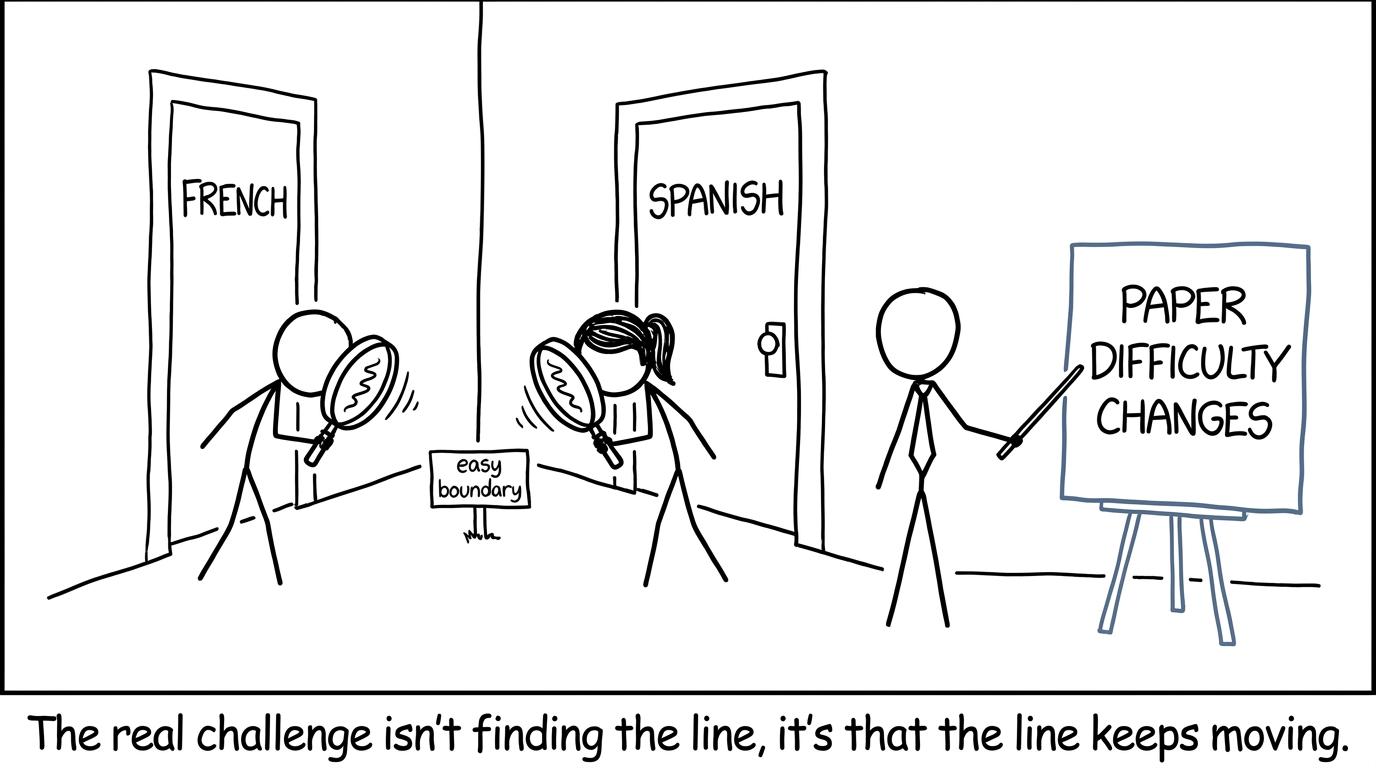 Students searching for an easy grade boundary behind the French and Spanish doors
What does a generous grade boundary actually mean?
A grade boundary is the minimum total mark needed to receive a particular grade. If a Higher tier boundary for grade 777 is 155155155, a candidate needs at least 155155155 marks for that grade in that series.
Students often call the lower of two boundaries “more generous”. That description is understandable, but incomplete. A lower boundary may indicate that examiners found one set of papers more demanding. It does not prove that the language itself was easier to learn or that candidates had an advantage.
When maximum marks differ, raw marks should be converted into percentages before qualifications are compared:
Boundary percentage=boundary markmaximum mark×100\text{Boundary percentage}=\frac{\text{boundary mark}}{\text{maximum mark}}\times 100Boundary percentage=maximum markboundary mark×100Even percentage comparisons have limits. Different papers test different vocabulary, grammar and skills, while speaking performance and cohort characteristics can also vary. Boundaries are better treated as historical reference points than as league tables.
GCSE French vs Spanish grade boundaries in 2025
The table below uses confirmed summer 202520252025 subject boundaries from AQA, Pearson Edexcel and Eduqas. These were the final awards for the outgoing specifications rather than boundaries for the reformed qualifications first examined in 202620262026.
| Exam board and tier | Maximum mark | French target boundaries | Spanish target boundaries | Lower boundary at the grades shown |
|---|---|---|---|---|
| AQA Higher | 240240240 | Grade 999: 205205205; grade 777: 159159159; grade 444: 114114114 | Grade 999: 203203203; grade 777: 155155155; grade 444: 109109109 | Spanish |
| AQA Foundation | 240240240 | Grade 555: 163163163; grade 444: 151151151 | Grade 555: 163163163; grade 444: 146146146 | Equal at grade 555; Spanish at grade 444 |
| Edexcel Higher | 280280280 | Grade 999: 226226226; grade 777: 175175175; grade 444: 110110110 | Grade 999: 240240240; grade 777: 185185185; grade 444: 109109109 | French at grades 999 and 777; Spanish at grade 444 |
| Edexcel Foundation | 280280280 | Grade 555: 190190190; grade 444: 171171171 | Grade 555: 189189189; grade 444: 166166166 | Spanish |
| Eduqas Higher | 240240240 | Grade 999: 195195195; grade 777: 146146146; grade 444: 110110110 | Grade 999: 190190190; grade 777: 146146146; grade 444: 115115115 | Spanish at grade 999; equal at grade 777; French at grade 444 |
| Eduqas Foundation | 240240240 | Grade 555: 158158158; grade 444: 138138138 | Grade 555: 178178178; grade 444: 157157157 | French |
The pattern changes as soon as the board, tier or target grade changes. AQA’s Spanish boundaries were lower throughout the selected Higher tier grades. Edexcel French had a substantially lower grade 999 threshold, but Spanish was one mark lower at grade 444. Eduqas moved in both directions depending on the grade and tier.
That is why a sweeping claim such as “Spanish always has better boundaries” does not survive contact with the data.
You can apply the same careful comparison to maths through MathsGenie’s AQA GCSE grade boundary tables, always checking the correct subject, tier and series.
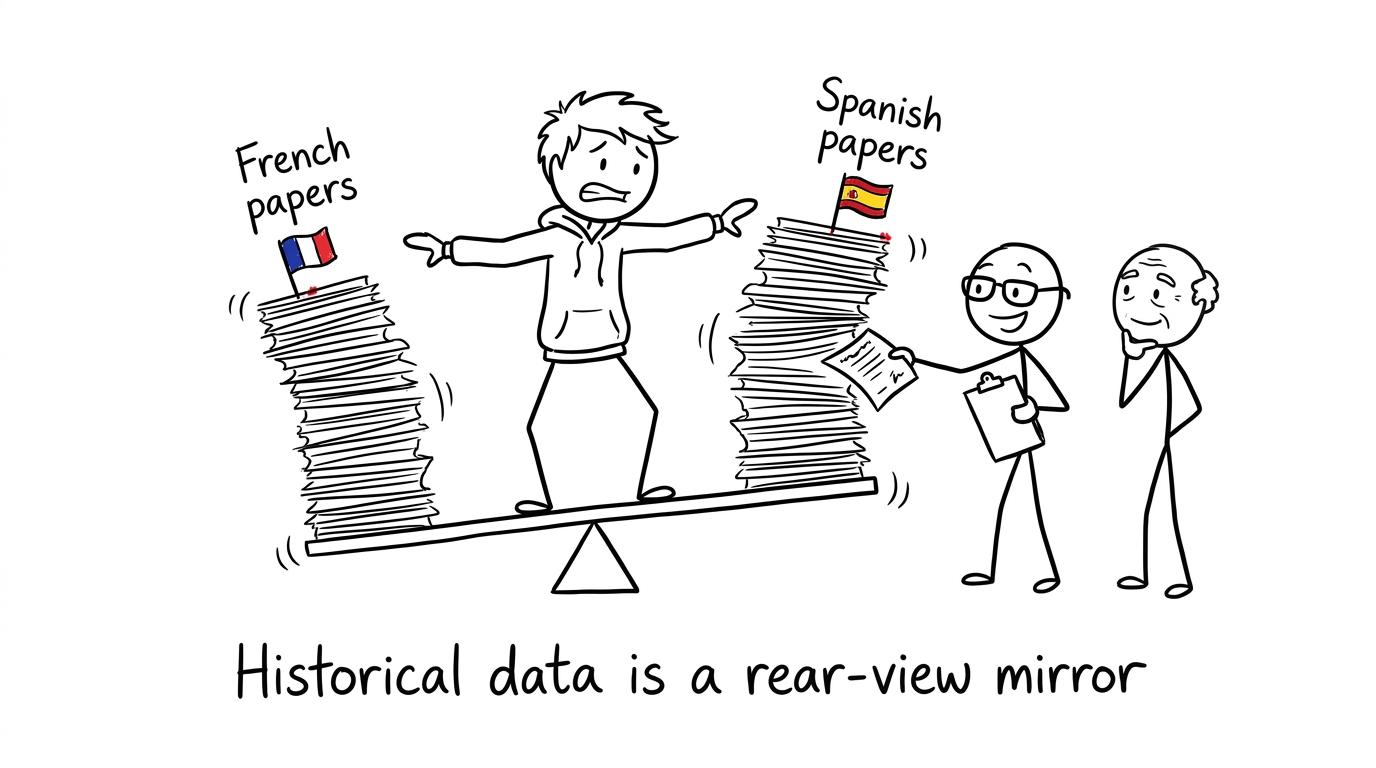 A student balancing French and Spanish papers while the examiner changes them each year
Why historical results do not reveal the easier language
In England in 202520252025, approximately 29.7%29.7\%29.7% of French entries achieved grade 777 or above, compared with approximately 27.1%27.1\%27.1% in Spanish. That does not establish that French had more generous grading.
The students taking each language are not identical groups. Schools may offer different languages, entry patterns can vary, and the balance between foundation and higher tier matters. Overall results combine boundaries, candidate attainment, teaching, tier entry and examination performance.
Ofqual’s earlier review found evidence that French and German had been graded more severely in statistical terms than Spanish. Adjustments were subsequently introduced to align French and German more closely with Spanish, with the final phase applied in 202420242024 and continuing for the final legacy awards in 202520252025.
This history explains why an older belief that French is always graded more harshly should not be carried forward without checking current evidence. Grading policy changed, papers changed, and now the specifications have changed too.
The 2026 specification reset matters
Reformed GCSE French and Spanish qualifications were first taught from September 202420242024 and are being awarded for the first time in summer 202620262026. Their assessment objectives have changed, although students still take foundation or higher tier and are assessed through listening, speaking, reading and writing.
Across the reformed qualifications, 75%75\%75% of the marks come from examinations and 25%25\%25% from the speaking assessment. The overall assessment objectives allocate 35%35\%35% to understanding and responding to spoken language, 45%45\%45% to written language, and 20%20\%20% to knowledge and accurate application of grammar and vocabulary.
Ofqual has explicitly warned that old boundaries should not be assumed to apply at the same mark or percentage on the new specifications. The official summer 202620262026 boundaries cannot be known before results day on 202020 August 202620262026, because exam boards need evidence from marked work before setting them.
The regulator expects overall outcomes to be broadly similar to previous years and requires measures to prevent students being unfairly advantaged or disadvantaged by the reform. However, broadly similar outcomes do not imply similar raw marks.
What the comparison means for your target grade
A boundary is a line, but sensible revision needs a buffer. Trying to land exactly on last year’s threshold leaves no room for an unfamiliar listening extract, a misunderstood writing task or an unusually demanding paper.
If you are targeting grade 4 or 5
Concentrate first on reliable coverage across all four skills. Foundation tier offers grades 111 to 555, while Higher tier targets grades 444 to 999, with a possible grade 333 safety net for candidates narrowly below grade 444.
Your teacher should advise on tier entry using evidence from several assessments, not one historical boundary. A lower boundary on Higher tier does not remove the risk created by questions targeted at more demanding grades.
If you are targeting grade 7
Look beyond the total mark. Identify whether listening speed, grammatical accuracy, speaking development or reading inference is causing repeated losses. A grade 777 target becomes more manageable when it is divided into specific skill improvements.
Do not assume that choosing French or Spanish would have changed your result. The 202520252025 data show that the apparent advantage depends heavily on the exam board.
If you are targeting grade 9
At the top end, small weaknesses can matter because consistently strong performance is needed across the qualification. Historical boundaries can provide context, but your revision should focus on the quality demanded by the specification and mark scheme rather than a speculative cut-off.
The safest target is not “last year’s grade 999 mark”. It is your strongest repeatable performance under timed conditions.
A lesson maths students can use immediately
Grade-boundary anxiety often comes from focusing on something outside your control. The productive alternative is to measure what you can change: marks secured, topics repaired and errors that do not return.
Start in the GCSE Maths revision hub, choose your board and tier, and complete a timed assessment. Students taking Pearson can use the Edexcel GCSE Maths revision pathway, while OCR candidates can use the OCR GCSE Maths revision hub.
Then follow the same disciplined cycle that works for language revision:
- attempt work without notes;
- mark it honestly;
- identify the reason for each lost mark;
- practise the smallest skill that fixes the problem;
- retest it later.
MathsGenie’s guide to using GCSE past papers properly explains how to turn a score into an error log rather than treating it as a verdict.
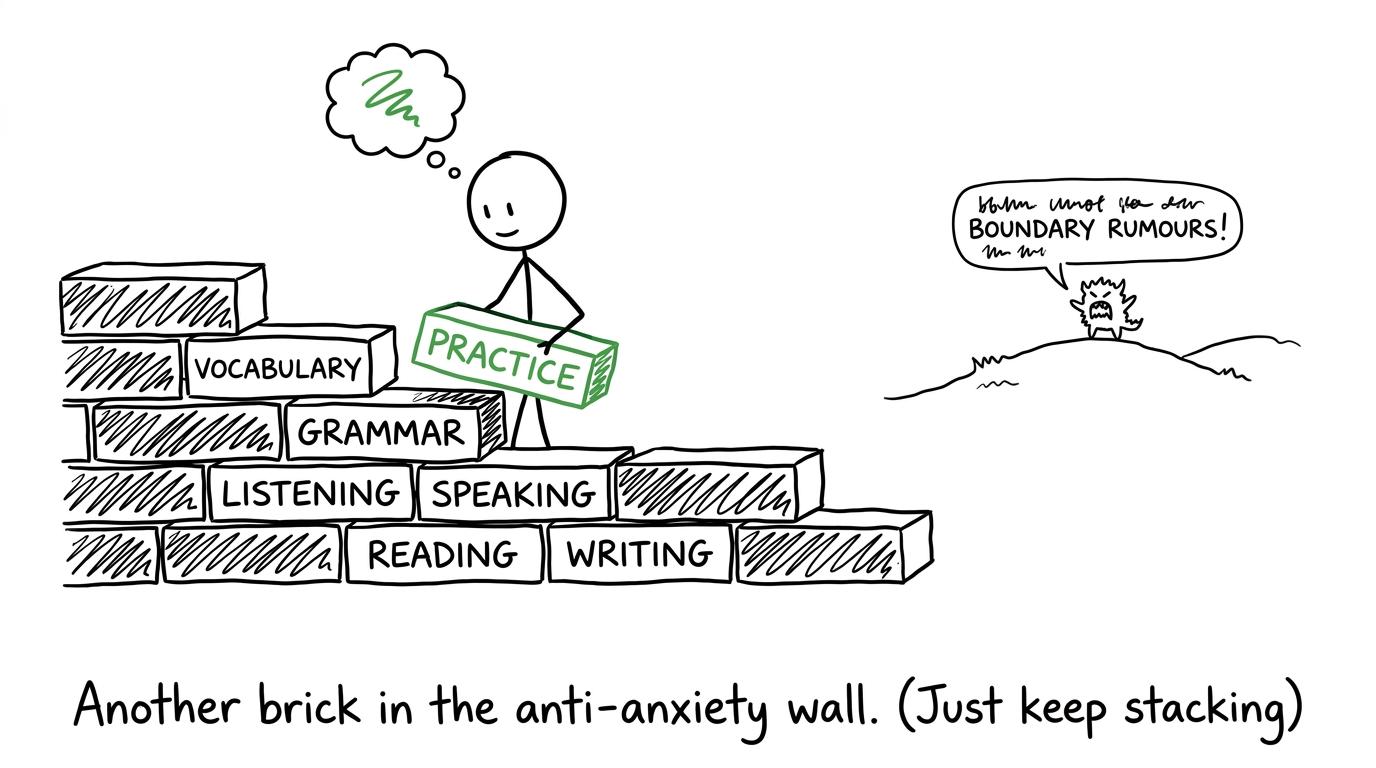 A student building a revision wall while boundary rumours remain outside
Common mistakes when comparing French and Spanish
Comparing raw marks from different totals
A boundary of 175175175 out of 280280280 cannot be compared directly with 159159159 out of 240240240. Check the maximum mark and, where necessary, calculate a percentage.
Mixing foundation and higher tier
The tiers target different grade ranges and levels of demand. Always check the tier printed beside the boundary.
Treating one year as a permanent pattern
Boundaries move because paper difficulty and evidence from candidate work change. Several years can show context, but none can guarantee the next boundary.
Using notional paper boundaries as final grades
Final GCSE grades are awarded from the total subject mark. Exam boards may publish notional component boundaries to support interpretation, but these are guides rather than separate official paper grades.
Revising towards the minimum
A predicted boundary can encourage false precision. Build a margin instead. In maths, GCSE mini tests provide quick evidence of whether a weak topic is improving, while GCSE predicted papers offer fresh exam-style practice near the examination.
Make your preparation stronger than the boundary
The fairest conclusion is not that French wins or Spanish wins. In 202520252025, the lower boundary changed with the board, tier and grade. For 202620262026, the new specifications mean that legacy raw marks require even more caution.
Choose and revise your language according to your teaching, confidence and performance across the assessed skills. For maths, take the same evidence-led approach: use MathsGenie’s free revision lessons and practice questions to repair gaps, then test your progress with mini tests, past papers and predicted papers. Mark schemes and video solutions show where marks are actually earned.
You cannot control the final boundary. You can build a performance strong enough not to depend on guessing it.