GCSE French Study Group: Make It Actually Work
GCSE French study group advice for focused speaking, listening, reading and writing practice, with clear roles, timed tasks and honest feedback.

A study group can begin with excellent intentions and end with forty messages about when everyone is free. No French is spoken. No vocabulary is tested. Eventually, someone sends a photograph of their notes and everyone quietly agrees that this counts as revision.
A GCSE French study group works when it has a fixed time, a narrow goal, active tasks and an agreed finish. Keep it small, usually three or four people, and make every meeting produce evidence: vocabulary recalled, speaking recorded, answers marked or mistakes logged. Friendship helps, but structure does the real work.
The same principle matters when French sits beside maths, science and every other GCSE. Your group should make French revision more efficient, not consume the evening you planned to spend on algebra.
The quick checklist
Before arranging the first session, agree these rules:
- Invite people who are willing to prepare and participate.
- Fix a regular day, start time and finish time.
- Choose one French skill and one specification topic per meeting.
- Give everyone a practical role.
- Keep phones away unless they are needed for audio or a timer.
- Test from memory before opening notes.
- Use questions that match your exam board and tier.
- End by recording mistakes and setting the next task.
- Cancel or change the format if the group repeatedly wastes time.
That last rule matters. A revision method is not valuable merely because it sounds organised.
 A study group ties down a distracting group chat balloon before opening revision books
Start with the exam, not the group chat
A vague invitation such as “Does anyone want to revise French?” creates a vague meeting. Begin instead with the assessment you are preparing for.
For the current AQA and Pearson Edexcel GCSE French qualifications, listening, speaking, reading and writing are separately assessed, with each contributing 25%25\%25% of the qualification. Both have Foundation and Higher tiers, and students take the same tier across their assessments. Other specifications may organise tasks or timings differently, so check your own exam board materials rather than borrowing a friend’s assumptions.
Your first planning message could therefore identify:
- the exam board and tier;
- the skill being practised;
- the specification theme or vocabulary area;
- the resource everyone must bring;
- the exact start and finish times.
“Thursday: Higher French, travel vocabulary, speaking prompts, finish by six” is useful. “French revision sometime?” is a wish.
Choose people who will improve the session
The best group is not necessarily made up of the highest-attaining students. It needs people who will attempt answers, listen carefully and accept correction without turning every mistake into a debate.
Three or four members usually allow everyone to speak while still providing different ideas and feedback. A larger group can work, but it becomes easier to hide and harder to keep conversations focused.
Look for complementary strengths. One person may hear verb endings clearly. Another may remember vocabulary. Someone else may be good at spotting whether an answer addresses every bullet point. Nobody needs to become the permanent expert. In fact, rotating responsibility makes everyone retrieve and explain more.
If someone misses a meeting, continue without restarting the entire plan. A reliable small group is more useful than a large group that is always waiting for one more person.
Give every meeting a visible structure
Collaborative learning is most effective when tasks and responsibilities are deliberately structured. Simply placing students together does not guarantee useful learning. Your agenda should make participation unavoidable but manageable.
A focused session might follow this shape:
Arrival and closed-book recall
Begin with a short vocabulary or grammar check. Everyone answers independently before comparing responses. This prevents the most confident person from supplying answers while everyone else experiences the comforting illusion of recognition.
Low-stakes quizzing can reveal gaps that rereading hides. Keep the atmosphere calm: the purpose is to find what needs attention, not to rank friends.
Main skill practice
Spend most of the meeting on one exam skill. Match the task to the group’s purpose:
- Speaking: rotate through role-play, reading aloud, visual stimulus and unprepared follow-up questions where these appear in your specification.
- Listening: play a short extract, answer independently, compare evidence and replay only after committing to an answer.
- Reading: identify key details, opinions, time frames and plausible meanings from context.
- Writing: plan responses, check whether every bullet point is covered and review grammar against the relevant assessment guidance.
Do not try to “cover French”. A narrow session creates clearer feedback.
Mark, diagnose and correct
Compare work with an official mark scheme, teacher guidance or a trusted model supplied by your school. Do not award marks because an answer “basically means the same thing” unless the accepted guidance supports that judgement.
Record the cause of each mistake. “Listening” is too broad. “Confused a negative statement with a positive one” gives you something to fix.
Exit check
Finish by testing the same material without notes. Each person should state one secure area, one remaining weakness and one action before the next meeting.
This plan, recall, practise, check, correct, retest, is also a strong framework for maths. MathsGenie’s twenty-minute GCSE maths revision routine shows how to use the same cycle when the group session ends and independent revision begins.
Rotate roles so nobody disappears
Roles remove the awkward question of who is supposed to lead. Change them each meeting:
- Chair: reads the agenda and stops the session drifting.
- Timekeeper: protects each task and the agreed finish.
- Questioner: selects prompts and asks follow-up questions.
- Checker: uses the mark scheme or criteria and records uncertainties.
- Reporter: writes the shared mistake list and next actions.
In a group of three, combine roles. The important point is that everyone produces French. A student who only times other people for six weeks has developed excellent stopwatch skills and very little else.
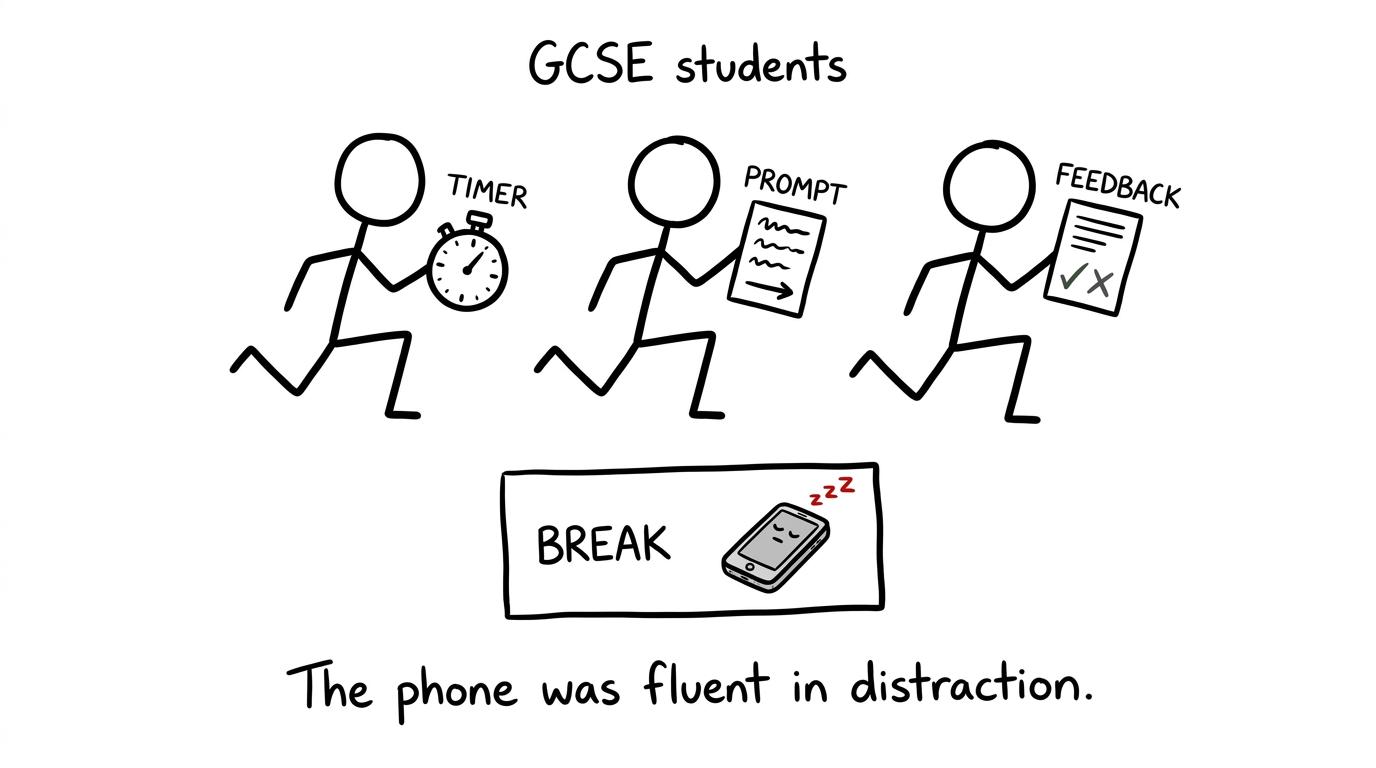 Students run a speaking relay while a distracting phone waits in a break box
Make speaking practice feel safe but real
Speaking is where a group offers something solitary revision cannot: an unpredictable human response. Yet it only works if students are allowed to hesitate, try again and receive precise feedback.
Agree a simple feedback order:
- First, say whether the response communicated a clear answer.
- Next, identify one specific strength.
- Then give one correction or improvement.
- Finally, ask the speaker to repeat the improved version.
Avoid interrupting every sentence. Constant correction can destroy fluency and make quieter members stop volunteering. Instead, the checker can note patterns and discuss them after the response.
Use unprepared follow-up questions rather than memorising one polished script. Current specifications place value on responding to spoken or visual prompts, although the exact task format depends on the board. Practising flexibility is therefore more useful than making every answer identical.
Keep preparation small and accountable
Homework for the group should be light enough that everyone actually completes it. Ask members to bring one of the following:
- a short set of vocabulary prompts;
- two speaking questions;
- one reading extract selected from approved course materials;
- a completed exam question ready to mark;
- three errors from recent classwork.
Put the task and deadline in one message. Do not create a second discussion about how the task should be interpreted.
If preparation is repeatedly missing, begin sessions with independent preparation time or reduce the task. The aim is not to punish anybody. It is to design a system that survives ordinary school weeks.
Protect your wider GCSE revision timetable
Students preparing for French are usually preparing for maths as well. A successful French group should leave enough energy for both.
Place the meeting inside a realistic weekly plan rather than adding it on top. MathsGenie’s GCSE maths revision timetable can help you balance regular topic work with paper practice. If the exam period is close, the GCSE one-month revision plan offers a tighter structure.
Keep independent maths revision evidence-led. Use the GCSE maths revision hub to choose your board, then move between lessons, practice questions and papers. AQA students can use the AQA GCSE maths revision page, while Edexcel students can work through Edexcel GCSE maths past papers.
Shorter practice is useful when French has taken part of the evening. The Edexcel GCSE maths mini tests and forty-five-minute tests provide manageable timed options. Closer to the examinations, use GCSE predicted papers alongside past papers, not as a replacement for learning weak topics.
Use a shared mistake log, not shared notes
Shared notes often become an attractive document that nobody tests themselves on. A shared mistake log is more useful because it records where performance broke down.
For each issue, write:
- the skill and topic;
- what went wrong;
- the correct rule or interpretation;
- who needs to revisit it;
- when it will be retested.
Keep personal weaknesses private if anyone feels uncomfortable sharing marks. The group needs useful patterns, not a public league table.
At the start of the next meeting, retest a selection of previous errors. This creates continuity. Without retesting, a correction may be understood for thirty seconds and then quietly forgotten.
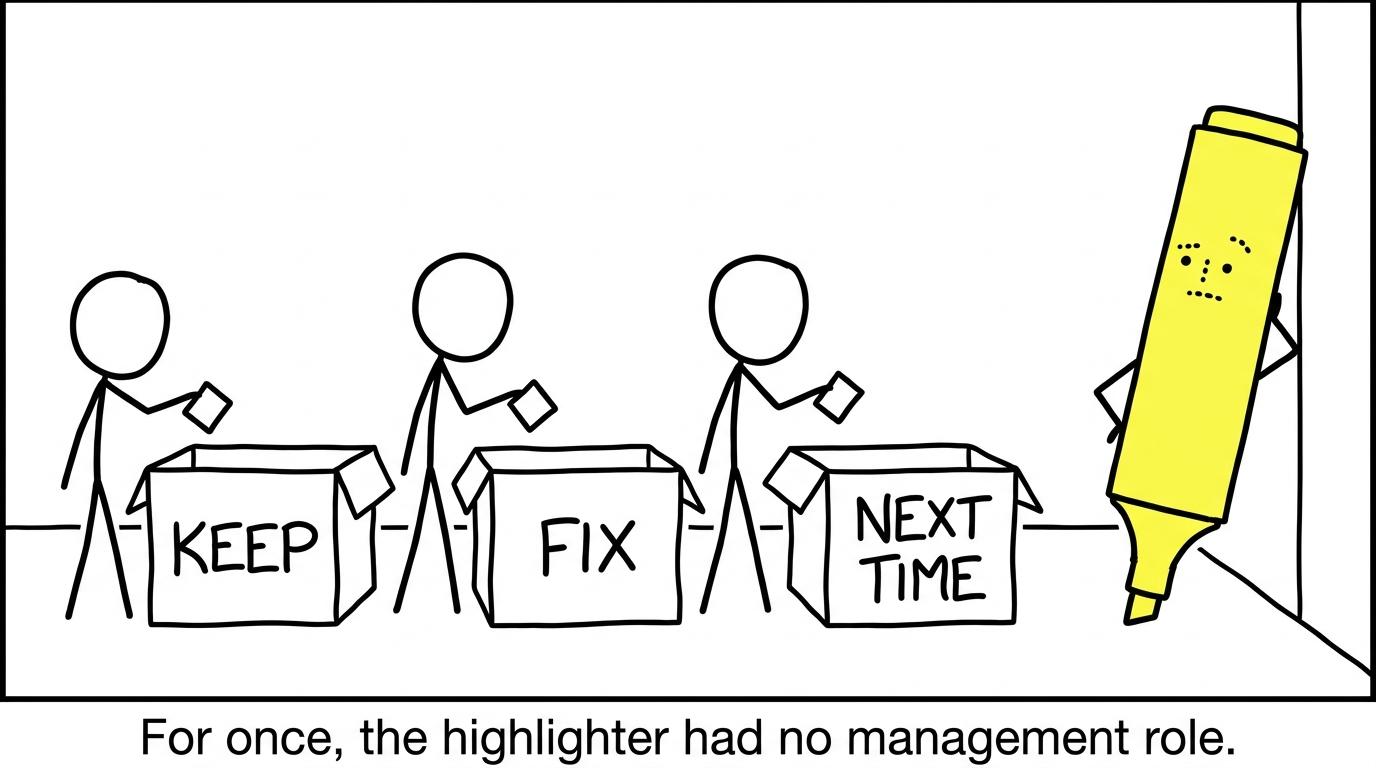 Students sort revision notes into keep, fix and next-time boxes
Common mistakes that make study groups fail
Spending the meeting making the plan
Planning should happen before the start. Use a repeatable agenda and change only the topic and skill.
Letting one person answer everything
Require silent individual thinking before discussion. Rotate who answers first and who checks.
Revising only comfortable topics
Choose content from recent errors, teacher feedback and specification coverage. Confidence is pleasant, but it is not always evidence of need.
Correcting from memory
Students can confidently agree on the same incorrect rule. Use mark schemes, specification materials and teacher guidance, then flag genuine uncertainty for your teacher.
Turning every session into speaking practice
Conversation suits a group, but GCSE French also assesses listening, reading and writing. Track coverage so one enjoyable skill does not crowd out the others.
Meeting for too long
A defined, energetic session is better than an evening that slowly dissolves. Stop at the agreed time and leave with a next action.
Allowing the chat to become the group
Use the chat for logistics, resources and one clear reminder. If discussion does not help the next meeting happen, it probably belongs elsewhere.
Make the next meeting easy to start
A study group succeeds through repetition, not one heroic afternoon. Before everyone leaves, confirm the next time, topic, skill and preparation task. Then stop.
Your French group can supply live questions, listening partners and immediate feedback. MathsGenie can provide the same sense of structure for your maths revision: free revision lessons, topic practice, mini tests, past papers, predicted papers, mark schemes and video solutions. Use the group where people add value. Use MathsGenie when focused independent practice is the better tool.
Set the first agenda now. Keep it small, test from memory and finish with evidence that the meeting changed what you can do.