Is GCSE French Similar to GCSE Spanish?
GCSE French similar to GCSE Spanish? Explore the real overlap in skills, grammar and exams, plus how to decide whether a second language suits you.
Enjoying one GCSE can create a tempting thought: perhaps a closely related subject will feel like a head start rather than a fresh beginning. If you are asking, “Is GCSE French similar to GCSE Spanish?”, the short answer is yes, but mainly in the skills, grammatical ideas and assessment structure, not in the language you must actually know.
French experience can make Spanish feel more familiar. You already understand what conjugation means, why adjective agreement matters and how to prepare for listening, speaking, reading and writing. But Spanish still brings its own vocabulary, pronunciation, verb forms and common expressions. The overlap is useful scaffolding, not a shortcut to a second qualification.
The quick overlap checklist
GCSE French and GCSE Spanish have genuine similarities:
- both assess listening, speaking, reading and writing
- both require translation between English and the assessed language
- both involve vocabulary recall, dictation and accurate pronunciation
- both use ideas such as gender, agreement, tense and verb conjugation
- both are available at foundation and higher tier
- revision methods transfer well between them
The important differences are equally real:
- vocabulary is not interchangeable
- pronunciation and spelling rules differ
- verb endings must be learnt separately
- familiar-looking words can have different meanings
- cultural content and language use are distinct
- taking both creates additional revision and assessment commitments
That last point matters when you are also preparing for maths, English and your other GCSEs. A subject can be enjoyable and still require serious timetable space.
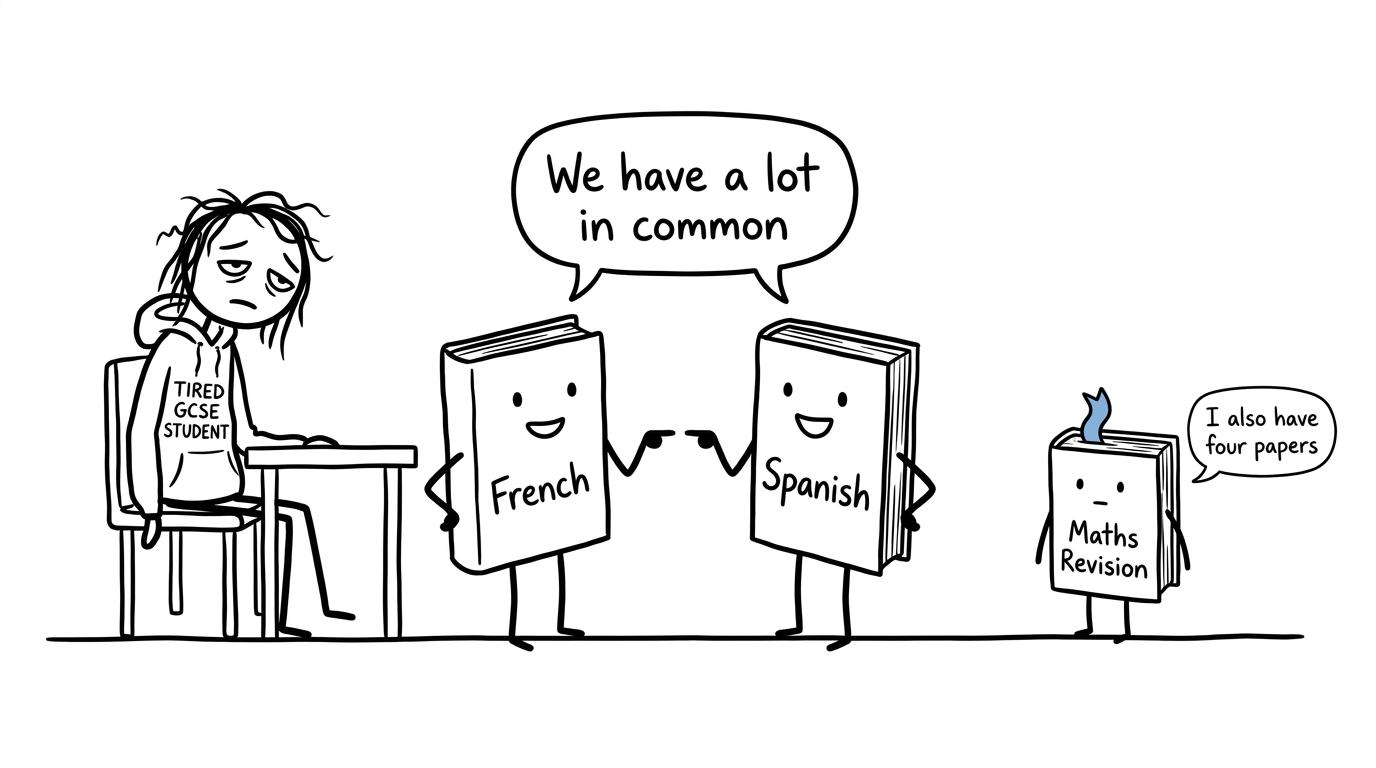 Two language textbooks discover that they have similar exam luggage while a maths book joins the conversation
Where GCSE French and GCSE Spanish genuinely overlap
The assessment skills are closely aligned
For GCSE French and Spanish qualifications taught in England from September 2024, with first assessment in summer 2026, the Department for Education sets common subject-content expectations. Students must understand written and spoken language, write accurately, translate, complete dictation and communicate through speech.
Ofqual's assessment arrangements continue to use foundation and higher tiers, with students entered at the same tier across their assessments. Speaking accounts for 25%25\%25% of the qualification. Exact paper order, timings and task design depend on the exam board, so always use the specification for your own AQA, Edexcel, OCR or other approved course.
This shared framework is meaningful. Someone who has prepared a French role play already knows that listening carefully to the prompt matters. Someone who has practised French dictation understands that small spelling details can cost marks. Those habits transfer directly, even though the Spanish answers themselves must be learnt.
The grammatical thinking feels familiar
French and Spanish are Romance languages, so several underlying ideas resemble one another. In both courses, students encounter:
- masculine and feminine nouns
- adjective agreement
- singular and plural forms
- definite and indefinite articles
- present, past and future time frames
- regular and irregular verb patterns
- negatives, questions, pronouns and connectives
This gives French students an advantage in grammatical awareness. You are less likely to be surprised by the idea that an adjective may change form or that a verb ending can reveal who is performing an action.
However, recognising an idea is not the same as knowing its Spanish form. The two languages organise some structures differently, use different irregular verbs and do not always express the same thought in parallel ways. Your French knowledge helps you ask the right questions; it does not automatically supply the answer.
Many revision habits transfer
The strongest overlap may be procedural rather than linguistic. Effective language revision in either subject involves:
- frequent retrieval of vocabulary
- listening without relying on a transcript
- speaking aloud rather than rehearsing silently
- revisiting grammar across several days
- correcting work using a mark scheme or teacher feedback
- practising under time pressure
This is also recognisable to anyone using MathsGenie's GCSE revision resources. In maths, understanding a method is only the beginning; you then need to retrieve and apply it independently. Languages reward the same movement from recognition to recall.
Where the similarity stops
Vocabulary overlap is helpful but limited
French and Spanish share Latin roots, and both contain international vocabulary that may look familiar to an English speaker. This can help with intelligent inference while reading.
Yet GCSE success depends on precise recall. The official subject content expects foundation students to know 1,2001,2001,200 lexical items, with a further 500500500 at higher tier. These lists are language-specific. Similar roots may reduce the feeling of unfamiliarity, but they do not remove the need to learn Spanish vocabulary accurately.
You must also guard against false friends: words that look related but differ in meaning or usage. Guessing from French can occasionally help, but treating French as a Spanish dictionary will create avoidable errors.
Pronunciation works differently
Spanish spelling often provides relatively direct clues about pronunciation once its sound-symbol rules are understood. French includes features such as silent final letters, nasal vowel sounds and linking between words.
Neither system is automatically easy. They are simply different. A student with confident French pronunciation still needs to learn Spanish letter sounds, stress patterns and natural rhythm. This is particularly important because the revised GCSE content includes read-aloud work and dictation, directly testing the relationship between written and spoken language.
Similar topics do not mean reusable answers
Within an exam board, French and Spanish qualifications may follow closely aligned principles and thematic contexts. Pearson, for example, states that its French, German and Spanish qualifications were developed under the same principles and testing requirements, while recognising that vocabulary and cultural material differ.
That does not mean you can translate a memorised French paragraph word for word. Natural phrasing, grammar and cultural references belong to each language. Strong candidates build flexible knowledge in Spanish rather than attempting to repaint a French answer with Spanish vocabulary.
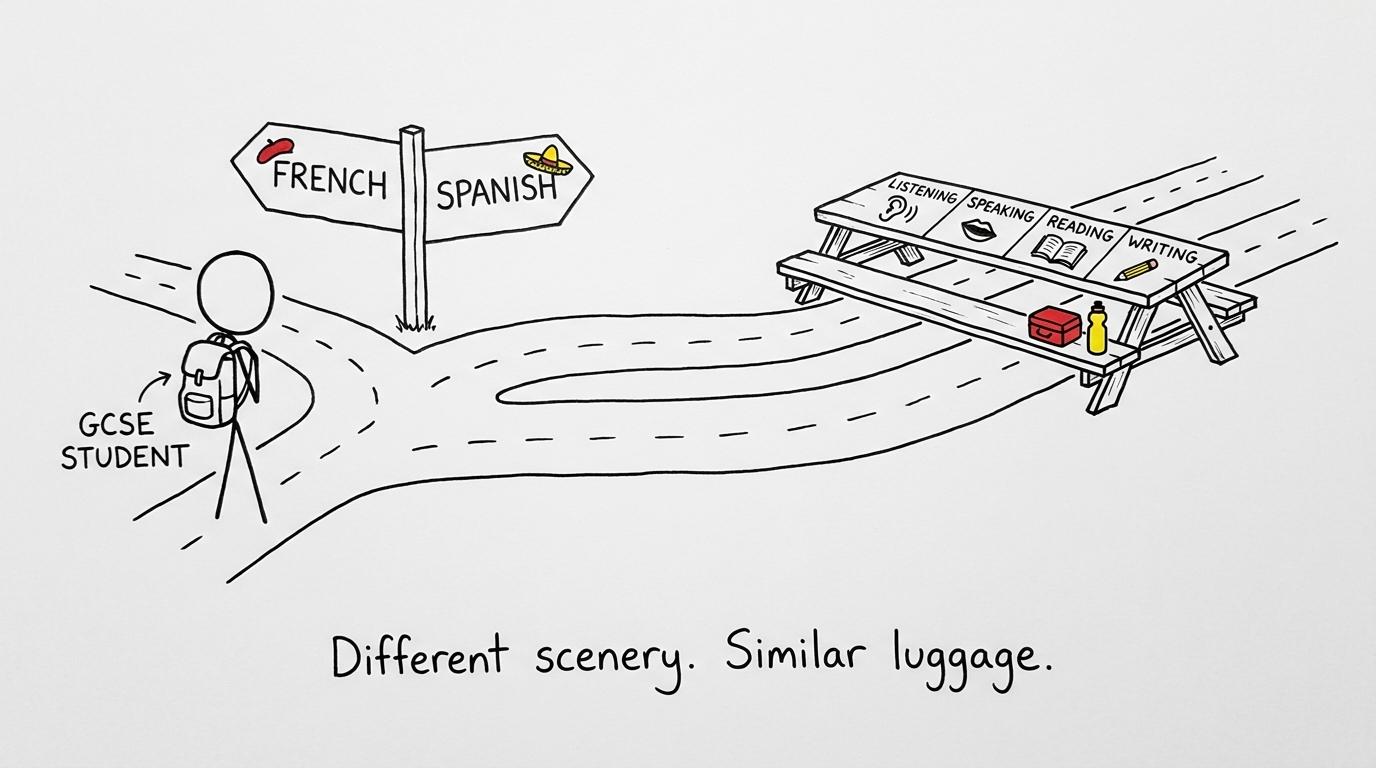 A student discovers that the French and Spanish paths have different scenery but share the same skills bench
Should you take GCSE Spanish after enjoying French?
Enjoyment is a good signal because language learning depends on regular contact. It is not, by itself, a complete decision.
Ask yourself these questions:
- Did you enjoy learning the language itself, or mainly the French class and teacher?
- Do you like speaking and listening as well as reading and vocabulary work?
- Can your school provide suitable Spanish teaching and examination entry?
- Will Spanish replace another option or be taken in addition to your existing subjects?
- Can you give both languages separate revision time without weakening maths and English?
- Are you interested enough to continue when the early familiarity disappears?
If most answers are positive, French is a useful foundation for Spanish. If your timetable is already crowded, waiting may be wiser. GCSE Spanish is a complete course, not an informal extension of French.
Your school should confirm which qualification and specification it offers. AQA, Edexcel, OCR and Eduqas do not necessarily arrange every task identically, and availability varies by centre. Check the current specification and sample assessment materials rather than assuming your Spanish papers will copy your French papers exactly.
How to balance two languages with GCSE maths
The hidden cost of an extra subject is not intelligence. It is attention.
A realistic plan gives each subject a specific purpose. French and Spanish need short, frequent vocabulary and listening sessions. Maths needs regular problem-solving, feedback and timed paper practice. Placing all three inside one vague instruction to “revise” makes it too easy to choose whichever feels most comfortable.
Use a weekly structure such as:
- brief French and Spanish retrieval on separate days
- one longer productive session for writing or speaking in each language
- focused maths topic sessions using free GCSE lessons and practice questions
- a timed maths section, mini test or past paper at the weekend
- one catch-up block that can absorb missed work
MathsGenie's guide to building a GCSE maths revision timetable can help you protect maths time instead of fitting it into whatever remains. If exams are approaching, the one-month GCSE revision plan offers a more concentrated structure.
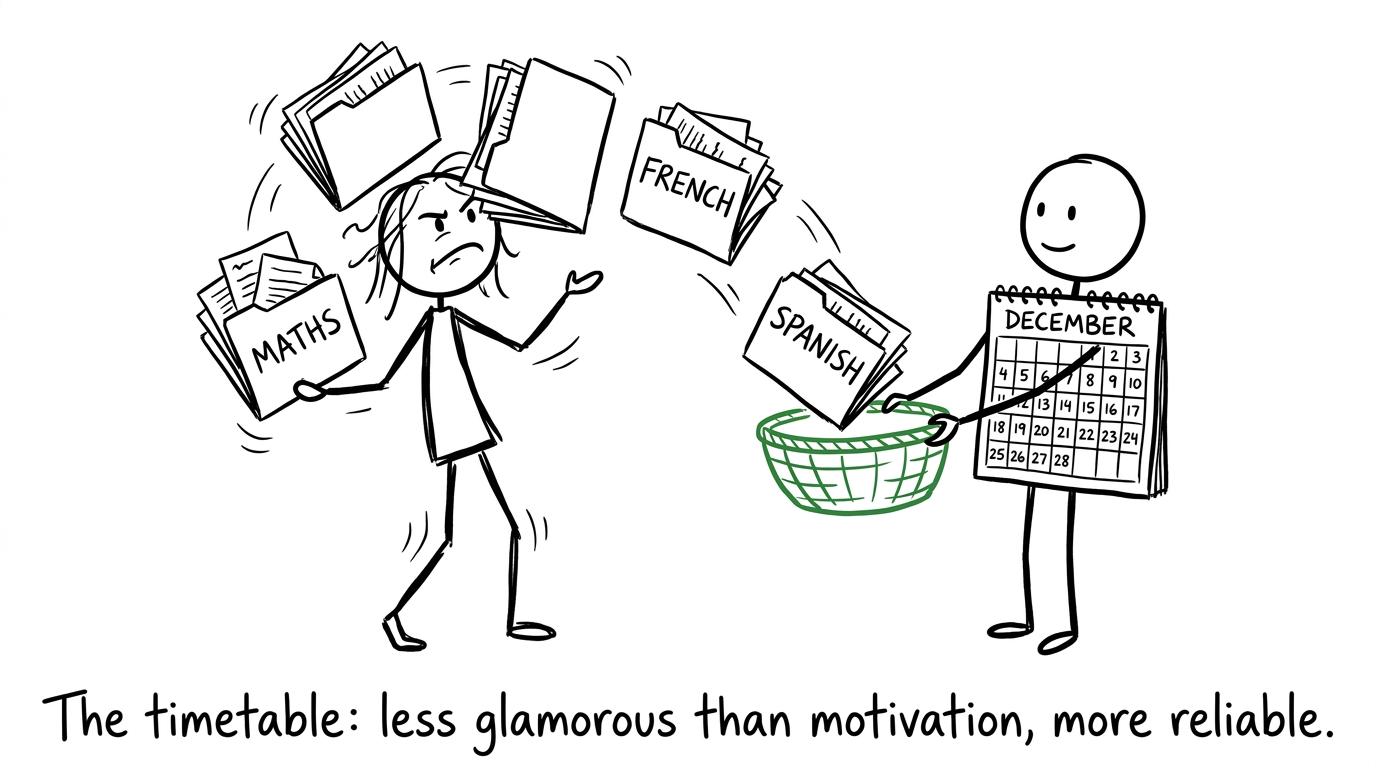 A revision calendar calmly catches the subjects that a GCSE student was trying to juggle
Common mistakes when comparing French and Spanish
Assuming Spanish will require half the work
Prior French knowledge reduces the learning curve for certain concepts, but you still need a distinct vocabulary base, secure pronunciation and independent exam practice.
Mixing similar-looking language
Interference is normal when related languages are learnt together. Keep separate vocabulary resources and record words or structures that you repeatedly confuse. Contrast them deliberately rather than hoping the confusion disappears.
Revising only through recognition
Reading a vocabulary list can feel reassuring because every word looks familiar. Cover the answer and retrieve it. Say it aloud. Write it from memory. Recognition is not the same skill as production.
Ignoring your exact specification
Do not revise from assumptions about another language, an older qualification or a different exam board. Confirm your board, tier, vocabulary requirements and task formats with your teacher.
Letting an enjoyable option displace core revision
A new language can be refreshing, which makes it tempting to revise instead of a difficult maths topic. Use MathsGenie's guidance on the best order for learning GCSE maths topics to keep weak areas visible.
Similar enough to help, different enough to matter
So, is GCSE French similar to GCSE Spanish? Yes. The qualifications develop comparable skills, use related grammatical concepts and reward many of the same revision habits. Enjoying French is therefore a sensible reason to explore Spanish.
But the overlap should be viewed as a foundation, not a discount. Spanish asks you to build a new vocabulary, a new sound system and a separate body of accurate language. Before committing, check your school's course, examine the current specification and make an honest timetable for every subject.
Then protect your maths preparation. Start at the MathsGenie GCSE hub, learn through free revision lessons and practice questions, and use Edexcel GCSE past papers or the resources for your own board to find lost marks. As exams approach, add GCSE predicted papers, mark schemes, video solutions and mini tests.
Enjoyment can begin the decision. A realistic plan is what makes it work.