

GCSE French Role Play Marking Explained
GCSE French role play marking explained: discover how examiners reward clear messages, relevant answers, questions and pronunciation in the 2026 GCSE.
The GCSE French role-play can feel strangely unforgiving. You may know the vocabulary, prepare every prompt and still wonder whether a hesitant answer will cost you marks. The useful truth about GCSE French role play marking is that examiners are mainly listening for successful communication: did you respond to the prompt, include every required detail and make your meaning clear?
You are not trying to deliver a flawless speech. The role-play is a short exchange in which each response has a job to do. Your exam board's exact rules matter, but clear, relevant messages usually matter more than ambitious language that becomes difficult to understand.
This guide focuses on the reformed GCSE French qualifications first assessed in summer 2026. If you are taking a resit or another specification, confirm the format with your teacher.
The role-play marking checklist
Before looking at the detail, remember these priorities:
- identify precisely what each English prompt requires
- communicate every requested detail
- respond appropriately to what the teacher says
- ask the required question or questions
- use language that makes your meaning unambiguous
- pronounce key words clearly enough to preserve the message
- keep answers short, relevant and manageable
- recover calmly if you misunderstand something
The principle is similar to reading a maths mark scheme. Effort is not marked directly; visible evidence is. MathsGenie's guide to using GCSE mark schemes as a revision coach explains the same feedback habit for maths: understand what earns credit, practise producing it, then correct the precise reason a mark was lost.
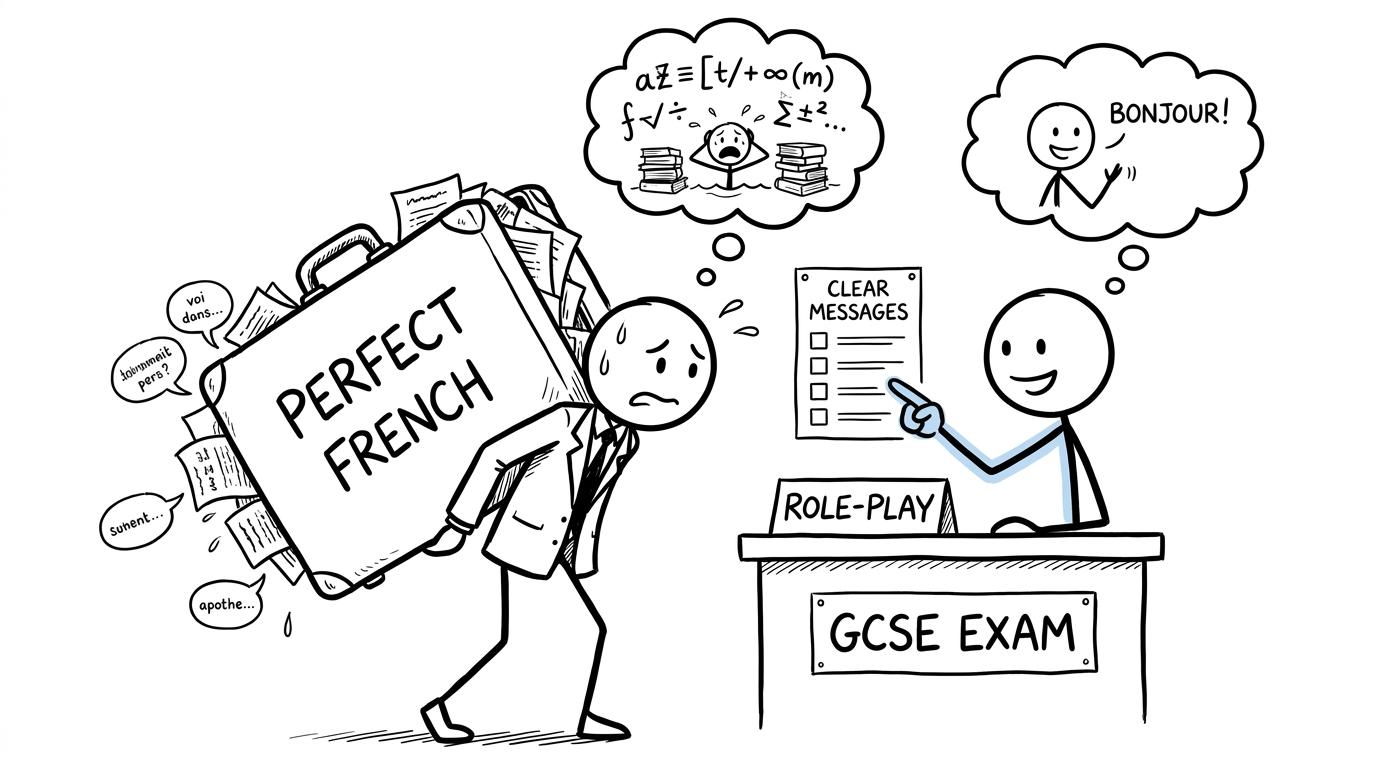 A student arrives with a suitcase of perfect French while the examiner checks five clear messages
Check your exam board before learning the rules
The reformed French GCSEs introduced for first assessment in 2026 are not identical. AQA and Pearson Edexcel both use five role-play tasks worth up to 222 marks each, giving 101010 marks in total, but their situations and tier requirements differ.
| Feature | AQA from 2026 | Pearson Edexcel from 2026 |
|---|---|---|
| Role-play total | 101010 marks | 101010 marks |
| Basic structure | Five tasks | Five prompts |
| Main focus | Conveying each message without ambiguity | Relevant, fully communicated responses |
| Situation | Informal interaction between friends | Transactional setting, such as a hotel or café |
| Student questions | One at both tiers | One at foundation; two at higher |
| Suggested duration | About 111 to 1.51.51.5 minutes | About 111 to 1.51.51.5 minutes |
AQA's prompts are in English. At foundation tier, tasks normally require one detail; some higher-tier tasks require two. Pearson Edexcel also provides the scenario and prompts in English. Its higher-tier role-play includes two student questions and a response using a future timeframe.
Eduqas discontinued its GCSE French qualification after summer 2025, although a restricted resit opportunity exists in 2026 for eligible previous candidates. OCR does not currently offer the reformed GCSE French qualification. Therefore, do not revise from a generic online checklist without checking the specification named on your entry.
What examiners are actually listening for
A message that answers the prompt
The first test is relevance. If the prompt asks for a preference, the examiner needs to hear a preference. If it requests a problem and a location, both pieces of information matter.
This is why recognising the task word is so important. Words such as describe, say where, give a reason and ask are instructions, not decoration. A fluent answer about the wrong subject may receive less credit than a simple answer that completes the requested function.
During preparation, reduce each bullet to its essential job. Do not write an elaborate script before confirming that every required element has somewhere to appear.
Meaning without ambiguity
For AQA, the top mark for an individual task is awarded when the message is conveyed without ambiguity. Pearson Edexcel similarly rewards a fully communicated response; partial communication or ambiguity earns less.
An error is therefore most damaging when it changes or obscures the message. A wrong verb form, missing negative or confused time reference can make the examiner uncertain about what you mean. A minor grammatical slip that leaves the intended message obvious may be less serious, particularly where the task is assessed for communication rather than through a separate accuracy grid.
This does not mean grammar is irrelevant. It means grammar serves meaning. Choose structures you can control.
Every requested detail
Small words in the prompt can decide a mark. If a task requests two details and only one is communicated clearly, AQA guidance treats the message as partial rather than complete.
Use preparation time to mark prompts containing requirements such as:
- two details
- an opinion and a reason
- a place and a time
- a problem and a preferred solution
Students often lose credit not because their French is poor, but because the answer is incomplete. That is an exam-reading problem as much as a language problem.
A genuine question where one is required
The question prompt is a compulsory task. The examiner is listening for a recognisable question that suits the situation, not a memorised question placed randomly into the exchange.
Prepare a small bank of dependable question forms and practise adapting them to different contexts. Intonation can support a question, but the wording must still communicate what you want to know. On Pearson Edexcel higher tier, remember that two prompts require questions; on foundation tier, one does. AQA requires one student question at both tiers.
Pronunciation that protects the message
You are not being rewarded for performing a theatrical French accent. The practical issue is comprehensibility.
In a communication-marked role-play, pronunciation matters when it prevents the examiner from identifying a key word, changes the apparent meaning or makes the response ambiguous. Clear vowel sounds, audible negatives and distinguishable numbers or times can therefore be more valuable than speed.
Slow down enough for the important information to survive. An understandable English-influenced accent is preferable to rushed speech that hides the message.
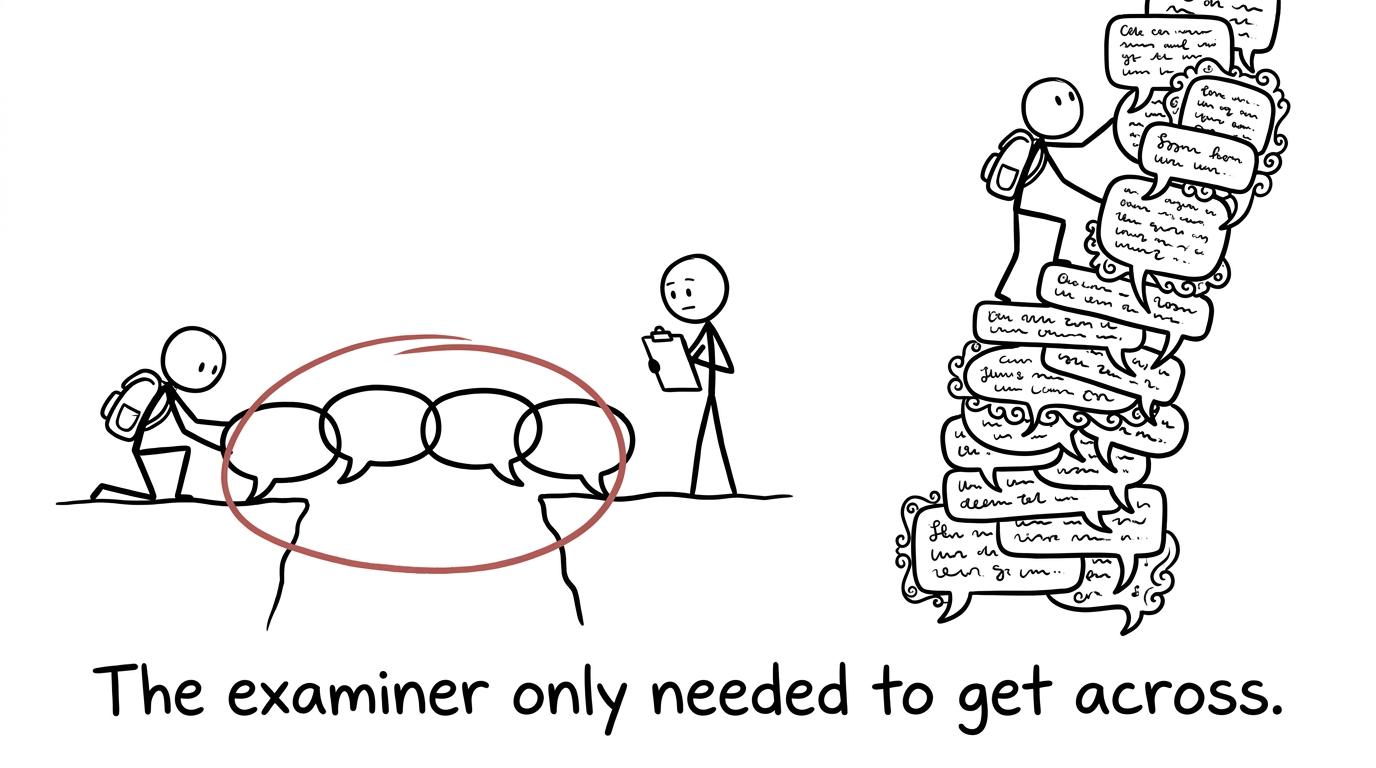 A short bridge of speech bubbles succeeds while an ornate vocabulary tower wobbles
Why longer answers are not automatically better
A role-play is not the section in which you need to display everything you know. AQA recommends roughly 111 to 1.51.51.5 minutes for the whole task, and Pearson Edexcel gives the same recommended range. The responses are meant to be concise.
Extra language creates extra opportunities to contradict yourself, drift away from the prompt or lose the required detail inside a long sentence. The strongest answer is often the shortest one that communicates the complete message naturally.
Pearson Edexcel specifically states that a one-word response cannot earn more than 111 mark. A few words or a short phrase may be enough for full communication, so do not confuse concision with giving isolated vocabulary. Aim for a compact, complete response rather than either extreme.
How to use preparation time effectively
Preparation time should reduce decisions, not produce a script that collapses if the teacher's wording feels unfamiliar.
For each prompt:
- underline the communication function
- circle the number of details required
- note a reliable verb or structure
- check whether you must ask a question
- identify any required timeframe
- rehearse the key information aloud in your head
Then test the card as an interaction. Can you recognise the likely question? Does your planned response answer it directly? Is the crucial word easy to pronounce?
This focused method resembles the short feedback cycles used in MathsGenie's 20-minute GCSE revision routine. One small skill, immediate practice and a quick correction usually beat unfocused rereading. You can organise French speaking practice alongside maths sessions with the free MathsGenie revision planner.
What to do if you do not understand
A missed question does not have to become a blank response. Ask for repetition using a repair phrase you have practised. AQA's guidance explicitly recognises clarification strategies: if clarification allows you to respond successfully, you can still receive the same task mark as if you had understood immediately.
The exact conduct rules vary. Pearson Edexcel teacher-examiners must use the set wording and cannot invent supplementary questions or rephrase them, although prescribed questions may be repeated. Your repair strategy should therefore request repetition rather than expect the teacher to explain the French in a new way.
Most importantly, do not let one difficult prompt consume the rest of the role-play. Listen for the next cue and begin again.
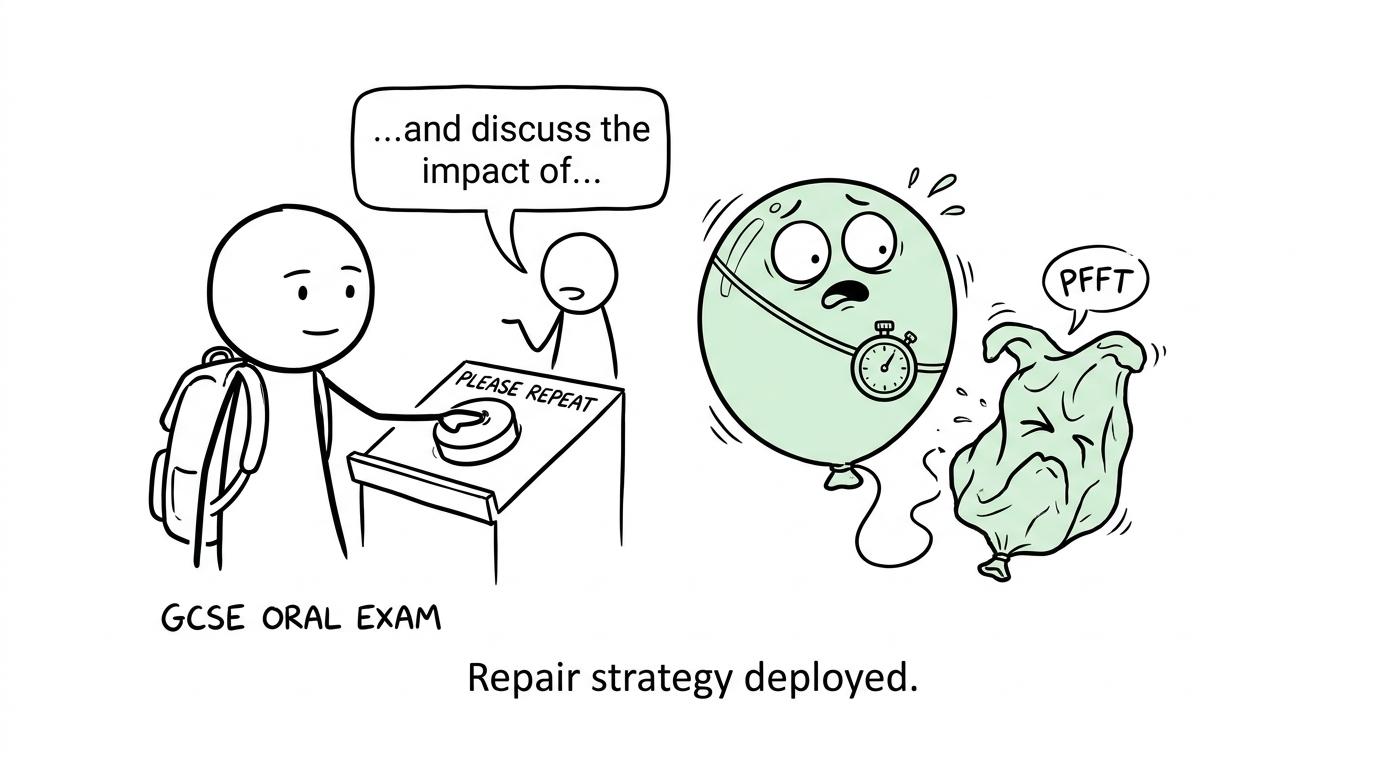 A calm student presses a repeat button and the panic monster deflates
A revision method that matches the marking
Practise in sets of five prompts so that your training resembles the assessment. Record your responses, then mark each one separately:
- Was it relevant?
- Was the complete message clear?
- Did it contain every requested detail?
- Could a listener identify the key words immediately?
- Was the required question unmistakable?
Classify every lost mark. Use labels such as missed detail, wrong task, ambiguity, question formation, pronunciation or listening. Then repeat a different role-play targeting the same weakness.
This is the same evidence-led process students can use across their revision. MathsGenie's GCSE Maths revision hub combines lessons and practice questions, while the GCSE resources collection adds mini tests and predicted papers. When building exam stamina, the Edexcel GCSE Maths past papers provide mark schemes and worked solutions. Different subjects require different knowledge, but the improvement loop remains stable: attempt, mark, diagnose, correct and retest.
Common GCSE French role-play mistakes
Answering the topic instead of the prompt
A familiar word can trigger a rehearsed paragraph. Pause and identify the exact function before speaking.
Missing the second detail
At higher tier in particular, a single bullet may contain more than one demand. Account for each part during preparation.
Giving a one-word answer
This is especially risky under Pearson Edexcel, where one word cannot receive full marks. Use a short phrase that communicates the answer securely.
Forgetting the question prompt
A statement with rising intonation may not communicate the required question clearly. Prepare dependable question structures and match one to the context.
Chasing complexity
An ambitious structure is not useful if it makes the message ambiguous. Secure French earns more than decorative French that breaks down.
Speaking too quickly
Speed can swallow negatives, numbers and endings. Give the examiner time to hear the information carrying the mark.
Treating one mistake as a disaster
Examiners assess the evidence they hear. Correct yourself briefly if needed, then continue. One uncertain response does not erase the remaining prompts.
Clear communication wins the marks
The role-play becomes less mysterious once you stop treating it as a performance. Examiners are listening for a series of completed communication tasks: relevant answers, all required details, clear questions and pronunciation that allows the meaning to arrive intact.
Practise those tasks in short, marked cycles. Keep your answers controlled. Use clarification when necessary, and judge every response by the specification for your own exam board.
For the rest of your GCSE preparation, make MathsGenie your free revision base. Use revision lessons and practice questions to rebuild weak maths topics, mini tests to check recall, and past papers, predicted papers, mark schemes and video solutions to turn uncertainty into a specific next step. The subject may change, but good revision keeps asking the same quiet question: what evidence will the examiner actually reward?










