GCSE French Revision Book Reviews: Buying Guide
GCSE French revision book reviews can mislead. Learn what to check before buying, from exam-board alignment and audio access to answers and usability.
A revision guide can look perfect online: thousands of positive ratings, a polished cover and a promise to contain everything you need. Then it arrives, and the vocabulary belongs to an older course, the listening practice requires missing audio, or the pages are so crowded that you quietly stop opening it.
That is why GCSE French revision book reviews are worth reading before you buy, but star ratings should be the beginning of your investigation, not the conclusion. Check the guide against your exact qualification, edition and learning needs. More importantly, decide whether it will help you practise French rather than simply read about it.
The same principle applies to maths revision. A resource earns its place through useful questions, clear feedback and repeated use, not because it looks impressive on a shelf.
Your pre-purchase checklist
Before buying a GCSE French revision guide, check:
- your exact exam board and qualification specification
- whether the edition covers the course you are currently being taught
- foundation or higher tier suitability, where applicable
- coverage of listening, speaking, reading and writing
- alignment with the prescribed vocabulary and grammar
- access to audio, transcripts, answers and model responses
- whether practice tasks resemble your board's assessments
- page design, explanations and level of difficulty
- whether access codes are reusable when buying second-hand
- what resources your school already provides
If two or three of these details are unclear, pause before paying. A book should reduce uncertainty, not create more of it.
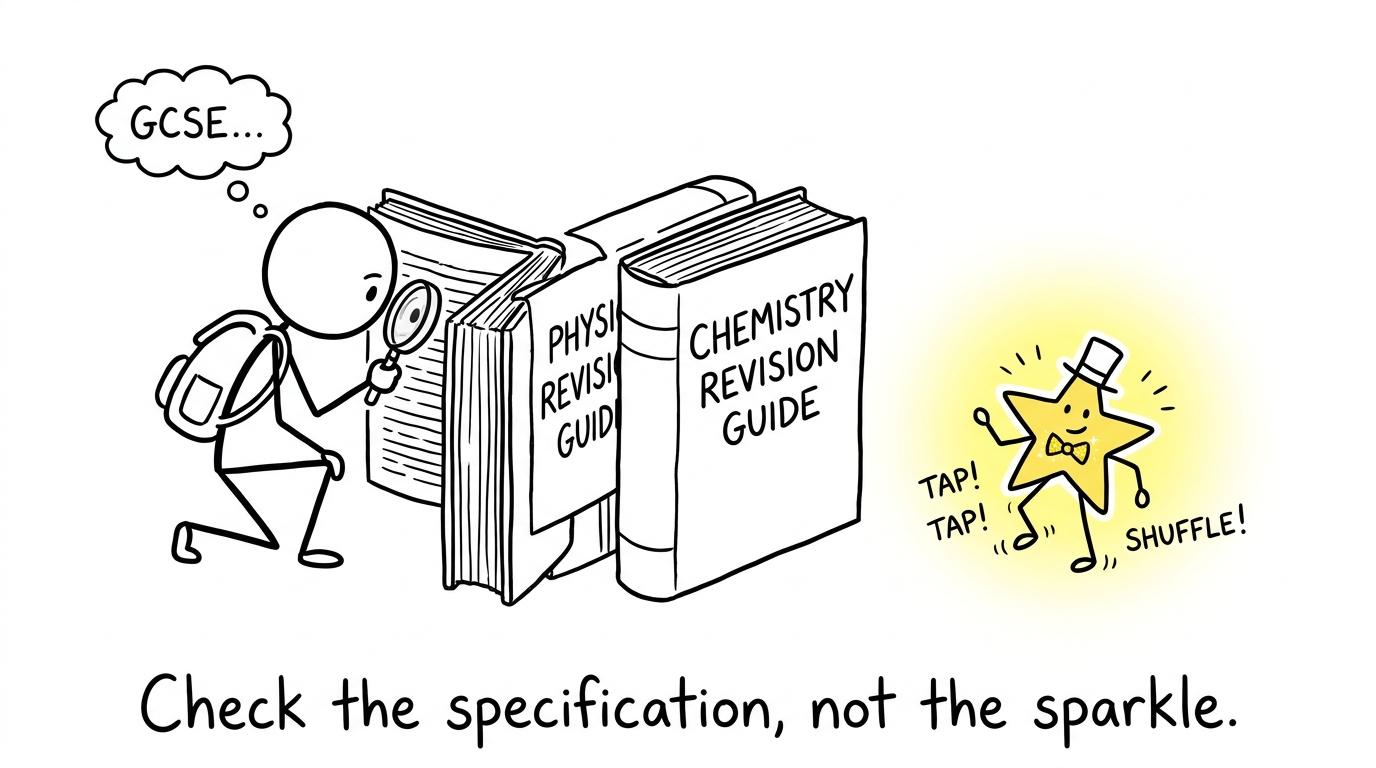 A student investigating revision guides while a five-star sticker tries to distract them
Why star ratings do not tell the whole story
A rating compresses several different judgements into one number. One reviewer may value concise vocabulary lists. Another may want detailed grammar explanations. A parent might review delivery speed rather than educational quality. An older review may describe a previous edition or specification.
Read the written comments with four questions in mind:
- Which edition did the reviewer use? Reviews for different editions can sometimes appear together on retail listings.
- Which exam board were they preparing for? A useful general French guide is not automatically a precise guide to your assessment.
- What did the reviewer actually test? Comments about layout are different from evidence about question quality or audio.
- Does their need resemble yours? A confident higher-tier student and someone rebuilding core vocabulary may reasonably prefer different books.
Treat reviews as clues. Repeated, specific observations are usually more useful than enthusiasm without detail. “The listening transcripts are included and clearly indexed” tells you something you can verify. “Amazing book” does not.
Check the specification before the publisher's promises
The most important words on the cover are not “complete”, “ultimate” or “exam success”. They are the exam board, specification and edition.
GCSE French qualifications have changed over time, and revised GCSE modern foreign language courses began being taught in England from 2024 for first assessment from 2026. That makes the publication date particularly important for students approaching current exams. An older book may still contain sound grammar practice, but it should not automatically be trusted as a complete map of the present qualification.
Ask your teacher for the exact awarding body and specification. Do not infer your French board from your maths board: a school can use Edexcel for GCSE maths and a different awarding organisation for French. Qualifications also differ across England, Wales and Northern Ireland, so the title “GCSE French” alone is not enough.
Then compare the book's contents page with the official specification. Look for current thematic coverage, grammar expectations, prescribed vocabulary and the relevant assessment structure. If a seller only displays the front cover, look for a publisher sample, ISBN, edition statement or contents preview before ordering.
Foundation and higher tier must be clear
Where your qualification is tiered, confirm whether the guide serves foundation, higher or both. A combined book should label the distinction clearly rather than leaving you to guess which vocabulary and tasks are appropriate.
More difficult is not automatically better. Material far beyond your paper can consume time without improving the skills you will be assessed on. Equally, a higher-tier student needs enough challenge to practise extended language, accurate grammar and less predictable comprehension.
Look for practice across all four language skills
A French guide can be excellent at vocabulary and still leave a serious gap. GCSE French assesses receptive and productive language skills, commonly organised around listening, speaking, reading and writing, although the precise paper structure and tasks depend on the specification.
A useful guide should explain how it supports each area:
- Listening: audio recordings, questions, transcripts and accessible playback instructions
- Speaking: prompts, pronunciation support and tasks that can be practised aloud
- Reading: varied texts with questions that require understanding rather than word spotting
- Writing: structured practice, grammar guidance and responses against which you can evaluate your work
Listening cannot be recreated fully by silently reading a transcript. Speaking cannot be improved entirely inside your head. Before buying, test every QR code or sample audio link you can access and check whether an account, app or separate purchase is required.
For a second-hand book, establish whether any digital code has already been redeemed. A cheap copy without essential audio may offer poor value.
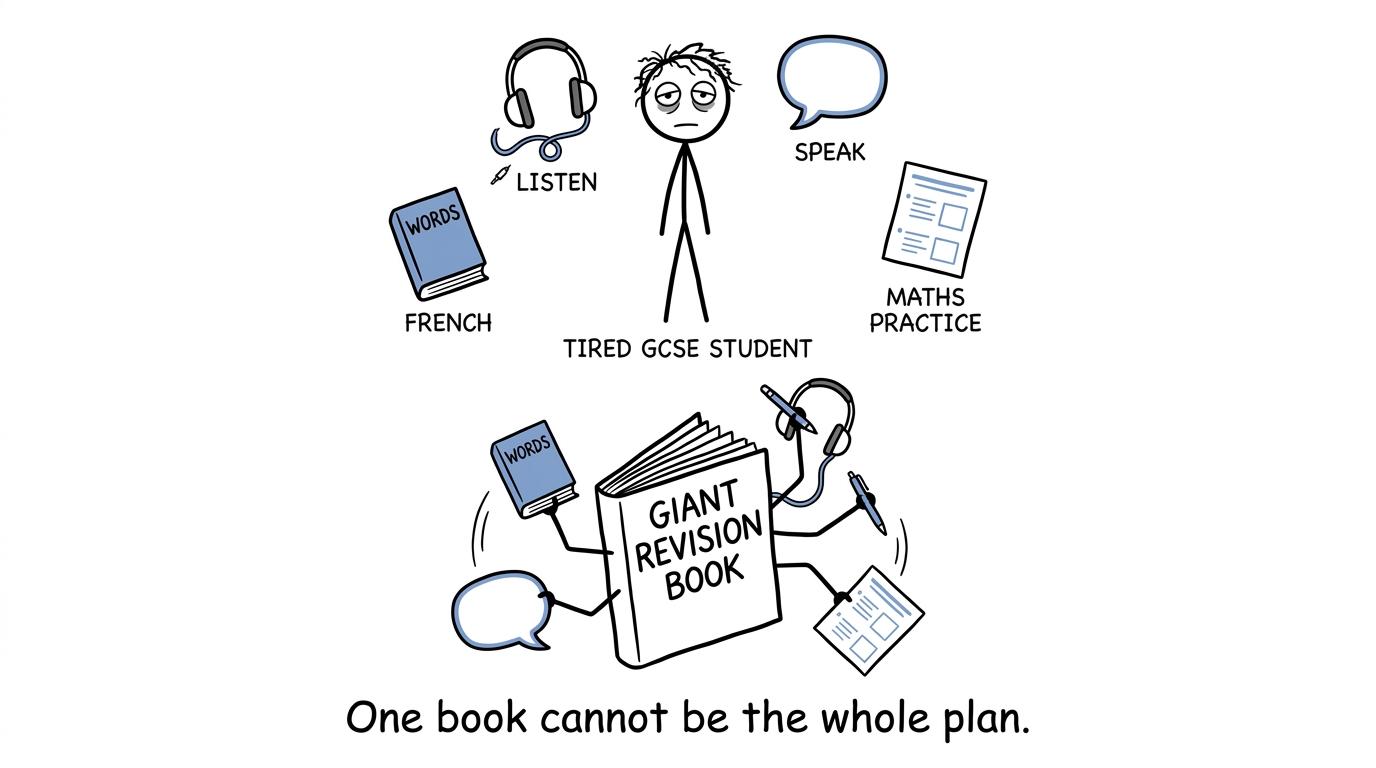 A many-armed revision book tries unsuccessfully to replace speaking, listening and practice tools
Inspect the answers, not just the questions
Questions create activity. Feedback creates improvement.
Check whether the book provides full answers, listening transcripts and useful guidance for open-ended tasks. A bare answer may be sufficient for a vocabulary match, but extended writing needs more. Model responses can reveal appropriate structure and language, while commentary or success criteria can help you notice tense control, agreement, word order and accuracy.
However, a model answer is not a script to memorise blindly. The real value lies in identifying reusable language and understanding why the response works.
This is familiar territory for maths students. On MathsGenie, GCSE maths revision lessons and questions are useful because learning can move from explanation to practice and checking. The same loop should shape French revision:
- retrieve vocabulary or grammar without notes
- complete a listening, speaking, reading or writing task
- check the answer, transcript or criteria
- identify one precise weakness
- return to that weakness with fresh practice
A French book that cannot support this loop is mainly a reference book. That may still be useful, but it should be sold and judged as one.
Decide whether the layout will help you return
The best revision guide is rarely the one with the most content. It is the one whose content you can find, understand and revisit.
Use preview pages to examine:
- whether explanations are readable without being vague
- whether vocabulary is presented in meaningful contexts
- whether grammar tables include enough guidance
- whether answers are easy to locate without seeing them accidentally
- whether pages provide space to think rather than overwhelming you
- whether sections are short enough for realistic revision sessions
Imagine using the book on a tired Wednesday evening. Can you choose one task and begin within a minute? If not, the design may create friction every time you revise.
This is why structured resources work well in maths too. MathsGenie's GCSE mini tests provide short, focused practice, while the guide to finding your weakest GCSE topics explains how evidence can replace guesswork. A good French guide should make similarly focused sessions possible.
Test the book before committing
If possible, borrow the guide from your school library, inspect a classmate's copy or examine legitimate sample pages from the publisher. Do not merely flick through it. Try using one section for a short revision session.
Ask yourself afterwards:
- Did I retrieve or produce any French?
- Could I check my work properly?
- Did the activity reveal a specific gap?
- Do I know what to practise next?
- Would I willingly use this format again?
Also check what you already own. Your teacher may provide vocabulary lists, booklets, audio and past assessments. Buying another all-in-one guide can duplicate those materials while leaving the real gap, perhaps regular speaking practice, untouched.
Fit the French guide into a wider GCSE plan
French is unlikely to be your only exam. A useful purchase must fit alongside maths, English, sciences and your other subjects without taking over the timetable.
A revision book is therefore best treated as one tool in a balanced system. Use it for focused knowledge and skill practice, then combine it with teacher feedback, spoken rehearsal and official exam-style material relevant to your qualification.
For maths, you can keep that parallel workload organised through a realistic GCSE maths revision timetable. Move from topic practice to Edexcel GCSE maths past papers, or select the matching board from the main revision hub. Closer to the exams, GCSE predicted papers can provide additional unseen practice after core topics have been revised.
The principle across both subjects is simple: learn, practise, mark, correct and revisit. Owning resources is not the same as using them.
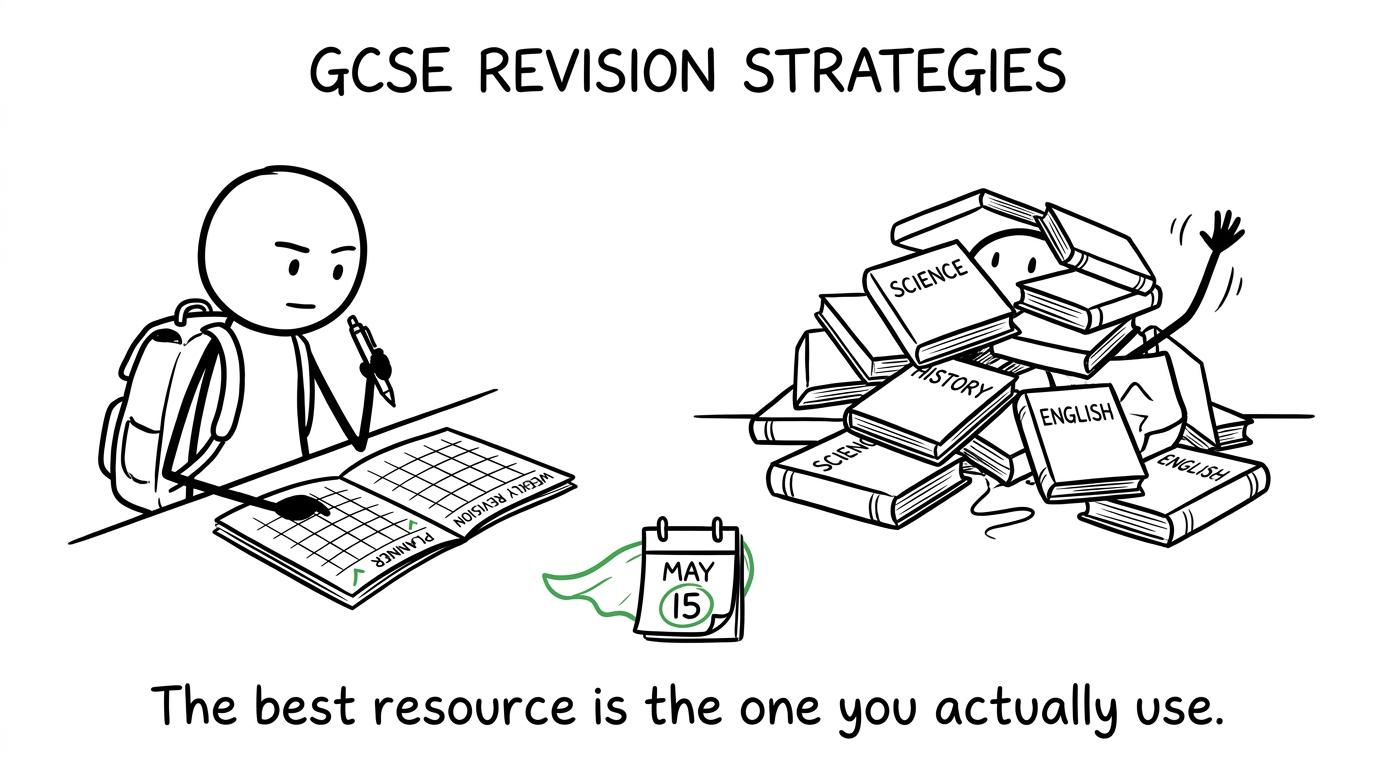 A superhero calendar saves one student while another disappears beneath unopened books
Common mistakes when choosing a French revision book
Buying by cover or rating alone
A polished design and high rating cannot confirm specification alignment, useful audio or suitable difficulty. Inspect the contents and sample material.
Choosing an outdated edition unknowingly
Older grammar exercises may remain useful, but assessment structure, vocabulary requirements and task types can change. Verify the edition against the course your teacher has named.
Assuming “all exam boards” means exact coverage
A general guide may teach valuable French without matching your board's precise assessment. Decide whether you need broad language support or board-specific exam preparation.
Ignoring audio and speaking practice
A book dominated by reading and writing cannot, by itself, provide balanced preparation. Check how listening and spoken French are supported.
Buying a second-hand copy with unusable digital access
Confirm that audio is freely available or that any required code remains valid. Also check whether answers have been written into the exercises.
Collecting resources instead of completing them
Several partly used books usually create more decisions, not more progress. Choose one core guide, use it consistently and add another resource only to solve an identified gap.
The final verdict
Yes, reviewing a GCSE French book before buying it is worth the effort. But the strongest review is your own structured check: correct specification, current edition, suitable tier, balanced skill coverage, dependable audio, meaningful answers and a format you will genuinely use.
Look beyond the stars. A revision guide should turn limited time into deliberate practice.
Then protect the rest of your GCSE preparation. Use MathsGenie's GCSE maths revision hub for free revision lessons, practice questions and video solutions. Build exam confidence with past papers and mark schemes, use mini tests to expose small gaps, and add predicted papers when you are ready for mixed, timed practice. Choose resources carefully, then let consistent use do the work.