

GCSE French Remark Appeal: Is It Worth It?
GCSE French remark appeal guidance: understand reviews, fees, deadlines and risks, then decide whether challenging your result is genuinely worthwhile.

Results day can shrink an entire course into one unsettling number. You remember the vocabulary learnt, the listening papers completed and the speaking answers rehearsed. Yet the grade on the page is not what you expected.
A GCSE French remark appeal may be worth requesting when you are close to the next grade boundary and a teacher can identify a credible marking error. It is usually less worthwhile when the decision rests only on disappointment or a general belief that the examination went better. The sensible first step is to obtain your component marks and, where available, copies of your marked work before paying for anything.
The process also has a risk: after a review, your mark and grade can go down, stay the same or go up.
The quick decision checklist
Before requesting a review, ask:
- How many marks am I below the next overall grade boundary?
- Which French component appears lower than expected?
- Has a French teacher inspected the marked script or available assessment evidence?
- Can the teacher identify a specific possible marking or clerical error?
- Would a higher grade affect sixth-form entry, a course requirement or another important decision?
- Am I prepared for the mark to decrease?
- What fee and internal deadline has my school set?
Being one mark below a boundary is not proof of incorrect marking. But a small gap, combined with strong evidence from the script, can make a review more reasonable.
A remark is officially a review of marking
Students often ask for a “remark”, but the formal post-results service is normally called a review of marking. That distinction matters.
The reviewer does not simply ignore the original result and mark the entire component from scratch according to personal preference. They check whether the mark scheme was applied correctly, whether every response was considered, and whether any academic judgement was unreasonable.
French contains responses where judgement matters, particularly in writing and speaking. Two trained examiners may reasonably differ slightly without either examiner making an error. A review changes marks where an actual marking error is identified, not merely because another mark might also have been defensible.
This is why “I thought my writing was good” is weak evidence. “The response satisfies a stated mark-scheme criterion that appears not to have been credited” is much stronger.
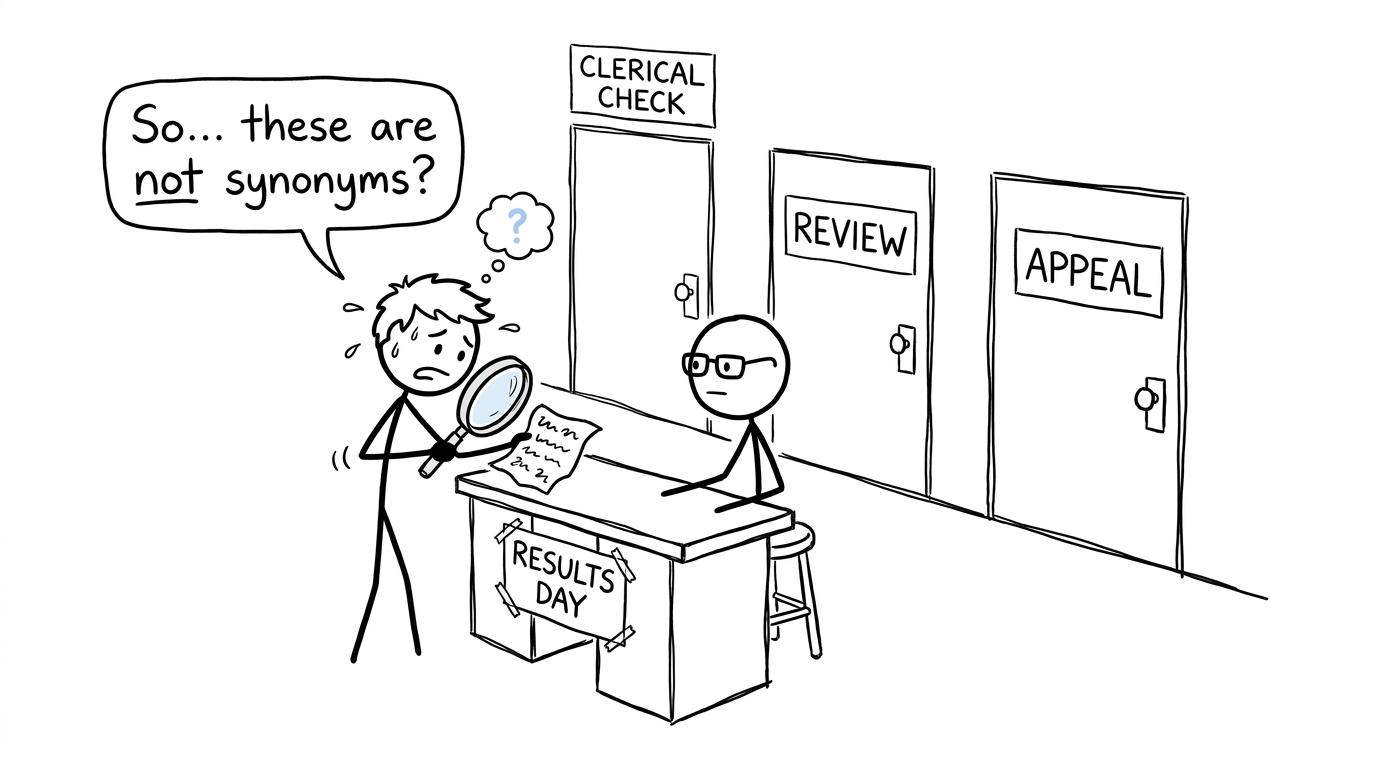 A student discovers that post-results services are not synonyms
How the GCSE French post-results process works
Although AQA, Pearson Edexcel, OCR and Eduqas publish their own administration details, the main route follows the Joint Council for Qualifications framework.
Get your component marks
Your overall French grade is built from separate assessed components, commonly covering listening, speaking, reading and writing. Ask your exams officer or French department for the mark awarded to each component and the relevant grade boundary information.
Calculate your gap to the next grade using:
mark gap=next grade boundary−current total mark\text{mark gap}=\text{next grade boundary}-\text{current total mark}mark gap=next grade boundary−current total markUse the boundary for your exact exam board, specification, tier and examination series. Boundaries can change between years. Maths students will recognise the same principle from the guide to how GCSE grade boundaries work: a boundary is a threshold, not a prediction of how many marks a review will find.
Request access to the assessment evidence
Where the exam board's access-to-scripts service covers the component, your school can request the marked paper. Access arrangements for recordings and other assessment evidence can differ, so ask the exams officer what is available for your French specification.
A subject teacher should then compare the evidence with the mark scheme. This is the most valuable part of the decision. It turns a request based on hope into one based on evidence.
Do this quickly. Access-to-script deadlines may arrive before the final deadline for reviews, and schools often impose an earlier internal deadline so staff have time to inspect the work and submit the request.
Choose the correct service
A clerical re-check checks administrative matters such as whether all pages were marked and whether marks were recorded and totalled correctly. It does not reconsider the quality of an answer.
A review of marking includes checks on the marking itself and normally incorporates the clerical checks. This is generally the relevant service if a teacher believes the mark scheme was applied incorrectly.
A review of moderation concerns internally marked work that was moderated by the exam board. It is normally requested for a centre's cohort rather than by one student. Your school will know whether this is relevant to any assessment in your specification.
Give written consent
For a clerical re-check or review of marking, your school must obtain your written consent after results have been issued. This confirms that you understand the outcome may lower, confirm or raise your mark and subject grade.
For most school candidates, the exams officer submits the request. Parents and students do not usually submit directly to the board. Private candidates may have a direct route or may need to work through their entering centre, depending on the board.
Wait for the outcome
A standard review of marking is generally completed within the published post-results timescale, commonly up to 20 calendar days after the board receives a valid request. The outcome will be sent to your centre, which should then tell you whether the mark or grade changed.
When is a GCSE French remark genuinely worth it?
A review is most defensible when several pieces of evidence point in the same direction.
You are close to a meaningful boundary
A small mark gap makes a grade change possible with fewer corrected marks. The word meaningful matters. Moving from a grade 333 to a grade 444, or reaching a grade required by a particular sixth form, may have an immediate consequence. A higher grade can still feel rewarding without changing your next step, but that changes how you should weigh the fee and risk.
Do not assume proximity guarantees success. Grade boundaries do not alter because a student narrowly missed them, and the setting of a boundary itself is not something an individual candidate can appeal.
A teacher finds specific concerns
The strongest reason is professional evidence. Your teacher may notice an unmarked section, a response placed in an apparently inappropriate level, or credit omitted despite the mark-scheme requirements being met.
Writing and speaking can involve academic judgement, so disagreement alone is insufficient. The question is whether the original mark could reasonably have been awarded by a trained examiner applying the scheme properly.
One component looks unexpectedly weak
A sharp difference between your usual performance and one component is a reason to investigate, not automatic evidence of an error. Listening conditions, misunderstood questions, timing or an unfinished writing response can all produce a genuine lower mark.
Compare the component with your script and mark scheme rather than relying only on mock grades. Mocks may have different boundaries, questions and marking conditions.
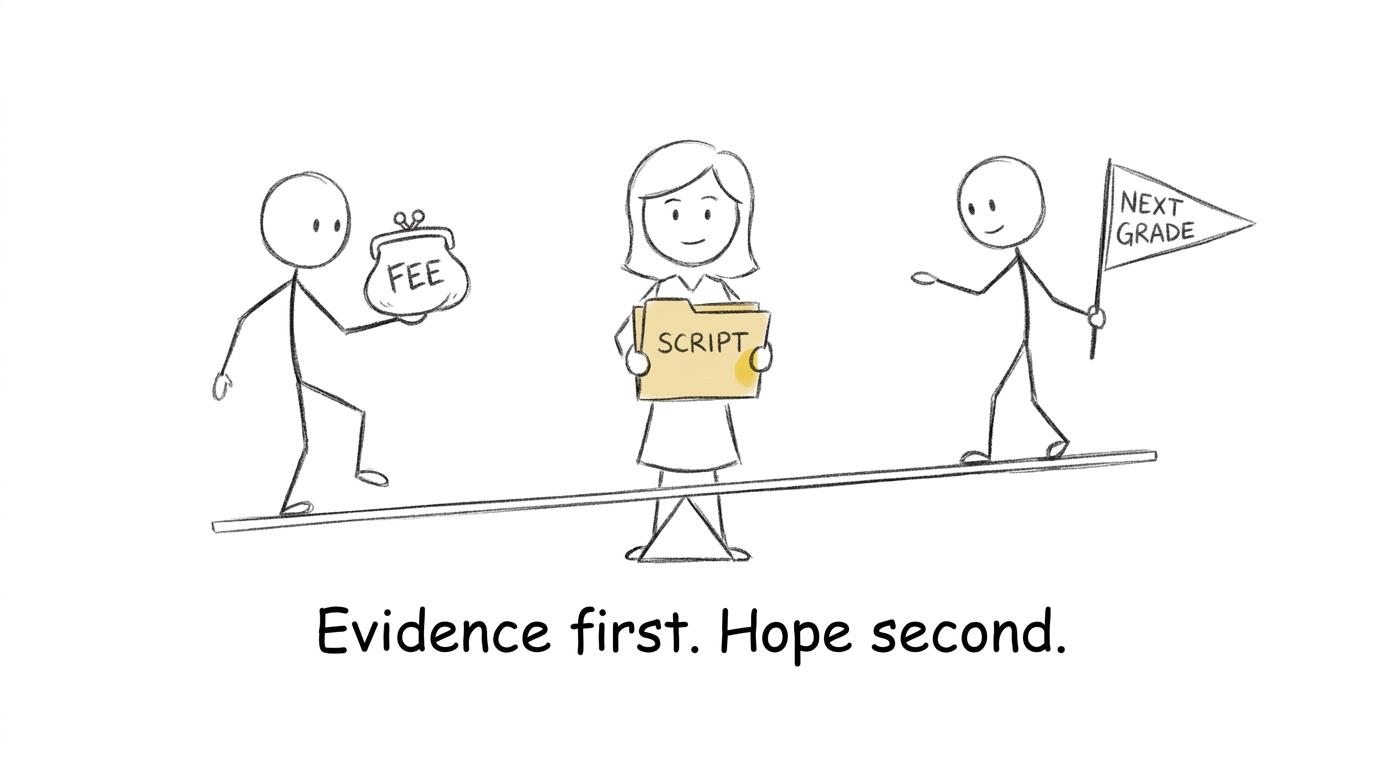 A fee and the next grade are balanced after examining the script
When a review is probably not worth the fee
Think carefully if you are many marks below the next boundary and nobody can identify a likely error. Several marks can change, but requesting multiple component reviews simply because each one might rise can become expensive.
A review is also less compelling when:
- the marked evidence supports the original award;
- the expected grade came mainly from optimistic predictions;
- the higher grade would not affect your next step;
- you are unwilling to accept a possible reduction;
- the request is driven by comparison with friends rather than your own work.
There is no shame in deciding not to proceed. Good decisions are not defined by whether you challenge a result. They are defined by whether you use the available evidence calmly.
How much does a French review cost?
Fees are normally charged per component rather than once for the whole subject. They differ between AQA, Edexcel, OCR and Eduqas and can change each examination series. A school may also apply an administration charge or choose to cover some costs itself.
Some boards waive the review fee when the overall subject grade changes, but the exact charging rule matters. Ask your exams officer for the current written fee schedule before consenting. Do not rely on figures from a previous results season.
For the June 2026 series, published board deadlines for standard post-results requests fall in September, with AQA and WJEC/Eduqas listing 24 September 2026. Your school is likely to set an earlier date. Always follow the date supplied by your own exams office for your board and series.
 A results deadline makes a rapid escape
What is an appeal after a review?
An appeal is not the first step and it is not simply another chance to ask for a more generous mark. Your school must normally receive the outcome of the relevant review of results before appealing.
An appeal can argue that a marking error remained after the review or that the exam board failed to apply its procedures consistently, properly or fairly. It needs clear grounds and supporting evidence.
For a school candidate, the head of centre submits the appeal. A private candidate can usually submit through the route specified by the board. Under the standard JCQ timetable, an appeal against a review outcome must normally be lodged within 30 calendar days of that outcome. A preliminary appeal comes first; an appeal hearing may follow if the preliminary stage does not resolve the concern.
Appeal fees are considerably higher than ordinary review fees and vary by board and stage. Your grade can still fall, remain unchanged or rise, so candidate consent is required. If your school does not support a request, ask for its internal appeals procedure promptly rather than waiting until the external deadline is close.
Common mistakes when requesting a French remark
Treating one mark below as proof
A narrow miss feels arbitrary, but the boundary does not create a marking error. Evidence must come from the assessed work and mark scheme.
Reviewing every component immediately
Fees are usually component-based. Begin with component marks and available scripts, then target the component where there is a credible concern.
Missing the school's deadline
The awarding body's final date is not necessarily your deadline. A school needs time to obtain consent, inspect evidence and complete the submission.
Confusing a clerical re-check with a marking review
A clerical service will not reconsider whether a French response deserved a higher level. Choose the service that matches the suspected problem.
Forgetting the downside
There is no automatic grade protection. A corrected error can reduce a mark as well as increase it.
Appealing without clear grounds
An appeal is not based on dissatisfaction alone. It should identify a remaining marking error or a procedural failure after the review.
Keep the rest of your GCSE plan moving
Post-results decisions can absorb more attention than they deserve. Gather the evidence, meet the deadline and make the decision. Then return your energy to what you can still influence.
If maths is part of your next examination season or a resit plan, use the GCSE Maths revision hub to choose your board and tier. The GCSE Maths topics by exam board guide can organise weak areas, while the MathsGenie revision planner turns those areas into a manageable routine.
Move from revision lessons to practice questions, then test the result with GCSE predicted papers. Use past papers properly by marking them carefully and learning from every lost mark. If you need to understand historical thresholds, compare the dedicated AQA GCSE grade boundaries and OCR GCSE grade boundaries pages.
Make the decision from evidence, not emotion
A GCSE French review is worth considering when the grade matters, the boundary gap is manageable and a teacher can point to a plausible error. An appeal is narrower: it follows a completed review and requires grounds showing a remaining marking or procedural error.
Start with your exams officer. Obtain your component marks, request the available evidence, ask a French teacher to inspect it and confirm the current fee and deadline. That sequence will not guarantee a higher grade. It will give you something more useful: a decision you can defend.
Then look forward. MathsGenie is ready with free revision lessons, practice questions, mini tests, past papers, predicted papers, mark schemes and video solutions to help turn the next result into one that needs no second look.










