

GCSE French Careers: Where Your Grade Can Help
GCSE French careers explained: discover jobs and apprenticeships where language skills help, when your grade matters, and what to study next.
A GCSE French result can feel difficult to place. You can picture where maths leads, or where science leads, but a language qualification can seem less direct. The useful answer is that GCSE French careers are rarely labelled “French jobs”. Instead, French becomes an extra capability within careers in business, travel, hospitality, logistics, government, education and technology.
A good grade can strengthen an application by showing that you can communicate, listen carefully and work across cultures. It may also help you progress to A Level French. However, GCSE French alone will not normally qualify you as a translator, interpreter or French teacher. Think of it as a door-opener rather than a complete professional qualification.
The short answer: where does GCSE French help?
GCSE French is most likely to get noticed when:
- an employer deals with French-speaking customers, suppliers or colleagues;
- an apprenticeship involves travel, tourism, freight or international trade;
- a customer-facing role values confident communication;
- you want to continue French at A Level or university;
- you combine French with maths, science, computing or business;
- two applicants have similar core qualifications and one offers an additional useful skill.
The British Council has consistently identified French among the languages of strategic importance to the UK. That does not mean every employer demands it. It means French can become valuable in the right organisation, particularly one operating across borders.
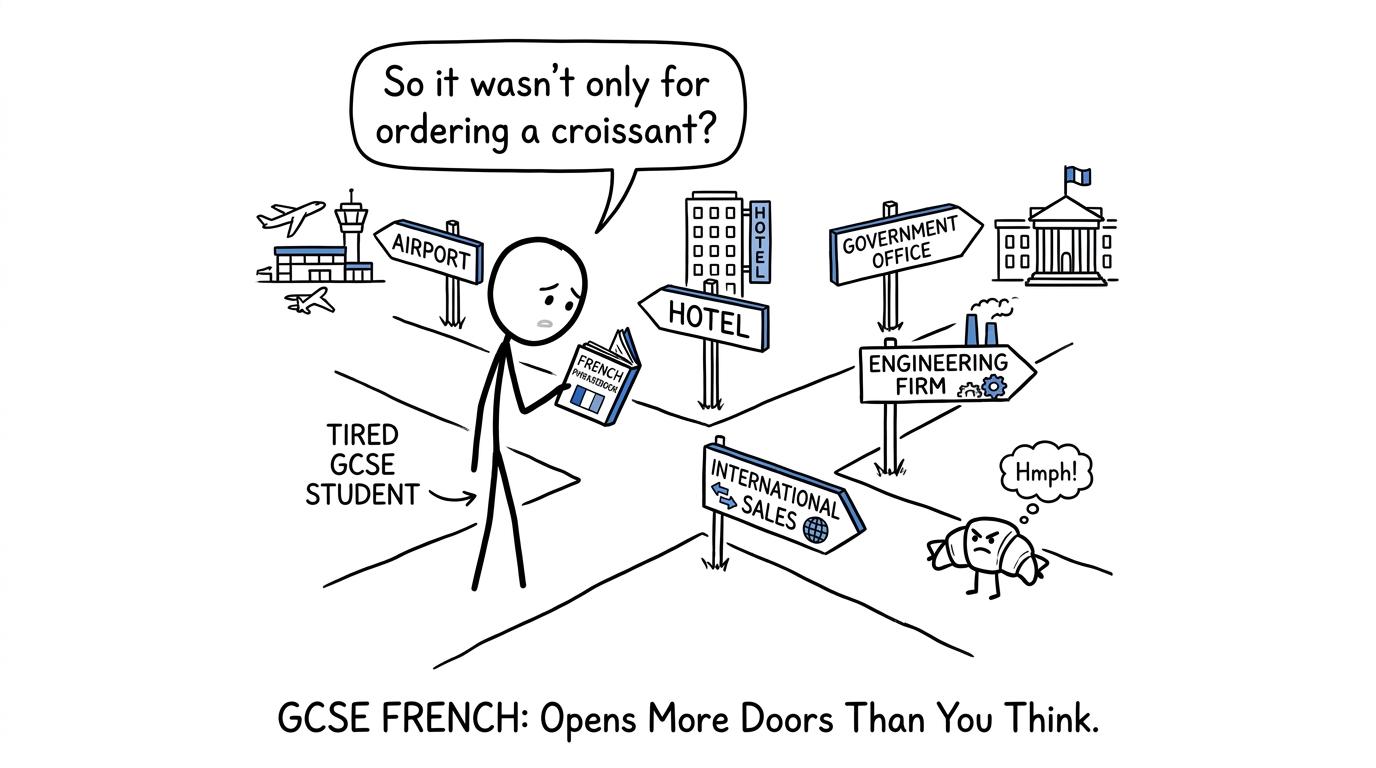 A student discovers that French can point towards several careers
Careers where French can make a practical difference
International business and sales
Companies selling products or services overseas need people who can build relationships. French may help in account management, purchasing, marketing, customer support and international sales.
At GCSE level, your qualification signals a foundation rather than professional fluency. It can still be worth mentioning when an employer has customers in France, Belgium, Switzerland, Luxembourg, Canada or French-speaking parts of Africa. If you continue learning, that foundation may eventually allow you to write emails, support meetings or understand customer enquiries.
Maths matters here too. Sales forecasts, profit margins, exchange rates and performance data all require numeracy. A student who combines French with strong GCSE maths has two complementary tools: communication and quantitative reasoning.
Travel, aviation and tourism
French can be useful in cabin crew, airport operations, passenger services, travel consultancy, tour operations and visitor attractions. Language ability is especially relevant when a job involves helping passengers, explaining arrangements or responding calmly when plans change.
Career guidance on language-related apprenticeships includes routes such as passenger transport operative and cabin crew. These are examples of relevant apprenticeship areas, not a guarantee that every vacancy will request French. Employers set their own entry requirements, so always inspect the current advert.
Hospitality offers similar possibilities. Hotels, resorts, event venues and restaurants may value staff who can welcome French-speaking guests. In these roles, useful communication often matters more than being able to recite perfect grammar.
Logistics, shipping and international trade
Goods cross borders even when employees do not. Freight forwarding, supply-chain operations, customs support, procurement and import-export administration all involve communication between organisations.
An international freight forwarding apprenticeship may not list French as essential. Nevertheless, an applicant who understands another language and has good numeracy can offer a useful combination. Logistics teams work with quantities, schedules, costs and changing delivery information. French can help with the people; maths helps with the system.
If the numerical side interests you, use the GCSE Maths revision hub to strengthen the skills that sit behind commercial and operational work.
Hospitality and customer service
French can help in hotels, restaurants, conference centres, luxury retail and customer-support teams. The advantage is straightforward: customers feel more confident when somebody can understand them.
A GCSE does not mean you should describe yourself as fluent. It does provide evidence that you have spent time listening, speaking, reading and writing in another language. Current GCSE French specifications assess those communication areas directly, across foundation and higher tier.
For customer-facing apprenticeships, employers may care just as much about reliability, teamwork and clear English. French works best as an additional strength rather than a replacement for those essentials.
Government, diplomacy, defence and public services
Languages can support careers in diplomacy, policy, border work, defence, intelligence and international development. The Foreign, Commonwealth and Development Office and related public bodies operate internationally, while policy roles may involve understanding other countries and communicating with overseas partners.
These careers usually require much more than one GCSE. Depending on the role, you may need A Levels, a degree, specialist training, security clearance or substantially stronger language competence. Still, GCSE French can be the first credible step in that direction. It shows an early willingness to understand a world beyond your immediate surroundings.
Teaching, translation and interpreting
These are the careers most obviously connected to French, but they require the clearest warning: a GCSE is a starting point, not the professional endpoint.
Secondary French teaching normally requires degree-level study or equivalent subject knowledge, followed by an approved teacher-training route. Translation and interpreting generally demand advanced language ability, excellent English and specialist knowledge. Legal, medical and technical language can be particularly demanding.
If one of these careers appeals to you, the sensible route is to continue French after GCSE, develop cultural knowledge and investigate the exact higher education or training requirements.
Engineering, technology, finance and data
French becomes particularly interesting when paired with a technical subject. International engineering firms, banks, software companies, consultancies and manufacturers do not only recruit linguists. They recruit engineers, analysts, developers and financial specialists who may need to collaborate with overseas offices or clients.
This is where subject combinations matter. French plus maths can support international finance or data analysis. French plus physics may suit engineering. French plus computing can help in technical support, software implementation or cyber security environments with international teams.
If you are considering one of these routes, build your mathematical foundations through the Edexcel GCSE Maths revision area, or use the wider hub to select AQA, OCR or Eduqas resources.
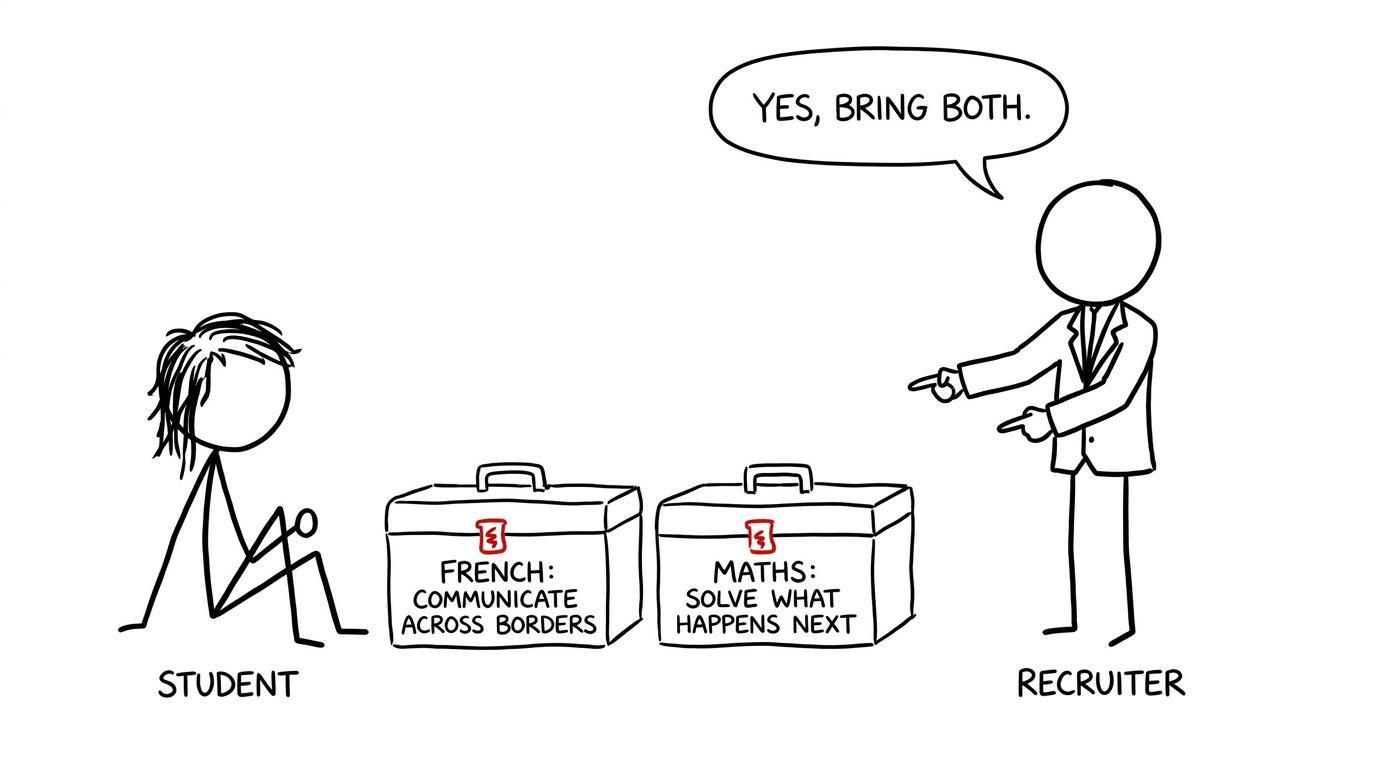 A recruiter asks a student to bring both language and maths skills
Apprenticeships where French may get noticed
There is not one standard “GCSE French apprenticeship”. Language skills tend to appear as desirable extras within broader programmes. Relevant areas can include:
- cabin crew and passenger transport;
- travel consultancy and hospitality;
- business administration;
- international freight forwarding;
- customer service and sales;
- bid and proposal coordination;
- marketing and events;
- policy and public-sector administration.
Entry requirements vary by employer, role and apprenticeship level. Many advanced apprenticeships ask for several GCSEs at grades 999 to 444, often including English and maths, but you must check each live vacancy rather than relying on a general rule. French might be essential, desirable or simply something that helps your application stand out.
That makes your maths grade important. Before applying, diagnose gaps using GCSE maths past-paper guidance, then use MathsGenie's method for finding weak topics instead of revising everything equally.
How employers are likely to read your French grade
A qualification communicates more than its subject title. A good GCSE French result can suggest that you have practised:
- listening for precise information;
- responding under time pressure;
- communicating in speech and writing;
- remembering and applying vocabulary;
- noticing patterns in grammar;
- persisting when understanding is incomplete.
Those are transferable skills, but avoid exaggerating what the grade proves. An employer may still test your spoken French or ask how recently you have used it. If you earned a strong grade but have not spoken French for two years, say so honestly and explain how you are refreshing it.
On an application, connect the qualification to the role. “GCSE French, grade 777” is evidence. “Used listening and speaking skills developed through GCSE French to communicate confidently with visitors” is a clearer explanation, provided it is true.
Should you take A Level French?
Consider A Level French if you enjoy the subject, can meet your sixth form or college's entry requirement and may want an internationally focused career. It develops the language beyond everyday GCSE contexts and usually carries more weight for roles that genuinely require French.
You do not have to choose between languages and technical subjects. French alongside maths, economics, sciences or computing can create a distinctive combination. If A Level Maths is part of your plan, explore the A Level Maths past-paper collection to see how the demands develop after GCSE.
Your decision should rest on interest, likely attainment and future course requirements. A subject is useful when you can sustain the effort needed to become good at it.
Common mistakes when thinking about GCSE French careers
Assuming French only leads to teaching
Teaching is one route, but languages also support business, logistics, tourism, policy and technical careers. Look for organisations with international customers or operations rather than searching only for jobs with “French” in the title.
Claiming fluency from a GCSE
A GCSE grade demonstrates assessed learning at that level. It does not automatically equal professional fluency. Describe your ability accurately and keep practising.
Ignoring English and maths requirements
Apprenticeships often pay close attention to core qualifications. French may distinguish you, but it will not necessarily compensate for missing English or maths requirements. Use a sustainable one-month GCSE maths revision plan if your exams are approaching.
Treating every vacancy as identical
One airline, hotel or freight company may value French highly; another may prioritise a different language or skill. Read the person specification and tailor your evidence.
Listing a grade without showing its relevance
Explain what the qualification helped you develop: communication, accurate listening, cultural awareness or the confidence to keep going when meaning is uncertain.
Turn qualifications into a useful combination
A single GCSE rarely decides an entire career. Careers are usually built from combinations: French and customer service, French and engineering, French and finance, or French and logistics. The grade gets noticed when it supports something an organisation genuinely needs.
Keep improving the core qualifications that apprenticeship providers and employers commonly inspect. Start at MathsGenie's free GCSE Maths hub, use revision lessons and practice questions to repair weak topics, then test yourself with mini tests, past papers and mark schemes. Nearer the exams, add Edexcel predicted papers and video solutions to sharpen your timing.
French may help you speak across borders. Maths may help you understand the decisions being made there. Together, they can give you more options than either subject first appears to offer.










