GCSE Food and Nutrition February Half-Term Revision
GCSE food and nutrition February half term revision: build a focused, balanced plan for theory, NEA reflection, food maths and other subjects too.
Make half-term useful without giving it everything
February half-term can create a strange kind of pressure. A free week appears in the calendar, so it feels as though every unfinished topic must fit inside it. Yet the best GCSE food and nutrition February half term revision plan is not a seven-day marathon. It is a focused checkpoint: identify your weakest areas, complete a few active revision sessions, maintain your maths, and leave with a plan you can continue afterwards.
That last point matters. Half-term should improve the weeks that follow, not become your only revision window.
For most students, the practical target is four or five Food Preparation and Nutrition sessions across the break, supported by short maths maintenance sessions and genuine time away from schoolwork. You are trying to build momentum, not exhaust it.
Your half-term revision checklist
Before creating a detailed timetable, keep the plan simple:
- Confirm your exam board and specification.
- Separate written-exam knowledge from NEA-related reflection.
- Choose three weak theory areas rather than revising everything.
- Include retrieval, exam questions and marking in each session.
- Practise food-related calculations such as percentages, ratios and unit conversions.
- Keep two or three short GCSE maths sessions in the week.
- Schedule rest and one catch-up block.
- Decide what you will revisit after half-term.
Use the free MathsGenie revision planner to place these sessions around your other subjects. A plan becomes more realistic when you can see the whole week rather than one subject in isolation.
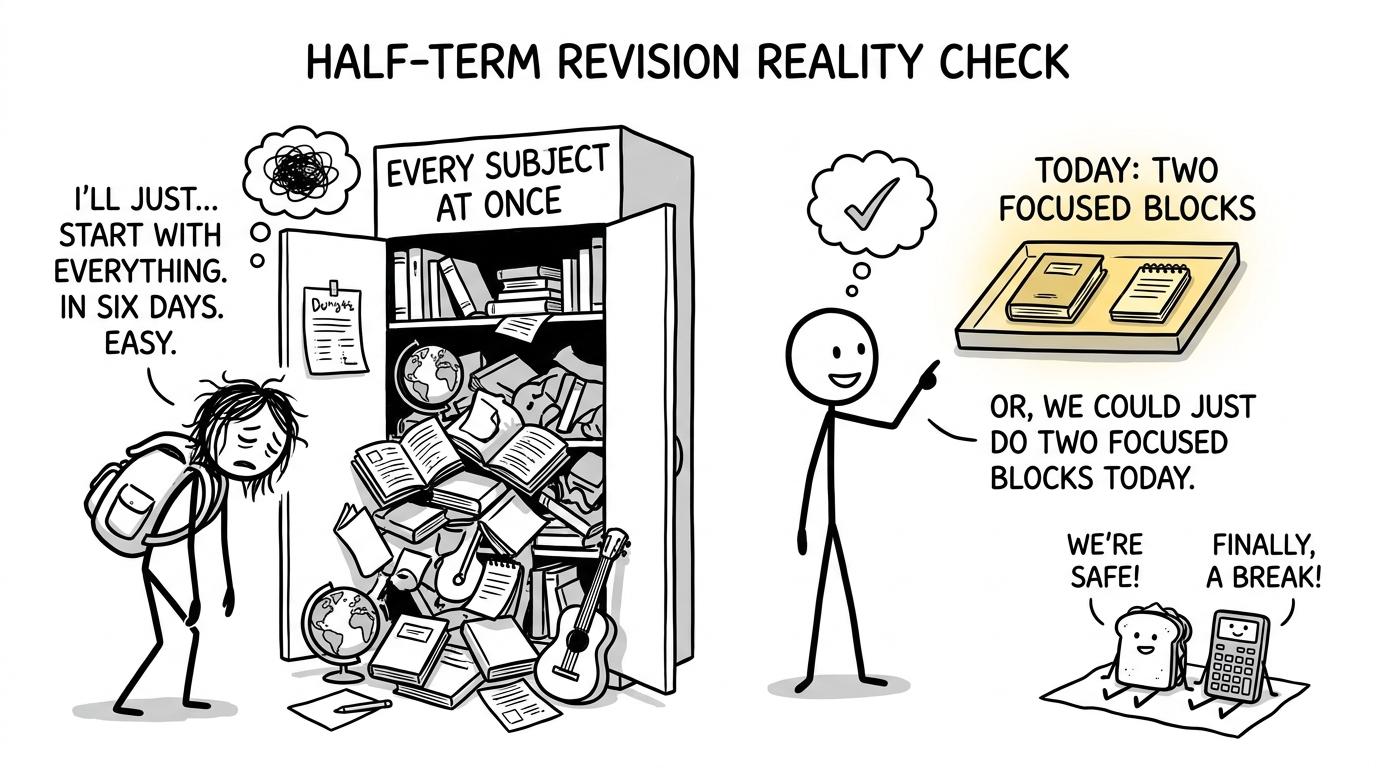 A student chooses two focused revision blocks instead of opening the cupboard of every subject at once
Begin with the specification, not your notes
GCSE Food Preparation and Nutrition is built around both theoretical understanding and practical application. Across the regulated qualification, the written examination contributes 50%50\%50% and non-exam assessment contributes 50%50\%50%. Within the NEA weighting, the food investigation accounts for 15%15\%15% and the food preparation task accounts for 35%35\%35%.
The detailed organisation varies by exam board. AQA groups its theory into food, nutrition and health; food science; food safety; food choice; and food provenance. OCR and Eduqas organise some material differently, and written-paper lengths are not identical. Check whether you study AQA, OCR or Eduqas rather than borrowing somebody else’s checklist.
Your school also controls important internal arrangements for supervised and authenticated NEA work. Half-term is therefore a good time to organise your own knowledge and questions, but you should not assume that unsupervised work can simply be added to a submitted portfolio. Follow your teacher’s instructions.
Create three lists from your specification:
- Secure: topics you can explain without notes.
- Shaky: topics you partly recognise but cannot apply confidently.
- Missing: topics you cannot currently explain.
Choose two shaky topics and one missing topic. This turns a large course into a manageable half-term target.
Use a focused five-session plan
The following structure leaves room for maths, other GCSE subjects and rest. Each Food Preparation and Nutrition session can last roughly 454545 to 606060 minutes. Stop at the planned time; an ending makes it easier to return tomorrow.
Session one: diagnose your gaps
Complete a short selection of questions from your own exam board without opening your notes. Include recall, application and one longer response if possible.
Mark the work using the official mark scheme supplied by your school or exam board. Record each error under one of four labels:
- missing knowledge;
- weak application;
- misunderstood command word;
- incomplete explanation.
A total mark tells you how the attempt went. An error label tells you what to do next.
Session two: nutrition and health
Revise macronutrients, micronutrients, sources, functions, deficiencies, excesses and the needs of different groups. Do not spend the whole session highlighting a textbook. Close the book and retrieve information first.
A useful pattern is:
- 101010 minutes of recall;
- 202020 minutes checking and repairing knowledge;
- 202020 minutes answering questions;
- 101010 minutes marking and recording corrections.
Link facts together. Knowing that a nutrient has a function is useful; explaining how food choice affects a person with particular dietary needs is closer to examination thinking.
Session three: food science and food safety
Focus on processes and causes rather than isolated vocabulary. You may need to understand how ingredients behave during preparation and cooking, as well as contamination, storage, temperature control and safe working practices.
Build explanation chains using prompts such as:
- What changes?
- Why does it change?
- Which condition causes the change?
- How does that affect the finished food?
Then answer questions from memory. Food science can feel familiar when reread, but the examination requires you to retrieve and apply it.
Session four: food choice and provenance
Revise factors influencing food choice, including dietary needs, culture, cost, availability, ethics and environmental considerations. For provenance, check that you can connect food origins and production methods to their consequences rather than merely listing terms.
Practise planning extended answers before writing them. A short plan can contain the relevant factor, a developed explanation and a link back to the question. This is more useful than memorising a generic paragraph that may not fit the prompt.
Session five: mixed questions and next steps
Return to the three topics selected at the beginning. Complete a mixed set under light time pressure, mark it, and compare the errors with Session One.
Anything still weak becomes part of your post-half-term plan. Anything improved should be revisited briefly after a few days. Revision is not finished because something felt clear once.
Protect your GCSE maths while focusing on food
A Food Preparation and Nutrition week should not make maths disappear. Two or three sessions of 202020 to 303030 minutes are enough to maintain continuity while Food remains the half-term priority.
Start at the GCSE maths revision hub, where you can choose your exam board and access revision lessons, question banks, worksheets, papers and solutions. Foundation and higher tier students should use resources matched to the paper they will actually sit.
Food contexts also rely on familiar numerical skills:
- scaling quantities using ratio and proportion;
- converting between units;
- interpreting nutritional information;
- calculating percentages;
- comparing costs and quantities;
- reading tables and graphs;
- finding and interpreting averages.
Keep the core relationships visible:
percentage=partwhole×100\text{percentage} = \frac{\text{part}}{\text{whole}} \times 100percentage=wholepart×100 mean=sum of the valuesnumber of values\text{mean} = \frac{\text{sum of the values}}{\text{number of values}}mean=number of valuessum of the valuesFor targeted support, use the GCSE ratio revision guide and GCSE averages lessons. The underlying maths is useful across specifications, although your final exam practice should match your own board.
Do not turn every maths session into a full paper. A short lesson followed by practice questions and immediate marking is enough to keep methods available. If you are unsure which skills need attention, use MathsGenie’s guide to finding your weakest GCSE topics.
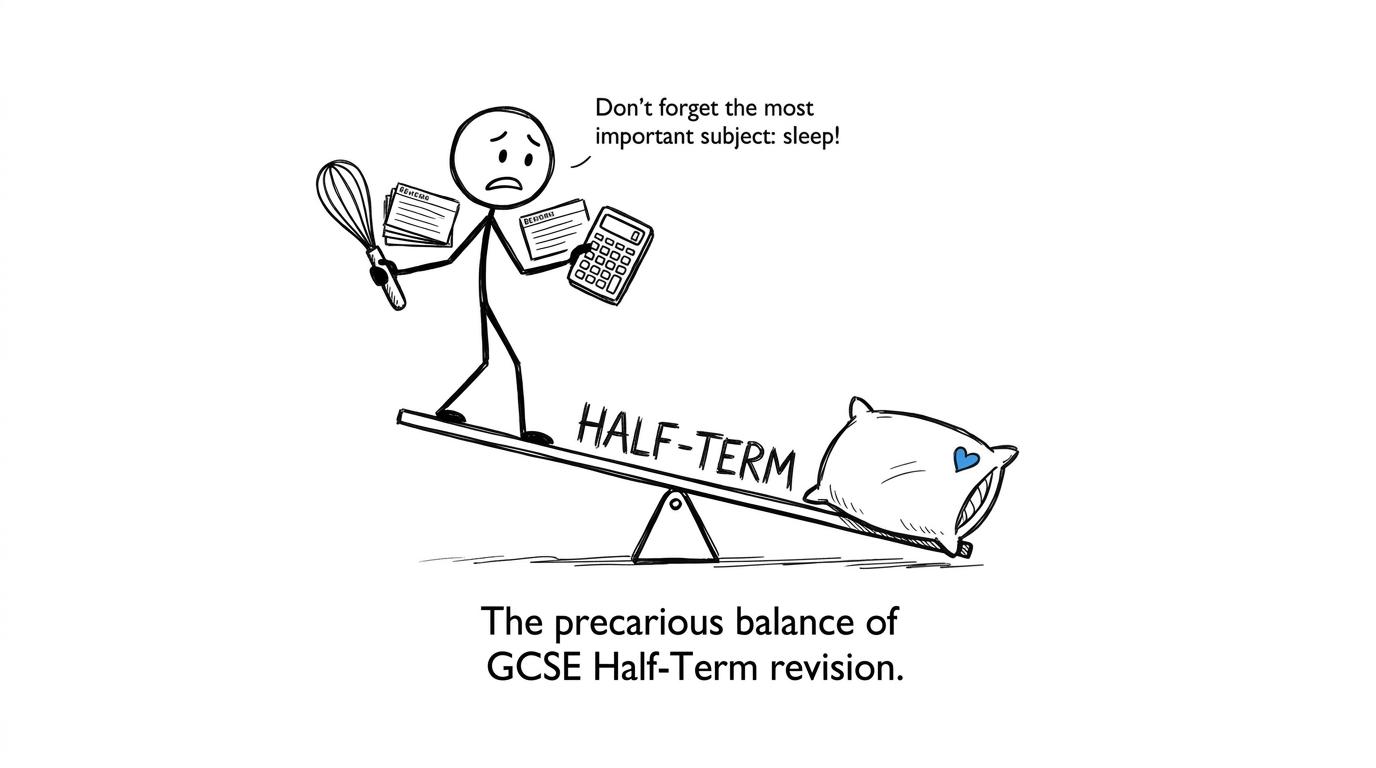 A student balances revision cards, a whisk, a calculator and some much-needed rest
Make every session active
The danger of half-term revision is not always doing too little. Sometimes it is spending hours producing attractive notes that never test memory.
Use this loop instead:
- Retrieve: answer from memory before looking.
- Check: compare your answer with accurate notes or a mark scheme.
- Correct: write the missing idea clearly.
- Apply: answer a new question.
- Revisit: return on another day without prompts.
For maths, the same loop is built into MathsGenie’s revision lessons, practice questions, mark schemes and video solutions. Short formats are particularly useful during a multi-subject week. The guide to when to start GCSE past papers explains how to move from topic work to timed sections without rushing into endless full papers.
If you take Edexcel GCSE Maths, the Edexcel past-paper collection places papers and mark schemes together. Students from other boards can select AQA, OCR or Eduqas through the main GCSE hub.
Keep NEA revision within the rules
Your NEA may be active around February, but productive work does not mean rewriting assessed material without guidance. Use half-term to strengthen the knowledge surrounding your work and to organise questions for your teacher.
Appropriate independent preparation may include reviewing taught food-science principles, revisiting practical techniques, checking your understanding of nutrition, and reflecting privately on feedback already given. Whether particular writing, evidence or practical activity may contribute to assessed work depends on the conditions set by your school and exam board.
Keep a short list headed Ask my teacher. Questions are more valuable than guesses when authentication and supervision matter.
Common mistakes during February half-term revision
Trying to finish the entire course
Coverage feels productive, but rushed coverage rarely reveals what you can retrieve. Select a few important weaknesses and improve them properly.
Revising only what feels comfortable
Familiar topics give quick reassurance. Begin with evidence from questions and mark schemes instead. The weakest topic may be less pleasant, but it offers the clearest return.
Treating practical knowledge and theory as separate worlds
Written questions can ask you to apply scientific, nutritional and safety knowledge to food preparation contexts. Practise making those links explicitly.
Ignoring units and numerical interpretation
Food questions may involve quantities, proportions, tables or nutritional data. Write units, check whether values are sensible and avoid rounding too early.
Completing questions without reviewing them
An unmarked question is unfinished revision. Use the mark scheme to identify missing terminology, weak development and calculation errors.
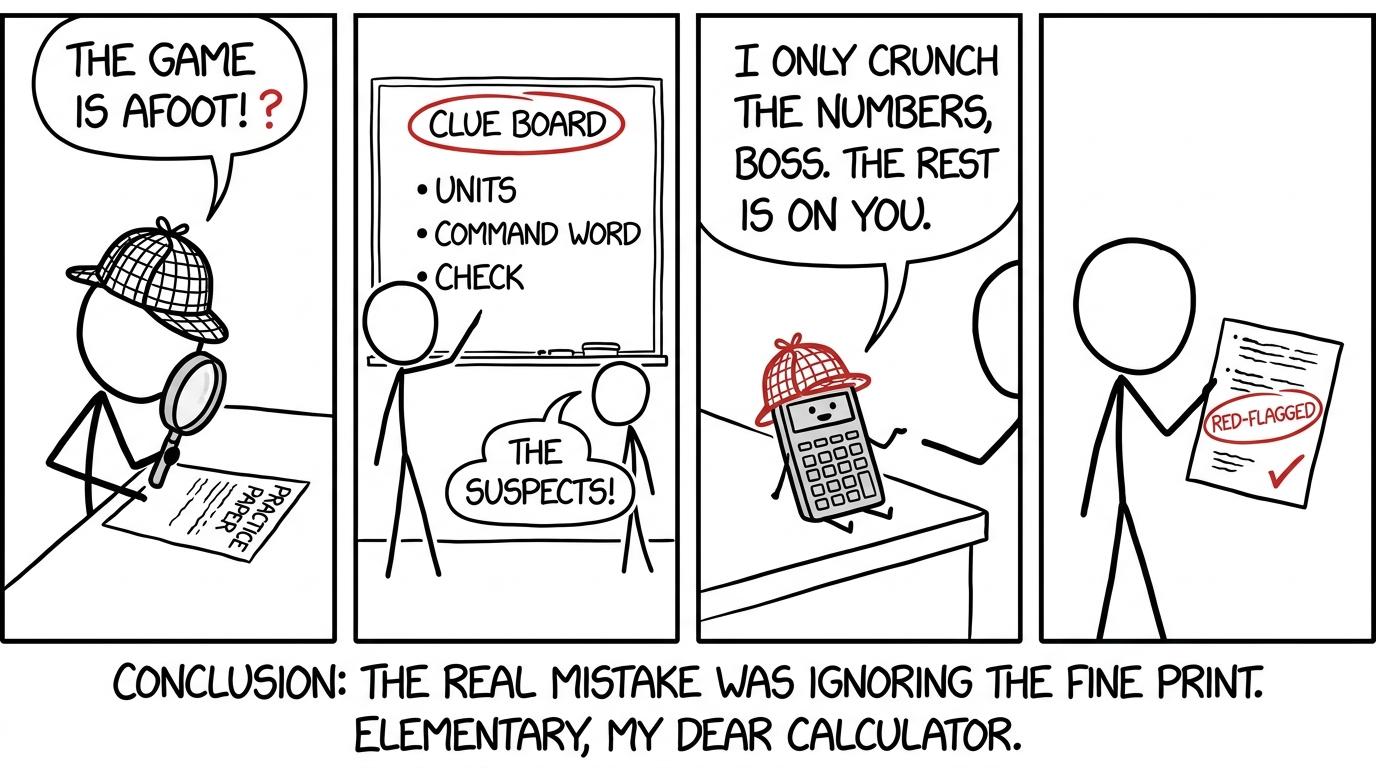 A revision detective investigates clues labelled units, command word and check
Sacrificing every break
Rest is not evidence that the plan has failed. It is part of a plan designed to continue. A week containing sleep, movement and time with other people is more sustainable than one built around guilt.
Leave half-term with a runway, not a cliff edge
On the final day, schedule the next three Food Preparation and Nutrition revisits. One might be a short nutrition retrieval session, another a food-science question set, and the third a mixed examination section. Put dates beside them.
Do the same for maths. Follow the best order for learning GCSE maths topics, then gradually add mini tests, past papers and GCSE predicted papers as the examination period approaches.
A good half-term does not solve everything. It reduces uncertainty. You know which Food Preparation and Nutrition topics need attention, which maths skills must stay active, and what the next session will contain.
Start with the MathsGenie revision planner, choose a short maths lesson, and complete a small set of practice questions today. Then use free revision lessons, mark schemes, video solutions, mini tests, past papers and predicted papers to keep the routine moving long after half-term ends.