

GCSE Food and Nutrition Easter Revision Plan
GCSE food and nutrition Easter holiday revision made manageable with a balanced plan covering theory, exam practice, maths skills and proper rest.
Easter can create a peculiar kind of pressure. The break looks long on the calendar, so it is tempting to build an enormous revision timetable. Then the first few days disappear, the timetable slips, and every unfinished task begins to feel like evidence that you are behind.
Effective GCSE food and nutrition Easter holiday revision does not need to consume the entire break. The better approach is to identify what you need to know, use short sessions to retrieve and apply it, practise the calculations that support the subject, and protect time for rest. A manageable plan completed consistently is worth more than an ambitious one abandoned after three days.
This guide shows you how to create that balance while keeping your GCSE maths revision moving too.
Your Easter revision checklist
Before filling every square of a timetable, establish a simple structure:
- Check your exam board and current specification.
- List topics as secure, uncertain or needing to be relearned.
- Plan focused sessions rather than vague revision days.
- Combine knowledge recall with exam-question practice.
- Include food-related calculations and data interpretation.
- Mark work and record the precise reason for each mistake.
- Leave several half-days or full days free.
- Review your progress midway through the holiday.
The principle is straightforward: revision should have boundaries. When you know when a session ends, it becomes easier to begin.
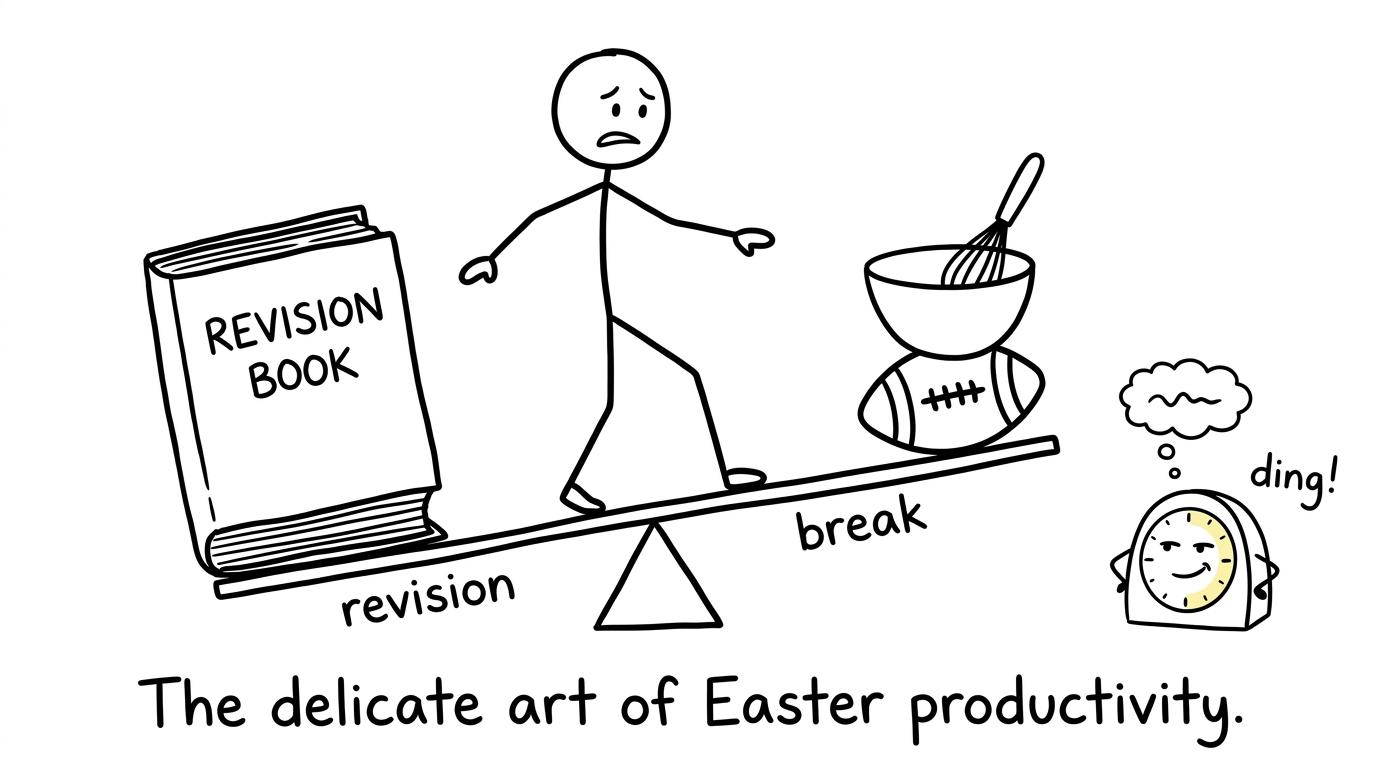 A student balancing revision, cooking and a proper Easter break
Start with the specification, not the textbook
Food Preparation and Nutrition is broader than memorising nutrients. The national subject content includes nutrition, food provenance, food choice, food science, preparation, cooking, safety and the ability to calculate nutritional and energy values.
The exact organisation depends on your board. AQA divides theoretical content into food, nutrition and health; food science; food safety; food choice; and food provenance. Eduqas organises its course into six content areas, while OCR uses sections covering nutrition, provenance and choice, cooking, and practical skills.
Assessment arrangements also differ. At the time of writing, AQA and Eduqas use a written examination lasting 111 hour 454545 minutes, while OCR's written paper lasts 111 hour 303030 minutes. For these specifications, the written examination contributes 50%50\%50% of the qualification and non-exam assessment contributes the other 50%50\%50%. Always confirm the current details with your teacher and your own board's specification.
Turn the headings from your specification into a traffic-light audit:
- Secure: you can explain and apply the idea without notes.
- Uncertain: you recognise it but struggle with detail or application.
- Relearn: you cannot yet produce a useful answer independently.
Be honest rather than harsh. The audit is a map, not a grade.
Build a revision plan that leaves room for Easter
A productive holiday does not require revision from morning to evening. For many students, two focused sessions on selected days are easier to sustain than one long, unfocused block.
A practical structure is:
| Part of the holiday | Main purpose | Suitable activities |
|---|---|---|
| First few days | Diagnose | Topic audit, short questions and checking previous feedback |
| Middle period | Repair | Relearn weak content, retrieve facts and practise application |
| Final few days | Test | Timed question sets, marking and final gap-filling |
You might use one morning session for Food Preparation and Nutrition and one later session for maths or another subject. Keep at least one clear break between them. A session should also have a visible finish line: one topic, one question set or one timed section.
Avoid assigning every minute in advance. Instead, decide on a small number of outcomes for the week, such as:
- explain the functions and sources of key nutrients;
- connect food-science processes to ingredients and outcomes;
- revise food safety and storage principles;
- practise one extended response;
- strengthen recipe proportion, percentages and unit conversions.
This is enough structure to create progress without turning the holiday into an imitation of the school day.
Divide Food and Nutrition into useful revision blocks
Nutrition, diet and health
Build compact recall sheets for macronutrients, micronutrients, fibre and water. For each nutrient, be ready to connect its function, sources, deficiency or excess, and relevance to particular dietary needs.
Do not revise these as isolated lists. Examination questions may ask you to apply knowledge to a life stage, health condition, dietary choice or proposed meal. Retrieval gets the information into memory; application makes it usable.
Food science and cooking
Food science becomes easier when organised around cause and effect. For each process, ask:
- What changes?
- What conditions cause the change?
- Which ingredients are involved?
- What happens to texture, colour, flavour or structure?
- How could the process succeed or fail in practice?
This framework can support revision of processes such as gelatinisation, coagulation, dextrinisation, caramelisation, aeration and emulsification, where required by your specification.
Safety, choice and provenance
These areas can be underestimated because they feel familiar. Familiarity, however, is not the same as an examination-ready explanation.
Revise the reasons behind safe preparation, cooking, cooling and storage practices. For food choice and provenance, connect consumer decisions to cost, culture, religion, ethics, seasonality, availability, health and environmental considerations. Practise selecting relevant factors rather than writing everything you know.
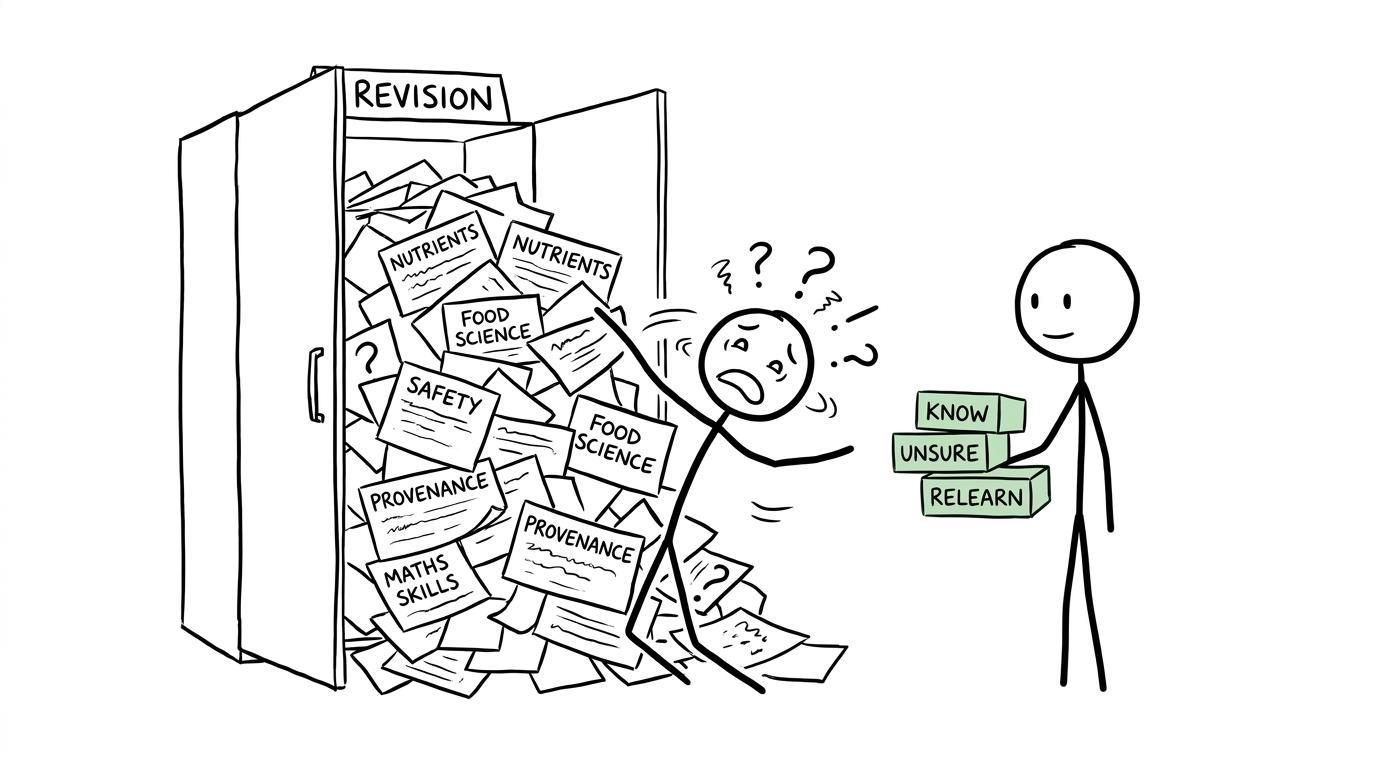 A revision cupboard overflowing before the topics are sorted
Use active revision instead of repeated reading
Reading notes can feel productive because it is smooth. Exams are not smooth. They require you to retrieve knowledge without seeing the page that taught it to you.
Use a repeatable cycle:
- Retrieve: close your notes and write or say what you remember.
- Check: compare your response with reliable course material.
- Correct: add only the missing or inaccurate detail.
- Apply: answer a question that places the knowledge in context.
- Revisit: return to the idea later in the holiday.
Flashcards are useful for concise knowledge, but not every topic belongs on a flashcard. A food-science process may need a labelled sequence. An extended response needs planning and evaluation. A calculation needs practice.
Keep an error log with three columns: topic, what went wrong, and next action. “Nutrition” is too broad. “Confused the function of iron with calcium; retrieve both tomorrow” gives you something you can actually fix.
Keep the maths inside Food and Nutrition secure
Food Preparation and Nutrition includes numerical thinking. Depending on the question and specification, you may need to interpret nutritional information, scale quantities, compare values, calculate proportions or work accurately with units.
Recipe scaling and proportion
The general scaling relationship is:
new quantity=original quantity×new number of portionsoriginal number of portions\text{new quantity}=\text{original quantity}\times\frac{\text{new number of portions}}{\text{original number of portions}}new quantity=original quantity×original number of portionsnew number of portionsThe same multiplier must be applied consistently to the relevant ingredients. MathsGenie's proportion revision resources and proportion revision guide are particularly useful for recipe-style questions.
Percentages and nutritional information
A percentage describes an amount out of 100100100. One useful general relationship is:
percentage=partwhole×100\text{percentage}=\frac{\text{part}}{\text{whole}}\times 100percentage=wholepart×100Check what the whole represents before calculating. A value per serving is not automatically the same as a value per 100 g100\text{ g}100 g. Revisit GCSE percentages practice if choosing the correct operation is slowing you down.
Ratio, units and data
Ratio can appear when comparing ingredient quantities or nutritional values. Keep the quantities in the same units before simplifying or comparing them. The GCSE ratio revision guide explains how to identify the whole, shares and one-part value.
Unit accuracy matters too. Remember relationships such as:
1 kg=1000 g1\text{ kg}=1000\text{ g}1 kg=1000 g 1 litre=1000 ml1\text{ litre}=1000\text{ ml}1 litre=1000 mlUse the conversions and units revision guide to strengthen this part of your GCSE maths revision.
Practise exam questions with a purpose
Do not save all exam practice for the final weekend. Begin with short questions by topic, then progress to mixed and timed sections.
For each set:
- answer without notes;
- use the time and mark allocation to judge the required depth;
- mark carefully using the relevant mark scheme;
- identify whether lost marks came from knowledge, application, terminology or timing;
- correct the response without copying the mark scheme blindly.
Command words matter. “State” usually calls for a concise fact. “Explain” requires a reasoned link. “Evaluate” needs a supported judgement that considers relevant strengths, limitations or alternatives.
Apply the same feedback loop to maths. The GCSE Maths revision hub brings together revision lessons, practice questions, worksheets and exam-board resources. As the exams approach, GCSE predicted papers can support broader exam preparation, but they should complement rather than replace topic repair and official past-paper practice.
MathsGenie's guide to when to start GCSE past papers explains why shorter diagnostic work can be more useful than repeatedly sitting full papers before weaknesses have been addressed.
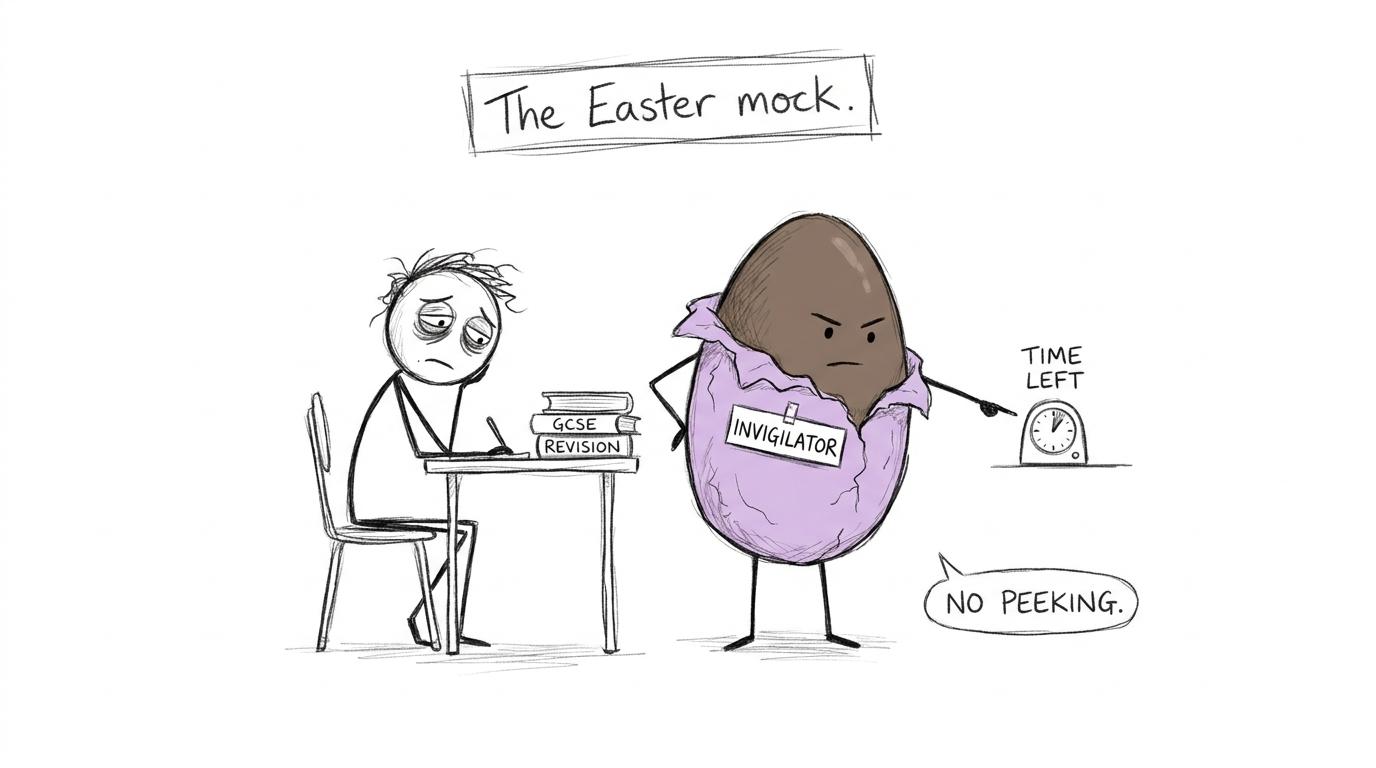 A giant Easter egg conducting a very serious revision session
Common Easter revision mistakes
Planning by hours rather than outcomes
“Revise Food for three hours” gives you no clear destination. “Retrieve nutrient functions and complete a marked question set” does.
Revising only favourite topics
Confidence can disguise avoidance. Start with one uncertain area while your concentration is strongest, then finish with something more secure.
Copying beautiful notes
Presentation has value only when it improves understanding. Spend more time retrieving, applying and correcting than decorating.
Ignoring calculations
Students sometimes treat numerical questions as separate from the subject. Practise proportion, percentages, ratio and conversions so that the arithmetic does not block your food knowledge.
Completing questions without marking them
An unanswered mistake is a warning. An unmarked mistake is invisible. Use mark schemes to find the missing link, then return to the question later.
Sacrificing the whole holiday
A timetable with no genuine breaks is unlikely to remain useful. Decide in advance when you will stop. Rest, meals, movement and time with other people belong in the plan rather than being rewards for finishing an impossible workload.
Finish Easter with a smaller, clearer list
Good revision does not remove every weakness at once. It turns a vague sense of being behind into a short list of specific next actions.
At the end of the holiday, repeat your traffic-light audit. Identify what has moved, what still needs attention and which topics should enter your school-week routine. Keep the list small enough to use.
For your maths preparation, make MathsGenie your next step. Use free revision lessons to repair weak methods, practise with topic questions and mini tests, then build exam confidence through past papers and predicted papers. Mark your attempts with the available solutions, including video solutions where provided.
The aim is not to let revision eat the entire Easter break. It is to return with stronger knowledge, better evidence about your weaknesses and a routine you can continue when school starts again.










