GCSE Food Coursework: How Much Can Teachers Help?
GCSE food and nutrition coursework teacher help: understand allowed guidance, malpractice boundaries and how to keep your assessed NEA work safely your own.
The unsettling part of coursework is that help can feel both necessary and dangerous. You want to ask whether your investigation makes sense, but you do not want to cross a line that costs marks. The short answer to GCSE food and nutrition coursework teacher help is reassuring: your teacher can explain the task, teach the underlying knowledge and skills, supervise your work, discuss safety and offer general guidance. They cannot make assessed decisions for you, rewrite your report or repeatedly direct you towards a higher-mark answer.
The official term for this coursework is non-exam assessment, usually shortened to NEA. Current JCQ rules require the submitted work to be your own. Your precise conditions depend on your exam board, live task and school instructions, so those documents always take priority over general advice.
The quick teacher-help checklist
Before asking for support, use this simple test:
- Usually allowed: explanations of the task, deadlines, assessment criteria, research methods, referencing, food safety and skills taught before or outside the live assessment.
- Usually allowed: general feedback identifying an area that may need more thought, provided the specification permits feedback at that stage.
- Potentially additional assistance: detailed instructions telling you what to investigate, which dish to choose, what conclusion to reach or exactly how to improve assessed work.
- Not acceptable: somebody writing, rewriting or substantially editing your report, or producing your analysis and evaluation for you.
- Always disclose: help from another person, source material and any permitted use of artificial intelligence.
- After final submission: you cannot revise the work. Adding or removing material after it has been presented for final assessment constitutes malpractice under JCQ rules.
A useful question is: does the support help me understand the process, or does it supply the assessed response? The first may be legitimate teaching. The second risks replacing your independent achievement.
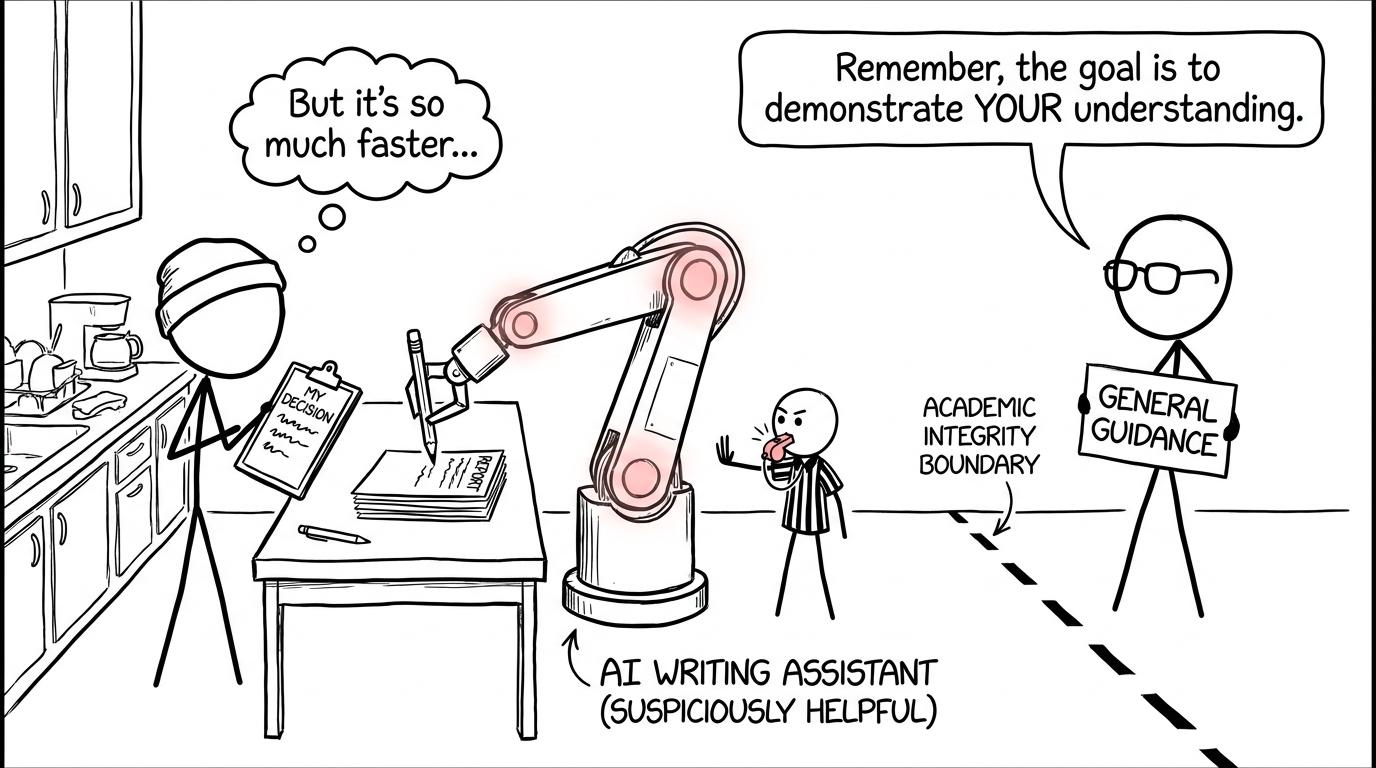 A teacher offers general guidance while a robot tries to write the coursework
What teachers can legitimately do
Teacher support is not forbidden. In fact, teachers must administer, supervise, authenticate and mark NEA correctly. The boundary exists because they must eventually confirm that the work is yours.
Teach knowledge and practical skills
Before the relevant assessment, teachers can teach nutrition, food science, preparation techniques, sensory testing, hygiene, experimental design and evaluation. They can demonstrate safe knife skills, explain how ingredients behave and show the class how to present data appropriately.
Teaching you how to calculate a percentage is ordinary teaching. Calculating the percentages in your live results table for you is different. If the numerical side is causing trouble, revise the method independently using MathsGenie's percentages revision guide.
Explain the brief and assessment arrangements
Your teacher can explain command words, submission arrangements, time limits, permitted resources and how the assessment criteria are organised. They can make sure you understand what the brief asks.
That does not mean they can convert the brief into a personalised plan that supplies all your decisions. Understanding the destination is allowed; being carried there is not.
Give general advice before final submission
Unless a subject specification prohibits it, teachers may normally review work and provide advice at a general level before it is submitted for final assessment. They might indicate that an explanation is unclear, that a section needs checking or that your evidence should connect more closely to the task.
They should not repeatedly edit your draft line by line or dictate the improvements needed to enter a particular mark band. If support goes beyond general advice, it may have to be recorded and reflected in the mark awarded.
Keep you safe
No assessment rule requires a teacher to ignore danger. Teachers remain responsible for classroom safety and can intervene where necessary. However, substantial practical help that affects the evidence of your skill may need to be documented and considered during marking.
Ask questions to authenticate your work
A teacher may ask you about your choices, method, sources or conclusions. This is not necessarily an accusation. Direct supervision and discussion help the school establish that the submitted work is genuinely yours.
What crosses the line towards malpractice
Malpractice is not simply “receiving any help”. The problem arises when assistance compromises the assessment, is concealed or allows work to be presented as independent when it is not.
A teacher should not:
- choose your hypothesis, investigations, dishes or final menu for you;
- supply task-specific model paragraphs for you to adapt;
- rewrite your analysis, conclusion or evaluation;
- correct every error and tell you precisely what to replace it with;
- allow assessed work to be improved after final submission;
- award credit for achievement produced through impermissible assistance;
- authenticate work they cannot confidently identify as yours.
JCQ instructions state that teachers must not credit additional assistance beyond what the relevant specification permits. Where acceptable extra support has been necessary, the teacher must award a mark representing the student's unaided achievement and record the assistance as required.
This protects everyone. Moderation only works when a mark describes what the student can do, not what a well-meaning adult can repair.
Why your exam board matters
AQA, OCR and Eduqas all assess GCSE Food Preparation and Nutrition through a written examination and NEA, but their component structures, mark allocations and detailed administration are not identical.
For example, the current AQA specification divides its NEA into a food investigation worth 303030 marks and a food preparation assessment worth 707070 marks. OCR describes separate food investigation and food preparation tasks with its own marking structure. Eduqas also uses two NEA assessments within its practical component.
Across these boards, the central principle remains stable: you must produce authentic work under the conditions stated in the specification. But never assume that instructions given to a friend on another board apply to you. Check:
- your exam board and specification;
- the instructions attached to the current live task;
- your school's NEA policy;
- what resources and feedback are permitted at each stage;
- when your work becomes the final submitted version.
The everyday word “coursework” can make the process sound informal. It is not. Live NEA is regulated assessment material.
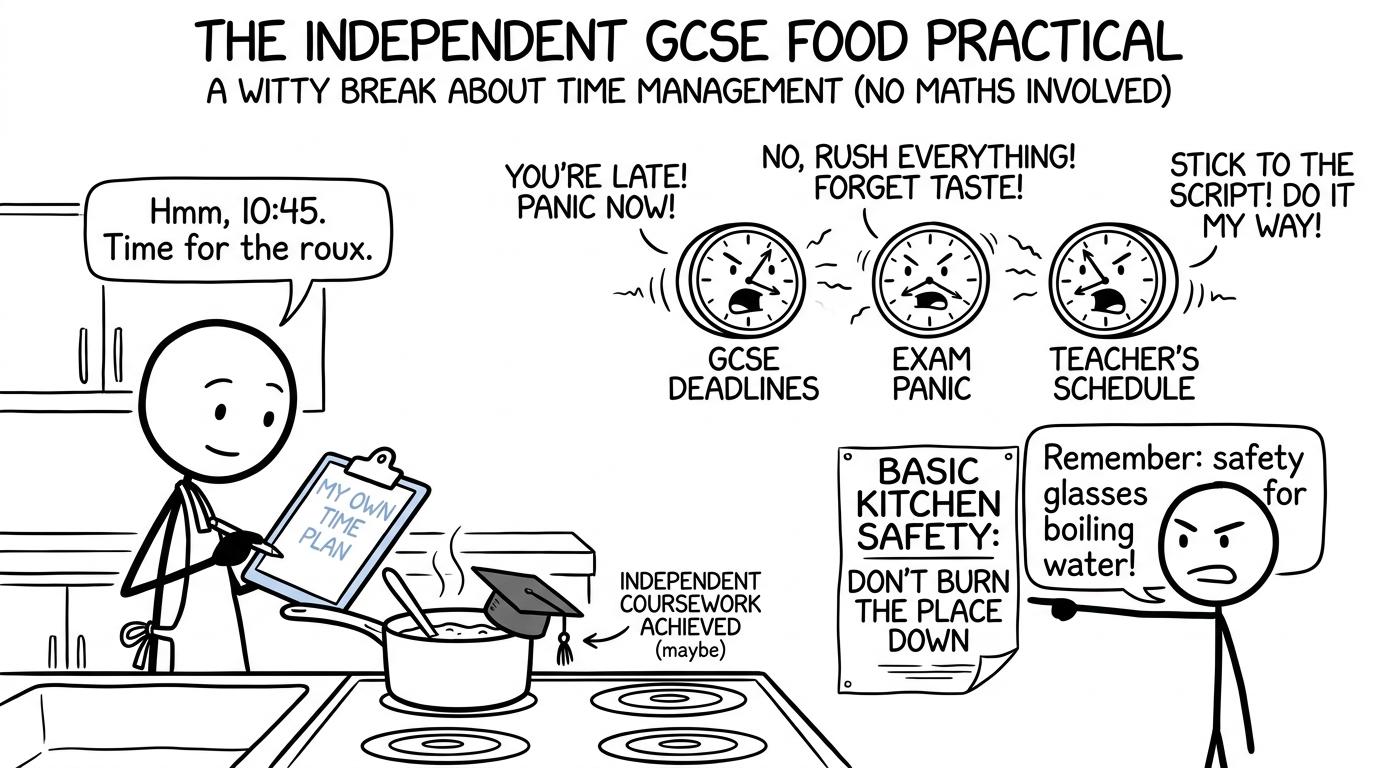 A student follows a time plan while the kitchen clocks argue
Using maths in food and nutrition NEA independently
Food investigations often involve quantities, ratios, percentages, averages, graphs and controlled variables. These calculations must remain your work, but you are allowed to learn the mathematical methods.
You may need to:
- scale ingredient quantities using proportional reasoning;
- compare recipe compositions using percentages;
- calculate a mean from repeated observations;
- choose a sensible graph for experimental data;
- control quantities so an investigation remains fair;
- interpret nutritional information and portion sizes.
For a mean, the underlying relationship is:
mean=total of the valuesnumber of values\text{mean}=\frac{\text{total of the values}}{\text{number of values}}mean=number of valuestotal of the valuesLearning that method from the averages revision guide is revision. Asking someone else to calculate and interpret all your live results would undermine your independence.
The same distinction applies to recipe scaling. You can strengthen the skill through the ratio revision guide, then apply it yourself to the assessed task. MathsGenie's GCSE maths worksheets provide separate practice without using or exposing your live NEA material.
Sources, AI and help from other people
Research is not the same as copying. You may be permitted to use books, websites and other sources, but material that is quoted, paraphrased or derived from elsewhere must be acknowledged according to your instructions.
Current JCQ guidance also covers generative AI. Whether an AI tool may be used at all depends on the assessment conditions and your school's instructions. If use is allowed, generated material is not automatically your own work and cannot earn marks as though you created it independently. Required acknowledgement can include the tool, date, prompt or question, saved output and an explanation of how it was used.
Do not use an AI tool to write an investigation, invent results, generate an evaluation or disguise copied material. Ask your teacher before using one, not after. If someone outside school helps you, tell your teacher so the assistance can be considered properly.
Keep live work secure
Do not send your portfolio to friends, upload it to a shared group chat or post photographs of live assessment material on social media. JCQ rules prohibit candidates from making assessed work available to others, and teaching staff must also keep live work secure while it is in their possession.
Collaboration during an ordinary lesson does not mean you can share assessed writing. Even where students collect information through a permitted group activity, each student must produce their own account and draw their own conclusions.
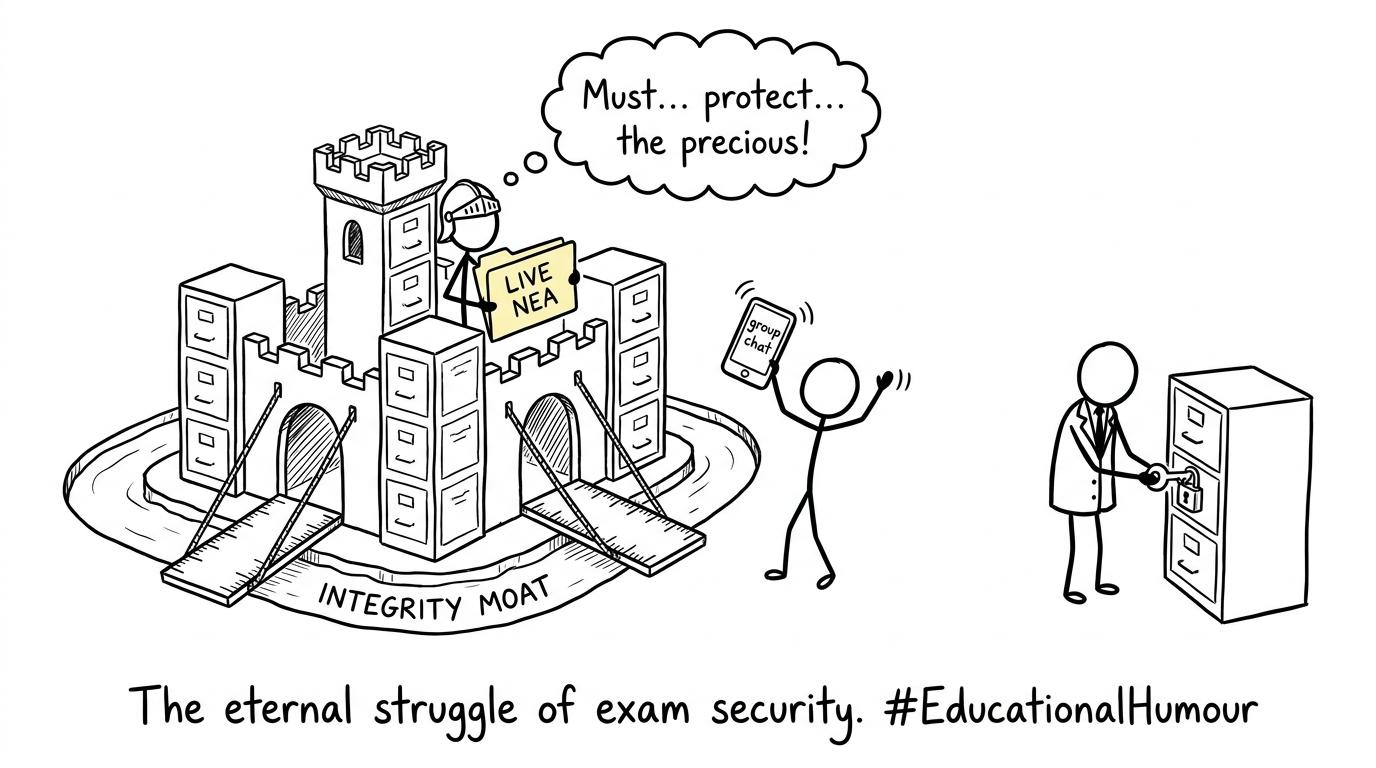 A student protects a live NEA folder from the group chat
Common mistakes that create avoidable risk
Treating general feedback as permission to request an answer
“Which section should I reconsider?” is different from “Tell me exactly what to write.” Ask for clarification of the rules or concept, then make the assessed decision yourself.
Hiding help because it seems minor
Undeclared assistance is often more serious than openly reported support. If a parent, tutor, friend or digital tool influenced the work, speak to your teacher before signing the authentication declaration.
Copying and changing a few words
Paraphrasing still uses another source's ideas. Detailed references may be required even when you do not copy a sentence exactly.
Improving work after final submission
Know your school's final submission point. Once work has been submitted for final assessment, it must not be revised. Do not quietly replace a page or alter a digital file.
Sharing work with classmates
Helping a friend by sending your report can place both students at risk. Keep live assessment evidence private and store it securely.
Ignoring the mathematical evidence
A polished report cannot rescue unreliable data. Check units, labels, calculations and whether your graph represents the evidence honestly. Use GCSE maths mini tests to identify weak numerical skills away from the live task.
A safe way to ask your teacher for support
Be specific about the rule rather than asking for the answer. Useful questions include:
- “Am I allowed feedback on this draft at this stage?”
- “Can you explain what this command word requires without commenting on my response?”
- “Which resources are permitted during this part of the task?”
- “How should I acknowledge this source or outside assistance?”
- “Has this version now been submitted for final assessment?”
- “May I use an AI tool for this purpose, and what evidence must I retain?”
A careful teacher may refuse a question because answering it would provide too much direction. That refusal is not abandonment. It is part of keeping your mark valid.
Keep your coursework authentic and your maths moving
The safest principle is simple: learn with support, but produce the assessed decisions, practical evidence, calculations and conclusions yourself. Declare sources and assistance, protect live work and ask about the rules before acting.
Then keep the rest of your GCSE preparation moving. Use MathsGenie's GCSE past papers library to practise under timed conditions, repair individual gaps with free revision lessons and practice questions, and check your progress using mark schemes and video solutions. Nearer your maths exams, add GCSE predicted papers for fresh exam-style practice.
Good assessment is not built on never needing help. It is built on knowing which help teaches you to think and which help thinks on your behalf.