GCSE Food and Nutrition Paper 1: What to Expect
GCSE Food and Nutrition Paper 1 explained: exam-board timings, question styles, key content, calculations and a focused revision plan for students.
The unsettling thing about an exam paper is not always the difficulty. It is the uncertainty. You may know about nutrients, food safety and cooking processes, yet still wonder what will actually appear when the booklet opens.
Here is the practical answer: GCSE Food and Nutrition Paper 1 is normally the written examination testing your theoretical knowledge and your ability to apply, analyse and evaluate it. It is different from the non-exam assessment because you are explaining decisions on paper rather than demonstrating practical skills in a kitchen. Expect a mixture of short responses, calculations, stimulus material and longer questions. The exact timing and structure depend on your exam board.
Paper 1 at a glance
Before planning your revision, check the specification named on your school materials. The current formats differ:
| Exam board | Written component | Time | Marks and weighting | Broad structure |
|---|---|---|---|---|
| AQA | Paper 111: Food Preparation and Nutrition | 111 hour 454545 minutes | 100100100 marks; 50%50\%50% | 202020 marks of multiple-choice questions, followed by five structured questions worth 808080 marks |
| OCR | Component 010101: Food Preparation and Nutrition | 111 hour 303030 minutes | 100100100 raw marks; 50%50\%50% | Compulsory questions, including short and extended responses |
| Eduqas | Component 111: Principles of Food Preparation and Nutrition | 111 hour 454545 minutes | 100100100 marks; 50%50\%50% | Stimulus-based questions followed by structured short and extended responses |
| WJEC in Wales | Unit 111: Principles of Food and Nutrition | Check your current course documents | Format depends on the specification being taught | Objective, quick-response, short and extended answers may be used |
Pearson Edexcel does not currently offer the same GCSE Food Preparation and Nutrition qualification in England, so do not revise from an old Edexcel Food Technology paper unless your teacher has specifically directed you to it.
Your immediate checklist is simple:
- Confirm your exam board and qualification title.
- Download its current specification or use the copy supplied by school.
- Check the front of a recent paper for time, marks and equipment instructions.
- Practise short, applied and extended questions.
- Revise the small but important maths skills used in food contexts.
- Mark answers against the relevant mark scheme.
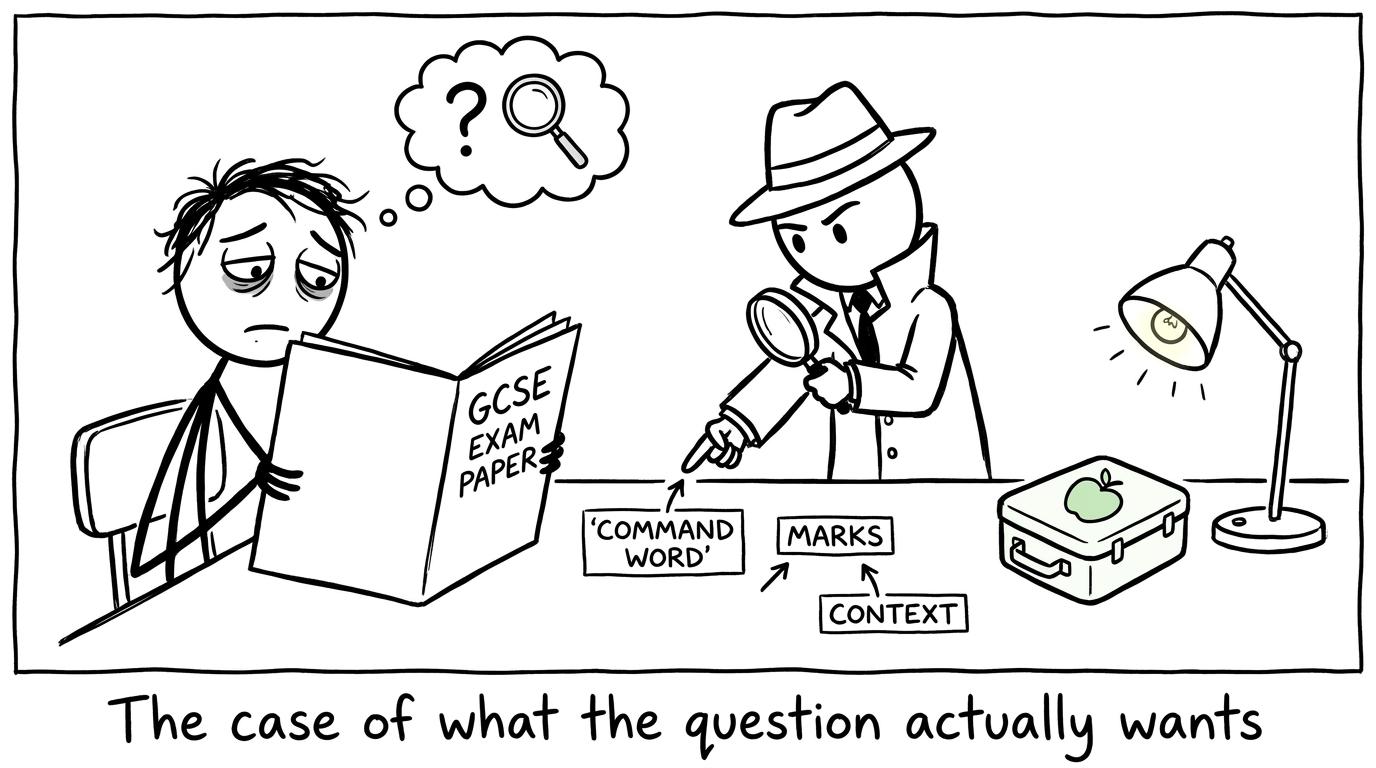 A detective investigates what an exam question actually wants
What is different about the written paper?
Practical lessons reward organisation, technique and the finished result. The written paper asks you to make your understanding visible without the food being in front of you.
That changes the task. Knowing that protein is important is not enough when a question asks you to recommend a meal for a particular person. You may need to identify an appropriate ingredient, connect it to a nutrient, explain its function and relate that function to the person's needs.
Official assessment objectives help explain this distinction. Across GCSE Food Preparation and Nutrition qualifications, the overall course assesses:
- AO1: knowledge and understanding;
- AO2: application of knowledge and understanding;
- AO3: planning, preparing, cooking and presenting dishes;
- AO4: analysis and evaluation.
AO3 is mainly assessed through practical non-exam assessment. The written examination therefore favours AO1, AO2 and AO4. In ordinary language, you must know the content, use it in unfamiliar situations and judge alternatives with reasons.
The question types to expect
Quick recall and objective questions
These questions test accurate facts and terminology. Depending on the board, you may meet multiple-choice, matching, identification or brief written items.
They can cover nutrients, dietary sources, food poisoning, storage, provenance, sensory properties and cooking terminology. Short does not mean unimportant. A vague term can lose a mark just as easily as a blank answer.
Questions based on stimulus material
A stimulus might be a food label, recipe, photograph, table, menu, investigation result or description of a consumer. The information is there to be used.
Read the heading, units and context before answering. If the question introduces a teenager with a particular dietary requirement, a generic paragraph about healthy eating may not apply closely enough. Quote relevant evidence from the stimulus and connect it to subject knowledge.
Applied food science questions
Food science is often assessed through changes that occur during preparation and cooking. You may need to explain processes such as gelatinisation, coagulation, denaturation, gluten formation, enzymic browning, caramelisation, aeration or the action of raising agents.
Revision becomes stronger when each process is connected to:
- the ingredient involved;
- the required conditions;
- the physical or chemical change;
- its effect on texture, colour, flavour or structure;
- a named food application.
This is more useful than memorising an isolated definition because application questions place the science inside a practical situation.
Extended responses
Longer questions reward organised reasoning rather than an uncontrolled page of facts. The command word matters.
An explain question needs linked causes and effects. Analyse asks you to examine information and relationships. Evaluate requires a balanced judgement supported by evidence. Discuss normally needs developed ideas and more than one relevant perspective.
Plan briefly before writing. Choose distinct arguments, develop each one and return to the specific person, product or problem in the question. Where a judgement is requested, state one clearly.
The content Paper 1 can draw upon
The names and groupings vary, but the written papers cover broadly connected areas:
- food, nutrition and health;
- nutrients, energy balance and dietary needs through life;
- food science and the functional properties of ingredients;
- food safety, contamination and microorganisms;
- food choice, including cultural, ethical, economic and medical influences;
- food provenance, sustainability and production;
- preparation methods, cooking techniques and sensory qualities.
A common revision trap is to learn nutrition thoroughly while treating practical knowledge as something that belongs only in the kitchen. Written questions can test why a technique is selected, how heat changes ingredients, how contamination is prevented or how a recipe could be modified.
The paper is synoptic in character: one question can bring several areas together. A menu recommendation, for instance, may involve nutrition, cost, food choice, provenance and cooking method. That is why isolated flashcards should be followed by mixed questions.
The maths hidden inside food questions
Food examinations are not maths papers, but numerical information often carries the context. You could be asked to interpret nutritional data, scale ingredients, compare costs, use percentages or convert units.
Useful relationships include:
percentage=partwhole×100\text{percentage} = \frac{\text{part}}{\text{whole}} \times 100percentage=wholepart×100and
new ingredient amount=original amount×new number of portionsoriginal number of portions.\text{new ingredient amount} = \text{original amount} \times \frac{\text{new number of portions}}{\text{original number of portions}}.new ingredient amount=original amount×original number of portionsnew number of portions.Revise percentages for GCSE Maths, especially when comparing a nutrient amount with a reference value. The fractions, decimals and percentages guide helps when data is presented in different forms.
Recipe scaling is direct proportion. The GCSE proportion revision guide covers the same structure used when portions change. Unit confidence matters too:
1 kg=1000 g1\text{ kg} = 1000\text{ g}1 kg=1000 g 1 litre=1000 ml.1\text{ litre} = 1000\text{ ml}.1 litre=1000 ml.Use the conversions and units resources if mixed units slow you down. Always show a clear method, retain units during the calculation and decide whether the final answer needs sensible rounding.
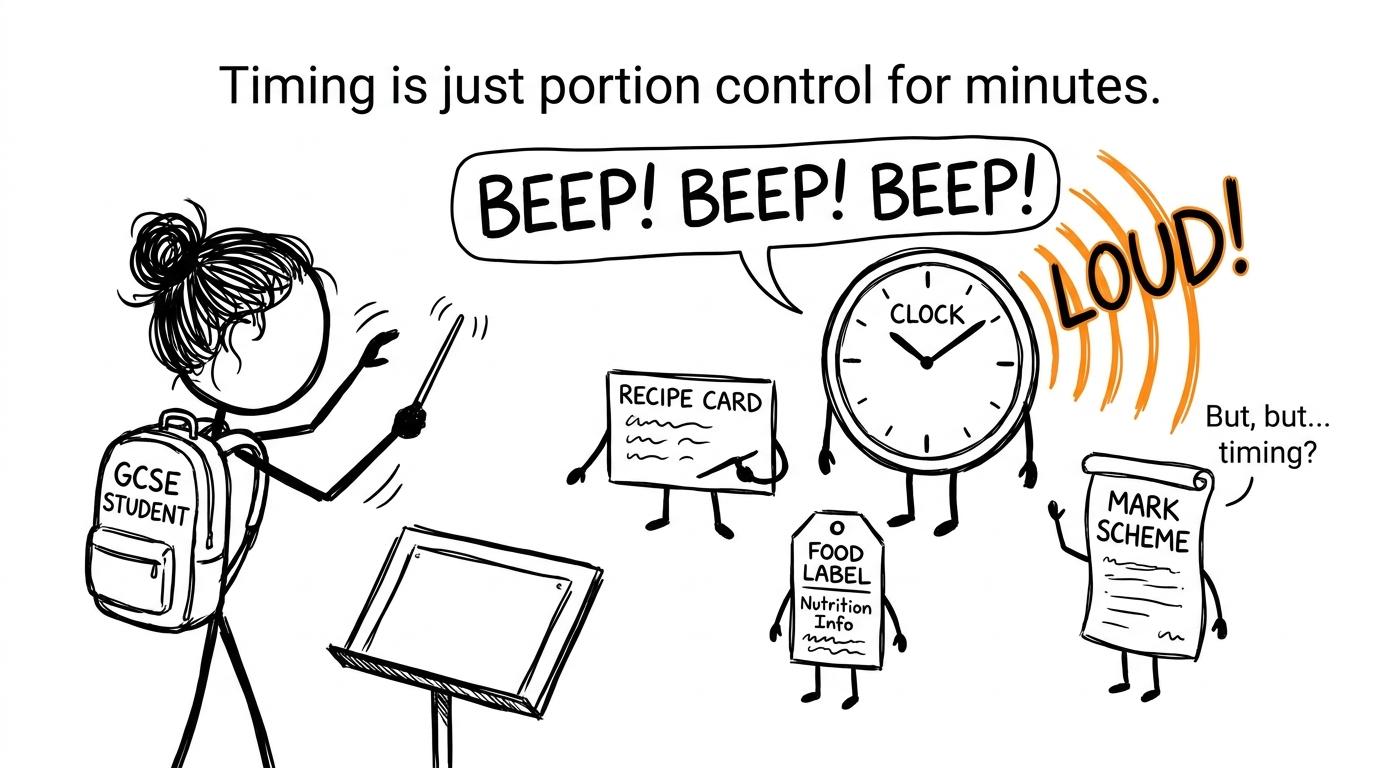 A student conducts an orchestra of exam materials while the clock plays too loudly
How to manage the timing
Timing should follow marks, not page length. A large photograph may occupy half a page while supporting only a small question. A compact extended-response box may carry far more marks.
Calculate an approximate pace using:
minutes per mark=total examination minutestotal marks.\text{minutes per mark} = \frac{\text{total examination minutes}}{\text{total marks}}.minutes per mark=total markstotal examination minutes.For AQA and Eduqas, the headline figures give:
105100=1.05 minutes per mark.\frac{105}{100} = 1.05\text{ minutes per mark}.100105=1.05 minutes per mark.For OCR, they give:
90100=0.9 minutes per mark.\frac{90}{100} = 0.9\text{ minutes per mark}.10090=0.9 minutes per mark.These are guides, not rigid rules. Objective questions may take less time, leaving more for reading stimulus material and constructing extended answers. Reserve a few minutes to revisit omissions, units and command words.
Practising under a timer makes pace less mysterious. MathsGenie's revision planner can help you schedule maths repair alongside subject revision, while the GCSE revision timetable guide explains how to combine focused practice with timed work.
A revision method that matches the paper
Start with specification coverage, then move towards application:
- Create a checklist from your board's subject content.
- Recall one topic without notes.
- Correct gaps using reliable class or exam-board materials.
- Answer questions requiring that knowledge in context.
- Mark them and record the exact reason each mark was lost.
- Reattempt weak question types after a gap.
- Finish with full, timed papers from your own board.
Do not merely count completed papers. A marked paper is evidence; an unreviewed paper is only activity. Separate errors into knowledge, application, calculation and exam technique. That tells you what to do next.
For underlying numerical weaknesses, use MathsGenie's GCSE Maths topics by board and tier to locate an appropriate lesson, then complete practice questions before returning to the food context. The MathsGenie past-paper tools can also build disciplined habits with timers, official mark schemes and recorded scores in maths.
Common mistakes on GCSE Food and Nutrition Paper 1
Revising for the wrong board
The broad subject content overlaps, but timings, section structures and terminology differ. Match every paper and mark scheme to the qualification you are taking.
Listing facts instead of applying them
A correct fact may not answer a question about a named consumer or product. Make the link explicit: identify the feature, explain its consequence and connect it to the context.
Ignoring the command word
A list cannot usually earn all the marks available for an explanation or evaluation. Let the command word determine the depth and shape of the response.
Giving repeated points
Saying the same idea in several forms does not create several developed arguments. Choose distinct nutritional, scientific, economic, ethical or practical considerations where relevant.
Dropping units or misreading portions
Nutritional information may be given per serving or per 100 g100\text{ g}100 g. Those are not automatically equivalent. Read labels carefully and keep units attached to calculations.
Spending too long on low-mark items
Marks provide a rough budget for time. Move on when a response is proportionate, then return later if time remains.
Walk into the paper knowing its shape
The written food paper is not a test of how many definitions you can unload. It asks whether you can recognise a problem, select relevant knowledge and make a justified decision. Once you understand that pattern, the paper becomes less unpredictable.
Confirm your board, learn the full content, practise with its official past papers and study the mark schemes closely. When percentages, portions, costs or conversions are the obstacle, use MathsGenie's free revision lessons, practice questions, mini tests and video solutions to repair the maths underneath. Then test those skills with past papers and predicted papers. Good revision does not remove every surprise; it makes you capable of handling one.