GCSE English Literature Early Entry: Is It Worth It?
GCSE English literature early entry: weigh readiness, workload, resit limits and the effect on maths revision before deciding whether to sit early.
The promise sounds attractive: finish English Literature in Year 10, remove one subject from the Year 11 exam season and create more space for maths, science and everything else. But GCSE English literature early entry is only a good idea when you are genuinely ready for the full assessment. It should not be a trial run.
For a student who has completed the course, produces consistently strong timed essays and can retain knowledge across every set text, early entry may reduce pressure later. For someone still developing analytical writing, quotation recall or exam stamina, another year of teaching may be considerably more valuable.
The short answer is simple: agree to early entry because the evidence supports it, not merely because finishing early sounds efficient.
The early-entry decision checklist
Before agreeing, you, your family and your school should be able to answer these questions clearly:
- Have you completed every part of your exam board's specification?
- Do your timed mock results already match your target grade?
- Can you respond to unfamiliar questions without relying on prepared essays?
- Can you recall and connect evidence from all the required texts?
- Will preparation interfere with GCSE maths, English Language or science?
- What teaching will replace Literature after the examination?
- What happens if the result is below your target?
- Has your exams officer explained the entry and resit arrangements?
If several answers are uncertain, waiting is not failure. It is often the more intelligent use of time.
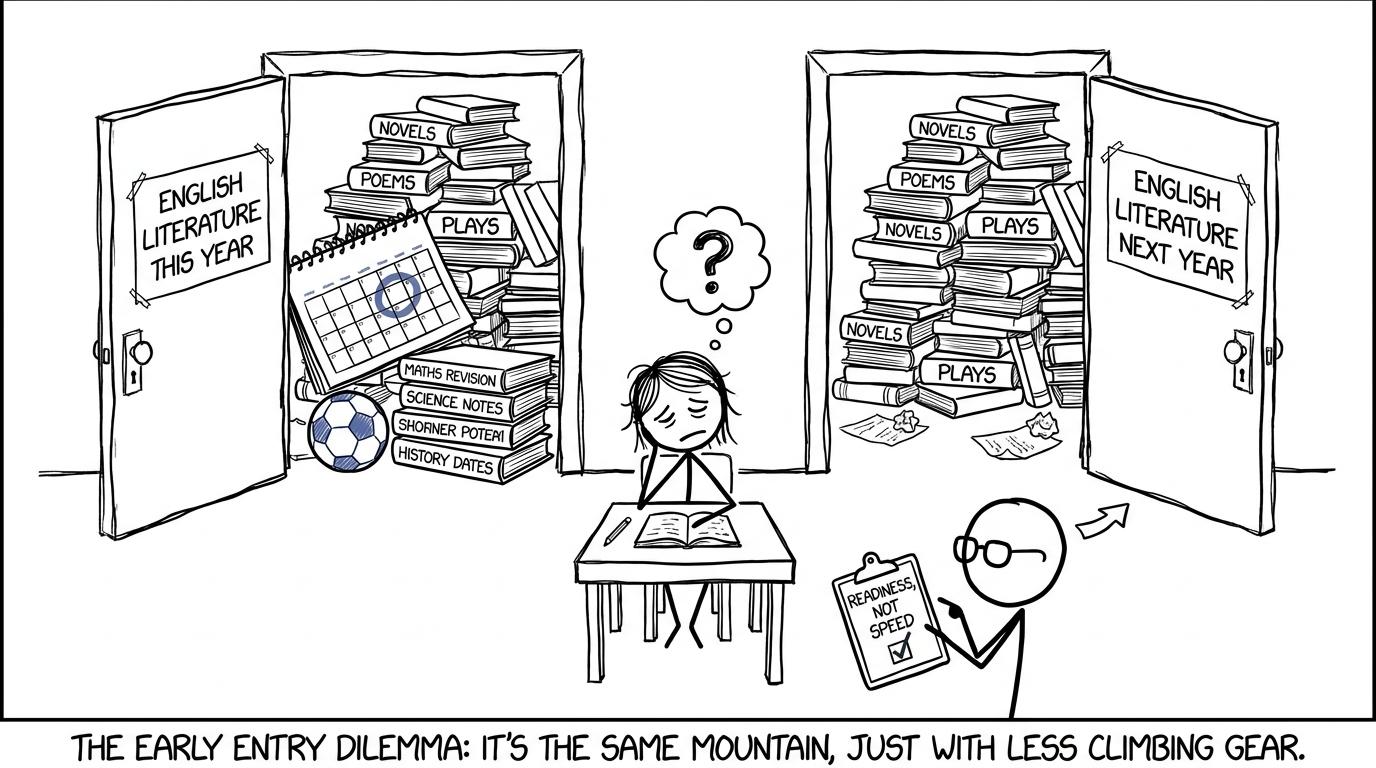 A student choosing between two equally book-filled English Literature routes
What GCSE English Literature early entry means
Early entry normally means completing the same GCSE qualification as other students but sitting it before the usual Year 11 summer series, commonly at the end of Year 10. It is not an easier paper or a reduced version of the course.
The exact assessment depends on your exam board. AQA, Pearson Edexcel, OCR and Eduqas organise texts and papers differently, so readiness must be judged against your own specification rather than a generic Literature checklist. For example, the current AQA and Pearson Edexcel qualifications are linear: the required papers are completed in one summer series. They include substantial closed-book assessment across areas such as Shakespeare, prose, drama and poetry.
GCSE English Literature is also untiered. There is no foundation or higher paper to adjust the level of entry. The same assessment must distinguish performance across the full grade range.
That creates an important principle: being ahead of your class is not automatically the same as being ready for the qualification. You need complete course coverage and reliable performance under examination conditions.
When taking English Literature early can work
Your performance is already secure
Early entry is most defensible when several pieces of evidence point in the same direction. One generous mock mark is not enough. Look for consistent results across different texts, teachers and question styles.
A ready student should be able to build a clear argument, choose precise textual references, analyse language, form and structure, discuss context appropriately and maintain accuracy under time pressure. Prepared paragraphs may help during revision, but the real test is whether you can adapt your knowledge when the question takes an unexpected angle.
It creates genuine space in Year 11
Removing a completed subject can make Year 11 calmer, particularly if the released lessons and homework time are used deliberately. That time might support English Language, science or targeted work through the GCSE Maths revision hub.
But the word genuine matters. Sitting the examination early does not automatically save time. An intensive Year 10 course may simply move the pressure forward. Ask to see how the school's curriculum and timetable will change after the exam.
You have a clear reason for doing it
Good reasons are specific: your teachers have strong evidence of readiness, the whole course has been taught, and the school has a credible plan for the time released. A weaker reason is that early entry sounds impressive.
Qualifications reward demonstrated performance, not speed. A secure grade achieved at the right time is usually more useful than an early result that undersells your ability.
Reasons to wait until Year 11
Analytical writing often improves with time
English Literature is not simply a memory test. Strong responses require judgement: which evidence matters, how interpretations differ and how a writer's choices support an argument. Those skills can deepen substantially with another year of reading, discussion, feedback and timed writing.
If your essays contain good ideas but remain inconsistent, extra teaching may be more valuable than a lighter Year 11 timetable.
The course may have been compressed too sharply
Covering a text is not the same as mastering it. A rushed course can leave little time for retrieval, comparison, alternative interpretations and practice across the complete range of questions.
Ask whether you have studied every required text in full and completed timed assessment across every paper component. If the answer depends on hurried holiday revision, the workload may be transferring from the timetable to you.
Resitting is not a quick safety net
In England, GCSE English Language and GCSE maths have a November examination opportunity for eligible students aged 16 or over. English Literature does not have the same November route. A Literature resit would normally require waiting for a later summer series.
Current performance-table rules in England also make first entry significant for schools where qualifications overlap within the same subject. These rules concern school accountability and are not identical to the way every college, employer or admissions team considers a student's qualifications. Your school should explain how an early result and any later resit would be recorded in your circumstances.
Do not agree on the assumption that you can simply try again a few months later.
How early entry could affect maths revision
For a student preparing for GCSE maths, the question is not merely whether Literature can be completed early. It is whether doing so improves the whole revision plan.
Imagine your weekly workload as a fixed budget. Extra Literature essays, quotation retrieval and timed papers must come from somewhere. If they replace unfocused screen time, the trade may be sensible. If they replace maths lessons, sleep or careful correction of mistakes, the cost is higher than it first appears.
Use evidence from both subjects. In maths, complete a diagnostic paper for your board and tier, then identify whether substantial gaps remain. MathsGenie provides dedicated collections of Edexcel GCSE maths past papers, AQA GCSE maths past papers and OCR GCSE maths past papers, with mark schemes and worked solutions where available.
If early Literature preparation prevents you from repairing repeated weaknesses in algebra, ratio, geometry or probability, the plan needs adjusting. The GCSE maths topics by exam board and tier guide can help you judge the remaining scope of your maths course.
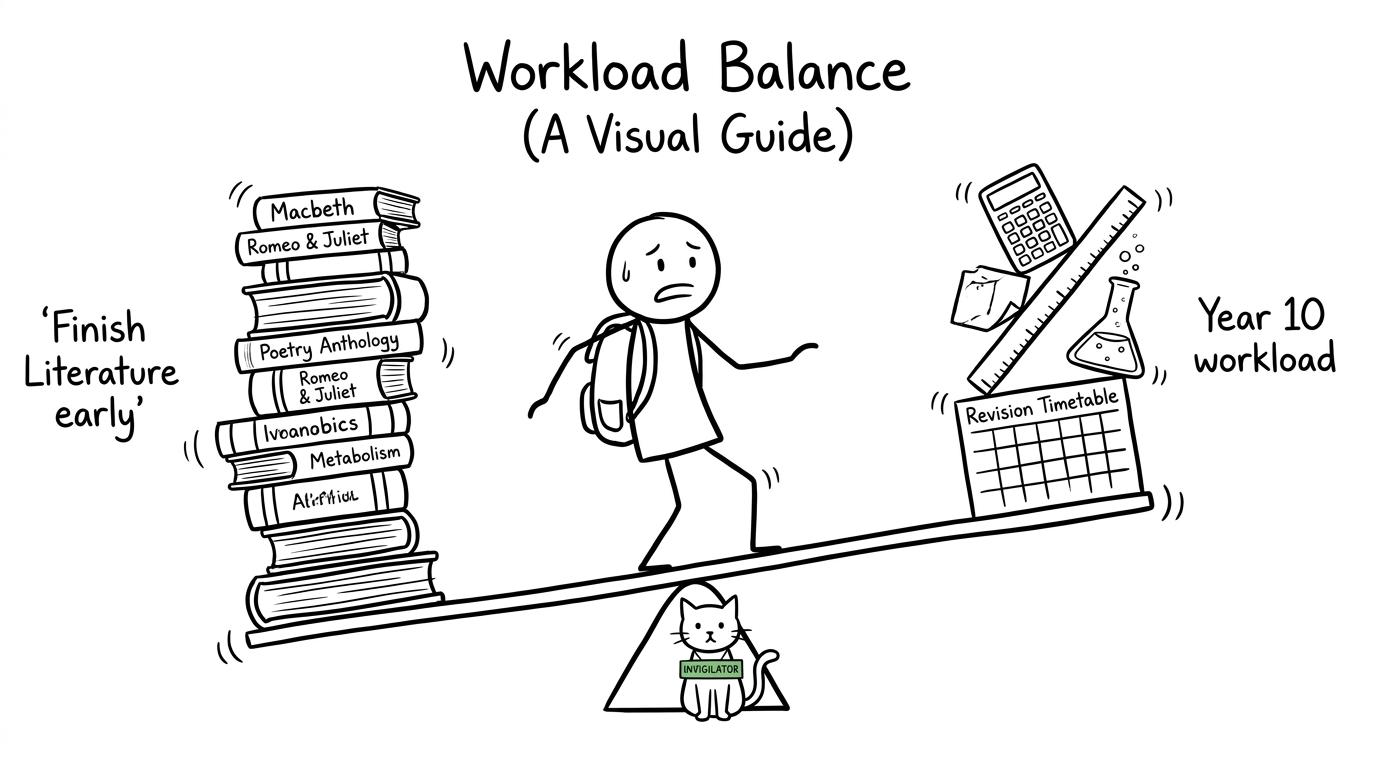 A student balancing English books against the rest of the GCSE workload
A sensible way to make the decision
Request evidence, not reassurance
Ask your English teacher for your recent marks by assessment objective, not just an overall prediction. Find out whether weaknesses are isolated or recurring. Also ask whether those marks came from timed, unseen questions completed without notes.
Then speak to your form tutor, head of year or exams officer about the wider timetable. The person teaching English may not see every pressure created across maths, science and optional subjects.
Test the proposed workload
Before the entry is confirmed, follow the likely early-entry revision schedule for two or three weeks. Include normal homework, timed Literature practice and your existing maths commitments. If sleep, attendance, concentration or other subject work deteriorates, treat that as useful evidence rather than a lack of determination.
Busy students often benefit from a smaller repeatable routine. The 20-minute GCSE maths revision routine shows how short sessions can preserve progress during demanding weeks.
Agree on what happens afterwards
Finishing Literature should create a plan, not an empty timetable. Decide whether the released time will support English Language, independent reading or other GCSE subjects. For maths, you might combine topic revision with Edexcel GCSE maths mini tests before progressing to full papers.
A clear post-exam plan is one of the strongest signs that early entry is being used thoughtfully rather than pursued for its own sake.
Common mistakes when considering early entry
Treating a predicted grade as a guarantee
Predictions are useful, but an early-entry decision should also reflect timed mocks, complete specification coverage and performance on unfamiliar questions.
Confusing fast progress with complete readiness
You may understand the texts quickly while still needing practice in comparison, essay structure, contextual integration or timing. Identify the specific skills that remain fragile.
Ignoring the effect on other subjects
An English Literature grade does not exist in isolation. Track whether accelerated preparation is reducing your maths practice, causing missed homework or making other mock results less secure.
Assuming a resit will be immediate
English Literature is generally available in the summer series rather than the November resit window used for GCSE maths and English Language. Confirm the current arrangements with your exams officer before entering.
Using the released Year 11 time badly
Finishing a subject early only helps if the saved time is protected. A structured plan such as the GCSE one-month maths revision plan can turn that space into focused practice rather than vague intentions.
The right decision is the one supported by evidence
GCSE English Literature early entry can work for a student who has completed the specification, performs securely in timed assessments and has a sensible plan for the time gained. It is less convincing when the course is being compressed, results are inconsistent or the decision depends on an easy resit that may not be available until the following summer.
There is no special prize for finishing first. The goal is to leave school with results that reflect what you can genuinely do, without weakening the rest of your GCSE programme.
Whatever you decide about Literature, keep maths revision calm and measurable. Start with the free MathsGenie GCSE hub, use revision lessons and practice questions to repair individual topics, and then build examination confidence through mini tests, past papers, predicted papers, mark schemes and video solutions. A good plan does not merely create more time, it gives that time a purpose.