Is GCSE English Language Useful Without A-level?
GCSE English Language useful without A-level? See how it supports college entry, apprenticeships, work and clearer reasoning in GCSE maths.
A qualification can be valuable even when it is the end of a road, rather than the start of a new one. If you have searched “gcse english language useful without a-level”, the short answer is yes. It can help you meet entry requirements for college, sixth form, apprenticeships and future employment. More quietly, it also develops reading, reasoning and communication skills that matter in GCSE maths.
You do not need to love analysing texts or plan to take A-level English. GCSE English Language is useful because almost every path beyond Year 11 expects you to understand information, explain decisions and communicate clearly.
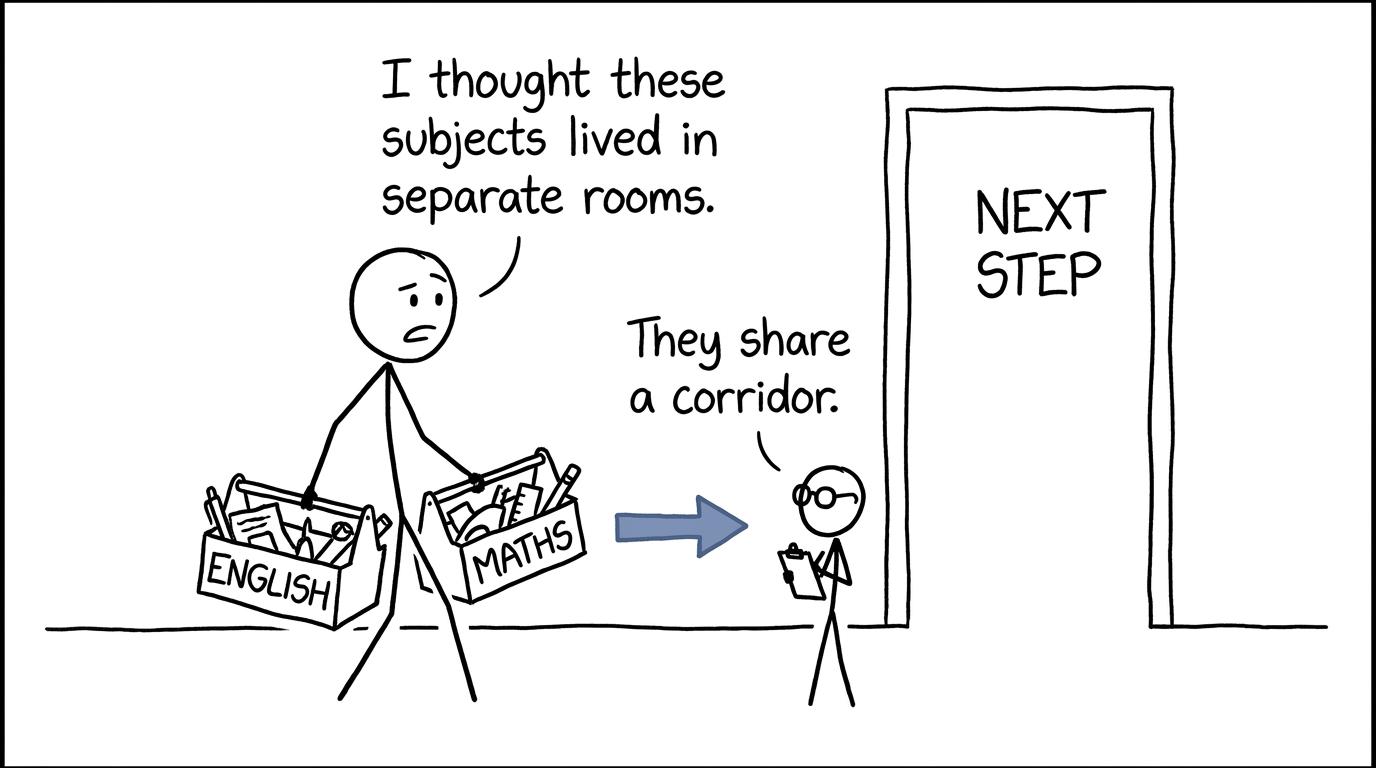 A student discovering that English and maths share a corridor
What GCSE English Language gives you
The exact papers and question styles differ between Edexcel, AQA, OCR and Eduqas, but the qualification broadly develops your ability to:
- retrieve and interpret information from unfamiliar texts;
- analyse how writers communicate ideas;
- compare viewpoints and evaluate arguments;
- organise ideas into a clear written response;
- adapt vocabulary, tone and structure for an audience;
- use spelling, punctuation and grammar accurately;
- speak and present ideas through the separately reported spoken language assessment.
Those skills do not belong only in an English classroom. They appear whenever you read instructions, write an application, challenge an unreliable claim or explain why an answer makes sense.
A useful checklist is:
- College and sixth form: many courses specify a minimum GCSE English Language grade.
- Apprenticeships: providers commonly consider English qualifications when setting entry requirements.
- Employment: employers may ask for GCSE English or an accepted equivalent.
- Further learning: reports, assignments and presentations require clear communication.
- GCSE maths: careful reading and precise explanations can protect marks.
Why colleges care about GCSE English Language
GCSE English Language is often treated as evidence that you can work independently with written information. This matters whether your next course is mathematics, engineering, health and social care, computing, business or a practical vocational programme.
Entry requirements are not identical. One sixth form might require grade 444 in English Language for general admission, while another might ask for grade 555 or higher for a particular course. Some courses also set separate requirements in GCSE Maths. You should therefore check the current published criteria for every institution and course you are considering.
In England, students who have not achieved grade 444 in GCSE English Language or an approved equivalent will normally need to continue studying English as part of a funded post-161616 programme. The precise programme depends on the student's prior attainment and the provider's arrangements. This is one reason English Language can affect your timetable even when you do not intend to take it at A-level.
The practical lesson is simple: securing the required grade in Year 11 may give you more choice later. It can reduce the need to balance an English resit with a demanding college course.
Does it matter for apprenticeships and employment?
It can. Apprenticeships combine occupational training with reading instructions, recording work, communicating with colleagues and completing assessments. Providers and employers set their own entry criteria, so there is no single GCSE English rule covering every vacancy. However, English attainment is frequently considered alongside maths and subject-specific requirements.
The same is true in employment. A job may never ask you to analyse a nineteenth-century extract, but it may ask you to:
- follow safety guidance;
- write an accurate email;
- understand a contract or rota;
- summarise a problem for a colleague;
- distinguish evidence from assumption;
- communicate appropriately with customers.
GCSE English Language does not prove that someone can handle every workplace situation. No single exam can do that. It does provide a widely recognised indication that the student has practised core literacy skills under assessed conditions.
For university applications, requirements vary by institution and course. Some universities specify a particular GCSE English Language grade, while others accept alternatives in defined circumstances. If higher education may be part of your future, check individual course pages rather than assuming that your A-level choices replace GCSE requirements.
How English Language helps in GCSE maths
English and maths are sometimes presented as opposites: one is about words and the other about numbers. In an exam, the boundary is much less tidy.
A calculation can be straightforward while the wording around it is difficult. Multi-step problems ask you to identify relevant information, ignore distractions and decide what the question actually requires. Those are reading skills before they become mathematical skills.
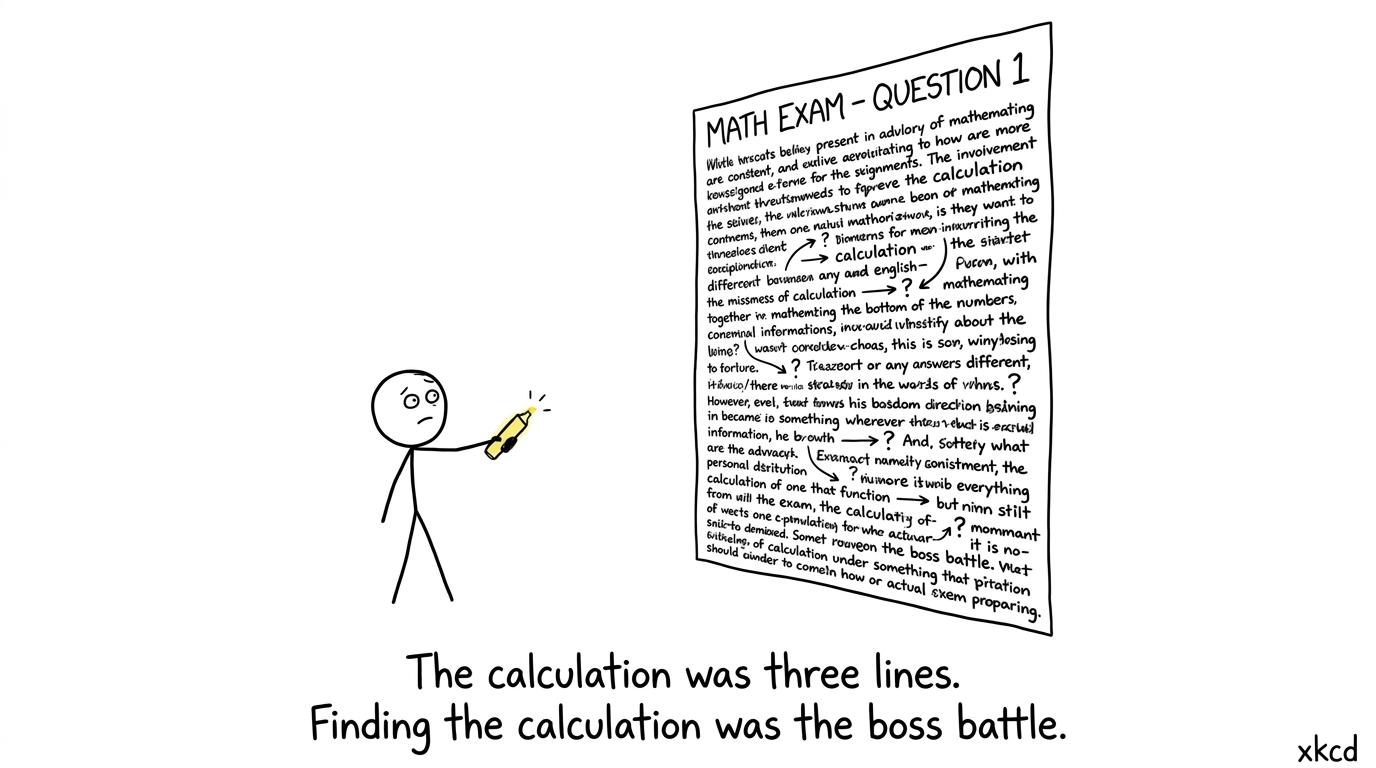 A student facing the boss battle of a worded maths question
Understanding command words
Words such as show, explain, estimate, compare, justify and prove signal different kinds of response. A correct calculation may not fully answer a question asking for justification. Equally, a long paragraph cannot replace mathematical evidence.
English Language revision develops the habit of noticing exactly what a prompt demands. In maths, that habit helps you avoid answering the question you expected instead of the one printed on the page.
Selecting relevant information
Worded problems often contain context, units, conditions and several quantities. Strong readers separate useful facts from background detail and keep track of relationships between statements.
This is especially important in probability, ratio, graphs, rates of change and problem-solving questions. The hardest step is sometimes not performing a technique but recognising which technique the language describes.
MathsGenie's GCSE maths revision resources let you practise these skills topic by topic. Videos can clarify the method, while the questions reveal how the same idea may be phrased in different ways.
Explaining mathematical reasoning
GCSE maths assesses more than recall. Across the specifications, students are expected to reason, interpret results and solve problems as well as carry out standard procedures.
Clear mathematical communication usually means a logical sequence of steps, correct notation and a concise conclusion. It does not mean adding decorative sentences. English Language helps because it trains you to organise an argument and connect each claim to evidence.
You can develop this under realistic conditions through GCSE maths past papers. After completing a paper, use its mark scheme and video solutions to compare not only the final answers but also the reasoning that earns marks.
English Language and A-level maths
Not taking A-level English does not make literacy disappear. A-level maths questions still need careful interpretation, particularly in mechanics, statistics and modelling. You may need to define assumptions, comment on a model, interpret statistical evidence or explain the limitations of a result.
If you are considering mathematics after GCSE, explore the A-level maths revision page and A-level maths past papers. They show how mathematical sophistication and precise reading develop together.
Beyond lessons, many STEM routes involve technical reports, research summaries, presentations and written evaluations. English Language is not preparation for every detail of those tasks, but the underlying habits travel well: read closely, identify the purpose, arrange evidence and communicate without ambiguity.
How to balance English and maths revision
The danger is thinking that one core subject must be revised at the expense of the other. A better approach is to give each subject a clear job.
For English Language, practise reading unfamiliar material, planning responses and writing to time. Use your own exam board's specification, past papers and mark schemes because paper structures differ.
For maths, revise weak topics before moving into mixed papers. MathsGenie's free resources include revision lessons, practice questions and video solutions arranged by grade and topic. Once individual methods feel secure, use full papers to practise selecting methods without being told which topic is being tested.
Predicted GCSE maths papers can add fresh exam-style practice close to the examination period. They should complement, not replace, official past papers: no predicted paper can guarantee the content of a live exam.
A practical weekly routine might include:
- short topic-focused maths sessions;
- one timed English Language section;
- mixed maths questions later in the week;
- marking and correcting both subjects;
- a final session devoted to errors rather than new content.
A MathsGenie revision planner can help turn a vague intention into specific sessions. The aim is not to fill every evening. It is to decide in advance what deserves attention.
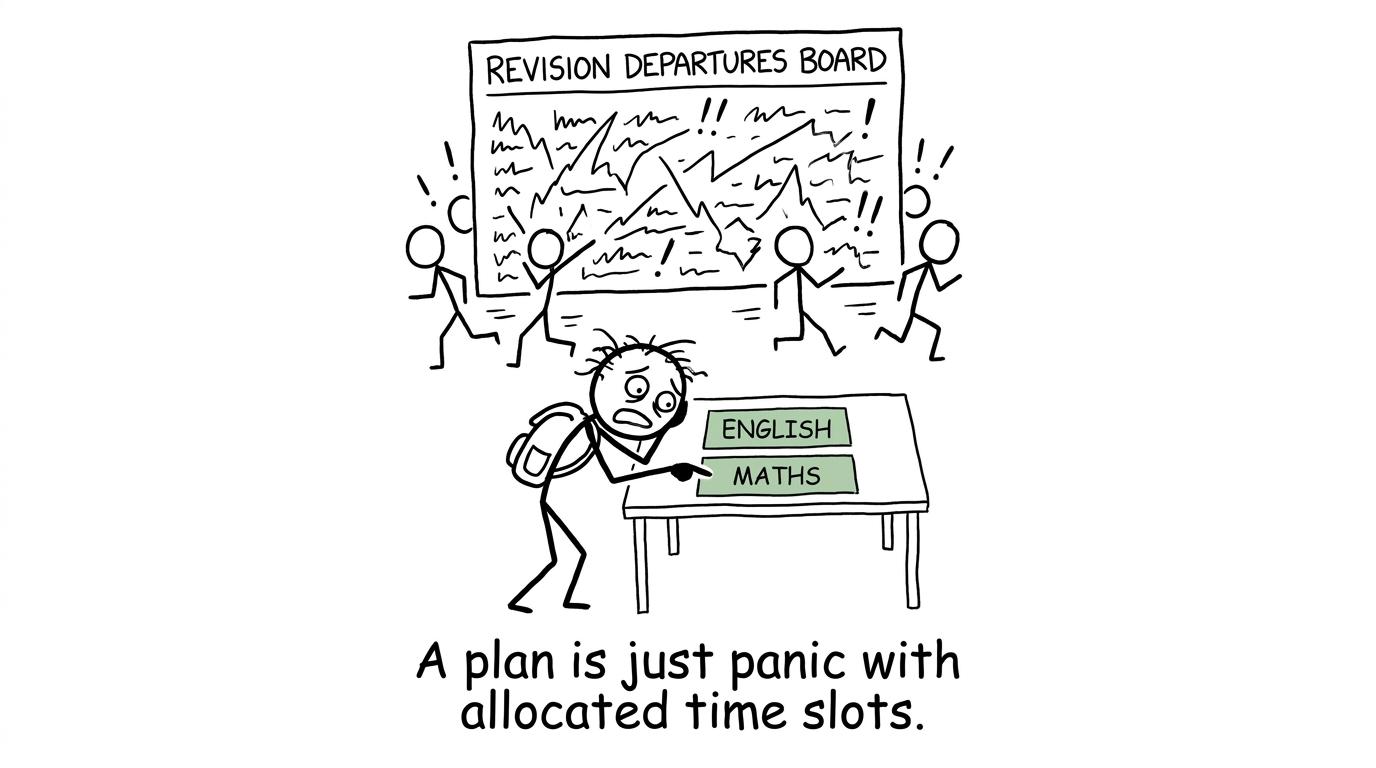 A revision timetable turning panic into allocated time slots
Common mistakes to avoid
Assuming English Language only matters for A-level English
Its main value is broader literacy. Entry requirements, applications, workplace communication and subjects involving written information can all make the qualification relevant.
Confusing English Language with English Literature
They are separate GCSEs. When a college, apprenticeship or university says it requires GCSE English, check whether it specifically means English Language, whether Literature is accepted, and which grade is needed.
Treating grade 444 as a universal entry requirement
Grade 444 is an important threshold in England, but individual providers and courses may ask for a higher grade. Requirements can also change. Always read the current course information and ask the provider if anything is unclear.
Believing good English means writing more in maths
Maths answers should be precise, not padded. Show the reasoning needed for the marks, use correct notation and answer in context where required. Extra writing can obscure a good argument if it is irrelevant.
Revising techniques but ignoring exam wording
Knowing a method is only half the task if you cannot recognise when to use it. Include unfamiliar, mixed and worded questions in your revision rather than completing only sets where the topic is already named.
GCSE English Language is a useful foundation
You may finish GCSE English Language and never take another qualification with “English” in its title. That does not make the work wasted. The subject can support entry to your next course, strengthen applications and make you more confident when information arrives in an unfamiliar form.
For a maths student, its value is particularly practical. Better reading helps you locate the problem. Better reasoning helps you connect the steps. Better communication helps an examiner see what you know.
Keep English revision focused on your own exam board, then make MathsGenie the centre of your maths preparation. Start with free GCSE maths revision, strengthen weak areas with practice questions and video solutions, and move on to past papers, predicted papers and mark schemes when you are ready. The two subjects may lead in different directions, but both give you tools for whatever comes next.