GCSE English Language and Literature Exam Clash Same Week
GCSE English language and literature exam clash same week? Balance English, maths and other papers with a plan that protects recall, practice and sleep.
The difficult part of exam season is rarely one paper. It is Tuesday evening, when English Literature is tomorrow, maths follows soon after, and three other subjects are competing for the same few hours. If you are searching for a GCSE English language and literature exam clash same week revision plan, the answer is not to divide every evening equally. Prioritise the next exam, maintain the subjects that follow, and use short, active tasks rather than trying to revise everything.
That means focused quotation recall and essay planning for Literature, timed reading or writing practice for Language, and compact maths sessions that prevent familiar methods from fading. Your plan should change each day as the next paper changes.
Your same-week revision checklist
Use these principles before building a timetable:
- Check your official school timetable, including the date, session and location of every paper.
- Give the largest revision block to the next exam.
- Keep later subjects alive with short maintenance sessions.
- Choose tasks that produce evidence: a plan, an answer, a marked test or corrected mistakes.
- Match English revision to your exam board and set texts.
- Match maths practice to your board, tier and calculator or non-calculator paper.
- Reduce the workload after an exam instead of attempting another marathon.
- Protect sleep and prepare equipment before stopping.
The aim is not equal attention. It is sensible attention.
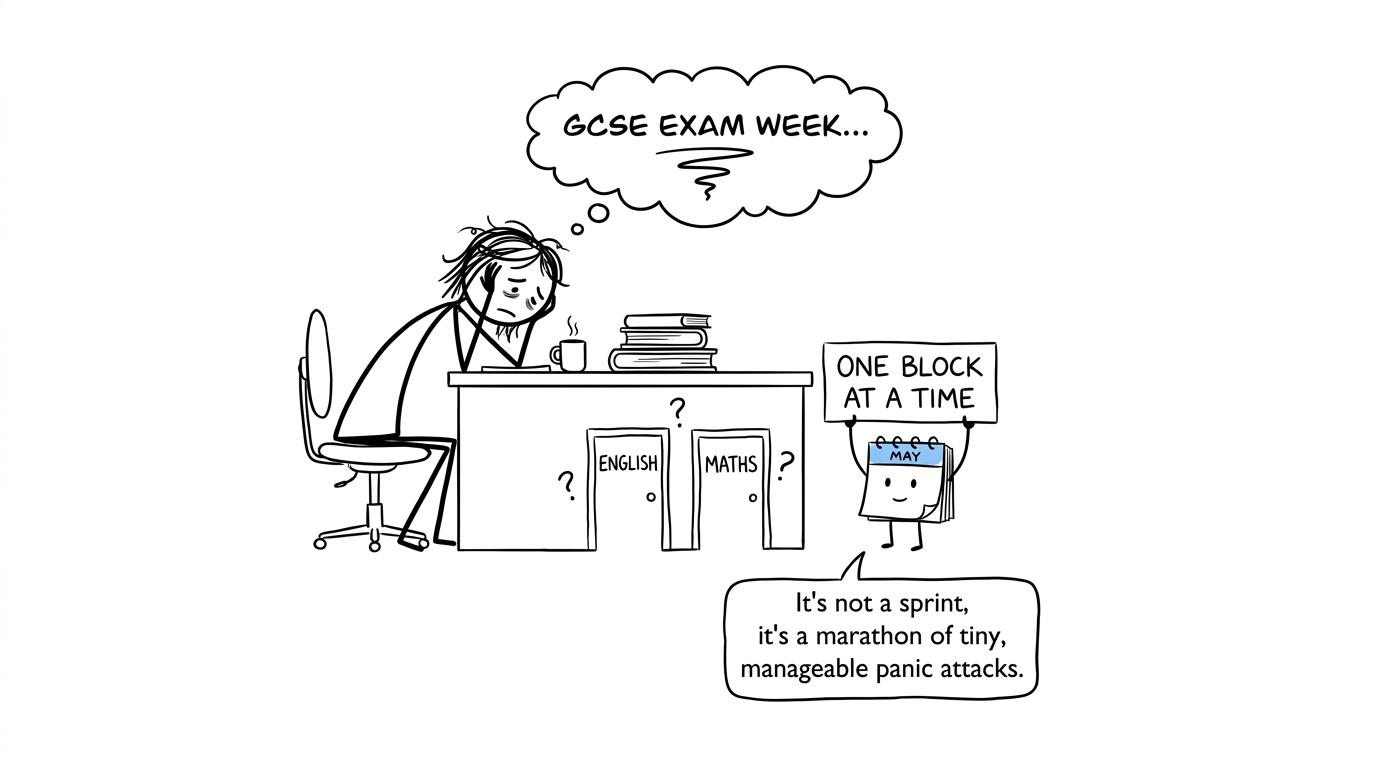 A GCSE student choosing one revision block at a time during a crowded exam week
First, check whether it is really an exam clash
Students often use “clash” to mean several demanding papers in one week. Officially, a timetable clash occurs when two or more exams are scheduled in the same session on the same day.
If two papers appear at the same time, contact your school’s exams officer immediately. Do not decide to miss one or assume that you can sit it on another convenient date. JCQ rules require schools and colleges to manage genuine clashes through formal arrangements, which can include consecutive papers or supervised timetable changes depending on the circumstances.
Your school should explain the arrangement. Confirm:
- which paper you will sit first;
- where you must report;
- whether you will remain under supervision;
- what you may bring for a supervised break;
- when you will be allowed to leave.
A contingency day is also not a personal catch-up day. It exists for examinations disrupted nationally or significantly locally. Always remain available for the full examination period specified by your school and use your individual timetable rather than dates remembered from friends or social media.
If the papers simply fall within the same week, the problem is revision capacity rather than exam administration. That is something you can plan.
Split attention by urgency, weakness and exam demands
A flat timetable gives every subject the same time. It looks fair but ignores reality. A paper tomorrow needs more attention than one next week, while a weak subject may need more maintenance than a strong one.
Use three categories each evening.
The next-paper block
Give roughly half of your available revision time to the examination that comes next. This is where you retrieve key knowledge, practise the paper format and correct final weaknesses.
For English Literature, that may involve:
- recalling a compact set of versatile quotations;
- planning responses for characters and themes;
- linking evidence to methods and context;
- writing one paragraph or timed section;
- checking the relevant assessment objectives.
For English Language, prioritise the exact reading and writing tasks used by your board. AQA, Edexcel, OCR and Eduqas do not organise every paper identically. Use your specification, teacher guidance and past materials rather than borrowing a generic online technique that may not match your questions.
The maintenance block
Use a shorter block for the important paper that follows. In maths, this should normally be active practice rather than reading notes.
The GCSE Maths revision hub lets you choose the appropriate exam board and work at foundation or higher tier. On a busy English evening, choose one weak skill, answer a small set of questions and mark it immediately.
If you need a quick check rather than a full paper, use the GCSE maths mini tests. A short test can preserve retrieval and reveal whether a method needs attention without consuming the entire evening.
The small catch-up block
Reserve a final, optional block for administration or light recall: pack equipment, review an error log, organise quotation cards or check tomorrow’s room. If you are exhausted, remove this block before cutting sleep.
A timetable is a decision tool, not a punishment contract.
Use different revision methods for Language and Literature
English Language and English Literature share analytical writing skills, but they are not revised in exactly the same way.
Revising English Literature during a crowded week
Literature rewards secure knowledge that can be adapted to the question. Avoid trying to memorise dozens of isolated quotations the night before. Select a smaller quotation core that connects to several characters, themes and ideas.
For each quotation, recall:
- who says it and where it occurs;
- the relevant theme or character;
- one or two language or structural choices;
- the interpretation you could argue;
- relevant context where the question and mark scheme require it.
Then plan responses rather than writing endless complete essays. A useful plan should contain a clear argument, a logical sequence of paragraphs and carefully chosen evidence. Write a timed paragraph when you need to test whether the plan can become fluent analysis.
Revising English Language during a crowded week
Language papers include unseen material, so memorising content is less useful than practising decisions. Train yourself to identify the question demand, select evidence efficiently, analyse effects and control time.
Alternate between:
- short reading-question drills;
- one planned extended response;
- timed openings or paragraphs;
- proofreading practice;
- reviewing an answer against the mark scheme.
Do not spend the evening inventing complicated acronyms. A simple method you can apply under pressure is more useful than a perfect-looking revision poster.
Keep maths moving without letting it take over
When English is tomorrow and maths is later in the week, maths needs maintenance rather than abandonment. Small, marked sessions work because they preserve contact with the subject.
Choose the resource that fits the time available:
- A short topic session if one method is insecure.
- A mini test if you need mixed retrieval.
- A timed paper section if maths is approaching.
- A complete paper only when you have the time and energy to mark it properly.
Students taking Edexcel can select an appropriate paper from the Edexcel GCSE Maths past papers. Equivalent collections are available for AQA GCSE Maths past papers and OCR GCSE Maths past papers.
Do not merely total the marks. Label each loss as a content gap, accuracy error, misreading or time problem. The article on finding your weakest GCSE topics explains how to turn that evidence into targeted practice.
As maths becomes the next paper, reverse the balance. Move from English maintenance to a longer maths block, but still avoid uncontrolled paper grinding. One carefully marked section can teach more than a complete paper that is never reviewed.
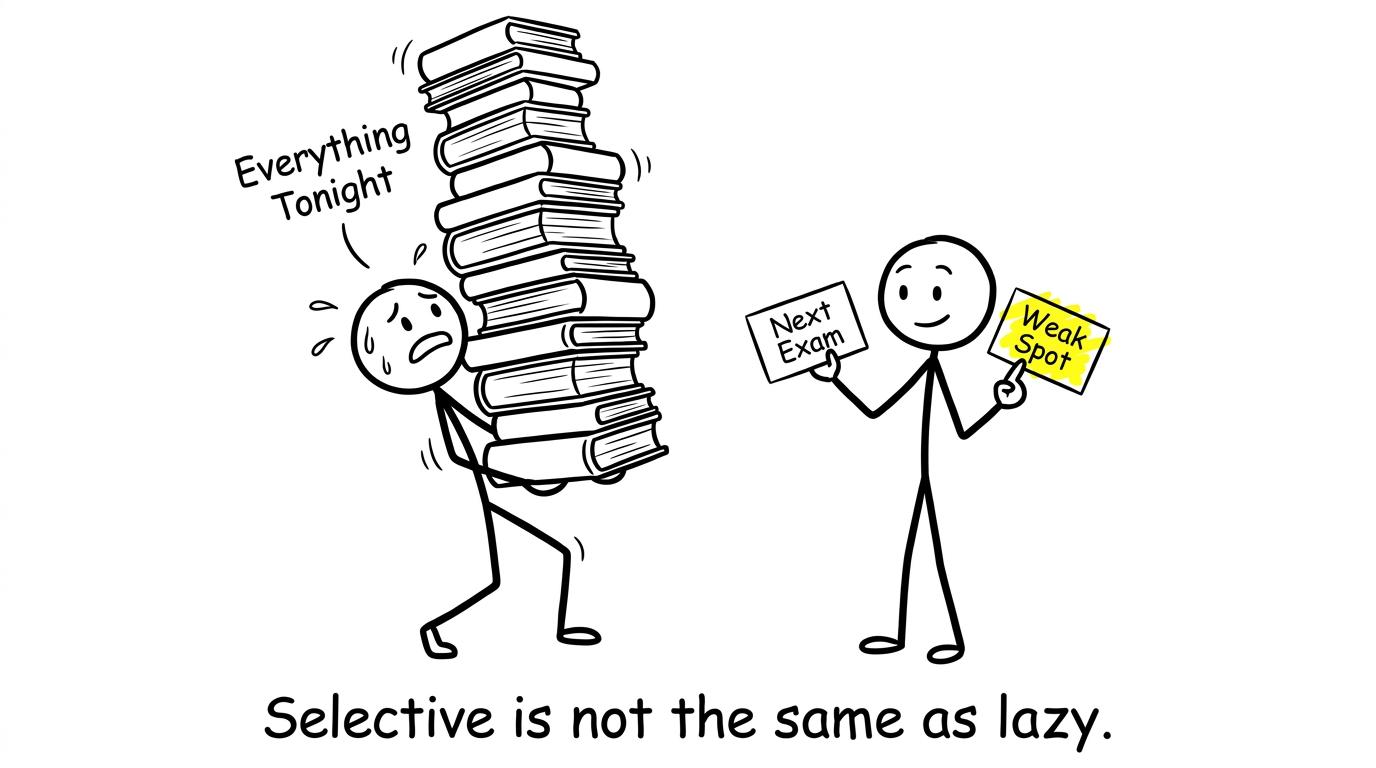 A student discovering that selective revision is not the same as laziness
Plan the day before and the day after each exam
The evening before an exam should narrow your focus. Confirm the paper, retrieve essential knowledge, complete one bounded practice task and stop at a planned time.
For maths, the GCSE maths night-before plan offers a structured alternative to panic revision. The same principle applies to English: no sprawling new topic, no unmarked full paper and no attempt to rescue the entire course after midnight.
After an exam, take a proper break before revising again. Avoid conducting a lengthy post-mortem with friends. You cannot change the completed paper, and comparing answers can consume attention needed for the next one.
When you restart:
- identify the next examination;
- choose one high-value task;
- complete a shorter session than usual if mentally tired;
- prepare tomorrow’s materials before finishing.
A crowded week is managed through repeated resets. Yesterday’s timetable may no longer be the right one once a paper has been completed.
Common mistakes when several GCSE exams fall together
Giving every subject equal time
Equal time ignores urgency and weakness. Allocate more time to the next paper while maintaining later subjects briefly.
Revising Literature only by rereading
Rereading can feel fluent without proving recall. Close the book, retrieve quotations, build arguments and plan paragraphs.
Treating English Language as impossible to revise
You cannot memorise the unseen extracts, but you can practise selection, analysis, writing control, proofreading and timing.
Completing maths papers without marking them
An unmarked paper provides activity but little direction. Use mark schemes and video solutions, record why marks were lost and repair the weakest method. MathsGenie’s guide to using GCSE past papers at the right stage can help you choose between topic work, short tests and complete papers.
Confusing a busy week with an official clash
Several exams close together are stressful, but an actual timetable clash means simultaneous papers. Report any same-session conflict to your exams officer immediately.
Sacrificing sleep to finish the timetable
A plan that requires endless late nights is badly designed. Remove low-value tasks, shorten maintenance blocks and stop at a fixed time.
Finish the week one paper at a time
When English Language, English Literature, maths and other GCSE papers gather in the same week, the calendar can make everything feel equally urgent. It is not. The next paper deserves your deepest focus; later papers need small, deliberate contact until their turn arrives.
Keep English revision specific to the paper. Retrieve quotations and plan arguments for Literature. Practise decisions, timing and controlled writing for Language. For maths, use short targeted questions, mini tests and marked paper sections until maths becomes the immediate priority.
MathsGenie makes that side of the week easier to organise. Start with the free GCSE Maths revision resources, then combine revision lessons and practice questions with mini tests, past papers, predicted papers, mark schemes and video solutions. Choose one useful task, finish it properly, and let the next clear step replace the panic.