GCSE English Language and Literature Early Entry
GCSE English language and literature early entry: weigh readiness, workload, resit rules and the effect on maths revision before making your decision.
A school suggests taking English a year early. At first, it sounds like a gift: finish two GCSEs sooner and create more room in Year 111111. But GCSE English Language and Literature early entry is only a good idea when you are already consistently ready for the real examinations and the preparation will not weaken your other subjects.
The short answer is simple. Early entry can suit a mature, secure student with strong timed-writing results and a clear plan for Year 111111. It is usually less helpful when the decision is based on one promising assessment, pressure to “get English out of the way”, or the assumption that an early attempt is consequence-free.
Before agreeing, ask:
- Are your current grades secure across several timed assessments?
- Have you completed the required texts and examination content?
- Can you produce your best work under full examination conditions?
- Will English preparation reduce the time available for maths and science?
- What happens if the result is below your target?
- Why does the school believe early entry is right for you specifically?
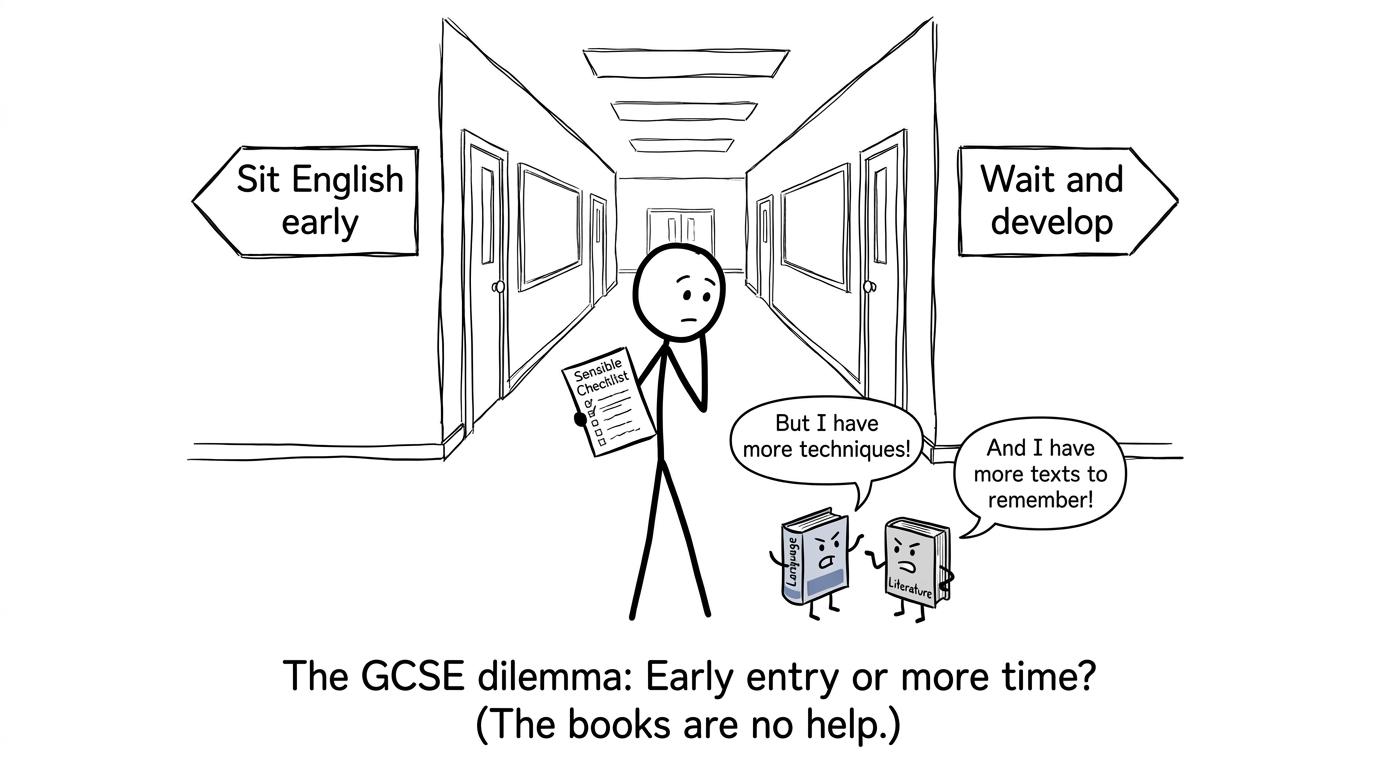 A student calmly comparing two routes through GCSE English
What early entry actually means
Early entry normally means sitting the formal GCSE examination before the summer in which most students in your year group take it. For example, a student might complete one or both English GCSEs in Year 101010 rather than Year 111111.
This is not the same as taking a mock examination. It is a real qualification entry, with real papers, deadlines and results.
English Language and English Literature are also separate GCSEs. Language assesses skills such as reading unfamiliar texts, comparing viewpoints and producing effective writing. Literature assesses your understanding of the set texts specified by your exam board, which may include a Shakespeare play, nineteenth-century fiction, modern texts and poetry.
The precise content and assessment structure differ between Edexcel, AQA, OCR and Eduqas. Arrangements also vary across England, Wales and Northern Ireland. Your school should therefore explain exactly which qualification, specification and examination series it is proposing.
When taking English early can make sense
Your performance is consistently secure
Readiness is a pattern, not a peak.
One high mock grade may show potential, but it does not prove that the same performance will appear on a different paper several months later. A stronger case is built from several timed assessments, covering different question styles, with marks comfortably above the boundary for your target grade.
Ask to see your marks rather than relying only on broad comments such as “doing well”. You should understand whether your weaknesses are occasional slips or gaps that need more development.
Literature readiness also requires complete coverage of the set texts. Knowing a few flexible quotations is not enough if your analysis becomes uncertain when the question focuses on a less familiar character, theme or extract.
You already write well under time pressure
English performance depends partly on judgement: selecting evidence, developing interpretations, organising ideas and adapting writing to audience and purpose. These abilities often improve with reading, feedback and maturity.
Early entry may be sensible if you can already sustain that quality across a full paper. If your strongest responses depend on extra time, teacher prompts or a familiar question, another year of development may be valuable.
The saved time has a defined purpose
“More time next year” sounds useful, but only if somebody has decided how that time will be used.
A good plan might redirect lessons towards another qualification, structured independent reading or targeted support. For a student preparing for maths, it could also protect regular access to free GCSE maths revision lessons, rather than leaving every difficult topic until the spring.
Finishing early has value when the released time becomes purposeful. Empty timetable space is not automatically an academic advantage.
When waiting is probably wiser
You are still developing essential skills
An early pass is not always the same as the best result you could reasonably achieve.
Suppose your current work is around grade 444, but your teachers believe another year could move you securely towards grade 666 or 777. Entering early may exchange long-term potential for short-term convenience. That trade-off might occasionally be justified, but it should be discussed openly.
This matters because entry requirements differ among sixth forms, colleges, apprenticeships and individual courses. English Language is particularly important in post-161616 progression, although each provider sets its own requirements. Check the requirements relevant to your plans rather than assuming any pass will be sufficient.
Preparation is crowding out maths
Time has an awkward property: it can be spent only once.
Intensive English preparation may coincide with algebra assessments, science practical work and other GCSE commitments. If you stop practising maths for several weeks, familiar methods can become slower and less reliable. Later, rebuilding them may consume the time early entry was meant to save.
Use a simple weekly audit. Record English lessons, homework, reading and timed papers, then protect realistic periods for GCSE maths topic revision and mixed practice. The aim is not to divide every hour equally. It is to prevent one decision from quietly damaging another subject.
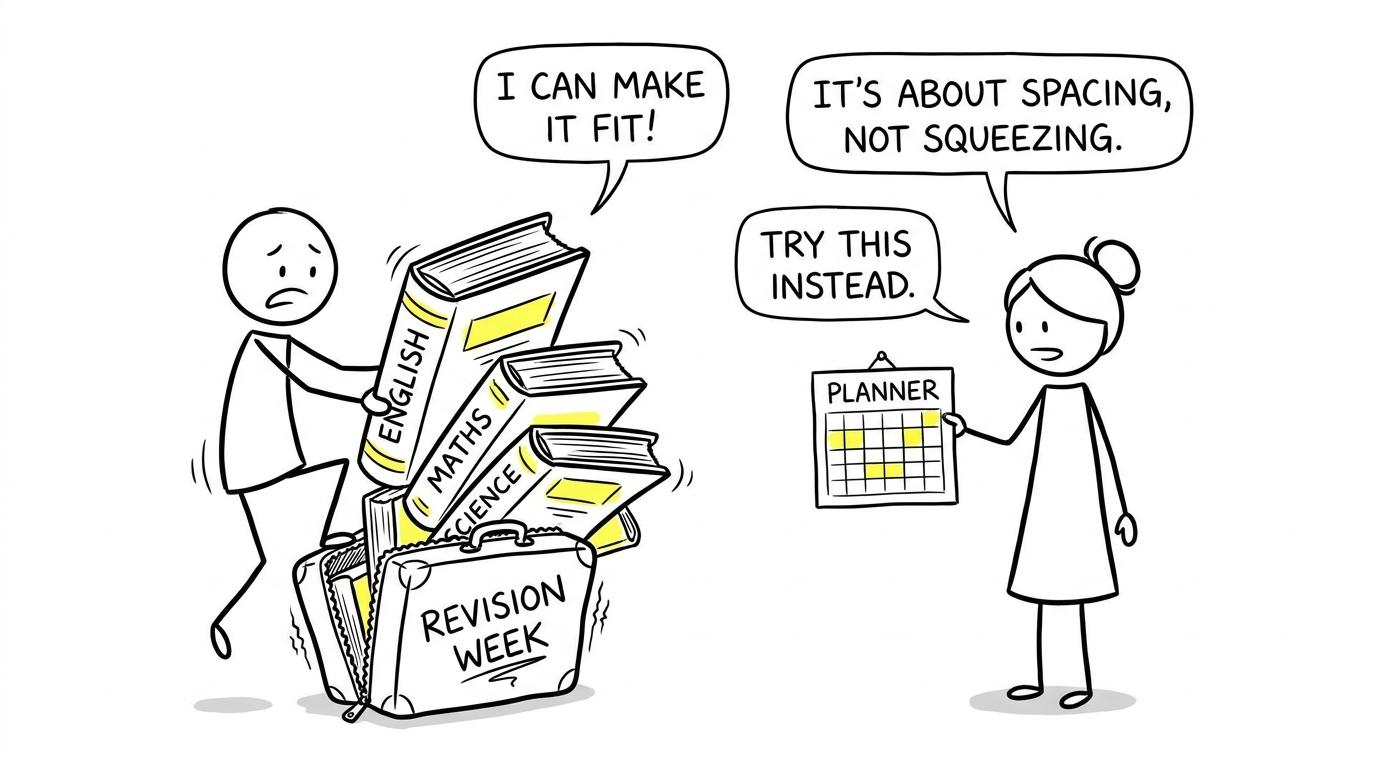 A student discovering that every subject will not fit into one revision week
The resit plan is vague
Never agree on the basis that you can “just resit” without asking for details.
Availability depends on the qualification, examination series, age rules, exam board and current regulatory arrangements. English Language may have a November examination opportunity for eligible candidates, whereas English Literature is generally assessed in the summer series. Your school must confirm the current rules that apply to you.
Ask who would teach you after an unsuccessful result, when another entry could happen, whether the same specification would be used and which result would matter for your next step.
In England, school performance measures can also apply first-entry rules to relevant qualifications. Accountability treatment is not necessarily the same as the result available to a student or seen by a college. Because these rules can change, request a clear explanation from the school rather than relying on an older forum post.
Questions to ask before agreeing
A useful conversation should involve your English teacher, examinations officer, parent or carer and, where appropriate, your head of year. Take this checklist with you:
Questions about readiness
- What grade do my recent timed papers indicate?
- How stable is that grade across Language and Literature components?
- Have I completed all set texts and required content?
- Which assessment objectives still need improvement?
- What grade does my teacher reasonably expect if I wait?
Questions about the examination entry
- Am I entering English Language, English Literature or both?
- Which exam board and specification am I following?
- In which examination series will I sit the papers?
- What are the current resit options and eligibility rules?
- How could early entry affect school accountability records?
Questions about Year 111111
- What will replace my English lessons?
- Will I continue reading and writing regularly?
- How will the school support me if I miss my target?
- How will the plan protect revision time for maths, science and other subjects?
The quality of the answers matters. “You should be fine” is reassurance, not a plan.
Protecting your GCSE maths progress
English and maths revision use different habits. English benefits from reading, planning, writing and reviewing interpretations. Maths improves through explanation followed by deliberate practice, checking and revisiting errors.
If you accept early entry, build a timetable that keeps maths moving. Use MathsGenie's free revision resources to identify topics by grade, then alternate focused topic work with GCSE maths past papers. Past papers reveal whether knowledge can be selected under examination conditions, not merely recognised in a lesson.
Near the final examination season, MathsGenie predicted papers can provide additional practice alongside official past papers. They should be treated as practice, not as a promise about which questions will appear.
If you are considering A Level Maths later, protecting strong GCSE foundations is especially important. The A Level maths revision area shows how ideas such as algebra, graphs and trigonometry continue into post-161616 study. An early English entry should create useful capacity, not force you to rush those foundations.
Common mistakes when deciding
Treating early entry as automatically impressive
Colleges are normally interested in your achieved qualifications and whether you meet their entry requirements. Sitting an examination early is not, by itself, evidence of a stronger result.
Looking only at the predicted grade
A grade without its evidence can be misleading. Look at raw marks, consistency, timing and performance across the full specification.
Assuming Language and Literature are interchangeable
They are separate qualifications with different content and skills. Readiness for one does not guarantee readiness for the other.
Ignoring the opportunity cost
Extra English papers, quotation revision and timed writing must fit somewhere. Consider which maths lessons, homework sessions or rest periods might be displaced.
Planning the first attempt but not the aftermath
Think through both outcomes. If the result meets your target, what replaces English? If it does not, what teaching and future entry are available?
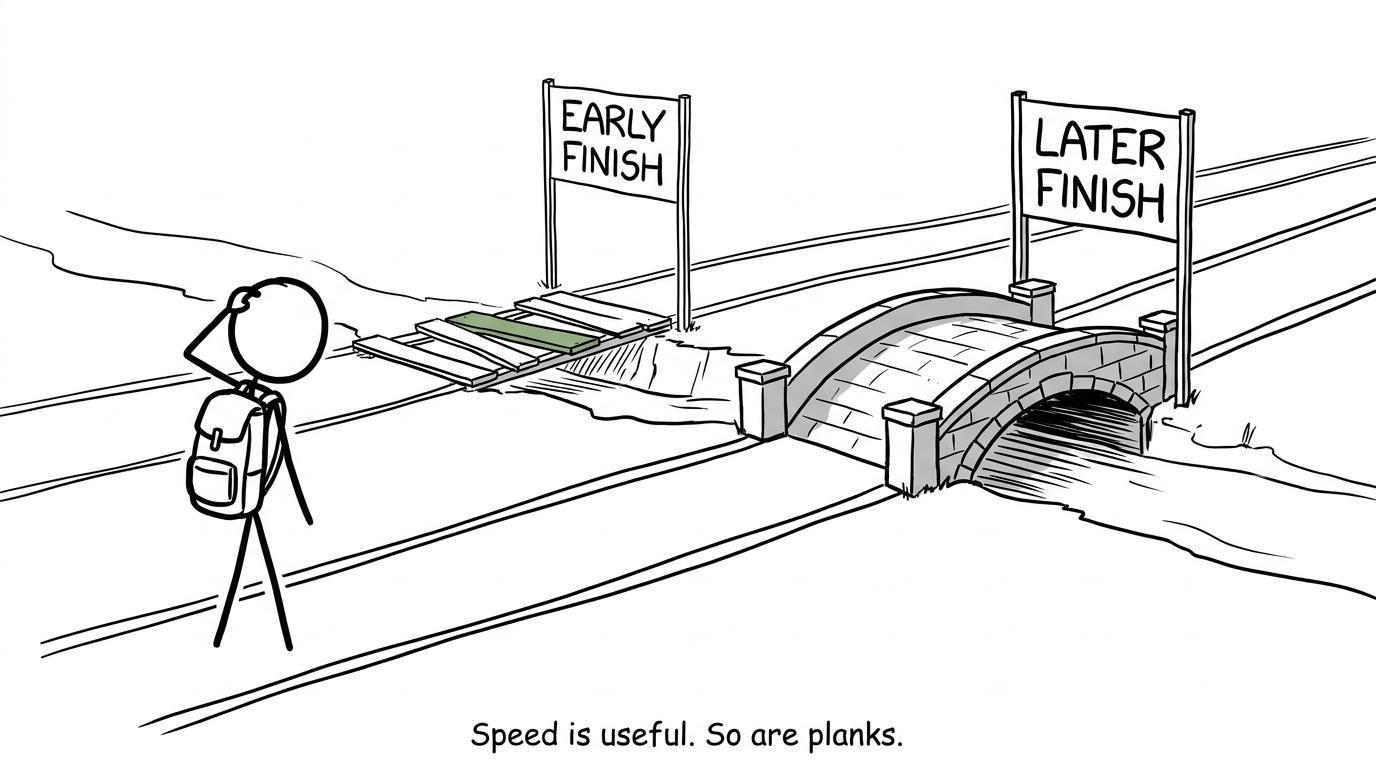 A student checking whether the fastest route has all its bridge planks
A good decision is personal, not hurried
GCSE English Language and Literature early entry is neither automatically ambitious nor automatically unwise. It makes sense when strong evidence shows that you are ready, the school has explained the current entry and resit arrangements, and the timetable genuinely benefits your wider education.
Waiting can be the more ambitious choice when another year would deepen your reading, sharpen your writing or raise your likely grade. Speed is useful only when it takes you where you wanted to go.
Before agreeing, ask for your assessment evidence, the exact qualification details and a written plan for the time that early entry would release. Then protect the subjects still ahead. Start with MathsGenie's GCSE revision lessons, practise with past papers and mark schemes, and use predicted papers as part of a balanced final revision plan. English may finish early. Your wider GCSE journey still deserves careful pacing.