GCSE English Language Harder Than Before? The Truth
GCSE English Language harder than before? Explore what changed, why the exam can feel tougher, and how maths students can prepare without losing focus.
The unsettling thing about GCSE English Language is that you cannot revise every possible answer. There is no finite list of quotations to memorise and no formula that guarantees full marks. You meet unfamiliar texts, make decisions under time pressure and explain effects that may not seem obvious at first.
So, is GCSE English Language harder than before? In England, the reformed qualification is harder in several concrete ways than the GCSEs it replaced: content was made more challenging, assessment moved towards final examinations, and students must respond to demanding unseen texts. However, that does not mean it becomes harder every year, nor that today’s grades can be compared directly with old letter grades using raw marks alone.
For a maths student balancing several exams, the practical message is simpler: English Language is demanding, but its recurring skills can be practised systematically.
The short answer
Here is the distinction that matters:
- Compared with pre-reform GCSEs: the current English qualification in England was deliberately designed to be more demanding.
- Compared with the last few normal exam years: there is no good evidence that it simply gets harder each summer.
- In terms of experience: it can feel especially difficult because the texts are unseen, responses are extended and time management matters.
- In terms of grading: exam boards adjust grade boundaries after papers have been marked so that differences in paper difficulty do not automatically make grades easier or harder to obtain.
- For revision: learning the assessment objectives, practising timed responses and analysing feedback are more useful than worrying about rumours concerning grade boundaries.
The current qualification discussed here is primarily the reformed GCSE used in England. Wales and Northern Ireland have different qualification and grading arrangements, so always check the specification for your school and exam board.
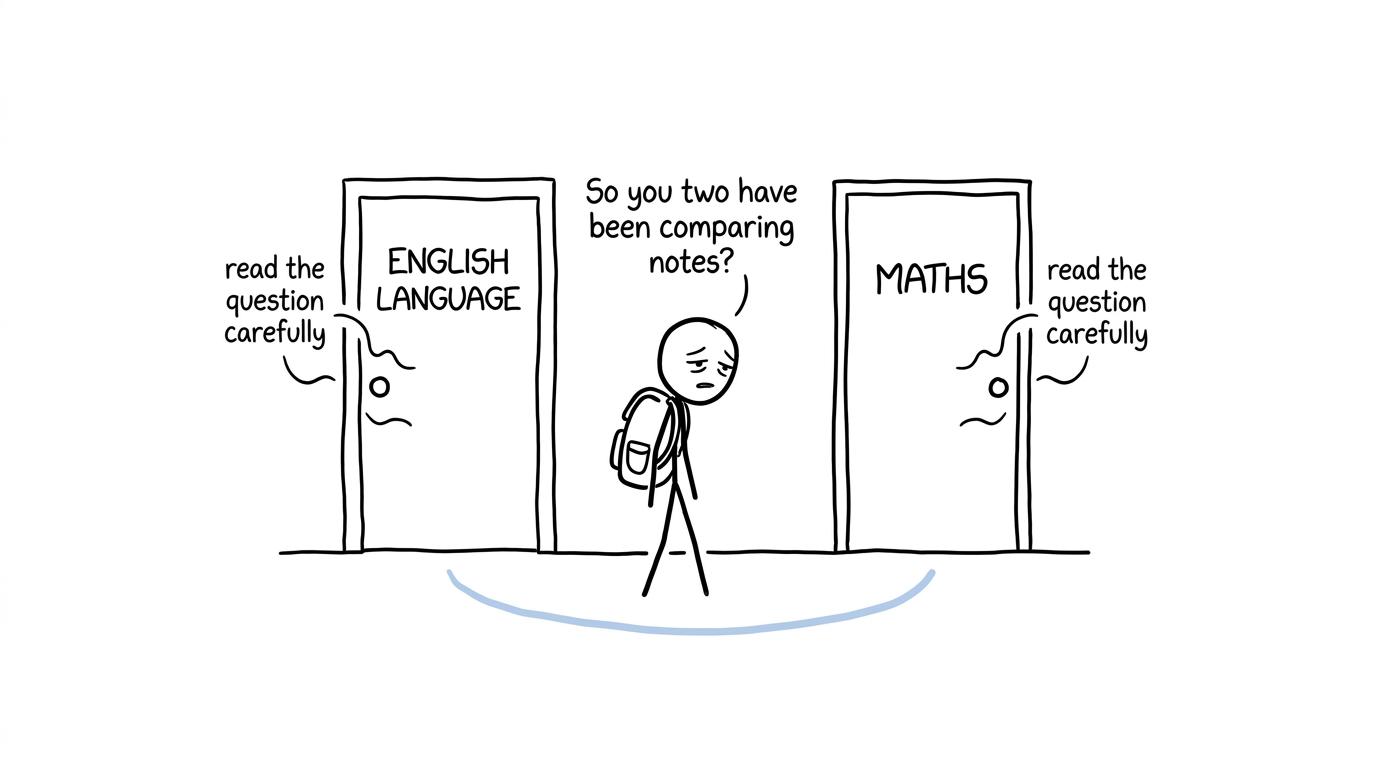 A student discovers that English and maths share an obsession with reading questions carefully
What actually changed in GCSE English Language?
The major reform was introduced for first teaching in England in 201520152015, with the first grades awarded in 201720172017. English Language, English Literature and maths were among the first subjects to move to the grades 999 to 111 system.
The change was not merely a new set of labels. Government and Ofqual material described reformed GCSE content as more challenging, with courses becoming linear and relying mainly on examinations.
Assessment became more concentrated
Under the previous framework, controlled assessment could contribute substantially to an English qualification. In the reformed GCSE English Language, the academic grade is determined by written examinations taken at the end of the course.
Spoken language is still assessed and reported separately, but it is unweighted and does not contribute to the final GCSE grade. This creates a particular kind of pressure: performance across the written papers matters enormously, and there is less opportunity to bank marks through assessed work completed earlier.
That is a genuine reason the modern qualification may feel harder. One difficult morning can seem to carry more weight.
Students face demanding unseen texts
The current subject content requires students to engage with high-quality, challenging texts from the nineteenth, twentieth and twenty-first centuries. They must interpret explicit and implicit ideas, analyse language and structure, compare perspectives and evaluate texts using evidence.
The reading and writing components are each worth 50%50\%50% of the qualification. Accuracy is not a minor extra: the assessment objective covering vocabulary, sentence structures, spelling and punctuation accounts for 20%20\%20% of the marks across the whole specification.
This rewards a broad combination of skills. You need comprehension, inference, analysis, organisation, control of language and enough stamina to apply them under timed conditions.
The top of the grade scale became more differentiated
The numbered scale is not a simple relabelling of every old grade. Ofqual aligned important reference points when the qualifications changed: broadly, the bottom of grade 777 aligned with the bottom of the old grade A, while the bottom of grade 444 aligned with the bottom of grade C.
Grade 999 was introduced to provide greater differentiation among the strongest performances, and fewer grade 999s were intended to be awarded than old A* grades. For students aiming at the very top, that makes the distinction between an excellent response and an exceptional one more visible.
Why English Language can feel harder than maths
Maths and English Language create uncertainty in different ways.
In maths, you may not know which topic the next question will test, but there is usually an established mathematical method. English Language provides the text, yet you must choose which details matter and construct an interpretation that answers the exact question.
That openness can create the false impression that English marking is arbitrary. It is not. Examiners work with assessment objectives and level descriptors, although those descriptors necessarily evaluate qualities such as clarity, analysis, evidence and organisation rather than one numerical answer.
There is also no foundation or higher tier in GCSE English Language. All candidates work within the same qualification framework. By contrast, GCSE maths students normally sit a tier matched to an available grade range. If you are planning maths revision, begin at the GCSE Maths revision hub, where resources are organised by exam board and level.
Does it become harder every year?
This is where perception and evidence separate.
A paper can be harder than the previous year’s paper. The extracts may feel less familiar, a writing prompt may be awkward, or one question may demand more thought. But a harder paper does not automatically mean harsher final grades.
Grade boundaries are set after students have taken the assessments and marking is sufficiently advanced. Examiners consider evidence about how demanding the paper was and the quality of students’ work. Boundaries can therefore move from one series to another.
Ofqual reported that overall GCSE outcomes in England in summer 202520252025 were broadly stable against 202420242024, with standards maintained year to year. JCQ’s subject data showed that, across all ages in England, approximately 59.7%59.7\%59.7% of English Language entries achieved grade 444 or above in 202520252025, compared with approximately 61.6%61.6\%61.6% in 202420242024.
That small change does not prove that the paper became harder. All-age figures include different groups of entrants, including post-161616 candidates, and yearly cohorts are not identical. Pass rates alone cannot isolate changes in paper difficulty, teaching, attendance, resit entry or student performance.
The careful conclusion is this: the reformed course is structurally more demanding than its predecessor, but it is misleading to assume that the required standard quietly rises every summer.
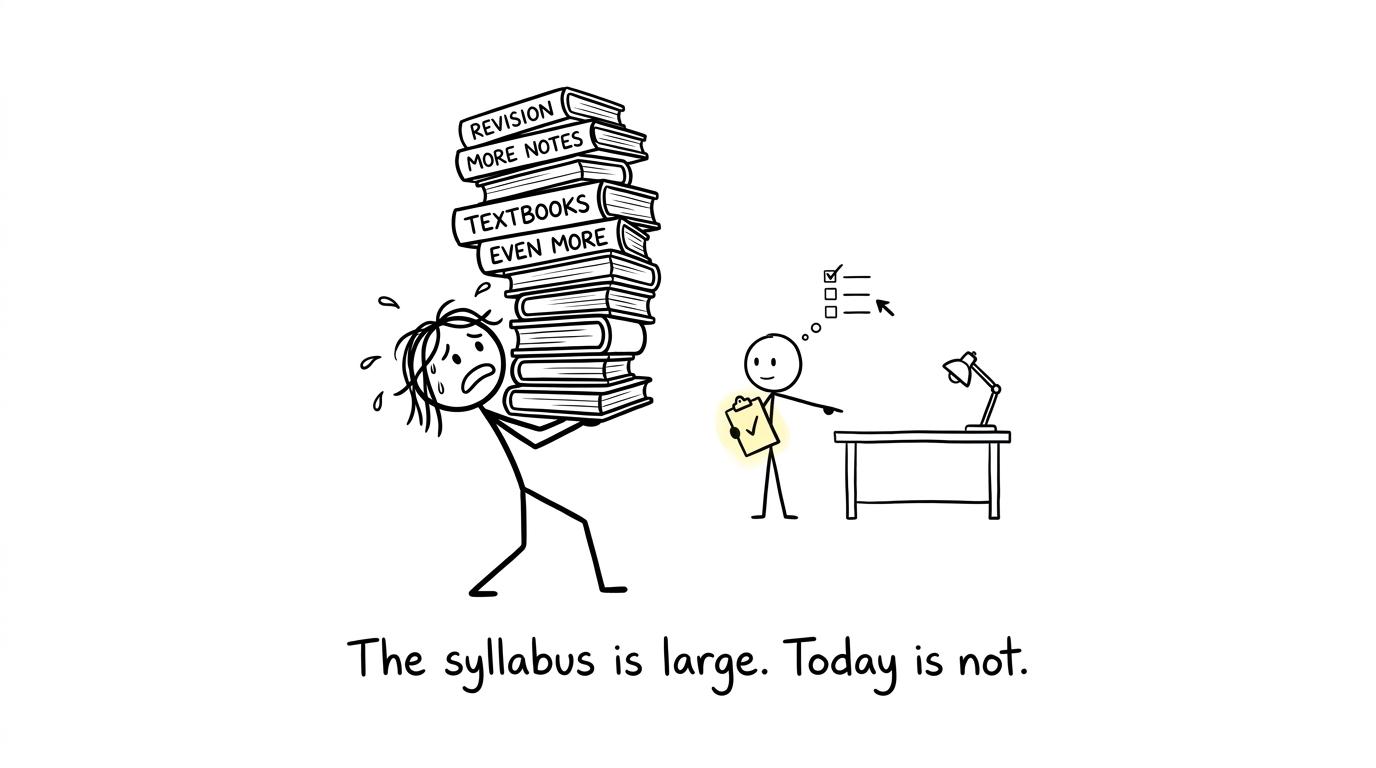 A huge syllabus is defeated by one small revision checklist
Why it may feel harder now
Even when the standard is stable, your experience may not be.
Unseen material prevents comfortable prediction
You can learn question types, analytical habits and writing structures, but you cannot know the exact extracts in advance. That uncertainty magnifies nerves. It also makes genuine skill more important than memorised paragraphs.
Timing exposes weak decisions
Many students understand a text but spend too long on an early question, leaving an extended writing task rushed. The problem is not always English ability. Sometimes it is the allocation of attention.
Maths papers create the same trap. One stubborn question can consume time that belongs to several accessible marks later. Practising with a timer makes this pressure familiar. MathsGenie’s GCSE past papers collection and guide to using past papers properly can help you build that habit for maths.
The exam asks for several skills at once
A strong English response may require accurate reading, relevant evidence, analysis, logical sequencing and technical accuracy. A strong maths solution can similarly require choosing a method, carrying out calculations correctly and communicating enough working to earn method marks.
In both subjects, knowing something privately is not enough. You must make that knowledge visible to the examiner.
A practical revision checklist for maths students
English should not swallow the time needed for maths, and maths should not become a reason to avoid English. Use a compact routine:
- Confirm whether you take AQA, Edexcel, OCR or Eduqas and download the correct specification.
- Learn what each English assessment objective rewards.
- Complete short, timed reading questions rather than repeatedly rereading notes.
- Practise planning extended writing before attempting full responses.
- Mark work using the official mark scheme and teacher feedback.
- Keep an error log covering timing, evidence, analysis, structure and technical accuracy.
- Reattempt the same skill with a different text.
- Give maths its own protected revision sessions.
For maths, the GCSE maths revision timetable guide offers a workable structure. You can use Edexcel GCSE Maths mini tests for shorter sessions, then move to Edexcel past papers when you are ready for full exam conditions.
The principle transfers across subjects: attempt, mark, diagnose, repair and retest. MathsGenie’s guide to using GCSE mark schemes effectively explains why the score is only the beginning. The useful part is discovering what the examiner could not reward and changing your next response.
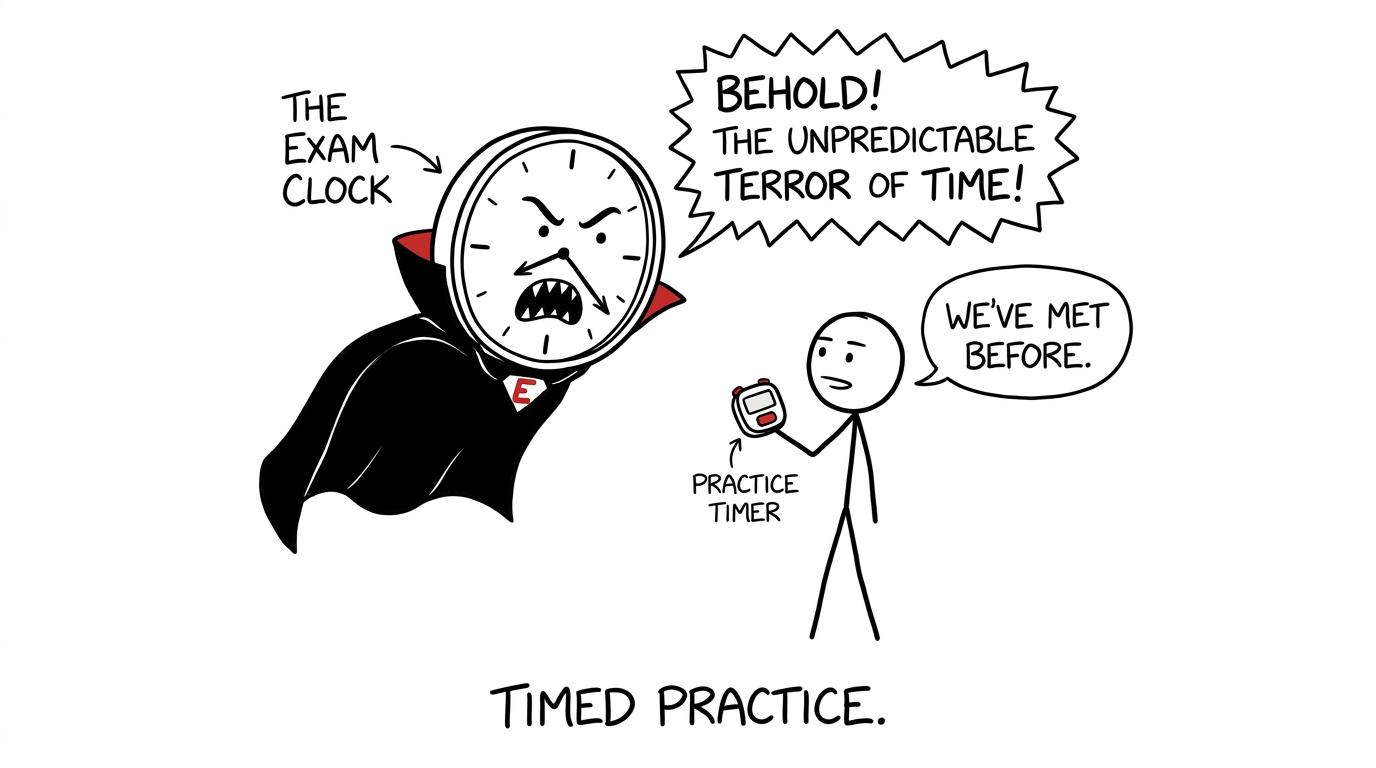 A student calmly recognises the exam clock from timed practice
Common mistakes when judging whether the GCSE is harder
Comparing raw marks from different years
A score on one paper cannot be compared fairly with the same score on another without considering each year’s grade boundaries and paper demand.
Treating grade 999 as identical to the old A*
The scales have reference points, but they are not a one-to-one conversion at every level. Grade 999 was created to distinguish the very strongest performances more sharply.
Assuming a lower national pass rate proves a harder exam
Results are affected by cohort composition, including the number and profile of resit candidates. A change in outcomes may have several causes.
Revising model answers instead of transferable skills
A memorised paragraph may not fit the unseen text or question. Practise selecting evidence, explaining effects and adapting your writing to purpose and audience.
Letting English anxiety damage maths revision
Concern expands to fill unplanned time. Give each subject a defined task. For maths, that might mean one revision lesson, a focused set of practice questions and immediate marking. Nearer the exams, add Edexcel predicted papers without using them as a substitute for official past papers.
The fairest conclusion
GCSE English Language did genuinely become more demanding when the reformed qualification replaced earlier versions in England. Its challenging unseen texts, end-of-course written assessment and sharper differentiation at the top support that conclusion.
But the story is not that examiners make it harder every year. Paper demand varies, boundaries respond to evidence, and regulators aim to maintain the meaning of grades over time. Much of today’s difficulty is also the unavoidable difficulty of demonstrating complex reading and writing skills under pressure.
You cannot control the extract that appears. You can control whether timed work feels familiar, whether you understand the assessment objectives and whether each mistake changes your next attempt.
Apply that same discipline to maths. Start with MathsGenie’s free revision lessons and practice questions, use mini tests to expose gaps, then build towards past papers and predicted papers. Mark every attempt carefully, check worked or video solutions and turn lost marks into your next revision task. Exams become less mysterious when your routine is not.