GCSE English Language Grade 4 Meaning Explained
GCSE English Language grade 4 meaning explained: understand the standard pass, old grade C comparison, resits and what the result means for next steps.
The difference between two neighbouring grades can feel strangely large on results day. One number may affect a college application, while another leads to another year of English lessons alongside everything else.
Here is the GCSE English Language grade 4 meaning in plain terms: in England, a grade 4 is officially described as a standard pass. It is broadly comparable with the old grade C and usually means that you will not be required to continue studying GCSE English Language under the government’s post-16 funding rules. However, individual sixth forms, colleges, apprenticeships and employers may set higher entry requirements.
That is the short answer. The more useful answer is what the grade represents, what it does not prove, and what you should do next, especially when maths revision is competing for the same limited time.
Grade 4 at a glance
- Grade 4 is a standard pass in the GCSE grading system used in England.
- It is broadly equivalent to the lower part of the old grade C standard.
- Grade 5 is described as a strong pass.
- English Language is not split into foundation and higher tiers.
- Your grade is based on your total marks across the written assessments, not on passing every question or skill separately.
- Grade boundaries vary between exam boards and examination series.
- A grade 4 normally removes the requirement to continue English under England’s post-16 condition of funding, although a course can still ask for grade 5 or higher.
- Your spoken language assessment is reported separately and does not contribute to the numerical GCSE grade.
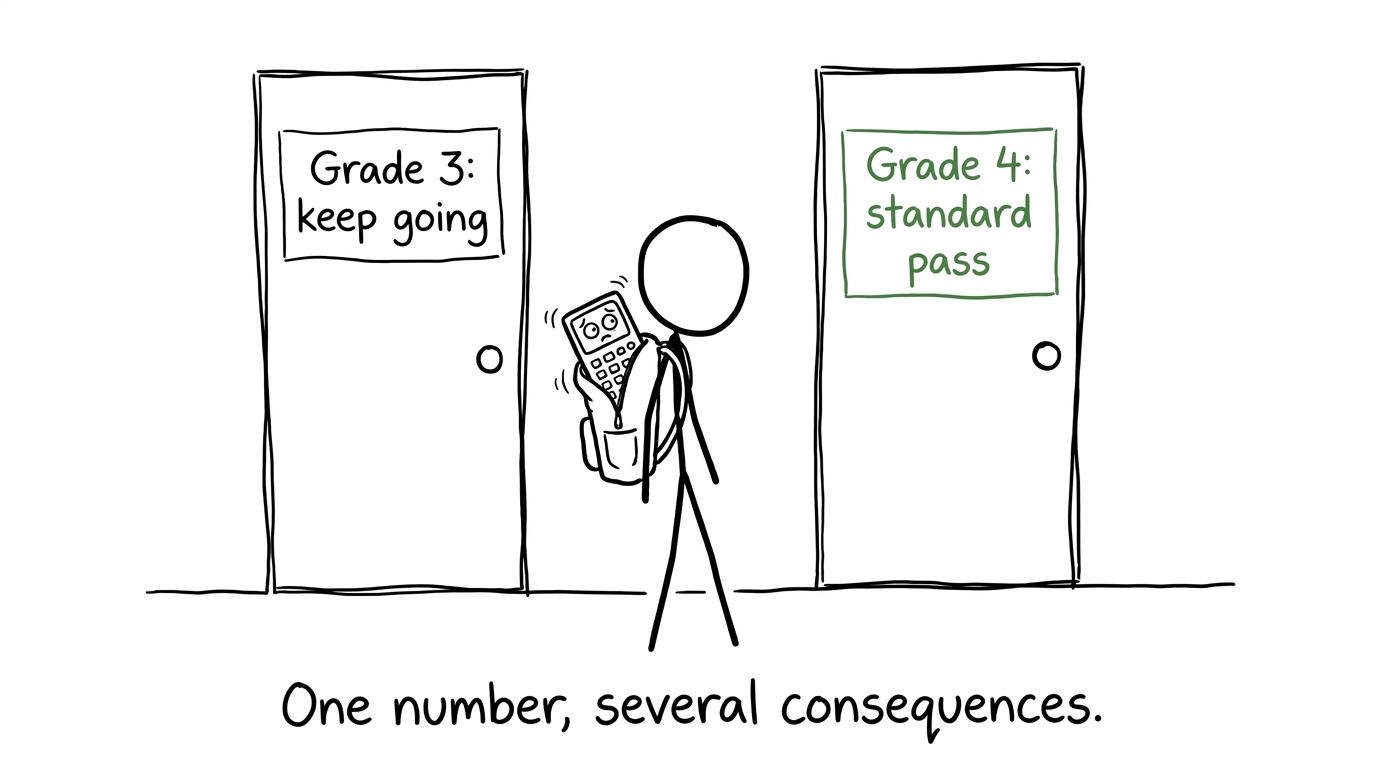 A student choosing between grade 3 and the standard-pass door
What does a grade 4 in GCSE English Language represent?
A grade is a summary of performance, not a complete portrait of ability. A student can be confident when discussing a text but lose marks through rushed written analysis. Another may write accurately yet struggle to interpret an unfamiliar extract under timed conditions. Both profiles could produce the same final grade.
Across Edexcel, AQA, OCR and Eduqas qualifications in England, GCSE English Language assesses broadly similar areas because the national assessment objectives shape each specification. These include:
- understanding explicit and implicit information;
- selecting and synthesising evidence;
- analysing how writers use language and structure;
- comparing ideas and perspectives where required;
- evaluating texts critically;
- communicating effectively for a specified audience and purpose;
- using vocabulary, sentence structures, spelling and punctuation accurately.
A grade 4 indicates that your combined mark reached the grade 4 boundary set for that examination series. In practical terms, it suggests a developing but credible command of the reading and writing assessed by the qualification. You have shown enough across the papers to meet the standard-pass threshold.
It does not mean every one of those skills is securely mastered. GCSE results are compensatory: stronger performance in one section can offset weaker performance elsewhere. That is why the mark breakdown, when available, can tell you more than the grade alone.
How grade 4 compares with the old grade C
When numbered GCSE grades were introduced in England, they were anchored to selected points in the old letter-grade system. The bottom of grade 4 was aligned with the bottom of the former grade C, while the bottom of grade 7 was aligned with the bottom of the former grade A.
Therefore, the safest comparison is:
| Current GCSE grade | Broad interpretation |
|---|---|
| Grade 4 | Standard pass; broadly comparable with the lower part of old grade C |
| Grade 5 | Strong pass; positioned above the old grade C threshold |
| Grade 7 | Broadly comparable with the old grade A threshold |
It is tempting to create a neat one-to-one conversion for every numbered grade. The systems were not designed that way. A grade 4 should not simply be renamed “a C” without qualification, but it does preserve the old C pass threshold closely enough for most everyday comparisons.
The term standard pass can also be misleading if it is heard as “barely passed”. Grade 4 covers a band of marks. A result near the top of that band may be only a few marks below grade 5; a result at the boundary still meets the recognised pass standard.
Is grade 4 good enough for college or an apprenticeship?
Often, yes, but not automatically for every course.
Many post-16 programmes treat grade 4 in English Language as meeting their basic English requirement. More academically demanding courses may ask for grade 5 or 6, particularly where extended reading and writing are central. A Level English subjects are likely to have higher requirements than courses with less written assessment.
Apprenticeship providers and employers also set their own criteria. A grade 4 may satisfy a vacancy’s GCSE requirement, but you should read the precise wording rather than assume that “pass” means acceptance everywhere.
There is another important distinction. English Language and maths are considered separately. Passing English does not compensate for a grade below 4 in maths, and passing maths does not remove an English requirement. If you are planning your next step, check both results against the published entry criteria.
For your maths preparation, the MathsGenie GCSE revision hub lets you focus on individual topics rather than revising the whole course indiscriminately. If grade 4 is your maths target too, the grade 4 maths revision resources bring together relevant lessons, practice questions and video support.
Does a grade 4 mean you must resit English Language?
In England, students aged 16 to 18 who have not achieved grade 4 in GCSE English or maths are generally required to continue studying the relevant subject as a condition of government funding for their institution. Students who already hold grade 4 or above are not normally covered by that resit requirement.
So, if you receive grade 4 in English Language, you would not usually be required to resit it. There are still exceptions worth checking:
- your chosen course may require a higher English grade;
- you may choose to resit because a future university course or career asks for more;
- your provider may discuss an improvement programme with you based on its own entry conditions.
Rules and qualifications differ across the UK. The description above applies specifically to the numbered GCSE system and post-16 arrangements in England. Wales and Northern Ireland retain different grading structures for many GCSE qualifications.
Why grade boundaries change
There is no permanent mark that always equals grade 4. Boundaries are set after the papers have been taken and marked. Awarding bodies use evidence about the difficulty of the assessment and student performance to maintain standards between years.
This means a harder paper can have a lower grade boundary without making the qualification easier. The goal is comparable performance, not an identical raw mark every summer.
The same principle matters in maths. A score from one past paper should be interpreted using that paper’s own boundaries rather than a boundary borrowed from another year. Use GCSE maths past papers and mark schemes to practise complete assessments, then review the method behind every lost mark.
Predicted grades and predicted papers are different from official results. A predicted grade is an informed estimate. A predicted paper is revision material designed around likely styles and specification coverage; it cannot identify the exact live questions. MathsGenie’s GCSE predicted maths papers are most valuable when used to expose gaps and practise exam decisions, not as a promise about what will appear.
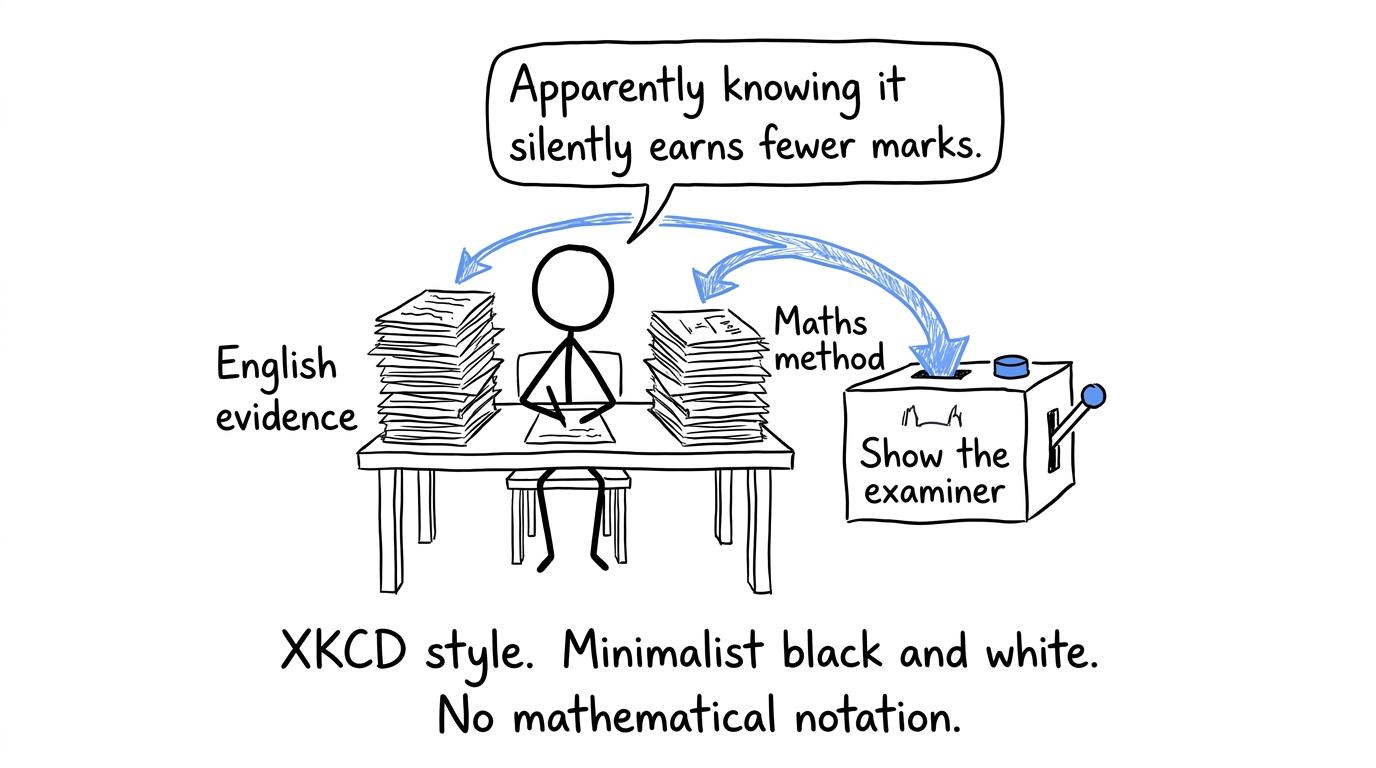 English evidence and maths method entering the same examiner machine
What English Language can teach you about maths exams
English and maths look different on a timetable, but the examiner faces the same basic problem in both: they can only mark what you communicate.
In English, an unsupported interpretation may earn less than a developed response using precise evidence. In maths, an answer without method may miss available working marks. Clear reasoning matters in both subjects.
The habits transfer surprisingly well:
- read command words carefully before beginning;
- select relevant information rather than copying everything;
- organise the response so the examiner can follow it;
- use precise vocabulary;
- leave time to check accuracy;
- compare your work with the mark scheme.
MathsGenie’s grade 5 maths resources can help when you are secure with grade 4 material and ready to extend your target. The aim is not to rush towards harder questions. It is to make the skills beneath your current grade dependable first.
Students considering mathematics beyond GCSE can also explore the free A Level maths revision resources, including topic lessons and examination practice. Entry requirements vary by school or college, so check them before choosing subjects.
What to do after receiving a grade 4
Your next action depends on what the result needs to do for you.
If grade 4 meets your entry requirement
Accept the achievement and redirect your effort towards the qualifications ahead. Keep a copy of the result, confirm that your college or apprenticeship provider has received it, and avoid resitting merely because the number feels modest.
If your course requires a higher grade
Ask for your marks and find out how far you were from the next boundary. Discuss the result with your school or college before requesting a review of marking or entering a resit. A review can cause a mark to rise, remain unchanged or fall, so it should be an evidence-based decision rather than a reaction to disappointment.
If you are still preparing for GCSEs
Build revision around feedback. Complete timed questions, mark them carefully, and identify whether marks are being lost through comprehension, analysis, organisation, technical accuracy or time management.
Use the same cycle for maths: learn a topic, answer practice questions without support, mark the work, then return to the specific step that failed. The MathsGenie home page provides a clear route into free GCSE and A Level revision, while the grade-organised pages help keep the workload realistic.
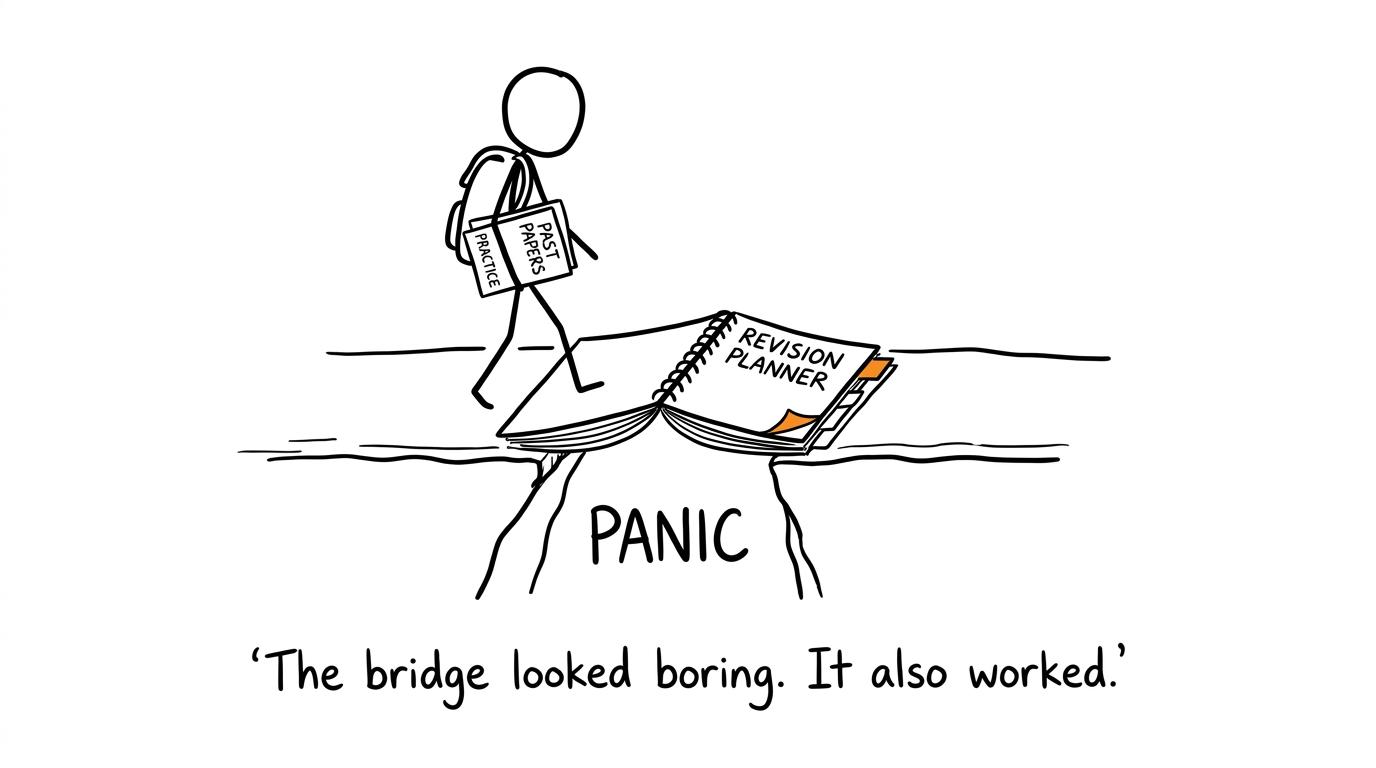 A revision planner forming a bridge over exam panic
Common mistakes when interpreting grade 4
Assuming grade 4 and grade 5 mean the same thing
Both may be described informally as passes, but official terminology distinguishes grade 4 as a standard pass and grade 5 as a strong pass. An institution can legitimately ask for grade 5 even though grade 4 is a pass.
Treating grade 4 as an exact old grade C
It is broadly comparable with the old C threshold, not a perfect translation of the entire old grade band. Avoid conversion charts that claim an exact letter equivalent for every numbered grade.
Thinking one weak section means the qualification was failed
The final grade comes from the total weighted marks. There is normally no requirement to “pass” every individual question or paper section independently.
Assuming the spoken language endorsement changes the final grade
The spoken language component is reported separately. It does not add marks to, or subtract marks from, the numerical English Language result.
Comparing raw marks from different years directly
Papers vary in difficulty, so grade boundaries can move. Compare each mark with the official boundary for the correct exam board, specification and examination series.
Make the grade a starting point
A grade 4 in GCSE English Language represents a recognised standard pass and broadly preserves the threshold associated with the former grade C. It can satisfy many post-16 requirements and usually means no compulsory English resit in England. But its real significance depends on the course, apprenticeship or career you want next.
Grades matter because they open doors. They become less useful when they turn into labels about intelligence or potential.
For maths, the next step can begin today. Choose the appropriate GCSE maths revision level, learn through the revision lessons and video solutions, test yourself with practice questions, then move to past papers, predicted papers and mark schemes. A calm, repeated process is rarely dramatic. It is simply how uncertain marks become dependable ones.