GCSE Eduqas Maths: Improve Using Mark Schemes
GCSE Eduqas students can use mark schemes to gain method marks, spot patterns, and boost grades. Learn a simple routine with examples.
GCSE revision can feel unfair when you almost know what you’re doing, but the paper still gives you zero. You got the right idea, you were close, you even had the correct final answer once or twice, and yet the marks don’t land. For Eduqas students, the fastest way to turn that frustration into progress is to stop treating the mark scheme like a verdict and start using it like a map. This guide shows how to use Eduqas mark schemes to improve in GCSE Maths, so you collect method marks, fix the specific errors that cost grades, and build exam-proof habits.
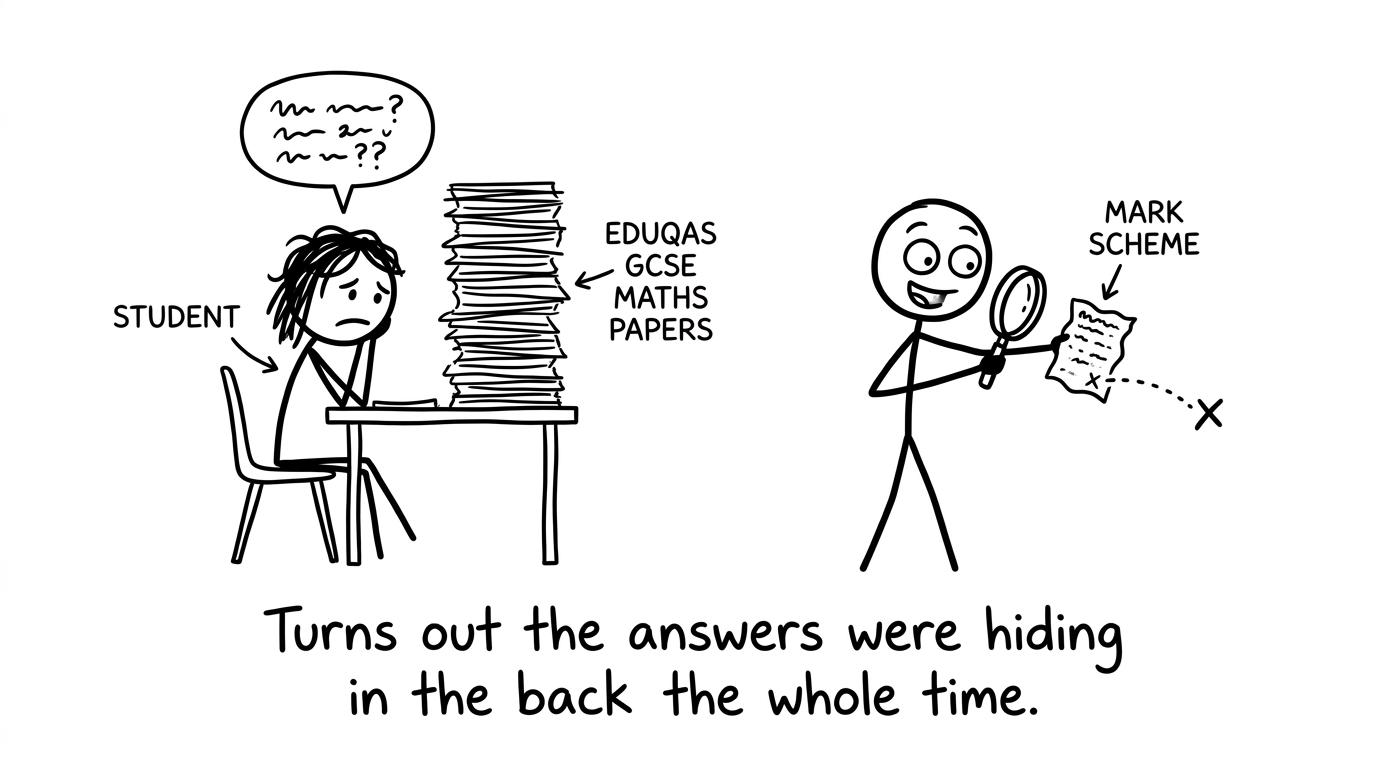 A mark scheme as a treasure map
What a mark scheme really is (and why Eduqas students should care)
A mark scheme isn’t just “the answers”. It’s a record of what examiners are instructed to reward. That matters because GCSE Maths marks are often split into method and accuracy, and Eduqas papers are no different. If you only check whether your final line matches the official answer, you miss the biggest opportunity in your revision: learning what earns marks even when you don’t finish perfectly.
On YesGenie, Eduqas students can access Eduqas GCSE Maths Revision plus Eduqas GCSE Maths Past Papers, where mark schemes sit right next to the questions. That pairing is powerful because it lets you practise exactly what the examiner will accept.
Mark schemes also reveal something calming: examiners expect mistakes. That’s why you’ll see follow-through, alternative methods, and notes like “may be seen in stages” or “accept … or equivalent”. In GCSE terms, that means you can often earn marks with correct structure even if arithmetic slips.
A quick checklist: how to use a mark scheme properly in GCSE Maths
Use this routine each time you complete a paper or an exam booklet:
- Attempt first, mark second: do the full question without looking.
- Highlight the mark split: identify where method marks are available.
- Annotate your work: write what you should have written at the line where your solution diverged.
- Create a micro-skill: turn the mistake into a 10-minute target (one topic, one habit).
- Re-attempt 24 hours later: same question, closed book.
If you want a ready structure for topic-by-topic practice (instead of full papers), use the Eduqas GCSE Maths Exam Booklets to focus your GCSE revision on the exact areas you keep losing marks.
Translating mark scheme codes: the few letters that change everything
Eduqas mark schemes use the same broad logic you’ll see across AQA, Edexcel and OCR, but the wording and codes still matter. The most useful ones for GCSE are:
- BBB marks: a basic fact/statement/answer mark (often no working needed).
- MMM marks: a method mark (you must show a valid approach).
- AAA marks: an accuracy mark (usually depends on earning the method mark first).
- FT: follow through (you can still score if you correctly use your earlier answer).
- SC: special case (marks awarded for a near-miss that shows partial understanding).
- oe: or equivalent (different forms are accepted).
- cao: correct answer only (no working, no marks).
The revision mindset shift is simple: in GCSE Maths, you are not trying to be perfect. You are trying to be markable.
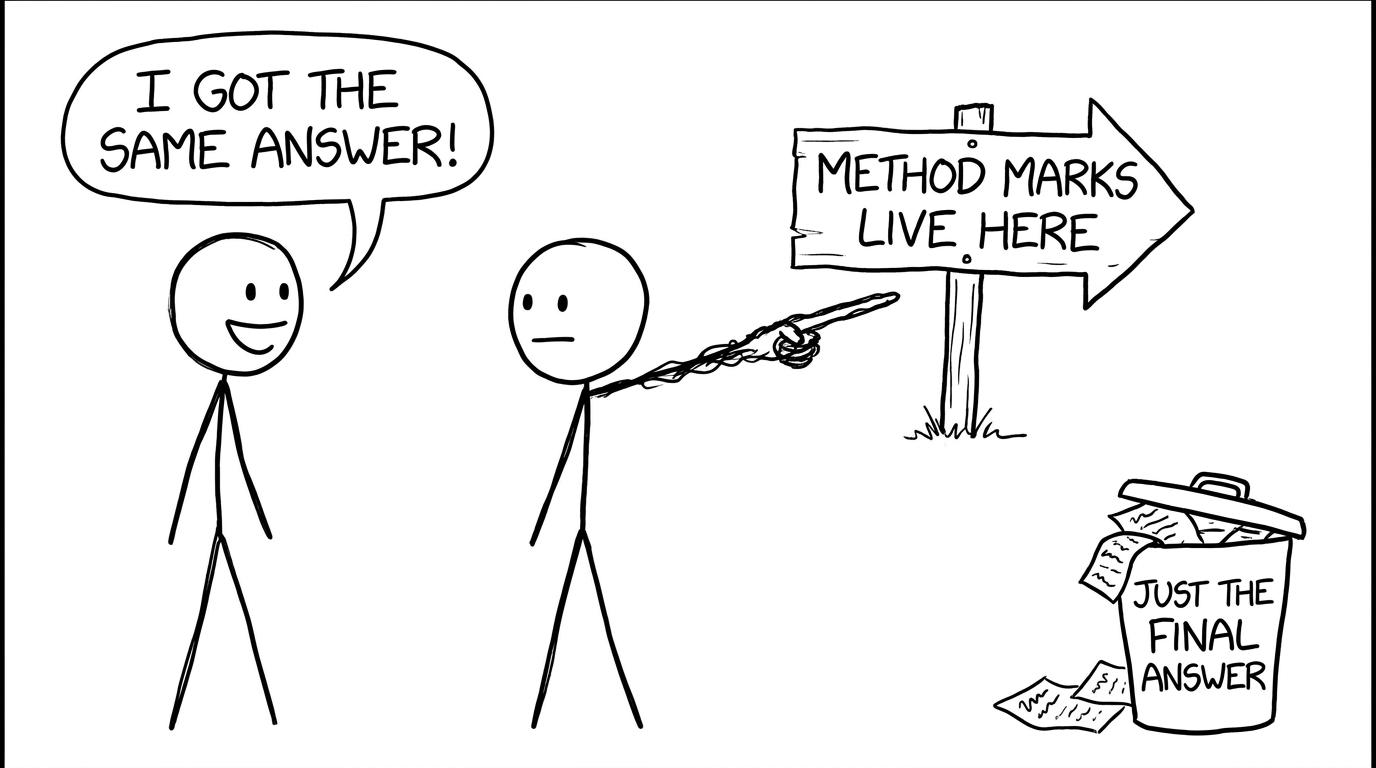 Method marks live here
Worked example: using the mark scheme to rescue method marks (percentages)
Imagine a GCSE question worth 2 marks:
Increase £80£80£80 by 15%15\%15%.
A common student answer is to do 80×0.15=1280 \times 0.15 = 1280×0.15=12 and then stop, or write 121212 as the final answer. The mark scheme typically rewards a method (finding 15%15\%15%) and then accuracy (adding to the original).
A fully secure solution is:
15% of 80=80×0.15=1215\% \text{ of } 80 = 80 \times 0.15 = 1215% of 80=80×0.15=12 80+12=9280 + 12 = 9280+12=92So the final answer is £92£92£92.
How the mark scheme changes your revision
If your final line was 121212, the mark scheme tells you something precise: you likely earned the method mark, and lost the accuracy mark because you didn’t apply “increase” correctly. Your fix is not “revise percentages” in general. Your fix is the micro-skill: always write a sentence that matches the command word, e.g. “Increase means add”.
On YesGenie, this kind of skill is best reinforced by short, repeated practice from lessons and exam-style questions: start with Percentages and then move into mixed exam questions via GCSE Past Papers.
Worked example: algebra marks are usually method-first
Suppose a GCSE algebra question is worth 3 marks:
Solve 3(2x−5)=273(2x-5)=273(2x−5)=27.
A mark scheme will usually allocate marks for expanding, rearranging, and solving. Here’s a clear solution:
3(2x−5)=273(2x-5)=273(2x−5)=27 6x−15=276x-15=276x−15=27 6x=426x=426x=42 x=7x=7x=7What to look for in the mark scheme
If you made an arithmetic slip (for example, writing 6x−15=27⇒6x=126x-15=27 \Rightarrow 6x=126x−15=27⇒6x=12), a follow-through mark might still exist later if you correctly divide by 666. The mark scheme teaches you an exam truth: even wrong numbers can still earn marks if your algebra process is correct.
To strengthen that process, pair the mark scheme with topic practice from Solving Equations and Expanding and Factorising. Your GCSE revision improves faster when each mark scheme note becomes a specific habit.
Worked example: “show that” questions are about communication
Eduqas GCSE papers often include questions where the final statement is given, but you must justify it. For example:
Show that 35\frac{3}{5}53 of 404040 is 242424.
A complete method is:
35×40=3×8=24\frac{3}{5} \times 40 = 3 \times 8 = 2453×40=3×8=24Here’s why the mark scheme matters: it will often accept different equivalent reasoning, but it will not reward unsupported statements like “it is 242424” with no working. Your GCSE takeaway is that “show that” means your working is the answer.
If this is a recurring weak spot, build a checklist line into your practice: write at least two connected equalities. Use Fractions to polish the mechanics, then return to exam questions in the Eduqas GCSE Maths Past Papers.
How to turn mark scheme feedback into a weekly plan (without burning out)
There’s a quiet pattern in high-performing GCSE students: they don’t do more papers; they do fewer papers, marked better.
Try this weekly loop:
One paper, three passes
- Pass 1 (timed): do a full Eduqas paper under exam conditions.
- Pass 2 (mark scheme learning): re-read each question with the mark scheme and write one improvement note.
- Pass 3 (targeted practice): choose the top three topics you dropped marks on and practise them.
You can find your paper source on Eduqas GCSE Maths Past Papers, then use Eduqas grade boundaries to understand what a realistic marks target looks like for your tier.
The “one line you’ll always write” habit
Mark schemes reward clarity. So build exam habits that are easy to repeat:
- After setting up a calculation, write “∴\therefore∴ …” before your final answer.
- Put units on measures (cm, m, cm2\text{cm}^2cm2, etc.).
- Write the equation before solving it.
These are small, but GCSE is a game of small marks.
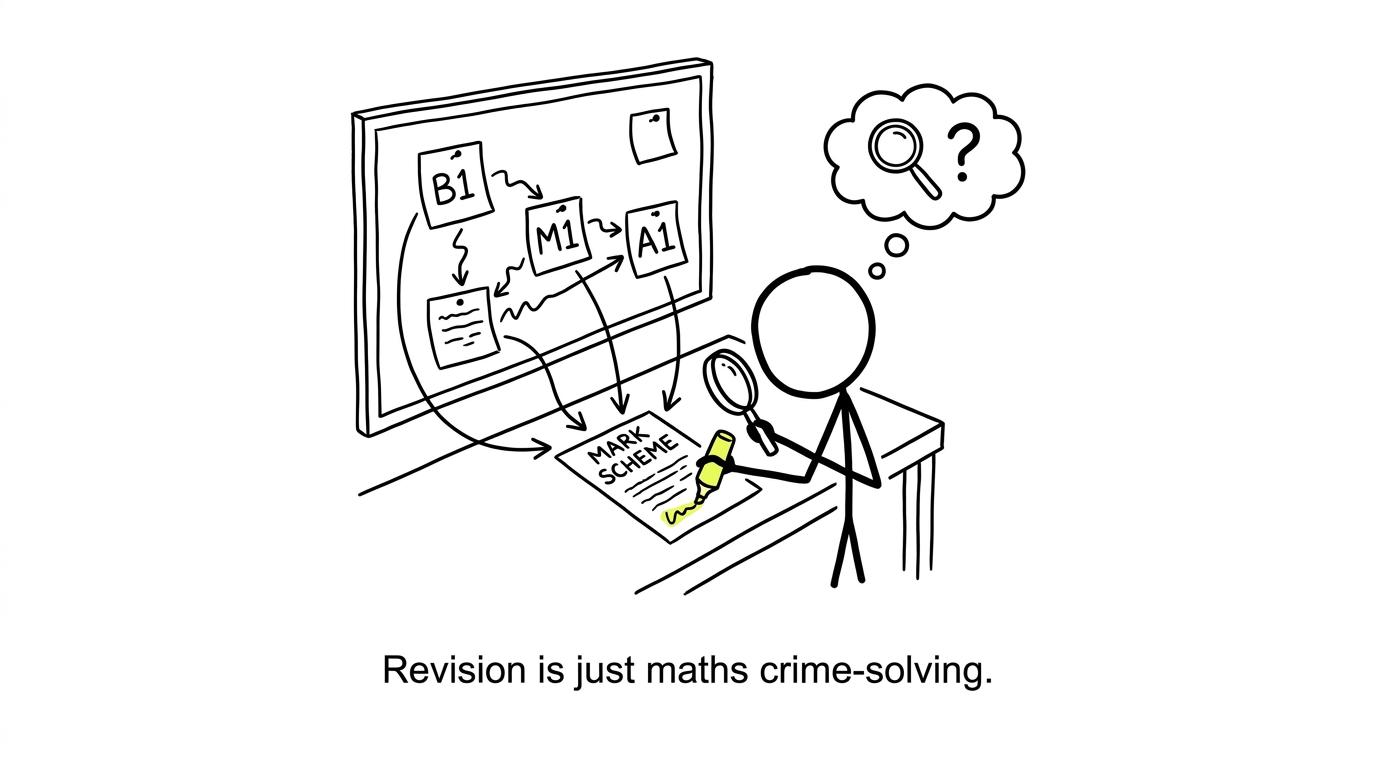 Revision as maths crime-solving
Common mistakes Eduqas students make when using mark schemes
- Only checking the final answer: you miss method marks and you don’t learn what the examiner wanted to see.
- Copying the model solution word-for-word: it feels productive, but you’re not testing recall. You need to re-attempt later.
- Ignoring alternative methods: mark schemes often show multiple valid routes. If one method never sticks, pick the other.
- Not noticing “cao”: for correct-answer-only items, you must hit the exact answer. That changes how you practise.
- Losing easy marks on units and rounding: mark schemes often specify acceptable rounding (for example, “awrt”). Be consistent.
- Treating one mistake as a whole-topic weakness: your real issue may be a single step (like rearranging, or writing the equation).
Bringing it together: use mark schemes to win back GCSE marks
The easiest GCSE marks to gain are rarely hidden in harder topics. They’re hidden in the gap between what you meant and what you showed. Eduqas mark schemes make that gap visible. They tell you when your working was close enough for method marks, when a unit would have secured the final accuracy mark, and when your algebra needed one more clear line.
If you’re revising now, make YesGenie your home base: use Eduqas GCSE Maths Past Papers with the mark schemes, track your progress against Eduqas grade boundaries, and fill gaps using free revision lessons like Percentages, Solving Equations, Fractions, and Expanding and Factorising. Then repeat the loop: practise, mark honestly, learn the pattern, and re-attempt.
Do that consistently, and the mark scheme stops being the thing that tells you what you didn’t get. It becomes the tool that shows you exactly how to get it next time, and that’s how GCSE grades move.