GCSE Economics Time Pressure Mistakes to Avoid
GCSE economics time pressure mistakes can cost easy marks. Learn how to manage calculations, data, diagrams and extended answers calmly in exams.
The final minutes of an economics paper can feel strangely expensive. A percentage sign disappears. A conclusion becomes one hurried sentence. A carefully drawn supply curve is left without labels. These GCSE economics time pressure mistakes rarely happen because students know nothing. They happen because the clock changes how students use what they know.
The immediate solution is not simply to write faster. It is to protect easy marks first: read the command word, match your effort to the marks available, show calculation steps, use the case-study context and leave enough time to complete every section. Under pressure, a dependable routine is more valuable than a perfect plan.
Official GCSE Economics requirements include calculations, graphs and data interpretation. At least 10%10\%10% of the qualification marks must reward quantitative skills at no lower than Key Stage 333 demand. This means your maths habits matter, whether you take foundation or higher tier GCSE Maths.
A quick time-pressure checklist
Before looking at the mistakes in detail, keep this short checklist in mind:
- Read the command word before reading the rest of the question again.
- Notice the number of marks and adjust the depth of your answer.
- Underline the relevant figures, dates, firms, markets or countries in the source.
- Write formulas and calculation steps before entering numbers into a calculator.
- Label both axes, curves and changes on economic diagrams.
- Move on when a question begins consuming time without producing marks.
- Return at the end to check units, conclusions and unanswered questions.
This is not a promise that every paper will feel comfortable. It is a way to remain functional when it does not.
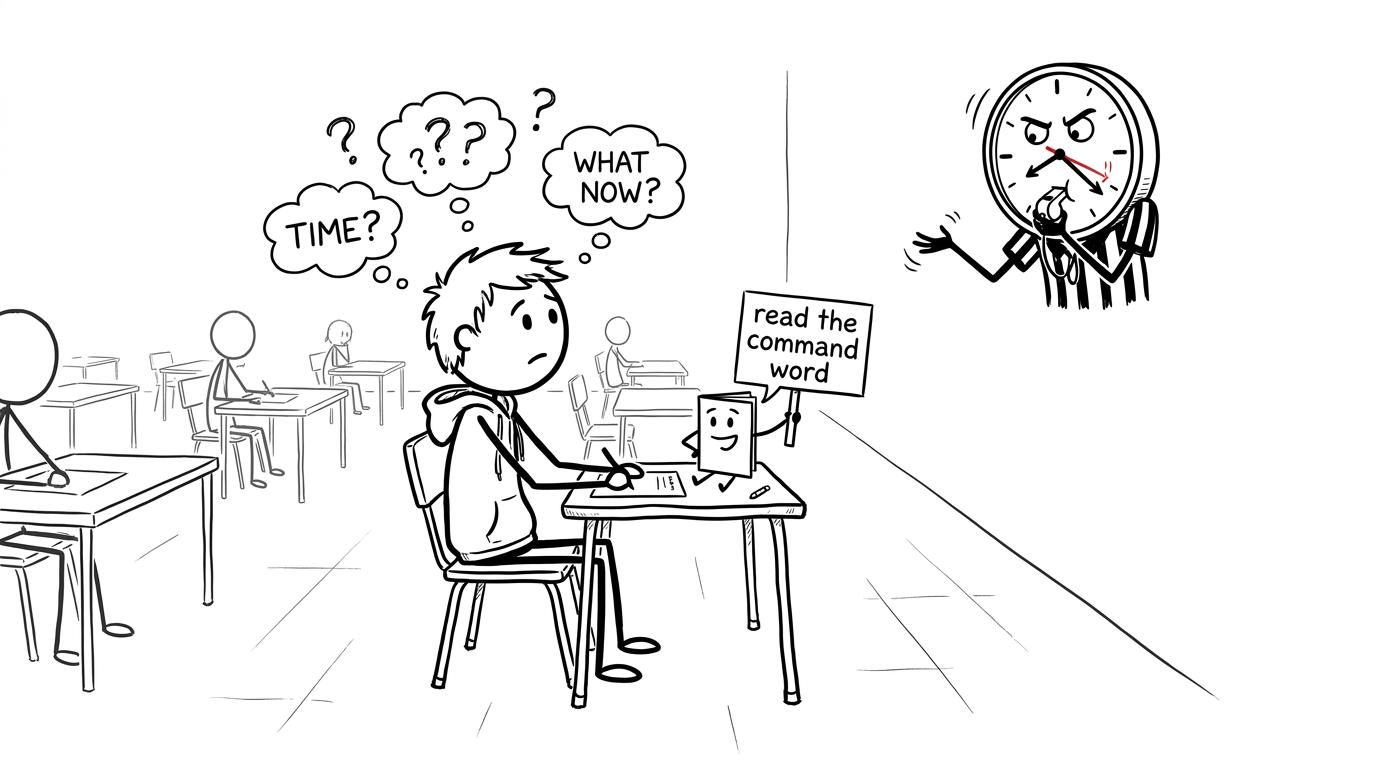 A GCSE student negotiates calmly with an impatient exam clock
Why time pressure changes otherwise good answers
GCSE Economics assesses more than recall. Across regulated GCSE specifications, assessment objectives reward knowledge and understanding, application to context, and analysis or evaluation. For AQA and OCR GCSE Economics, the overall weightings are 35%35\%35% for knowledge and understanding, 35%35\%35% for application and 30%30\%30% for analysis and evaluation.
That balance explains why memorised definitions are not enough. A student may correctly define inflation but still lose marks by failing to connect it to the household, business or economy described in the question. When time is short, answers often retreat towards whatever is easiest to recall. Context, reasoning and judgement disappear first.
Your defence is to recognise the job of each question:
- Knowledge: state or identify an accurate economic idea.
- Application: connect that idea to the information given.
- Analysis: explain a chain of cause and consequence.
- Evaluation: consider significance, limitations or alternatives before reaching a supported judgement.
The wording used by your exam board matters, so practise with papers and mark schemes that match your specification. The exam structure is not identical across boards. For instance, OCR GCSE Economics uses two 909090-minute papers worth 808080 marks each, but you should confirm the exact format for your own course rather than copying a generic timing rule.
Common mistakes students make when the clock is running out
Spending too long on low-mark questions
One difficult short question can become a trap. The student keeps searching for the perfect phrase while a larger extended response waits untouched.
Use marks as a guide to priority, not as a rigid seconds-per-mark formula. If you cannot begin after a brief pause, leave space, mark the question clearly and move on. Returning with ten minutes left is better than sacrificing an entire later section.
A useful three-pass approach is:
- First pass: secure questions you can answer confidently.
- Second pass: complete questions needing deeper thought or longer chains.
- Final pass: return to gaps and check preventable errors.
Practise this habit with short timed sets before trying full papers. MathsGenie's GCSE revision hub includes mini tests and practice resources that can help develop the same decision-making under pressure.
Misreading the command word
A correct answer to the wrong task earns little comfort. Students sometimes describe when asked to explain, or present several advantages when asked to evaluate.
Circle or underline the command word. Then translate it into an action before writing:
- Calculate: obtain a numerical answer and show the method.
- Explain: connect cause to consequence.
- Analyse: develop a logical chain using the context.
- Evaluate: weigh relevant arguments and reach a justified judgement.
Do not assume that the longest question merely wants more facts. It usually wants better-connected reasoning.
Giving generic answers instead of using the source
Under pressure, students often write a rehearsed paragraph that could apply to any market, firm or country. That may demonstrate knowledge, but it weakens application.
Use the source economically. Select one precise detail and make it perform a job in your reasoning. A figure can demonstrate scale. A named industry can reveal likely costs or demand conditions. A date may matter because short-run and long-run effects differ.
Avoid copying a full sentence from the source without explaining it. Evidence becomes valuable only when you connect it to the economic argument.
Dropping calculation steps and units
Calculator confidence can be deceptive. A mistyped figure may produce a plausible answer, while an unsupported final number gives you little opportunity to show your intended method.
Write the formula first. Important GCSE Economics relationships include:
Percentage change=new value−original valueoriginal value×100%\text{Percentage change}=\frac{\text{new value}-\text{original value}}{\text{original value}}\times 100\%Percentage change=original valuenew value−original value×100% Total revenue=price×quantity sold\text{Total revenue}=\text{price}\times\text{quantity sold}Total revenue=price×quantity sold Profit=total revenue−total cost\text{Profit}=\text{total revenue}-\text{total cost}Profit=total revenue−total cost Average cost=total costoutput\text{Average cost}=\frac{\text{total cost}}{\text{output}}Average cost=outputtotal costThen substitute carefully, retain sensible working and state the correct unit. Depending on the question, that might be pounds, a percentage, workers or units of output.
A common percentage-change error is dividing by the new value rather than the original value. Refresh the method with MathsGenie's percentages lesson. For mean and average-cost foundations, use the GCSE averages revision page.
Treating the number as the end of the answer
Economics calculations exist inside an economic context. If the question asks you to use data to support a decision, the numerical result needs interpretation.
After calculating, ask: what does this value mean for the economic agent in the question? Does it indicate rising costs, stronger demand, lower real income or a change in profitability? One accurate contextual sentence can turn arithmetic into economic reasoning.
MathsGenie's quantitative skills in economics guide covers percentages, averages, revenue, cost, profit, pay, graphs and data interpretation in one place.
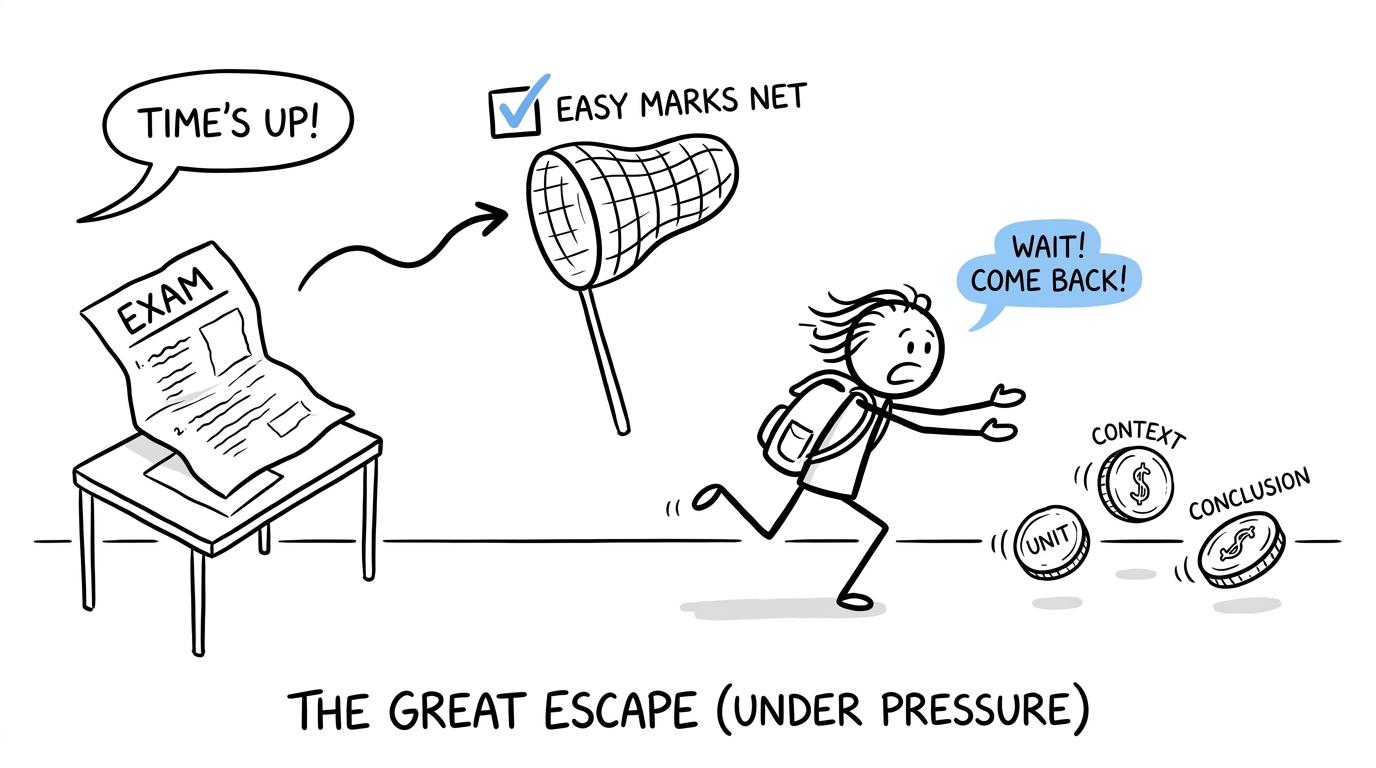 Easy marks escape until a student catches units, context and conclusions
Drawing incomplete economic diagrams
A rushed diagram may contain two lines and an arrow but communicate very little. Missing axis labels, indistinguishable curves and unmarked equilibria make the examiner infer what the student intended.
For supply and demand diagrams, check:
- price is on the vertical axis;
- quantity is on the horizontal axis;
- demand and supply curves are identified;
- original and new curves are distinguishable;
- the direction of any shift is clear;
- relevant equilibrium points are marked;
- the written explanation agrees with the diagram.
Remember the distinction between a movement along a curve and a shift of the curve. A change in the good's own price causes movement along the existing demand or supply curve. A relevant non-price factor may shift the curve.
Do not keep redrawing a diagram because it is untidy. Clarity matters more than artistic perfection.
Writing analysis as a list
A list of disconnected effects may contain several correct facts without showing why one event leads to another. Analysis needs a chain.
A reliable paragraph shape is:
- identify the economic change;
- explain the immediate effect;
- develop the consequence for a relevant economic agent;
- connect the reasoning to the source.
Words such as “because”, “therefore” and “as a result” can reveal missing links, but inserting them mechanically does not create analysis. Each sentence must genuinely follow from the previous one.
Rushing the conclusion into an unsupported opinion
An evaluation conclusion should not simply announce that one policy is “good” or “bad”. It should answer the question using a criterion.
Your judgement may depend on the size of the change, the time period, stakeholder priorities, the reliability of the evidence or the availability of alternatives. A concise, supported conclusion is stronger than a long paragraph that repeats both sides.
If time is almost gone, write the judgement first and support it immediately. Do not spend the final minute creating an elaborate opening sentence.
Leaving blanks instead of showing partial knowledge
A blank answer cannot reveal a correct definition, formula, diagram or reasoning step. If you are stuck, write something relevant and accurate before moving on. For a calculation, record the formula. For an extended response, note a valid effect and begin its causal chain.
This is not an invitation to fill space with guesses. It is a reminder that visible economic reasoning gives the mark scheme something to assess.
How to train for GCSE Economics time pressure
Time management is difficult to learn by reading about it. It improves when revision recreates the decisions made during an exam.
Start with a short section rather than a complete paper. Use a timer, remove notes and stop when time expires. Afterwards, separate lost marks into four categories:
- knowledge gap;
- calculation or diagram error;
- misreading or weak application;
- timing problem.
The distinction matters. Revising inflation again will not fix a habit of spending too long on the opening questions.
For transferable numerical fluency, use MathsGenie's Stage 4 topic practice, which includes percentages, fractions, ratio and drawing graphs. Then review errors with solutions rather than merely recording a score.
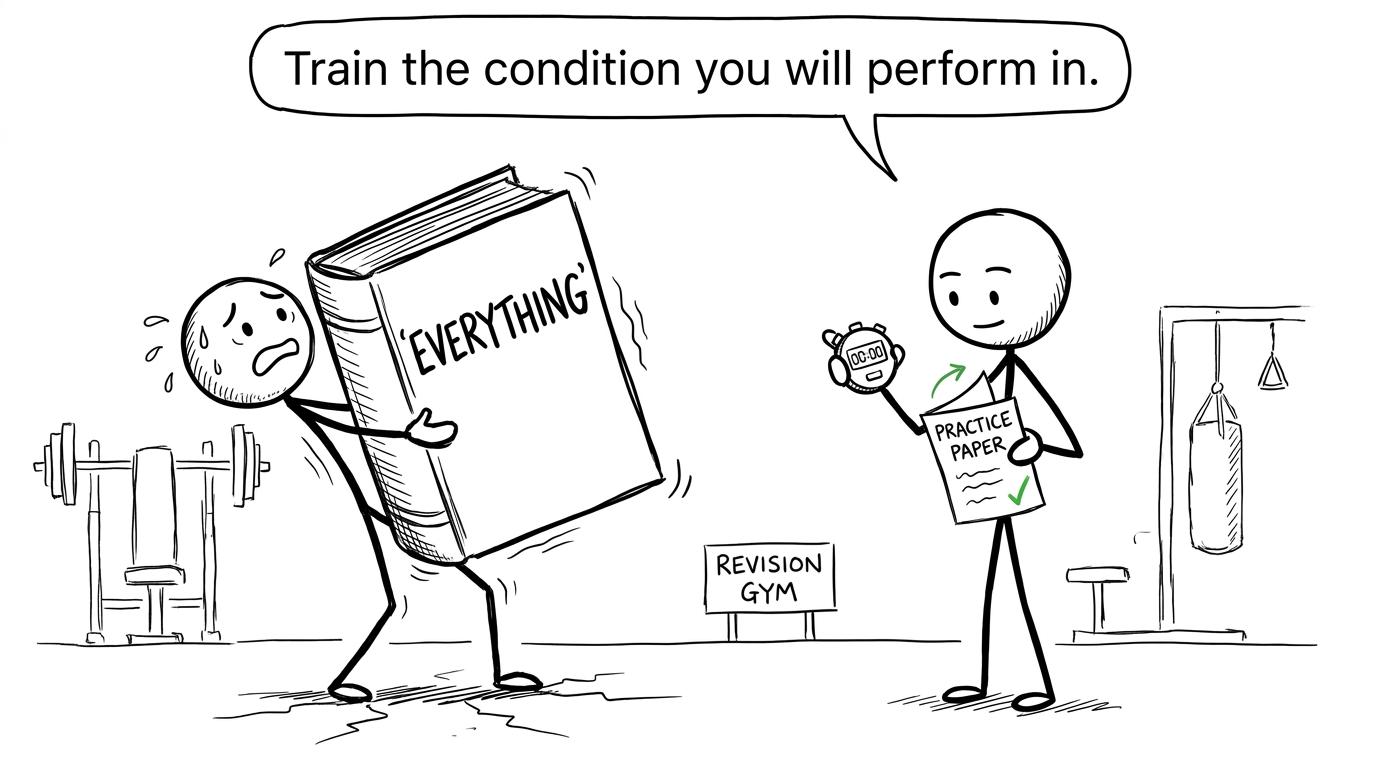 One student trains with a timer while another attempts to revise everything at once
As exams approach, combine subject-specific Economics papers from your school or exam board with MathsGenie's numerical practice. The guide to starting past papers explains how to progress from mini tests to timed sections and full papers. The GCSE predicted papers collection can provide fresh maths practice, but predicted papers should supplement official past papers rather than replace them.
A simple weekly routine is enough:
- complete one timed Economics section;
- mark it using the correct board's mark scheme;
- record the exact reason for each lost mark;
- repair one economic-writing weakness and one quantitative weakness;
- retest both without notes.
Make the final minutes deliberate
The clock does not usually create new weaknesses. It exposes habits that revision has left uncertain. If you normally calculate without writing a formula, that step will vanish under pressure. If you normally avoid conclusions, the exam will not suddenly make them easier.
Build small routines until they become automatic: command word, marks, context, reasoning, check. Use MathsGenie for free revision lessons, practice questions, mini tests, mark schemes and video solutions, then pressure-test your numerical skills with past papers and predicted papers. Begin with the quantitative Economics revision guide, identify the marks that most often escape, and practise protecting them.
The aim is not to make the clock disappear. It is to ensure that, when time becomes scarce, your method remains dependable.