

Does Your GCSE Economics Revision Environment Matter?
GCSE economics revision environment advice that explains what genuinely improves focus, memory and exam practice, with realistic tips for better revision.
Revision advice often begins with a photograph: a spotless desk, colour-coded notes and a suspiciously healthy glass of water. It suggests that concentration is something you can arrange like stationery.
The truth is more useful. Your GCSE economics revision environment does matter, but it is not a magic ingredient. A good environment reduces distractions, makes starting easier and supports active practice. It cannot replace retrieval practice, spaced revision, sleep or careful use of mark schemes.
You do not need a silent home office. You need a place where you can regularly complete the right task without fighting your surroundings every few minutes.
The short answer: environment matters as friction
Think of revision as a sequence of small decisions. You must sit down, choose a topic, begin a task, resist distractions and check what you know. An effective environment makes those decisions easier.
A useful setup should help you:
- begin revision without a long preparation ritual;
- protect focused periods from avoidable interruptions;
- retrieve knowledge rather than simply reread it;
- practise calculations and extended responses;
- check answers against mark schemes;
- return consistently across several weeks.
The best room with the wrong revision method produces very little. A merely adequate room with focused questions, self-testing and feedback can produce much more.
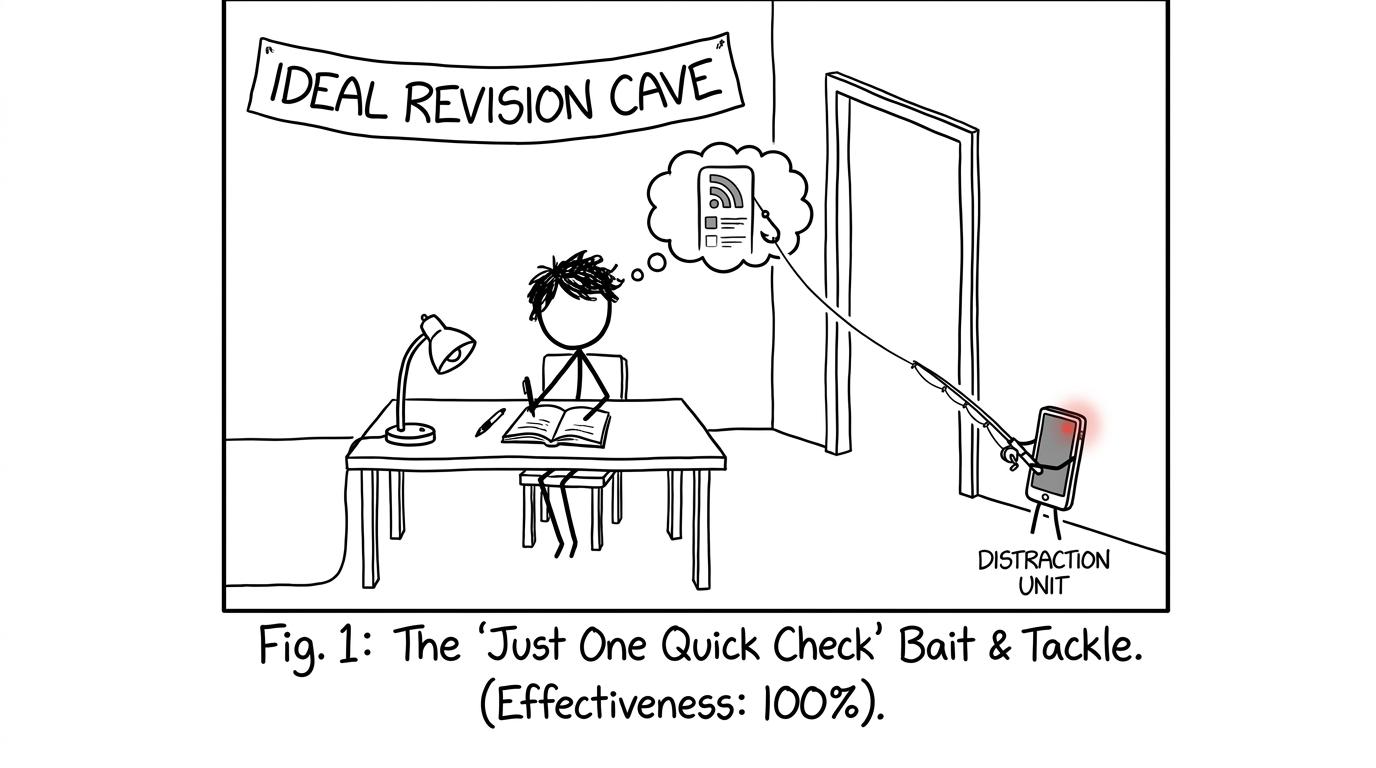 A student's phone fishing for their attention outside an ideal revision room
What actually makes a revision environment effective?
Fewer attention switches
A distraction does not have to consume half an hour to be costly. A notification, conversation or open browser tab can interrupt the chain of thought needed to explain why a market changes or evaluate a government policy.
The practical answer is not endless willpower. Remove the prompt where possible. Put your phone beyond reach, close unrelated tabs and tell people when you plan to finish. If you need your device for a video or digital paper, use full-screen mode and disable notifications for that session.
This matters particularly when writing longer Economics answers. Analysis depends on connected reasoning: one change affects an incentive, which changes behaviour, which creates a consequence. Repeated interruptions make that chain harder to maintain.
A clear task before you sit down
A tidy desk is less important than a specific intention. “Revise Economics” leaves too many choices. “Recall four causes of inflation, then answer one exam question and mark it” tells you exactly how to begin.
Prepare a short task list before each session. A simple structure is:
- recall key definitions without notes;
- answer practice questions;
- mark the answers honestly;
- record one weakness for the next session.
MathsGenie's free GCSE maths revision lessons use a similarly clear topic-by-topic structure. That approach is useful for the quantitative parts of Economics too: separate the skill, practise it and check it before moving on.
Enough comfort, but not so much that revision disappears
Physical discomfort competes for attention. Poor lighting, an awkward chair, excessive heat or persistent noise can make a demanding task harder to sustain. Yet maximum comfort is not always useful either. A bed or sofa may already be associated with rest and entertainment.
Aim for functional comfort: a stable surface, suitable chair, usable light and the materials you need. Water nearby can prevent an unnecessary trip becoming a twenty-minute detour.
Your environment should quietly support the task. It does not need to look impressive.
Silence, music or background noise?
There is no universal soundtrack for GCSE Economics revision. The important question is whether the sound competes with the mental work.
Speech and lyrics can be particularly distracting during reading and extended writing because both demand language processing. Familiar instrumental music or steady background sound may feel less intrusive for some students, especially where complete silence is unavailable.
Test this rather than guessing. Complete comparable tasks under two conditions, then consider:
- how much you finished;
- how accurately you recalled the content;
- whether your reasoning remained connected;
- how often you changed song or adjusted the volume.
Feeling productive is not the same as remembering. Judge an environment by the quality of work it produces.
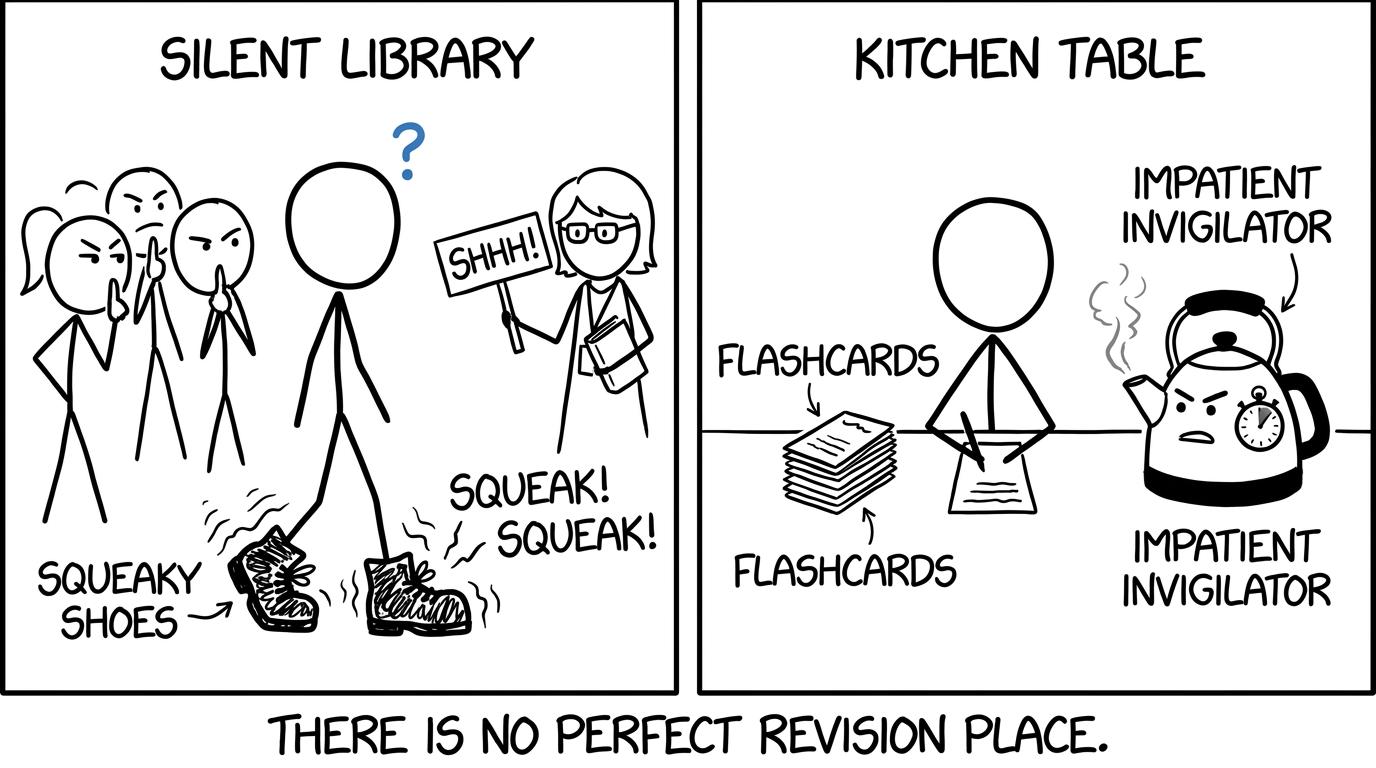 Two students discovering that neither a library nor a kitchen is perfectly silent
Should you always revise in the same place?
A regular location can become a helpful cue. When the same notebook, timer and desk repeatedly lead to focused work, starting may require less negotiation with yourself.
But do not become dependent on one perfect setting. Your real examination will take place in an unfamiliar room with other candidates, background movement and invigilators. Occasionally completing timed work at school, in a library or at a different table can help you practise retrieving knowledge under less familiar conditions.
A sensible balance is:
- use one reliable place for most routine revision;
- use alternative quiet places when home is distracting;
- complete some timed papers under realistic exam conditions.
Maths students can apply this directly by downloading GCSE maths past papers and completing them away from notes, videos and solution pages. Economics papers should be treated with the same discipline.
Match the environment to the Economics task
Different tasks require different levels of quiet and different materials. One setting does not need to serve every purpose.
Learning and recalling content
For definitions, diagrams and chains of reasoning, use closed-book retrieval. Keep notes out of sight until you have attempted to recall the material. Flashcards, blank-page recall and short verbal explanations can all reveal what is actually available from memory.
A little background noise may be manageable here, but the test must remain genuine. Looking at a definition before “remembering” it creates familiarity, not reliable retrieval.
Quantitative skills
Economics includes numerical information, graphs, percentages and data interpretation, although the precise requirements depend on your exam board and specification. A useful environment provides paper, a pen, a calculator where permitted and enough space to set out working.
For instance, percentage change is represented by:
Percentage change=new value−original valueoriginal value×100\text{Percentage change}=\frac{\text{new value}-\text{original value}}{\text{original value}}\times 100Percentage change=original valuenew value−original value×100You do not need to turn Economics revision into a separate maths course. You do need to identify weak numerical skills early. MathsGenie's lessons on percentages and the wider collection of free maths revision resources can help rebuild those foundations.
Extended responses and evaluation
Longer answers need sustained attention. Choose your quietest available setting, remove notes and work to a time limit. Afterwards, use the relevant mark scheme and examiner guidance from your own specification.
AQA, Pearson Edexcel and OCR papers do not necessarily use identical command words, mark allocations or structures. Check the current specification and materials supplied by your school rather than assuming that advice for one exam board transfers exactly to another.
Build a portable revision environment
Many students cannot control household noise, available space or when a room is free. Advice that depends on ideal circumstances is not very helpful.
Instead, create a small portable kit containing:
- the notes or questions needed for that session;
- pens, paper and an approved calculator where relevant;
- earplugs or headphones if they genuinely help;
- water;
- a timer;
- a brief plan showing what “finished” means.
This turns the environment from a room into a repeatable routine. A school library, classroom, kitchen table or community study space can become workable because the cues and process travel with you.
If planning is the real obstacle, break the week into short, named sessions. MathsGenie's revision planner offers a structure that can be adapted so Economics topics also receive deliberate, spaced attention.
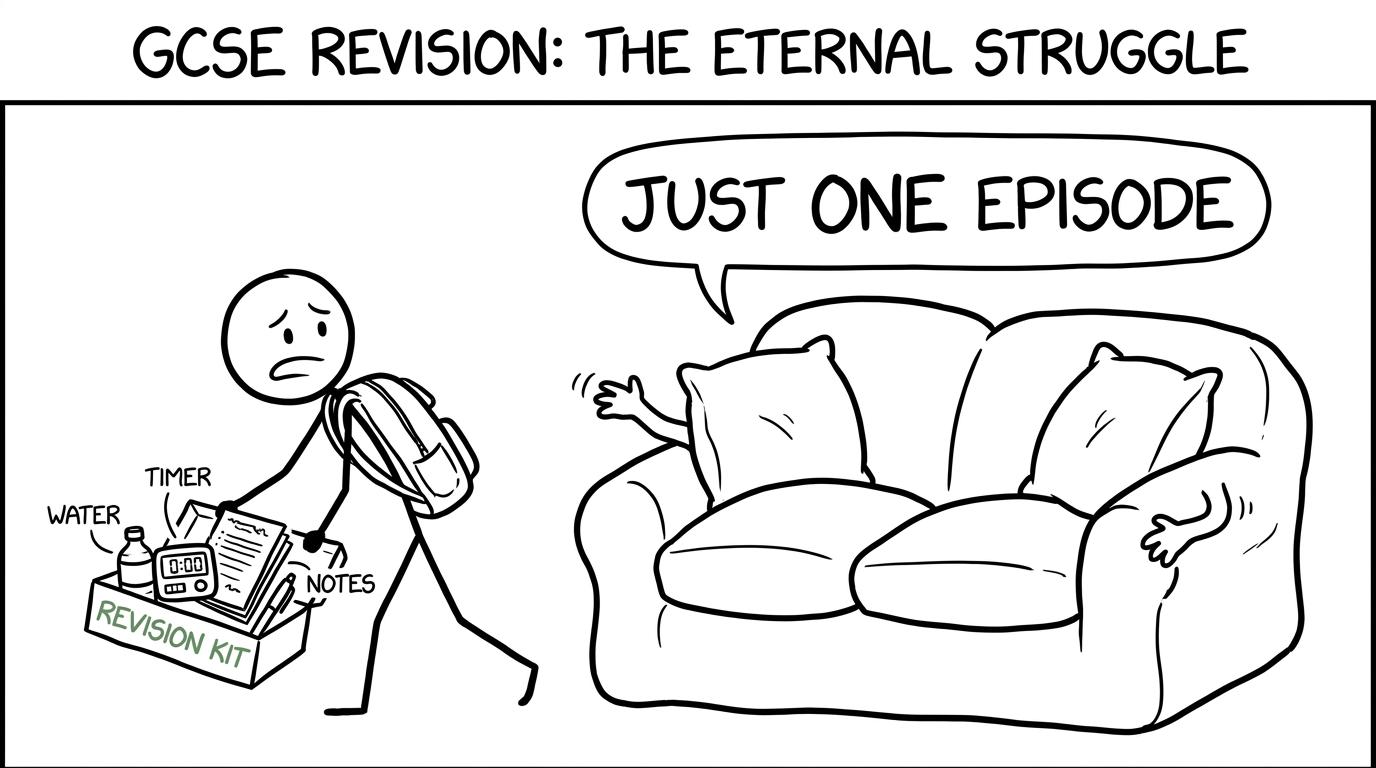 A student carrying a revision kit while a sofa attempts to offer one more episode
Make the environment support active revision
A beautiful setup can hide passive habits. Copying notes, highlighting pages and watching videos without answering questions may feel smooth because the information remains visible. Exams ask you to produce knowledge when the support has disappeared.
Place practice at the centre of the environment:
- keep questions visible and notes closed;
- use a timer for short periods of undisturbed work;
- mark attempts rather than judging them by effort;
- maintain a brief error log;
- return to missed content after a delay.
For maths exam preparation, GCSE predicted papers can provide additional practice after topic revision, while MathsGenie mini tests make it easier to check smaller areas without committing to a full paper. Predicted papers are practice resources, not guarantees of what will appear in an examination.
The same principle applies to Economics: use questions to diagnose gaps, not to forecast exact questions.
Common revision-environment mistakes
Waiting for perfect conditions
Noise, clutter or limited space can be genuine problems, but postponing every session until conditions are flawless creates a larger one. Find the best available option and reduce the most disruptive element first.
Spending more time organising than retrieving
Rearranging folders can be useful once. Repeating it every evening can become avoidance. If the session ends without recalling knowledge or answering questions, the environment has become the activity.
Keeping the phone face down on the desk
A silent phone can still invite checking. Put it in another room, inside a bag or with someone you trust during a short focused session.
Mistaking long sessions for effective sessions
Time at a desk is not the same as learning. Track completed questions, recalled topics and corrected mistakes. Take purposeful breaks before concentration collapses.
Revising only in comfortable, open-book conditions
Your examination will not provide notes, pause buttons or unlimited time. Include closed-book recall and timed paper practice so that the revision environment gradually resembles the demands of the exam.
Your environment matters, but your actions matter more
The honest verdict is that revision-environment advice is neither a myth nor the main event. Your surroundings influence attention and make good habits easier or harder. What ultimately sticks, however, depends on what you do there.
Choose a workable place. Remove the loudest distraction. Define one task. Retrieve information without support, answer questions and learn from the mark scheme. Then repeat the process on another day.
For your maths preparation, begin with MathsGenie's GCSE revision resources, use topic lessons and practice questions to repair gaps, then move towards mini tests, past papers and predicted papers. A dependable environment gets you to the desk. Focused practice is what moves your grade.










