

GCSE Economics Note Taking You'll Actually Use
GCSE economics note taking made practical: build concise, testable notes for definitions, diagrams, calculations, analysis and effective exam review.
A notebook can look impressive and still be almost useless in May. Pages are filled, headings are highlighted and every diagram has three colours. Yet when the book closes, the ideas disappear with it.
Effective GCSE economics note taking solves a different problem. It does not record everything said in class. It creates concise prompts that help you recall definitions, rebuild economic chains, interpret evidence and answer questions without depending on the page.
The simplest rule is this: write notes for the student who will review them six weeks later, not for the student who has just heard the explanation.
Your note-taking checklist
For each economics topic, aim to create:
- a specification-matched heading;
- five to eight essential terms with precise definitions;
- short cause-and-effect chains;
- diagrams you can reproduce from memory;
- formulas and quantitative skills in context;
- evaluation prompts covering different circumstances and stakeholders;
- retrieval questions with answers hidden;
- one clear record of mistakes found through exam practice.
This creates a revision tool rather than a transcript. Your notes should help you do something: recall, explain, calculate, analyse, evaluate or correct an error.
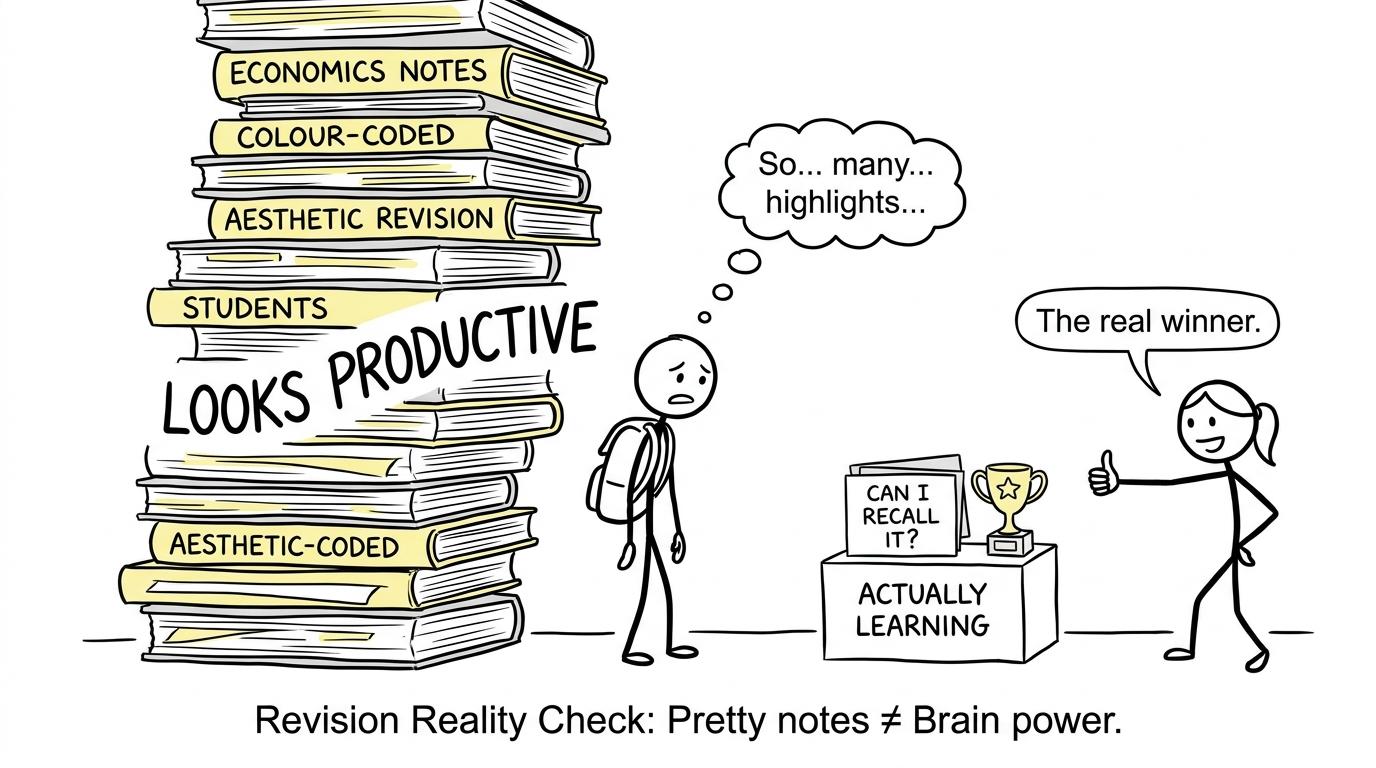 A trophy for useful flashcards while decorative notebooks tower nearby
Begin with the specification, not the textbook
Economics textbooks are written to teach. Specifications define what can be assessed. Those purposes overlap, but they are not identical.
Before making notes, find your exact qualification and specification. AQA GCSE Economics and OCR GCSE Economics organise their content differently. Pearson Edexcel also offers International GCSE Economics, which is not the same qualification as a domestic GCSE. Do not assume that a classmate using another exam board has the same topic boundaries or paper structure.
Turn each specification statement into a heading or question. For example, a broad heading such as “Inflation” is less useful than a set of prompts covering:
- what inflation means;
- how it is measured;
- possible causes;
- consequences for different economic agents;
- possible government responses;
- reasons why the effects depend on context.
This reveals gaps early. It also stops interesting but non-examinable detail from taking over your revision time.
Use a one-page economics note structure
A useful topic sheet can be divided into six zones. It does not need elaborate artwork.
Core knowledge
Write the minimum accurate definition of each key term. Then add one contrast where confusion is likely, such as a movement along a demand curve compared with a shift of the curve.
Definitions should be short enough to retrieve but precise enough to use in an answer. Avoid replacing technical language with vague wording that loses the economics.
Analytical chains
Economics rewards connected reasoning. Record chains with arrows or short lines rather than long copied paragraphs:
change →\rightarrow→ first effect →\rightarrow→ response by an economic agent →\rightarrow→ wider consequence.
Each arrow needs a reason. If you cannot explain why one stage leads to the next, the chain is not yet secure.
Diagrams
Keep a small bank of diagrams for topics such as supply, demand and market equilibrium. Label the axes, curves, original position and changed position clearly. Beneath each diagram, add three prompts:
- What changed?
- Why did it change?
- What happened to the relevant price and quantity?
Then cover the diagram and redraw it. A diagram you can only recognise is not yet a diagram you can use.
Quantitative skills
Official GCSE Economics requirements include percentages, percentage changes, averages, revenue, costs, profit, income, graphs and the interpretation of economic data. At least 10%10\%10% of marks across a GCSE Economics qualification must reward quantitative skills, assessed in an economics context.
Create a formula strip containing the relationships you must recall, including:
Percentage change=new value−original valueoriginal value×100%\text{Percentage change}=\frac{\text{new value}-\text{original value}}{\text{original value}}\times 100\%Percentage change=original valuenew value−original value×100% Average cost=total costoutput\text{Average cost}=\frac{\text{total cost}}{\text{output}}Average cost=outputtotal cost Total revenue=price×quantity\text{Total revenue}=\text{price}\times\text{quantity}Total revenue=price×quantity Profit=total revenue−total cost\text{Profit}=\text{total revenue}-\text{total cost}Profit=total revenue−total costMaths Genie’s quantitative skills in economics revision guide brings these skills together. If percentage calculations are slowing you down, return to the GCSE percentages revision guide. For savings and repeated change, use the compound interest and depreciation lesson.
Your notes should record more than a formula. Add prompts for units, the original value, appropriate rounding and what the result means economically.
Application and evidence
Economic answers often provide a context, extract or dataset. Your notes should therefore leave room for application rather than memorising one rigid paragraph.
For each topic, list the evidence you might need to notice:
- the country or market involved;
- the direction and size of a change;
- the period covered by the data;
- the groups affected;
- limitations of the information;
- details that make the general theory more or less relevant.
Do not fill your notes with unsupported current figures. Economic data changes. Learn how to select and interpret evidence supplied in a question, while keeping any class examples clearly dated and sourced.
Evaluation prompts
Evaluation is not a sentence beginning with “however”. It is a judgement about importance, effectiveness or likely outcomes.
Store flexible prompts rather than complete model conclusions:
- Does the outcome differ in the short run and long run?
- Which stakeholder gains, and who may lose?
- How large is the original change?
- What other conditions must hold?
- Are there opportunity costs or unintended consequences?
- Is the evidence reliable and sufficient?
These questions make your notes adaptable to unfamiliar contexts.
Turn every page into a retrieval tool
Rereading feels smooth because the words are already there. An exam is different: the page starts blank. Your revision should occasionally reproduce that difficulty.
After completing a note sheet, create questions in the margin or on a separate card. Good prompts ask you to:
- state a definition;
- list two causes without looking;
- rebuild an analytical chain;
- draw and annotate a diagram;
- select the correct formula;
- suggest a condition affecting the final judgement.
Close the notes before answering. Check afterwards in a different colour, then record only what was missing or inaccurate. That small moment of effort is more informative than another careful reread.
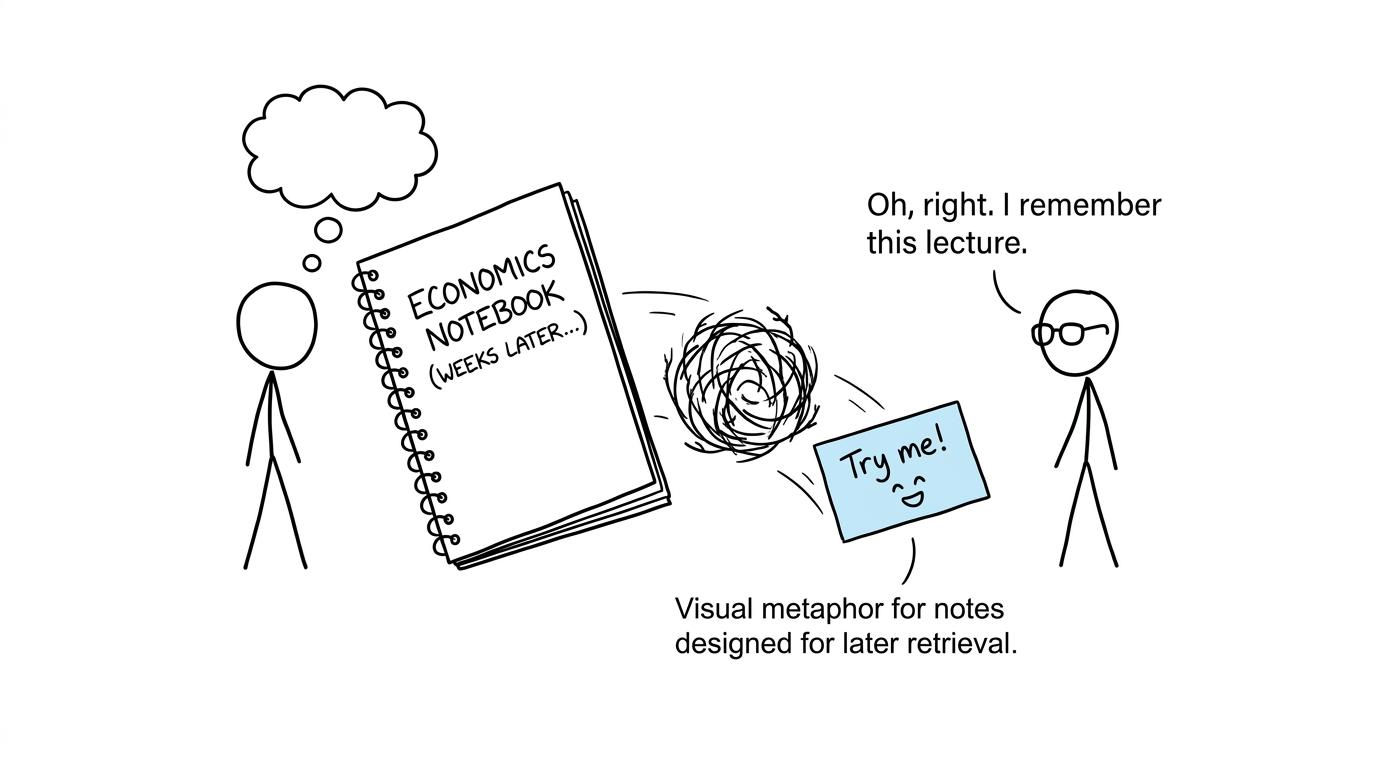 An eager question card meets a forgotten notebook and a tumbleweed
Build notes in layers rather than rewriting them
A useful page develops over time.
First layer: lesson: record the central concept, necessary vocabulary and a rough analytical chain.
Second layer: same-day review: reduce the material, correct inaccuracies and turn headings into retrieval questions.
Third layer: practice: add mistakes exposed by questions. Write why the mark was lost, not merely the correct answer.
Fourth layer: later review: answer the prompts from memory and mark weak sections for another return.
This is where economics revision and maths revision share the same logic. Notes identify what you know; questions test whether that knowledge survives without support. Maths Genie’s GCSE revision timetable guide can help you schedule those returns instead of leaving every topic until the final weeks.
Keep the delay realistic. Review once soon after making the notes, again several days later and then through mixed practice. The exact intervals matter less than repeatedly returning after some forgetting has occurred.
Connect economics notes to maths practice
Quantitative economics is not a separate chapter to ignore until the end. Attach a maths practice link or action to each relevant topic.
For inflation, growth and changing prices, revise percentage change. For interest on savings, review repeated percentage change. For unemployment, trade and other datasets, practise interpreting charts, averages and trends through the Edexcel GCSE Statistics revision hub.
A formula card cannot reveal whether you can choose a method under pressure. Follow it with questions. Nearer your maths exams, use Edexcel GCSE Maths predicted papers to test whether percentage, graph and data skills remain secure in mixed contexts. Predicted papers are practice resources, not promises about exact questions.
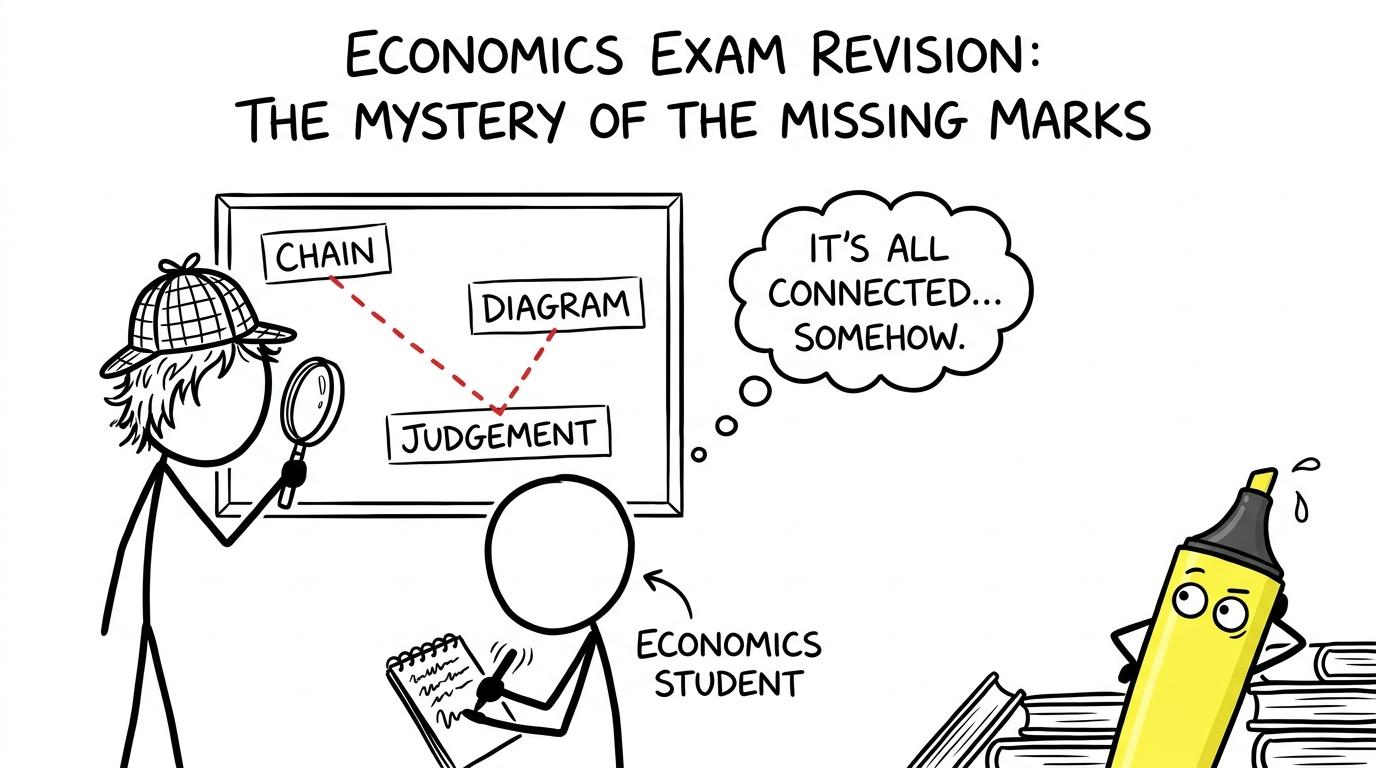 An economics detective connects chains, diagrams and judgement while watching a suspicious highlighter
Use mark schemes to improve the notes
A mark scheme is not just where you discover your score. It shows the precision, application and development an assessment rewards.
After an economics question, update your notes with one of four labels:
- K: knowledge or definition missing;
- A: application to the context missing;
- Chain: reasoning stopped too early;
- J: judgement was unsupported or ignored relevant conditions.
For a calculation, record whether the problem was formula choice, substitution, arithmetic, units or interpretation. This makes the next revision session specific.
Use the same habit with Maths Genie practice questions, mini tests and paper mark schemes. The aim is not to preserve a perfect notebook. It is to build a map of where marks are leaking.
Common GCSE economics note-taking mistakes
Copying complete slides
Transcription keeps your pen moving but rarely forces you to decide what matters. Condense the idea, then test whether you can explain it aloud without the slide.
Highlighting without a code
If half the page is highlighted, nothing has priority. Give colours fixed purposes, such as definitions, data and evaluation, and use them sparingly.
Writing model answers as scripts
A memorised paragraph may not fit the context in the exam. Save structures, chains and judgement prompts instead of rigid responses.
Keeping diagrams only as finished pictures
A polished diagram can create false confidence. Practise constructing it from a blank page and explaining every label.
Separating formulas from meaning
A formula without units, interpretation or context is incomplete. Your notes should remind you what each quantity represents and how the result supports an economic decision.
Never updating the page
The first version reflects what was taught. The useful version reflects what you later forgot, misunderstood or failed to apply.
Make your notes earn their place
The best economics notes are often less impressive at first glance. They contain gaps to fill, questions to answer and corrections from real practice. They look used because they are used.
Choose one topic today. Match it to your specification, compress it onto one purposeful sheet and test yourself without looking. Then strengthen the numerical side with Maths Genie’s free revision lessons, practice questions and video solutions. Use mini tests, past papers and predicted papers to expose weaknesses, and let mark schemes decide what your notes need next.
That is the quiet shift that makes revision work: your notebook stops being a record of time spent and becomes a tool for the next mark.











