GCSE Economics Flashcards Quizlet Guide
GCSE economics flashcards Quizlet guide: find accurate decks, revise key terms and calculations, and build a specification-matched set quickly.
A flashcard can create a comforting illusion. You recognise the words, turn the card over and think, "Yes, I knew that." Then the exam asks you to apply the idea to an unfamiliar market, and recognition is no longer enough.
The best GCSE economics flashcards Quizlet sets avoid that trap. They match your exam board, separate topics clearly, test recall from both directions and include the quantitative skills required by your specification. Public decks can save time, but only after you have checked them. Your own small, carefully edited deck is often more useful than a collection containing hundreds of unverified cards.
This guide explains which decks are worth using, how to check them and how to build an effective set quickly.
Your flashcard checklist
Before committing revision time to a Quizlet set, check that it:
- names your exam board and current specification;
- follows the topics in your own specification;
- gives precise definitions rather than vague summaries;
- distinguishes similar concepts, such as demand and quantity demanded;
- includes formula recall and interpretation questions;
- uses short answers that can genuinely be retrieved;
- avoids unsupported claims about current economic conditions;
- complements exam questions rather than replacing them.
If a deck fails several of these checks, do not try to repair every card. Find a better starting point or build your own.
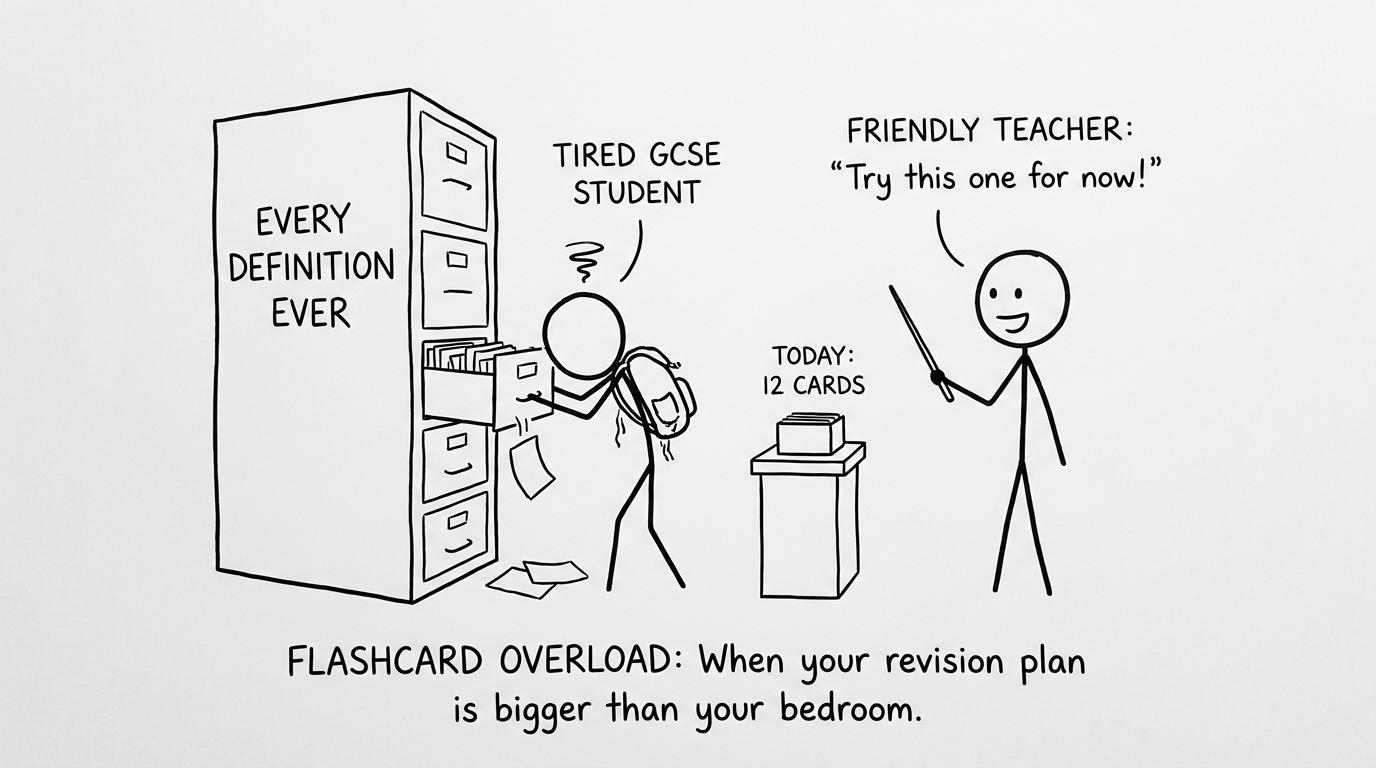 A student choosing a manageable flashcard box instead of an enormous revision filing cabinet
Which GCSE Economics flashcard decks are worth using?
There is no single public Quizlet deck that is automatically best for every student. AQA, Pearson Edexcel and OCR organise and assess GCSE Economics content differently. Teachers may also teach topics in a different order.
The strongest approach is to use three kinds of deck.
Specification-matched topic decks
Search using your board, qualification and exact topic, rather than simply searching for GCSE Economics. A narrow set on market failure, labour markets or government objectives is easier to verify than an enormous deck covering the whole course.
A useful public deck should identify its specification and use terminology consistent with that document. Open your exam board's current specification separately and compare the deck's headings with it. The specification is the controlling document; a popular set is not.
Be cautious when a deck has no named board, combines GCSE and A Level content, or contains material copied from an older course. Extra detail can feel impressive while directing attention away from what your examination actually requires.
Teacher-created definition and application decks
A set created or recommended by your teacher has an important advantage: it should reflect the course being taught in your classroom. It may also use the command words and chains of reasoning expected in your assessments.
Still check individual cards. A good economics card should not merely pair a term with a paragraph copied from notes. It should ask one answerable question, such as what a term means, what may cause a change or what consequence could follow.
Cards that ask for an application to a short context are particularly useful. Economics examinations reward more than isolated definitions. You need to select relevant knowledge and connect it logically to the situation in the question.
A personal mistakes deck
This is usually the smallest deck, but it can become the most valuable. Add a card whenever you:
- confuse two economic terms;
- forget a formula;
- misread a graph;
- leave out a link in an explanation;
- use a definition that would be too imprecise for a mark scheme.
Your mistakes deck responds to the course you are actually experiencing, not the course somebody else found difficult. Review it alongside MathsGenie's GCSE revision resources when weaknesses involve percentages, averages, ratios or graphs.
How to judge a public Quizlet set quickly
A deck does not become trustworthy because it has many terms or has been saved by many users. Popularity measures attention, not accuracy.
Use a five-minute audit before revising from it.
Check the first ten cards
Compare ten definitions with your class materials and specification. Look for missing conditions, circular definitions and cards that place several unrelated ideas on one side. One minor wording difference is not necessarily a problem, but repeated inaccuracies are a reason to leave the set.
Inspect its topic boundaries
A deck called "the economy" may mix inflation, unemployment, economic growth, fiscal policy and monetary policy without showing how they differ. That makes weak areas difficult to identify.
Prefer sets divided into meaningful sections. Smaller decks also make revision sessions more focused: you can test one topic, record the errors and then move to exam questions.
Look for retrieval, not recognition
Simply rereading a card is not a proper test. Hide the answer, say or write your response, and only then turn the card over. Retrieval practice is useful because it requires you to bring information to mind rather than merely recognise familiar wording.
A strong card has a clear prompt and an answer brief enough to check. If the reverse contains an entire textbook paragraph, divide it into separate questions.
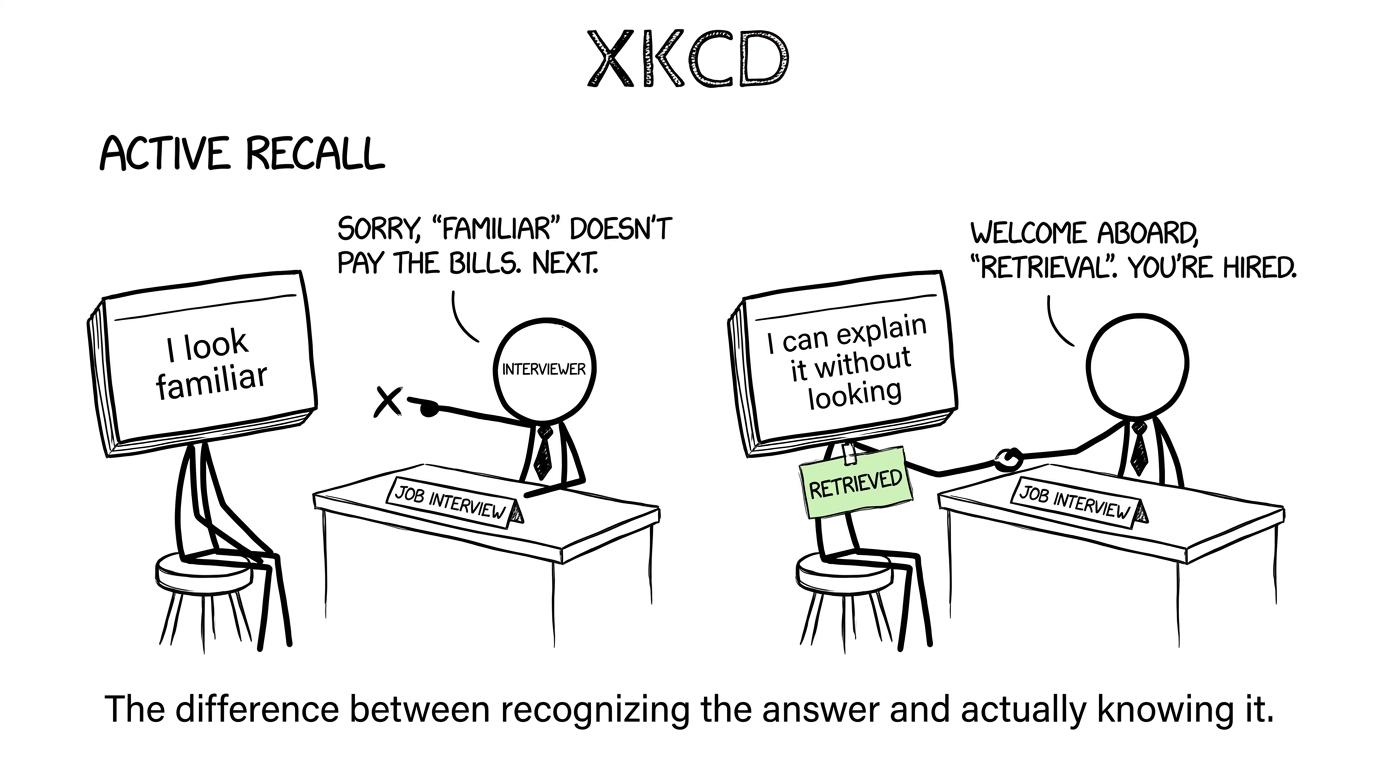 Two flashcards interviewing for a retrieval job, with genuine recall getting the role
How to build your own GCSE Economics deck fast
Building cards can become a form of procrastination. The aim is not to produce beautiful stationery. It is to create prompts you can test repeatedly.
Start with the specification headings
Create folders or sets using the topic structure for your own board. Under each heading, list:
- essential definitions;
- causes and consequences;
- advantages and disadvantages;
- stakeholder effects;
- formulas and units;
- graph movements and interpretations;
- common evaluation points.
Begin with a manageable batch, such as fifteen to twenty-five cards for one topic. Test those cards before creating the next batch. A deck becomes useful when it is used, not when it is complete.
Write questions, not labels
A front reading "inflation" invites recognition. A question such as "What is inflation?" demands a definition. Other useful prompt patterns include:
- What is the difference between two related concepts?
- State two possible causes of this change.
- Which stakeholders could gain or lose?
- What assumption might weaken this argument?
- Which formula is needed, and what does each quantity represent?
Keep one main demand on each card. When an answer includes several steps, use a short chain or split it across cards.
Make cards reversible where appropriate
You should be able to retrieve a term from its definition as well as retrieve the definition from the term. Reversing suitable cards exposes shallow familiarity: knowing that you have seen a phrase is different from being able to name the concept accurately.
Not every card should be reversed. A long application prompt may make little sense backwards. Use judgement rather than applying one format mechanically.
Tag uncertain cards immediately
Use a consistent label for cards you cannot answer confidently. Revisit these more often, then retire or reduce their frequency once recall becomes secure. Keep returning to older topics so that revision is spaced across time rather than concentrated into one evening.
Include quantitative skills in your economics cards
Economics students can lose marks by knowing the theory but hesitating over a calculation. Your exact requirements depend on your specification, so use its quantitative-skills section as your checklist.
Useful formula cards may include percentage change:
Percentage change=new value−original valueoriginal value×100\text{Percentage change}=\frac{\text{new value}-\text{original value}}{\text{original value}}\times 100Percentage change=original valuenew value−original value×100Revenue and profit relationships may be written as:
Total revenue=price×quantity sold\text{Total revenue}=\text{price}\times\text{quantity sold}Total revenue=price×quantity sold Profit=total revenue−total cost\text{Profit}=\text{total revenue}-\text{total cost}Profit=total revenue−total costWhere price elasticity of demand is required, the relationship is:
PED=percentage change in quantity demandedpercentage change in price\text{PED}=\frac{\text{percentage change in quantity demanded}}{\text{percentage change in price}}PED=percentage change in pricepercentage change in quantity demandedCheck whether your course expects discussion using the negative sign or the absolute magnitude. Your teacher and exam board materials should determine the convention you use.
A formula card should test more than memorisation. Include separate prompts about choosing the correct formula, identifying the original value, interpreting the result and checking whether an answer is reasonable.
MathsGenie can strengthen the underlying methods through grade 2 GCSE maths revision, grade 3 GCSE maths revision and grade 4 GCSE maths revision. These skills should then be practised in an economics context using questions from your own board.
Turn flashcard recall into exam marks
Flashcards are good for definitions, formulas, distinctions and compact reasoning chains. They are not a complete rehearsal for extended responses.
After testing a topic, answer an exam-style question without the cards. Then compare your response with the mark scheme. This reveals whether you can select knowledge, apply it to the context, analyse consequences and evaluate limitations.
A sensible revision sequence is:
- retrieve the key knowledge from cards;
- correct uncertain answers;
- complete relevant practice questions;
- mark the work carefully;
- add genuine errors to your personal deck;
- revisit the topic later.
Use the MathsGenie revision planner to organise this alongside your maths workload. For mathematical fluency, rotate in GCSE maths past papers and MathsGenie predicted papers rather than spending every session on digital cards.
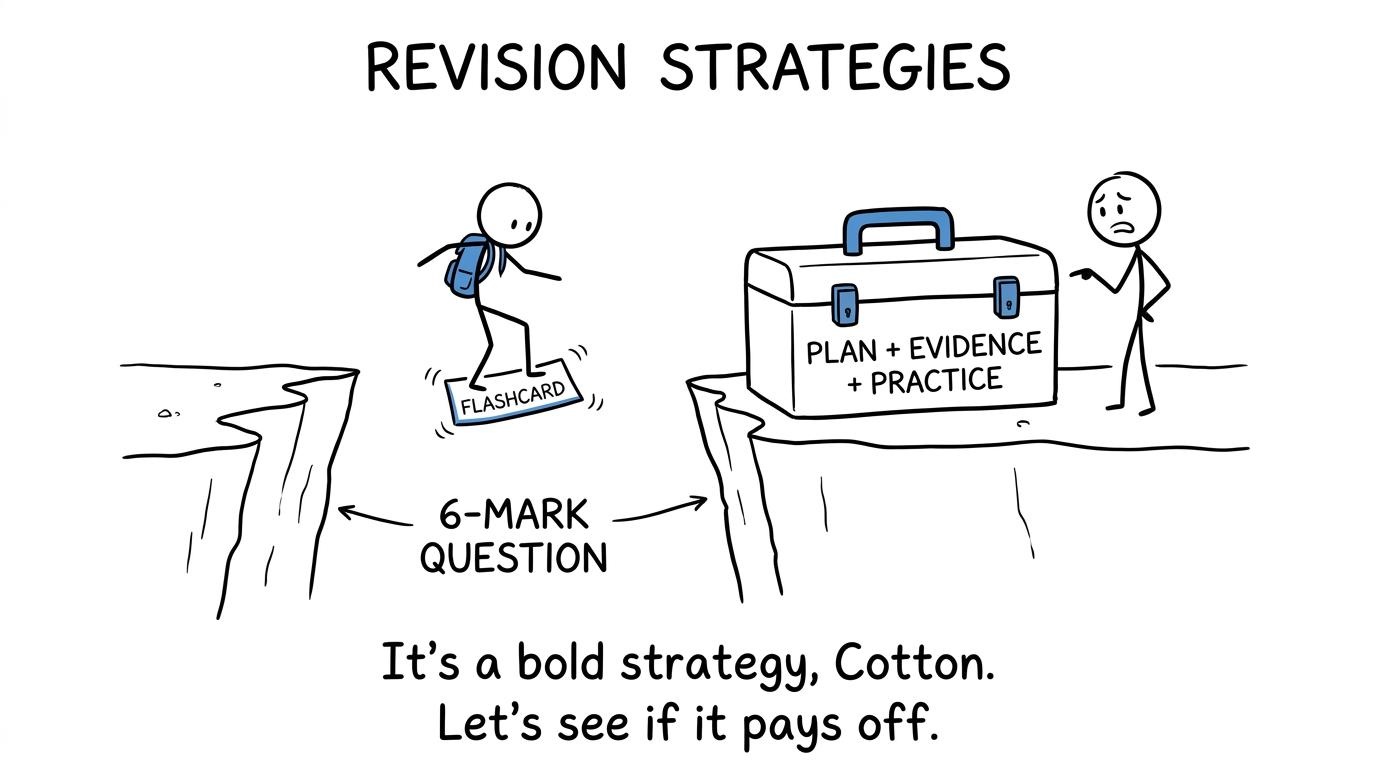 A flashcard discovering that a longer exam question needs a full revision toolbox
Common mistakes with Economics flashcards
Trusting a deck without checking its board
A correct definition can still be poorly matched to your specification. Confirm the board, qualification and topic coverage before investing time.
Copying notes instead of creating prompts
Typing a page of notes onto the reverse of a card does not make it easier to retrieve. Split large ideas into focused questions with checkable answers.
Marking a familiar answer as correct
If your response was vague, incomplete or only appeared obvious after turning the card over, mark it as uncertain. Honest checking makes the next session more useful.
Revising definitions but ignoring calculations
Create cards for formulas, units, graph interpretation and the meaning of calculated results. Support weak foundations with MathsGenie's free maths revision lessons.
Using flashcards instead of exam questions
Knowing a definition is only the first step. Economics examinations also require application, analysis and evaluation. Move from cards to timed questions and mark schemes.
Build a deck that earns its place
The best GCSE Economics deck is not necessarily the longest or most popular. It is the one that matches your specification, exposes what you cannot yet retrieve and leads naturally into exam practice.
Start with one topic today. Audit any public set, remove weak cards and add the definitions, formulas and mistakes that matter to you. Then close the deck and answer a real question.
For the mathematical side of your preparation, make MathsGenie your next step. Use the free revision lessons and practice questions to repair individual skills, then test them through past papers, predicted papers, mark schemes, video solutions and mini tests. Flashcards help knowledge stay available; deliberate practice teaches you what to do with it.