GCSE Economics 3 to 5: A Practical Grade Guide
GCSE economics 3 to 5 guidance: improve knowledge, analysis, evaluation, numeracy and exam technique to turn basic answers into secure responses.
A grade 333 Economics answer often contains more knowledge than its mark suggests. The student recognises the topic, remembers a definition and may even identify the right effect. But the explanation stops just before the marks begin to accumulate.
Moving GCSE economics 3 to 5 is therefore not simply about memorising another folder of notes. It means giving accurate definitions, applying ideas to the context, building complete chains of reasoning, handling economic calculations and reaching supported judgements. In short, you must turn what you know into something an examiner can reward.
This guide explains the specific changes that tend to make that possible. Grade boundaries vary between exam boards and examination series, so there is no permanent mark that guarantees a grade 555. The dependable approach is to improve the quality of each response while following the current specification and mark scheme for your exam board.
Your grade 333 to grade 555 checklist
Focus your revision on these seven changes:
- replace vague descriptions with precise economic terminology;
- apply each answer to the business, market or economy in the question;
- explain consequences through connected chains of reasoning;
- use diagrams as part of the analysis, not as decoration;
- show every step in quantitative questions;
- evaluate by explaining why an outcome may vary;
- practise under time pressure and act on mark-scheme feedback.
The gap is not one dramatic leap. It is usually several small improvements repeated across an entire paper.
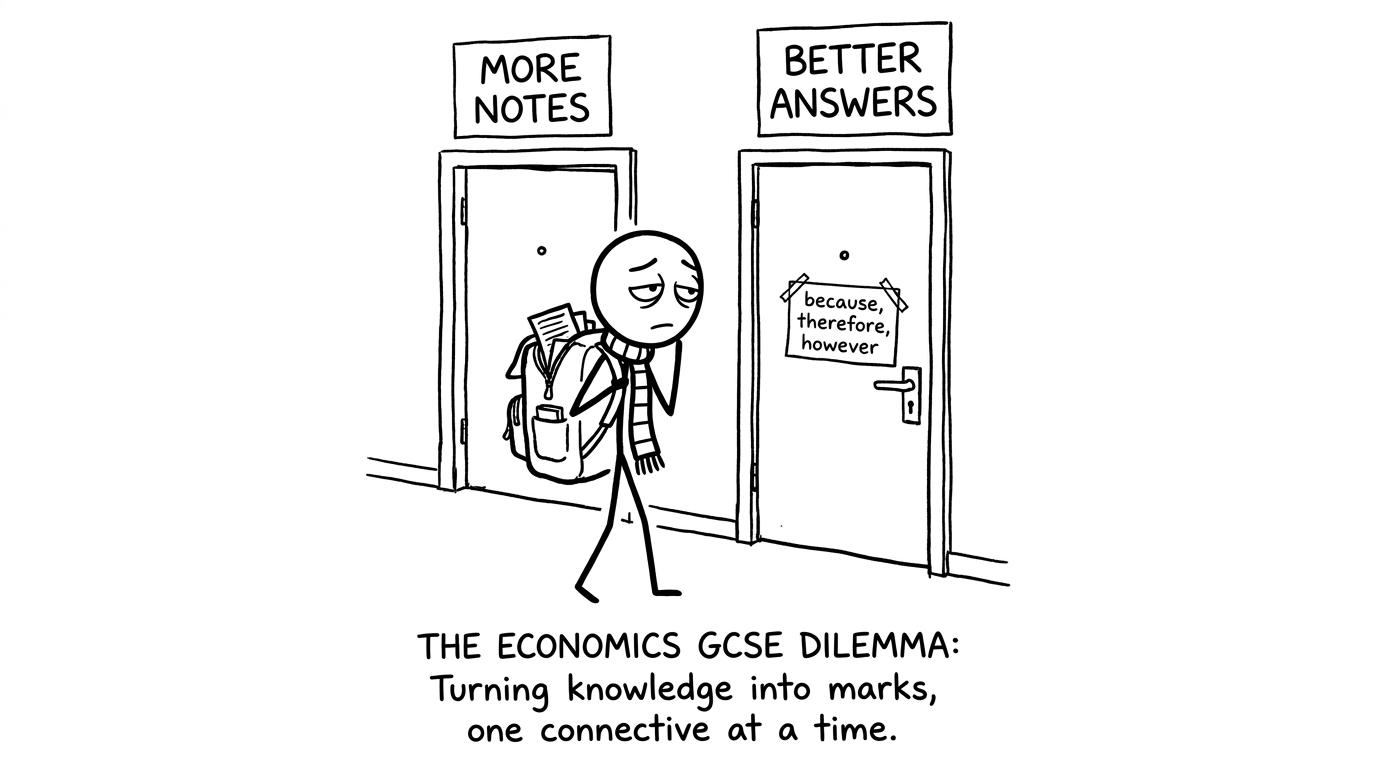 A student choosing between more notes and better answers
What separates a grade 333 from a grade 555?
A grade is awarded from your total performance, not from a particular writing style. Nevertheless, there are clear differences between responses operating around these levels.
| Around grade 333 | Moving towards grade 555 |
|---|---|
| Recalls isolated facts | Selects accurate and relevant knowledge |
| Repeats information from the question | Uses the information to support an argument |
| States that something will rise or fall | Explains why it changes and what follows |
| Draws a diagram without discussing it | Uses the diagram to explain a new equilibrium or consequence |
| Gives an unsupported opinion | Reaches a judgement based on economic reasoning |
| Attempts calculations mentally | Writes the formula, substitution, answer and units |
| Revises by rereading | Retrieves knowledge and completes exam questions |
Current GCSE Economics specifications from boards such as AQA and OCR assess a mixture of knowledge, application, analysis and evaluation. The exact wording and paper structure vary, so use your own board's specification rather than assuming every course is identical.
The important pattern is universal: knowing a concept starts an answer, but application and reasoning develop it.
Build knowledge that you can retrieve
Weak revision often feels productive. Highlighting a page creates visible progress, but recognition is not the same as recall. In the examination, there is no highlighted sentence waiting to prompt you.
Organise each topic around a compact set of questions:
- What does the term mean?
- What causes it?
- Who is affected?
- What are the short-run and long-run consequences?
- What diagram or calculation could support the explanation?
- Under what conditions might the result be different?
Practise saying definitions without looking, then check every key word. A definition of inflation, for example, must distinguish a sustained increase in the general price level from one product merely becoming more expensive.
Keep the scale manageable. Ten minutes of retrieval on demand, supply, market failure or government policy is more revealing than an hour spent copying the same notes.
Turn statements into chains of analysis
A common grade 333 response identifies the first effect and stops. A stronger response follows the mechanism.
Build paragraphs with a simple mental structure:
Change →\rightarrow→ mechanism →\rightarrow→ consequence →\rightarrow→ affected group.
Useful connective phrases include “because”, “this means that”, “therefore” and “as a result”. They are not magic words; their value is that they force you to connect one economic idea to the next.
Suppose a question concerns a change in business costs. Naming the likely movement is only the beginning. You may need to explain how costs affect profitability or supply, how the market outcome changes and what that means for consumers, workers or the government. Every link must be economically plausible.
Avoid making chains artificially long. One secure chain is better than three speculative consequences. Stop when the reasoning no longer follows clearly from the information provided.
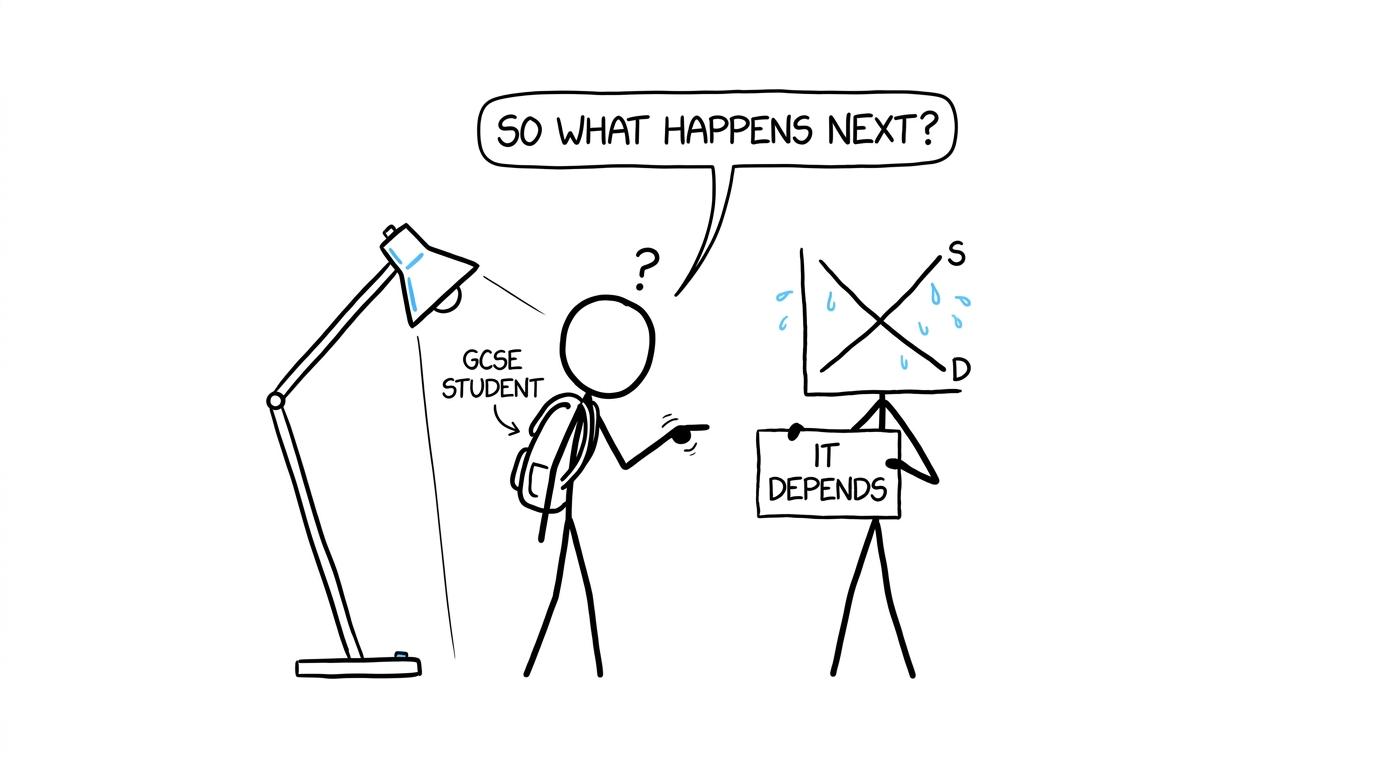 A student asking an economic graph what happens next
Apply every answer to the context
Application means using the details supplied in the question. It is not achieved by mentioning the business's name once and then writing a generic paragraph.
Before answering, underline useful evidence such as:
- the type and size of a business;
- whether a market is competitive;
- numerical data or a trend;
- the income or age of consumers;
- the time period involved;
- the state of the wider economy.
Then ask, “Which part of my argument does this evidence support?” A statistic should do a job. A feature of the market should alter your reasoning. Context becomes valuable when it helps explain why an outcome is likely.
This is one of the quickest ways to improve an answer because it does not require learning a new topic. It requires paying closer attention to the question already in front of you.
Develop evaluation rather than adding “it depends”
Evaluation is not disagreement for its own sake. It is a reasoned assessment of how strong an argument is, followed by a supported conclusion.
Good evaluation can consider:
- magnitude: is the change large enough to matter?
- time: might short-run and long-run effects differ?
- elasticity: how responsive are consumers or producers?
- stakeholders: who gains and who bears the cost?
- assumptions: what must be true for the argument to hold?
- priorities: is the objective growth, profit, equity or stability?
A judgement should answer the exact question. State which factor is most important and explain why it outweighs the alternative in this context. Do not introduce a completely new argument in the final sentence.
For extended responses, planning two analytical routes before writing can prevent repetition. The goal is not to write the longest answer. It is to make the final judgement feel earned.
Secure the quantitative marks
Economics includes data, percentages, averages, ratios and graphs. These questions reward careful method as much as confidence. MathsGenie's free GCSE Maths revision lessons can help you repair the underlying numeracy without revising irrelevant advanced material.
Know the structure of common calculations, including percentage change:
Percentage change=new value−original valueoriginal value×100\text{Percentage change}=\frac{\text{new value}-\text{original value}}{\text{original value}}\times 100Percentage change=original valuenew value−original value×100Revenue uses:
Revenue=price×quantity sold\text{Revenue}=\text{price}\times\text{quantity sold}Revenue=price×quantity soldPrice elasticity of demand is represented by:
PED=percentage change in quantity demandedpercentage change in price\text{PED}=\frac{\text{percentage change in quantity demanded}}{\text{percentage change in price}}PED=percentage change in pricepercentage change in quantity demandedYour exam board may use particular conventions when interpreting elasticity, so follow the terminology taught for your specification.
When a calculation appears, write the formula, substitute carefully, give the requested units and check whether rounding is required. A negative value may carry economic meaning, so do not remove the sign automatically.
Use MathsGenie's lessons and practice questions on percentages, percentage change, ratio and averages to strengthen these skills. For interpreting relationships between variables, the scatter graphs revision lesson is also useful.
Use diagrams as economic arguments
A diagram earns its place when it helps explain an outcome. Draw it accurately, label the axes and curves, show the relevant shift, and refer to the resulting change in your written analysis.
Before accepting your diagram, check:
- Have I shifted the correct curve?
- Does the direction match the cause?
- Are the original and new positions distinguishable?
- Have I explained what the movement means economically?
Never assume the picture speaks for itself. The examiner needs to see that you understand the causal relationship represented by it.
Practise for marks, not just completion
Past-paper practice becomes powerful only when it changes what you do next. Complete a focused set of questions, mark it carefully and record the reason for every lost mark.
Use four error categories:
- missing knowledge;
- weak application;
- incomplete analysis or evaluation;
- calculation or examination technique.
This turns a disappointing mark into a revision plan. If most losses come from context, another evening memorising definitions will not solve the main problem.
Economics papers should come from your own exam board, but MathsGenie's GCSE Maths past papers can build confidence with the numerical demands that appear across data-heavy subjects. The site's predicted GCSE Maths papers are designed for maths preparation rather than Economics forecasting, but they provide further timed numeracy practice with mark schemes and video solutions.
 An examiner searching a long paragraph for its judgement
Common mistakes that hold students at grade 333
Answering the topic instead of the question
A rehearsed paragraph may contain correct economics but still miss the command word. Identify whether you must calculate, explain, analyse, assess or evaluate before beginning.
Copying the source without using it
Quoting data is not enough. Explain what the evidence indicates and how it strengthens your economic argument.
Jumping between unrelated effects
A list of possible consequences is not a chain of analysis. Develop one route fully before beginning another.
Giving balance without a judgement
Writing one argument on each side shows awareness, but evaluation requires you to weigh them. Decide which effect is likely to dominate and justify that choice.
Hiding the calculation
A correct number with no method is fragile. Show the stages, retain sensible accuracy until the final line and include the appropriate unit.
Treating every mistake as a knowledge gap
Some students know enough for a grade 555 but lose marks through vague wording, weak context or unfinished answers. Diagnose the type of error before choosing the remedy.
A realistic revision routine
Use a repeatable weekly cycle rather than waiting for motivation:
- retrieve one Economics topic from memory;
- correct the gaps using your specification and class materials;
- answer short and extended questions on that topic;
- mark them and rewrite one weak paragraph;
- complete a short numeracy session;
- revisit the same errors several days later.
As the examination approaches, combine topic practice with complete timed papers. Do not chase a fixed percentage from an old grade boundary. Boundaries can change, while better definitions, clearer reasoning and accurate calculations remain useful in every series.
Make the next answer better
Going from grade 333 to grade 555 in GCSE Economics is less about suddenly becoming brilliant and more about becoming deliberate. Define precisely. Use the context. Follow consequences. Show your calculations. Judge rather than merely list.
Begin with one weak area today. Use MathsGenie's free GCSE revision to strengthen percentages, ratios, averages and graph interpretation, then apply those skills to Economics questions from your exam board. Combine revision lessons with practice questions, mini tests, past papers, predicted Maths papers, mark schemes and video solutions. The grade improves when feedback stops being something you read and becomes something you use.