

GCSE Chemistry Early Entry: Is It a Good Idea?
GCSE chemistry early entry: weigh readiness, practical work, first-entry rules and revision pressure before deciding whether an early exam is right for you.
The offer can sound flattering: your school thinks you could sit Chemistry before most students. Yet the important question is not whether you are capable of early entry. It is whether taking the qualification early gives you a better overall outcome.
For most students, GCSE chemistry early entry is sensible only when the full specification has been taught, required practical work is secure, timed papers show consistently strong performance, and the extra preparation will not weaken maths, English or other GCSE subjects. Finishing early can create useful space in Year 111111, but sitting before you are ready can lock avoidable pressure into an already crowded timetable.
This is a decision to make from evidence, not excitement.
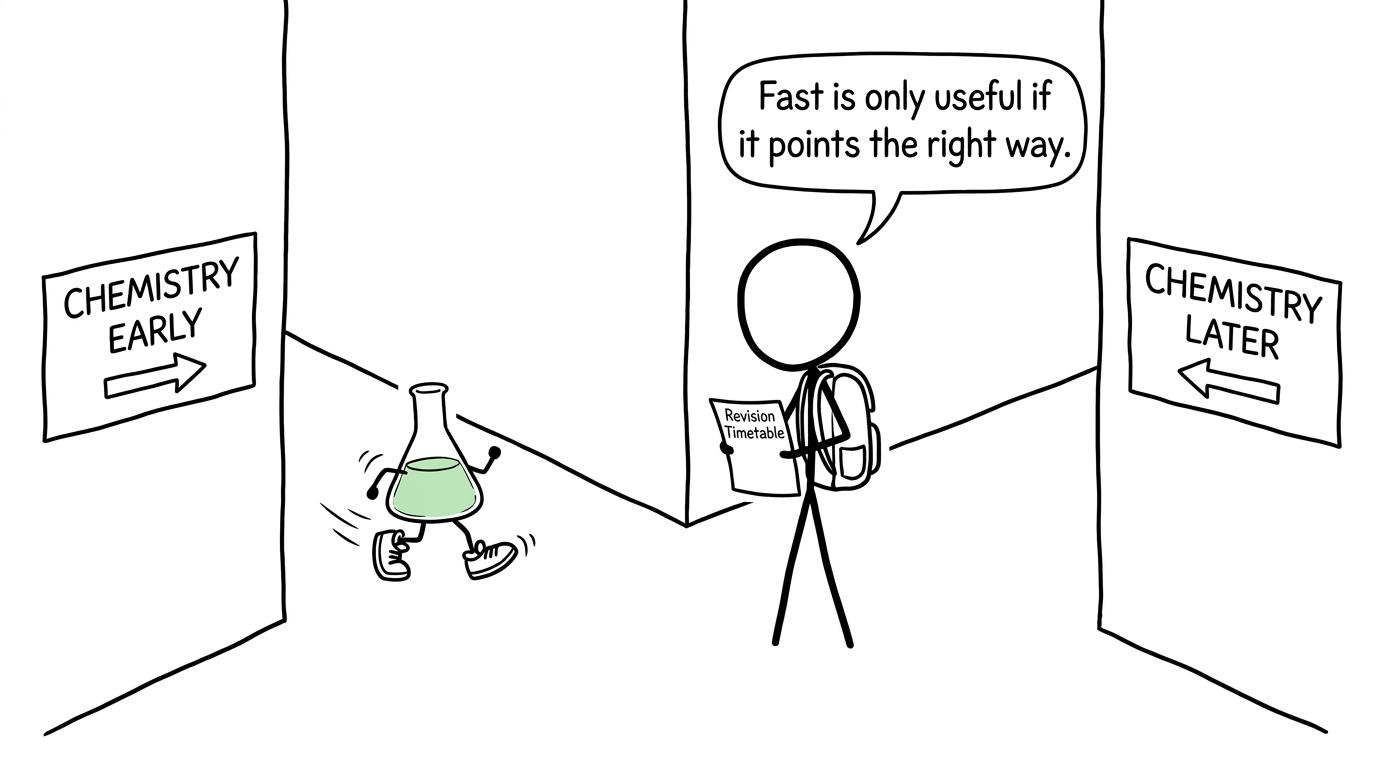 A student choosing between early and later Chemistry exam paths
GCSE chemistry early entry checklist
Before agreeing, you, your parents or carers, and your teachers should be able to answer yes to most of these questions:
- Have you been taught the complete Chemistry specification for your exam board?
- Have you completed the required practical activities or covered the relevant practical requirements?
- Can you answer unfamiliar application questions, rather than merely recall facts?
- Are your results consistent across both papers and all topic areas?
- Are your quantitative chemistry and graph skills secure?
- Can you revise Chemistry without reducing essential maths and English preparation?
- Does your school have a clear plan for what you will do after the early examination?
- Have you discussed the consequences of a disappointing first result?
One unusually high classroom test is not enough. A better test is several papers completed under controlled conditions, marked against official mark schemes, with weaknesses reviewed honestly.
What taking GCSE Chemistry early actually means
Early entry usually means sitting the same GCSE qualification as other students, but before the end of Year 111111. It is not a shortened or easier version of the course. You still need to meet your exam board's specification and assessment requirements.
The precise structure differs between AQA, Pearson Edexcel, OCR and Eduqas. Separate GCSE Chemistry is also different from Combined Science, which awards two GCSE grades and integrates biology, chemistry and physics. Before considering entry, confirm the qualification, specification, tier and exam board with your school.
Modern GCSE Chemistry qualifications are generally linear, meaning the written components are taken at the end of the course rather than gradually banked as separate modules. For example, AQA GCSE Chemistry has two written papers, each contributing 50%50\%50% of the qualification. Other boards organise their papers differently, so readiness should be judged against your own specification.
In England, current Department for Education guidance says that where a pupil takes the same qualification more than once, the first entry normally counts in the school's key stage 444 performance measures. This does not prevent a resit, and an individual may still be able to use their best result for applications, but it gives schools a reason to treat early entry carefully. Accountability arrangements vary across the UK, so students in Wales or elsewhere should ask their school how the relevant rules apply.
When early entry can be a good idea
You have completed the course properly
Moving quickly through a textbook is not the same as completing a science course. Strong candidates have covered the entire specification, connected ideas across topics and developed the practical understanding expected in written examinations.
For AQA Chemistry, questions drawing on required practical knowledge account for at least 15%15\%15% of the qualification's marks. Practical understanding cannot safely be postponed until after an early examination. You may be asked to interpret results, identify variables, evaluate a method or explain how accuracy could be improved.
Early entry is more credible when laboratory work, theory and exam practice have developed together.
Your evidence is consistent
Readiness is not a feeling. It is a pattern.
A student may know atomic structure extremely well while losing marks on electrolysis, organic chemistry, rates, chemical analysis or quantitative questions. Completing several full papers can reveal whether knowledge holds up when topics are mixed and time is limited.
Use the same diagnostic principle that works in maths: record what cost you marks, classify the cause and test the weakness again. MathsGenie's guide to finding your weakest GCSE topics explains how to turn paper results into specific next actions rather than vague promises to revise more.
Finishing early creates purposeful time
An early GCSE can reduce Year 111111 pressure, but only if the released time has a planned use. It might support deeper study, enrichment or preparation for remaining qualifications. Without a plan, the apparent time saving can disappear.
The strongest reason to enter early is not simply, "I can finish sooner." It is, "I am ready now, and this creates a clear educational benefit later."
When waiting is usually wiser
The syllabus has been compressed
Compression creates a quiet risk. You can cover every heading while leaving too little time for retrieval, practical understanding and unfamiliar problems. Chemistry rewards connections: particle models support bonding, bonding supports properties, and balanced equations support quantitative work.
If the final topics are being rushed purely to reach an earlier exam series, waiting may produce a stronger grade with less stress.
Your result depends on familiar questions
A student can appear secure when questions resemble class notes. The real examination may combine information in a new context. Strong readiness includes explaining, applying, analysing and evaluating, not just remembering definitions.
A useful pre-entry test is an unseen paper completed without prompts. Mark it strictly, then revisit the same weak areas using a different set of questions. MathsGenie's advice on when to begin GCSE past papers is written for maths, but its central lesson transfers well: start early enough for the result to change what you do next.
Chemistry is taking marks away from maths
Every revision hour has an opportunity cost. An extra evening spent accelerating Chemistry is an evening unavailable for algebra, geometry or English Language.
That does not mean every subject needs equal time. It means the decision should reflect the whole GCSE portfolio. Use the free MathsGenie revision planner to map realistic weekly commitments before accepting additional Chemistry preparation.
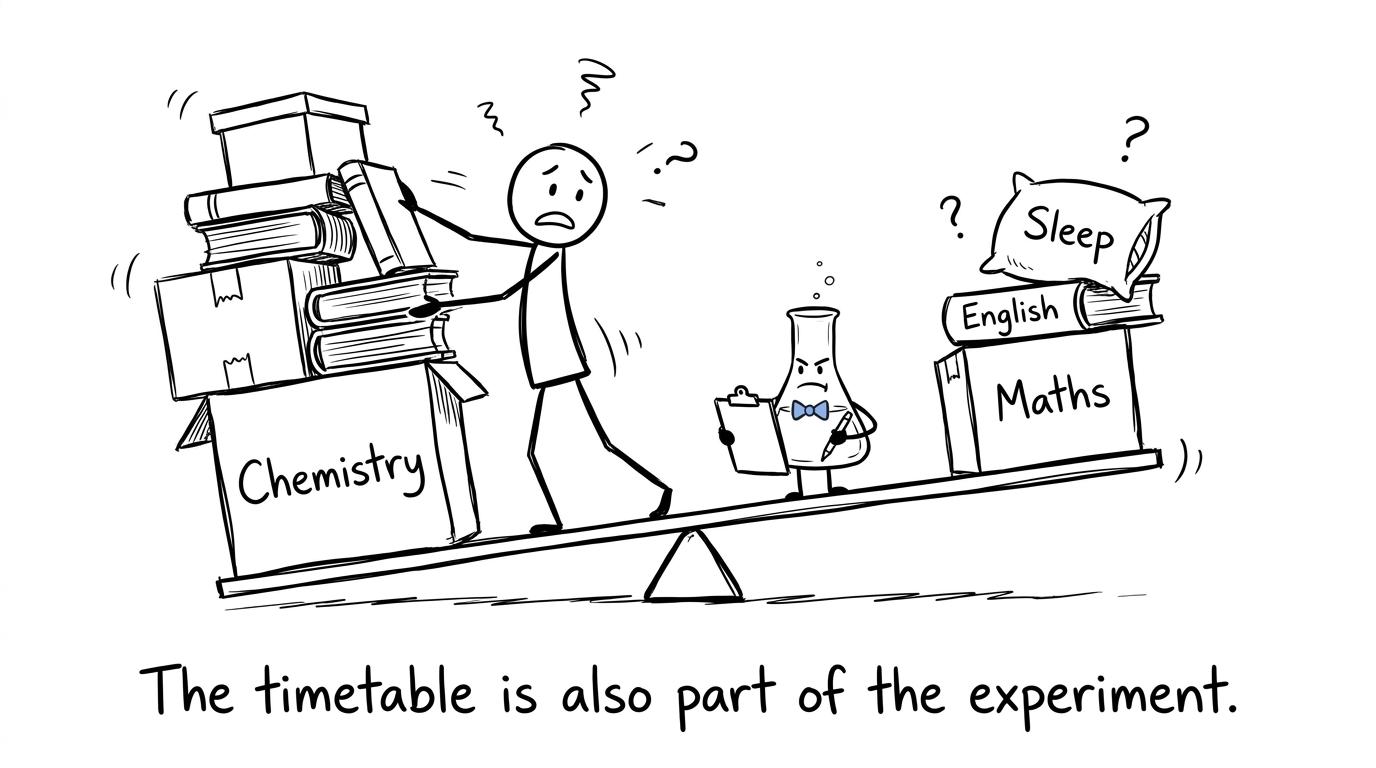 A student balancing Chemistry, Maths, English and sleep
Why maths readiness matters in GCSE Chemistry
Chemistry contains more mathematics than its rows of symbols first suggest. Specifications include skills involving decimals, standard form, ratios, fractions, percentages, significant figures, means, substitution, rearranging formulae and interpreting graphs.
Typical relationships include concentration,
concentration=mass of solutevolume of solution,\text{concentration} = \frac{\text{mass of solute}}{\text{volume of solution}},concentration=volume of solutionmass of solute,and percentage yield,
percentage yield=actual yieldtheoretical yield×100.\text{percentage yield} = \frac{\text{actual yield}}{\text{theoretical yield}} \times 100.percentage yield=theoretical yieldactual yield×100.These are not worked examples to memorise. They show why weak proportional reasoning or formula rearrangement can limit Chemistry performance even when scientific knowledge is good.
Before early entry, check whether you can:
- convert units reliably;
- use ratios and percentages accurately;
- substitute into equations with correct units;
- rearrange straightforward formulae;
- select suitable significant figures;
- plot and interpret graphs;
- use gradients and tangents where required;
- judge whether a calculated result is reasonable.
MathsGenie's GCSE maths revision hub provides board-specific lessons, question banks, worksheets and revision guides. If ratios are a weak point, begin with writing and simplifying ratio. For a broader check, the GCSE self-assessment resources can help identify skills that need attention before they appear inside a Chemistry context.
How to make the decision with your school
Ask for a short meeting with the teacher responsible for the entry. The conversation should cover more than your current predicted grade.
Ask what evidence supports the recommendation
Useful evidence includes performance across the full specification, unseen paper results, practical competence and consistency over time. Ask whether the recommendation is based on your individual readiness or on a whole-class timetable decision.
Confirm the practical arrangements
Find out which required practical activities or specified apparatus and techniques you must complete, how absences will be handled, and how practical understanding will be assessed before the examination.
Discuss the first-entry implications
Ask how an early result and any later resit would be treated for you and for the school's performance measures. The rules can be technical, and your school or exams officer should explain them for your qualification and location.
Agree on a stopping rule
A sensible plan includes permission to delay. For example, the entry might proceed only if full mock papers remain at the agreed standard and the revision workload stays manageable. Changing course after new evidence is not failure. It is good judgement.
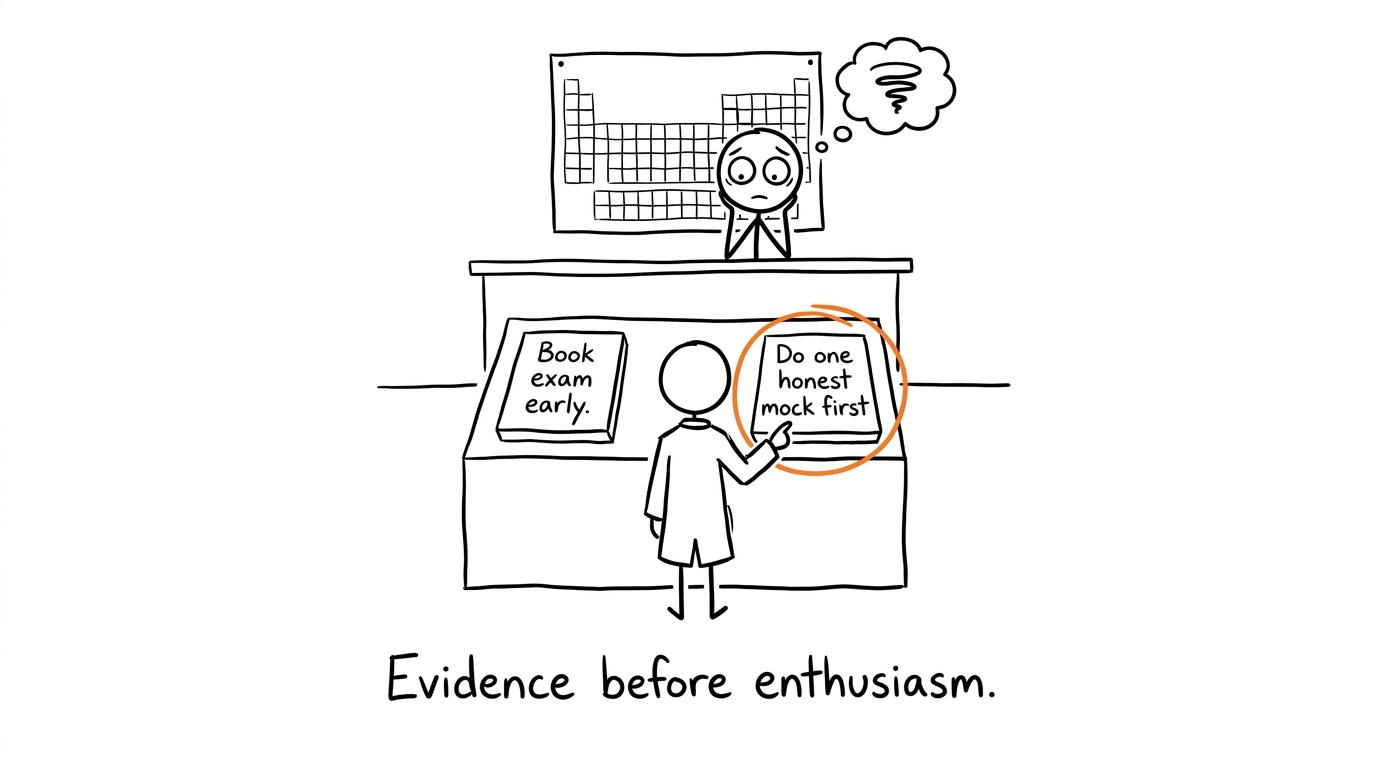 A student wisely choosing an honest mock before booking an early exam
Common mistakes when considering early entry
Treating speed as proof of mastery
Finishing content quickly proves that you can move quickly. It does not prove durable recall, practical understanding or performance under exam pressure.
Focusing only on the predicted grade
A predicted grade is useful, but it is not a guarantee. Look at topic coverage, paper consistency, timing and the reasons marks are being lost.
Ignoring the second paper
Students sometimes judge readiness from the topics they studied first. An early decision should be based on the complete qualification, not a preferred half of it.
Assuming a resit removes all risk
A resit may be possible, but it creates more revision, another examination and possible first-entry consequences for school measures. It should be a safety option, not the original strategy.
Letting Chemistry consume the timetable
Acceleration can feel productive because the goal is visible. Meanwhile, quieter gaps in maths accumulate. Build a balanced GCSE maths revision timetable and protect regular practice across your core subjects.
Using papers without learning from them
Completing a paper is only the measurement stage. Improvement comes from marking, diagnosing, repairing and retesting. MathsGenie's Edexcel GCSE maths past papers demonstrate this complete loop through papers, mark schemes and solutions.
The best decision is the one supported by evidence
Taking GCSE Chemistry early can be a good idea for a student who has genuinely completed the course, understands the practical work, performs consistently in unseen papers and can absorb the workload without weakening other subjects. It is a poor bargain when the main argument is prestige, impatience or the hope that a rushed first attempt can simply be repaired later.
Pause before agreeing. Check the specification. Sit honest mocks. Review the first-entry position with your school. Protect maths, English, sleep and the rest of your timetable.
Then let the evidence decide.
Whatever happens with Chemistry, keep your maths preparation steady through MathsGenie's free revision lessons, practice questions, mini tests and revision planner. Build towards past papers, check every attempt with mark schemes and video solutions, and use predicted papers near the examination to expose the final gaps. Early or not, the reliable route is the same: learn, practise, review and return stronger.











