

GCSE Business Half-Term Revision That Gets Done
GCSE business half term revision made manageable: build a focused plan, practise recall, improve exam answers and protect time for a proper break.

Half-term creates a strange kind of pressure. There is enough free time to imagine transforming your entire GCSE Business grade, but enough distraction to postpone starting until Sunday evening.
The answer is not to surrender the whole break. Effective GCSE business half term revision means choosing a few important weaknesses, completing short sessions that produce visible work, and stopping at a planned time. You need to retrieve knowledge, answer questions and correct mistakes, not spend seven days making increasingly colourful notes.
A sensible half-term might contain four or five focused sessions. The rest can remain a break. This article shows you how to decide what to revise, structure each session and strengthen the numerical skills that Business questions often require.
Your half-term revision checklist
Before planning individual days, decide what success will look like. Keep the list small enough to finish:
- Check your exam board specification: Edexcel, AQA, OCR or Eduqas.
- Identify three weak areas from tests, homework or teacher feedback.
- Schedule four or five focused sessions rather than vaguely planning to revise every day.
- Include knowledge retrieval, exam questions and correction in every session.
- Practise Business calculations without relying on your notes.
- Leave at least one full day with no revision.
- Finish half-term with a short list of what still needs attention.
The purpose is not to complete GCSE Business. It is to return to school knowing several important areas better than you did before.
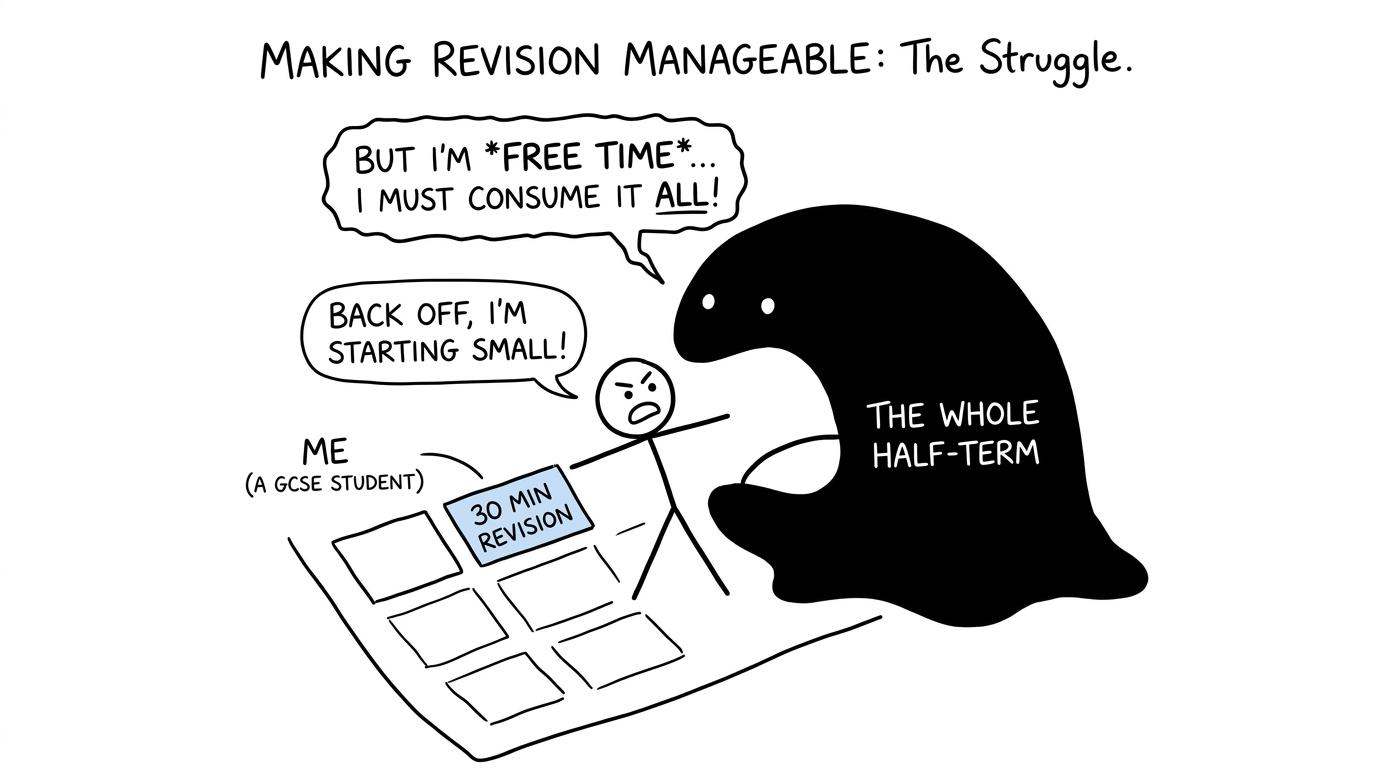 A student protecting one manageable revision block from the whole half-term
Start with a diagnosis, not a timetable
A timetable built before you understand your weaknesses can look organised while achieving very little. Start by examining a recent assessment, practice paper or set of questions.
Sort each lost mark into one of four categories:
- Knowledge: you could not recall a definition, formula or business concept.
- Application: you knew the concept but did not connect it to the business in the question.
- Analysis: you stated an effect but did not develop the chain of consequences.
- Judgement: you gave a conclusion without weighing the relevant evidence or circumstances.
Your teacher's feedback and your exam board's mark schemes should guide this process. Assessment structures and command-word expectations differ between specifications, so revise for the qualification you are actually taking.
Choose three priorities from the diagnosis. One might be a content area such as finance. Another might be calculations. The third might be extended responses. A short, specific list creates a finish line; “revise Business” does not.
Maths students can use the same principle with the GCSE Maths revision timetable guide: personal weaknesses should determine the plan, not whichever topic feels most comfortable.
Build a half-term plan that protects the break
A realistic plan should tell you when to start, what to produce and when to stop. Try spreading these sessions across the week:
The knowledge session
Choose one weak Business unit. Close your book and write everything you can remember about its key terms, advantages, disadvantages and connections. Then check your notes and add only what was missing.
Finish by answering several short questions. The result should be evidence of retrieval, not copied pages.
The calculation session
Practise the numerical techniques named in your own specification. Depending on the board and topic, these may include revenue, costs, profit, cash flow, averages, percentages, percentage change, profit margins or break-even.
MathsGenie's OCR GCSE Business calculations guide provides a useful overview for OCR students. If you take another board, check its specification because terminology and required techniques can differ.
The exam-answer session
Complete a small selection of questions in timed conditions. Include at least one response requiring developed reasoning. Mark it with the correct mark scheme and compare the answer with the wording of the question.
Do not merely write down your mark. Record why marks were lost: missing context, an undeveloped chain, weak knowledge or an unsupported judgement.
The repair session
Return to the mistakes from the first three sessions. Reattempt questions without looking at the previous answers. This session is where revision starts becoming more reliable because you are testing whether the correction has lasted.
The final check
Use the last session for mixed retrieval and a short timed set. Write three headings afterwards: secure, improving and next priority. That becomes your plan when school resumes.
Make every revision session produce something
Passive revision feels comfortable because recognition is easy. A paragraph looks familiar, a highlighted term seems obvious, and the session appears successful. The exam asks for something harder: recalling and using ideas without the page being open.
Use this simple session structure:
- First few minutes: retrieve key terms or formulae from memory.
- Main task: answer questions without notes.
- Review: use a mark scheme, teacher guidance or solution.
- Correction: improve an answer or reattempt the calculation.
- Exit note: record one precise action for next time.
An exit note should say, “Explain how the effect changes costs before discussing profit,” rather than, “Do better analysis.” Specific corrections can be acted upon.
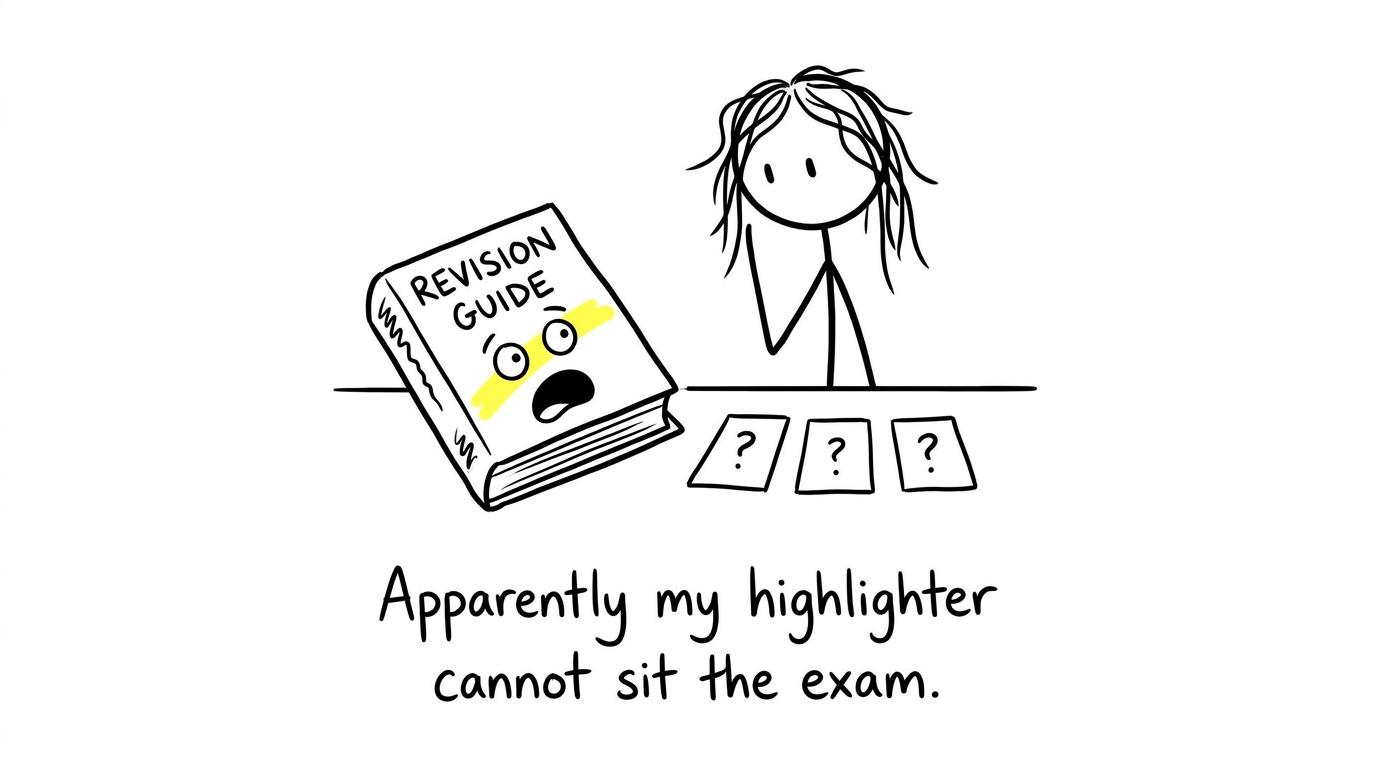 A revision guide discovers that a highlighter cannot sit the exam
Strengthen the maths inside GCSE Business
Business calculations are rarely difficult because they involve advanced maths. They become difficult when students select the wrong figures, forget the meaning of a result or lose track of units.
Learn each formula alongside its purpose. Common relationships include:
Revenue=selling price per unit×quantity sold\text{Revenue} = \text{selling price per unit} \times \text{quantity sold}Revenue=selling price per unit×quantity sold Total costs=fixed costs+total variable costs\text{Total costs} = \text{fixed costs} + \text{total variable costs}Total costs=fixed costs+total variable costs Profit=revenue−total costs\text{Profit} = \text{revenue} - \text{total costs}Profit=revenue−total costs Percentage change=changeoriginal value×100\text{Percentage change} = \frac{\text{change}}{\text{original value}} \times 100Percentage change=original valuechange×100Your board may use additional formulae, so treat its current specification and formula guidance as the final checklist.
For percentage change, the denominator is the original value. MathsGenie's percentage change revision lesson helps reinforce this underlying skill. The broader Edexcel GCSE Maths revision hub also contains lessons and practice questions on percentages, averages, ratio and graphs.
When practising a calculation:
- identify what the question asks for;
- recall the formula before selecting figures;
- substitute carefully;
- show the main stages of working;
- include the correct unit, such as pounds, units or %\%%;
- interpret the result in the business context.
The final step matters. A calculated profit margin is not only a number; it may help a business compare performance, consider pricing or judge whether costs are under control. The exact conclusion still depends on the information in the question.
If weak number skills are slowing you down, the MathsGenie learning scheme provides structured practice in percentages, percentage change, exchange rates and ratio.
Improve analysis without memorising whole essays
Long model answers can create another form of passive revision. You remember the shape of an essay but struggle when the case study changes.
Instead, practise building chains of reasoning. A useful internal prompt is:
business decision →\rightarrow→ immediate effect →\rightarrow→ operational or financial consequence →\rightarrow→ impact on the objective
The arrows are not sentences to copy into an exam. They are a reminder that analysis needs movement. If a business changes its price, your answer should explore what might happen next and why, using the circumstances provided.
Application comes from selecting relevant context, not inserting the business name repeatedly. Use details such as its market, objectives, size, costs, customers or competitive situation where they genuinely affect the reasoning.
For evaluative questions, avoid preparing one conclusion for every possible case. Ask instead:
- Which factor is most important here?
- What does the available evidence support?
- Does the answer depend on time, finance, objectives or stakeholder response?
- What additional information would make the judgement stronger?
Always follow the command word, mark allocation and guidance for your own board.
Use papers to find gaps, not to prove your worth
A half-term is usually better suited to selected Business questions than an endless sequence of full papers. Choose questions connected to your three priorities, answer them under light time pressure and review them properly.
One marked question can teach more than several unmarked ones. Look for the precise place where the response stopped earning credit. Then rewrite only the weak section before attempting a fresh question later.
The same feedback loop supports maths revision. MathsGenie's GCSE past papers collection organises papers and mark schemes by exam board, while the guide to when to start GCSE past papers explains how shorter sections can build towards full timed practice.
Do not use a Maths paper as a substitute for Business practice. Use MathsGenie to repair the numerical skill, then return to a Business question where you must select, calculate and interpret the figures in context.
Common GCSE Business half-term revision mistakes
Planning every hour
An overcrowded timetable turns one missed session into a sense that the entire week has failed. Schedule fewer sessions and give each one a clear outcome.
Revising only favourite topics
Confidence is pleasant, but your assessment evidence should choose the priorities. Spend most of the week repairing weaknesses, with a smaller amount of mixed recall to maintain stronger areas.
Copying notes instead of retrieving
Neat notes can support revision, but copying is not a dependable test of recall. Close the source, attempt the task, and then check what was missing.
Doing questions without marking them
Unmarked practice preserves uncertainty. Use the relevant mark scheme and identify the exact reason for every lost mark.
Ignoring calculation units and meaning
A numerical answer needs the appropriate unit and, where requested, an interpretation. Check whether the result represents money, a percentage, a quantity or another measure.
Sacrificing the whole break
Tired revision becomes slower and less honest. Give sessions a stopping time, keep sleep steady and leave room for ordinary half-term life.
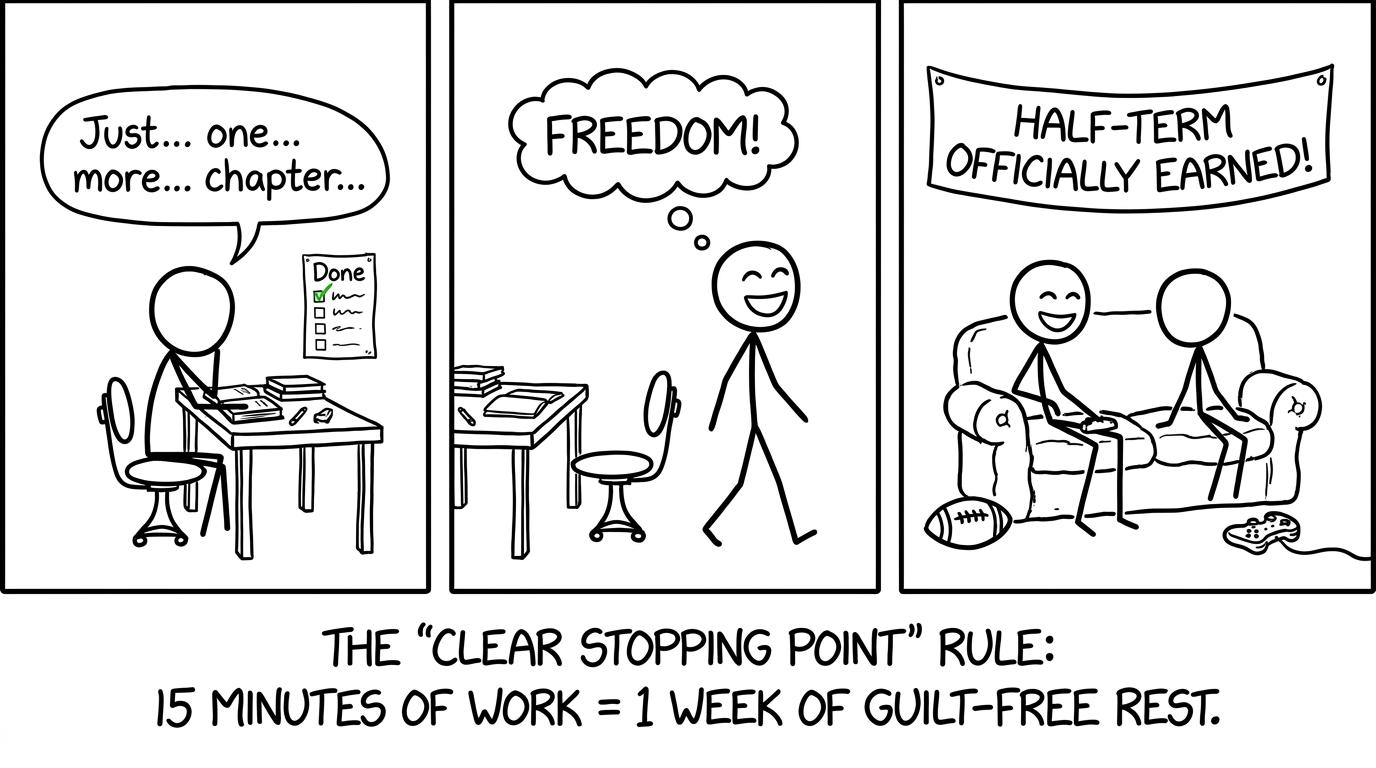 A student finishes a short revision session and returns happily to half-term
Finish half-term with proof of progress
Good half-term revision should leave behind evidence: questions attempted, errors corrected, formulae retrieved and a smaller list of weaknesses. It should not leave you feeling that every free hour belonged to an exam.
Choose three priorities today and schedule the first short session. For the numerical side of Business, use MathsGenie's free revision lessons and practice questions to strengthen percentages, ratio, averages and graphs. Then apply those skills in your board's Business questions and check your reasoning carefully.
As the maths exams approach, move from topic practice to MathsGenie's mini tests, GCSE topic and tier guidance, past papers, predicted papers, mark schemes and video solutions. The goal is not to revise all day. It is to make each finished session change what you can do.











