

GCSE Business Grade 5 Meaning: A Strong Pass
GCSE business grade 5 meaning explained: discover what this strong pass shows, how it compares with old grades and which skills can raise your result.

A result can look precise while still feeling mysterious. You open the envelope, see a grade 5 and immediately wonder whether it is good, average or enough for what comes next.
The GCSE business grade 5 meaning is straightforward at its core: in England, a grade 5 is officially described as a strong pass. It sits above the grade 4 standard pass and is broadly comparable with the upper part of the old grade C and the lower part of the old grade B. It suggests that you have demonstrated sound business knowledge and can often apply it, analyse information and reach supported judgements.
But a grade is a summary, not a complete diagnosis. Understanding what lies behind it is much more useful than attaching a label to it.
Grade 5 at a glance
- A grade 5 is a strong pass in the English GCSE grading system.
- It is higher than grade 4, which is the standard pass.
- It broadly occupies the space between a high old grade C and a low old grade B.
- It does not correspond perfectly to one old letter grade.
- It normally reflects a secure overall performance, rather than mastery of every topic.
- The number of marks required changes between exam boards and exam series.
- GCSE Business is not divided into foundation and higher tiers.
- Strong numerical interpretation can support marks in finance, marketing and data-response questions.
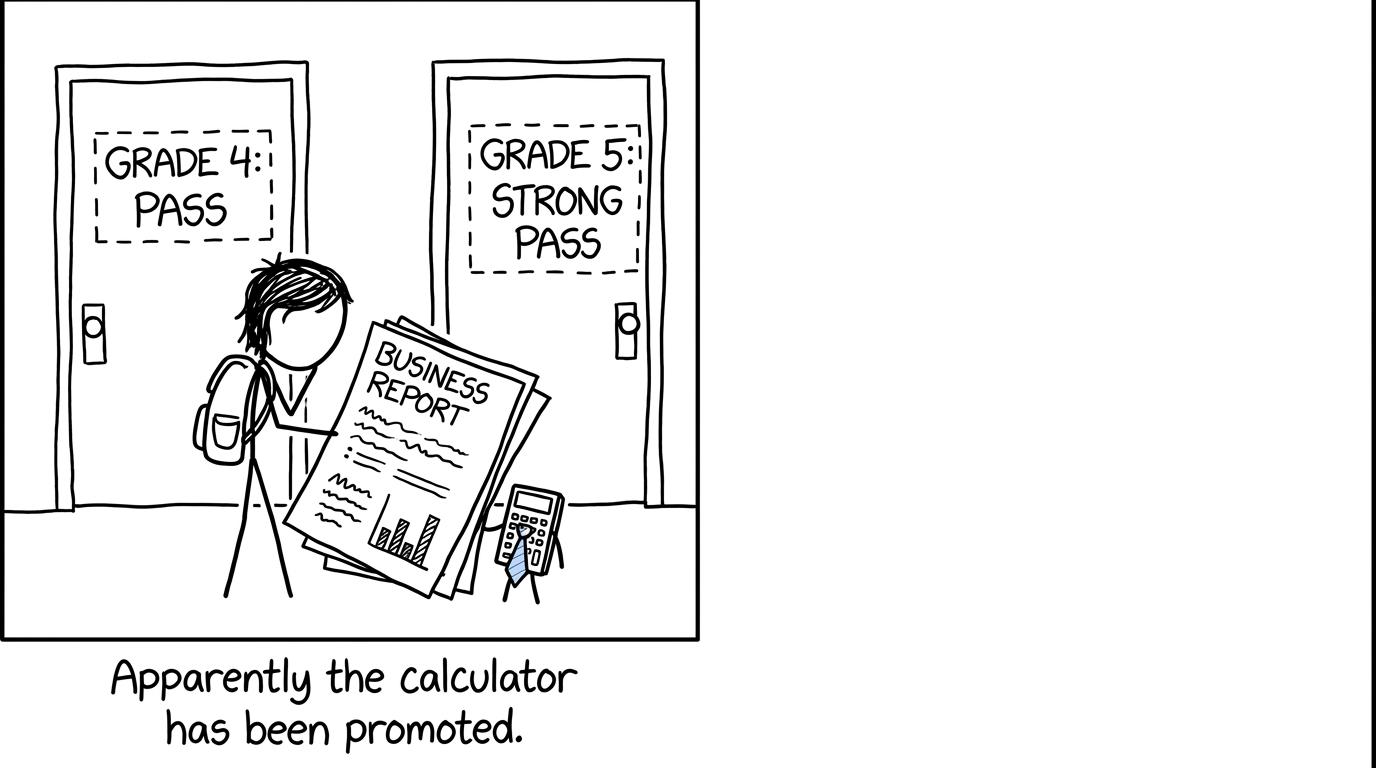 A student discovers that even the calculator has earned a promotion
What does a grade 5 in GCSE Business actually represent?
A grade 5 indicates that your total mark reached the grade 5 boundary set for that examination series. Grade boundaries are determined after the papers have been taken and marked, so there is no permanent percentage that always guarantees this grade.
That matters. A paper may be more demanding in one year than another, and boundaries can move to maintain comparable standards. Your exam board, whether AQA, Edexcel, OCR or Eduqas, publishes the relevant boundaries when results are released.
A grade 5 therefore represents a standard of attainment, not a fixed percentage of correct answers.
In practical terms, a student working around this level will commonly be able to:
- recall and explain important business terms and concepts;
- apply knowledge to a business described in a case study;
- interpret tables, charts and financial information;
- develop some logical chains of analysis;
- recognise advantages, disadvantages and business consequences;
- make decisions supported by evidence;
- complete many routine business calculations accurately.
This is not an official promise that every grade 5 student can perform every skill equally well. GCSE grades are based on the combined mark across the qualification. One student may be particularly strong in finance but less secure in extended evaluation, while another may write convincing arguments but lose marks through numerical errors.
Is a grade 5 equivalent to a B or a C?
The most accurate answer is: roughly a high C or low B, but not exactly either.
When England moved from letter grades to the grades 9-1 scale, only certain points were formally aligned. The bottom of grade 7 was aligned with the bottom of the old grade A, the bottom of grade 4 with the bottom of the old grade C, and the bottom of grade 1 with the bottom of the old grade G.
There is no exact official statement that every grade 5 is identical to a particular old letter grade. The broad comparison looks like this:
| Current grade | Broad comparison with old grades | Description |
|---|---|---|
| Grade 7 | Bottom aligned with old grade A | Strong achievement |
| Grade 6 | Broadly within old grade B territory | Above a strong pass |
| Grade 5 | High C to low B | Strong pass |
| Grade 4 | Bottom aligned with old grade C | Standard pass |
| Grade 1 | Bottom aligned with old grade G | Lowest numbered grade |
The distinction is worth keeping. Calling a grade 5 simply “a B” makes the comparison sound more exact than it is. The reformed qualification and grading scale were not created by merely renaming every letter.
What separates a grade 5 from a grade 4?
The official distinction is that grade 4 is a standard pass, while grade 5 is a strong pass. In the exam itself, however, there is no special set of grade 5 questions. Your final grade comes from the total number of marks earned across the papers.
Moving from grade 4 towards grade 5 often depends on accumulating marks in several places:
- using business terminology accurately rather than vaguely;
- applying each answer to the organisation in the case study;
- explaining consequences instead of listing disconnected points;
- using numerical evidence to support an argument;
- giving a justified conclusion when evaluation is required;
- avoiding preventable calculation and reading errors.
Knowledge gets an answer started. Application and reasoning make it valuable.
For example, recognising that rising costs may reduce profit shows knowledge. A stronger response identifies the relevant cost in the case study, explains how it affects the particular business and considers whether the impact depends on factors such as pricing, demand or competitors. This is an illustration of answer quality, not a worked examination question.
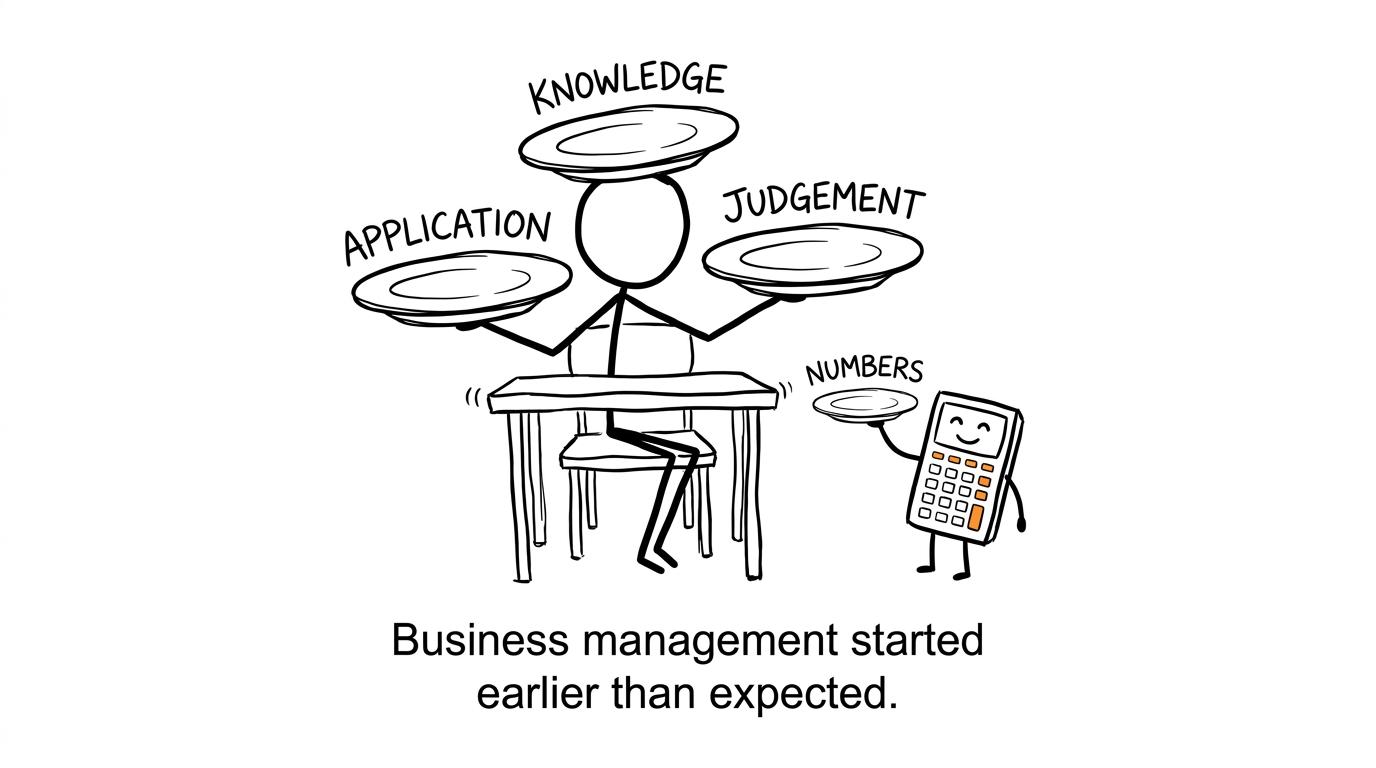 A GCSE student balances knowledge, application, judgement and numbers
The abilities behind a strong pass
Knowledge that can be used
GCSE Business specifications cover connected areas such as business activity, external influences, operations, human resources, marketing and finance. A grade 5 student should know many of the central concepts, but recall alone is not enough.
Examiners also reward selecting relevant knowledge. A long paragraph containing everything you remember may earn less than a shorter answer built around the exact business, decision and command word.
Application to context
Case-study details are not decoration. They tell you which knowledge matters.
Useful application might refer to the business's size, product, market, ownership, customers, finances or objective. Repeating the company name does not automatically demonstrate application; the detail must affect the reasoning.
Analysis and supported judgement
Analysis explains a chain of consequences. Evaluation weighs evidence and reaches a supported decision. At grade 5 level, these skills may be present but not completely consistent across every extended response.
A useful self-check is to ask:
- Have I explained why the point matters?
- Have I connected it to the case?
- Have I used evidence?
- Have I considered what the answer depends on?
- Does my conclusion actually answer the question?
Why maths matters in GCSE Business
Official GCSE Business specifications require quantitative skills. Across the major exam boards, at least part of the assessment involves calculations or interpreting numerical and graphical data. The purpose is not to test advanced algebra; it is to see whether you can use numbers to understand a business decision.
Important relationships include:
profit=revenue−total costs\text{profit}=\text{revenue}-\text{total costs}profit=revenue−total costs percentage change=changeoriginal value×100\text{percentage change}=\frac{\text{change}}{\text{original value}}\times 100percentage change=original valuechange×100 gross profit margin=gross profitrevenue×100\text{gross profit margin}=\frac{\text{gross profit}}{\text{revenue}}\times 100gross profit margin=revenuegross profit×100Depending on your specification, you may also need to interpret cash flow, market share, break-even information, averages, ratios, graphs or investment data. Always follow the formulae and terminology required by your own exam board.
The calculation is only the first layer. You may then need to explain what the result means for costs, profit, liquidity, customers or a proposed decision. MathsGenie's GCSE Business interpretation guide explains how to move from numerical evidence to business meaning and judgement.
If the arithmetic feels less secure than the business content, revisit the free GCSE maths revision hub. The percentages revision lesson and Stage 4 number practice are particularly relevant to many business calculations.
How to move beyond a grade 5
The leap to a higher grade is rarely about writing twice as much. It is usually about making more of each sentence and losing fewer routine marks.
Diagnose the marks you are losing
After completing an assessed question or paper, place each lost mark into one of four categories:
- missing knowledge;
- weak application;
- incomplete analysis or evaluation;
- calculation or exam-technique error.
This turns “I need to improve Business” into a manageable instruction. If most losses come from calculations, use targeted maths practice. If they come from evaluation, compare your conclusions with the mark scheme and identify what evidence was missing.
Practise retrieval and application together
Do not revise a definition and assume the job is finished. Recall the concept, then ask where it would matter, which stakeholder it could affect and what evidence might support a judgement.
For the numerical foundations, MathsGenie's guide to the best order for learning GCSE maths topics can help you strengthen percentages, ratio, graphs and statistics without jumping randomly between skills.
Use timed practice carefully
Timed work reveals whether you can produce clear reasoning under pressure. Mark it honestly, correct it and revisit the same weakness later. The approach in MathsGenie's guide to starting GCSE past papers is equally useful here: diagnose first, repair gaps and then increase the amount of full-paper practice.
A simple GCSE revision timetable can also prevent Business calculations and maths revision from becoming separate last-minute problems.
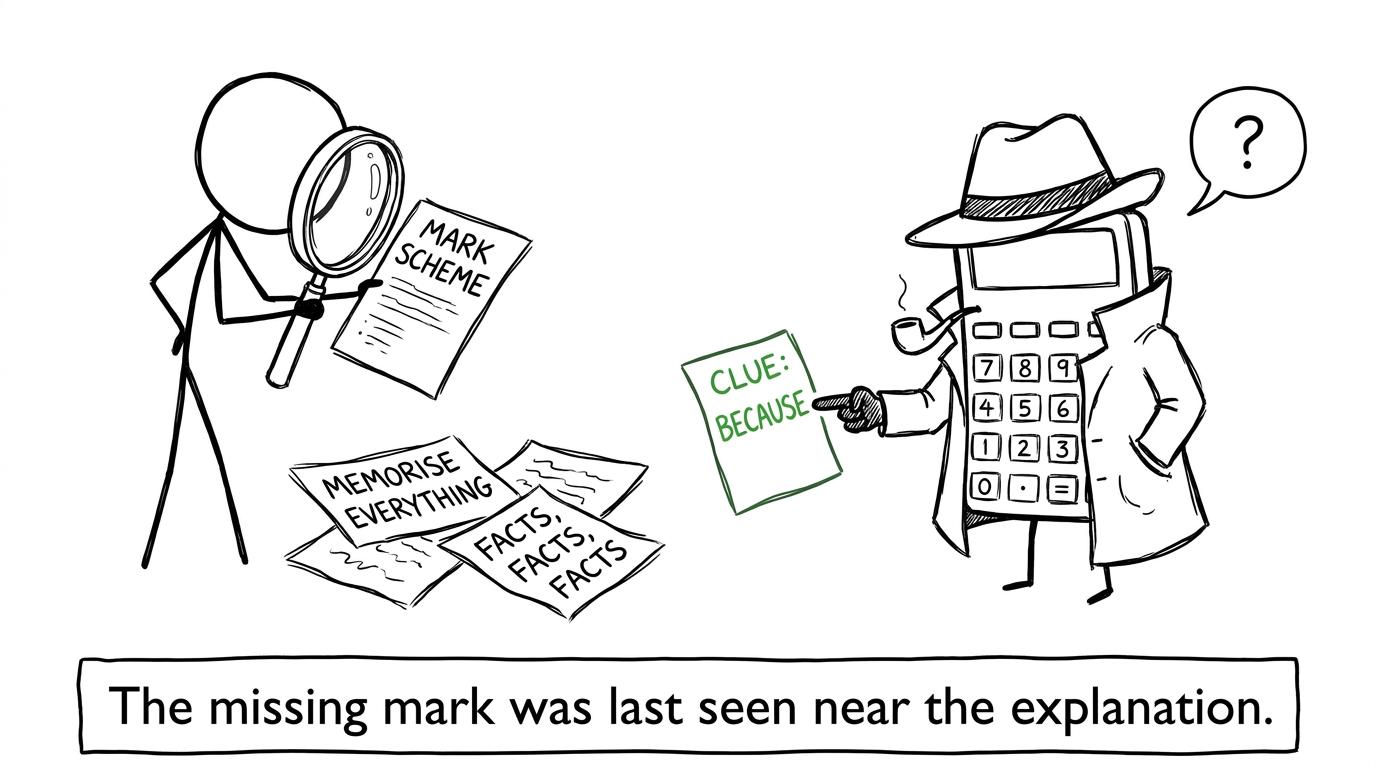 A student investigates the mysterious disappearance of an explanation mark
Common mistakes when interpreting or aiming for grade 5
Treating grade 5 as an exact old grade B
It is more accurate to describe it as a strong pass spanning broadly high C to low B territory. The two grading scales do not have a perfect one-to-one conversion.
Assuming one percentage always earns the grade
Grade boundaries vary by exam board and examination series. Use the official boundary for the exact qualification and year rather than a percentage found in an old discussion or unrelated paper.
Believing the grade proves equal strength everywhere
A grade 5 is based on the overall mark. It does not show whether finance, marketing, application or evaluation was your strongest area.
Memorising without applying
Definitions can earn marks, but case-study questions require context. Select details that change the likely effect or decision.
Calculating without interpreting
A correct figure may answer only part of a question. Explain what it shows and why it matters to the business.
Revising by rereading alone
Recognition feels comfortable but can exaggerate confidence. Retrieval, practice questions and mark schemes show whether the knowledge is available when the page is blank.
Make the grade a starting point
A grade 5 in GCSE Business is a meaningful achievement: it is a strong pass and broadly sits between the upper old grade C and lower old grade B. It suggests secure knowledge and a developing ability to apply concepts, analyse business information, use quantitative evidence and make supported judgements.
It also tells you where the next opportunity lies. Better application, fuller reasoning and more reliable calculations can turn small mark gains into a different final grade.
Use MathsGenie as your free revision base. Strengthen the numerical skills Business depends on through revision lessons and practice questions, then test them with GCSE predicted papers, past papers, mini tests, mark schemes and video solutions. A grade summarises the paper you have completed. Good revision changes the one still ahead.











