

GCSE Biology vs the Alternative Option Grade Boundaries
GCSE biology vs the alternative option grade boundaries explained using 2025 data, fair comparisons and practical advice for choosing your target grade.
A grade boundary can look like a shortcut. If one subject appears to require fewer marks, it is tempting to call it the easier choice and move on. But GCSE biology vs the alternative option grade boundaries is not a comparison that raw marks alone can settle.
Here, the “alternative option” means Combined Science, the usual alternative to taking separate GCSEs in Biology, Chemistry and Physics. The short answer is that Combined Science often had lower percentage thresholds at several comparable grade levels in the June 2025 boundaries. That does not automatically make its boundaries more generous. It has different content, papers, total marks and grading arrangements, while boundaries adjust for paper difficulty.
The useful question is not simply, “Which boundary is lower?” It is, “Which course gives me the best chance of producing the standard of work needed for my target grade?”
The comparison at a glance
Before using any boundary table, check:
- whether you take separate Biology or Combined Science
- your exam board, such as AQA, Pearson Edexcel, OCR or Eduqas
- whether you sit foundation or higher tier
- the maximum mark for the complete qualification
- whether your target is a single Biology grade or a Combined Science double grade
- whether the figures come from the correct exam series
At the time of writing, June 2025 provides the latest confirmed summer boundaries. Boundaries for a future series cannot be known in advance because exam boards set them after the papers have been taken and marking is nearly complete.
You can inspect the detailed figures through MathsGenie’s GCSE Biology grade boundary guide and Combined Science marks per grade comparison.
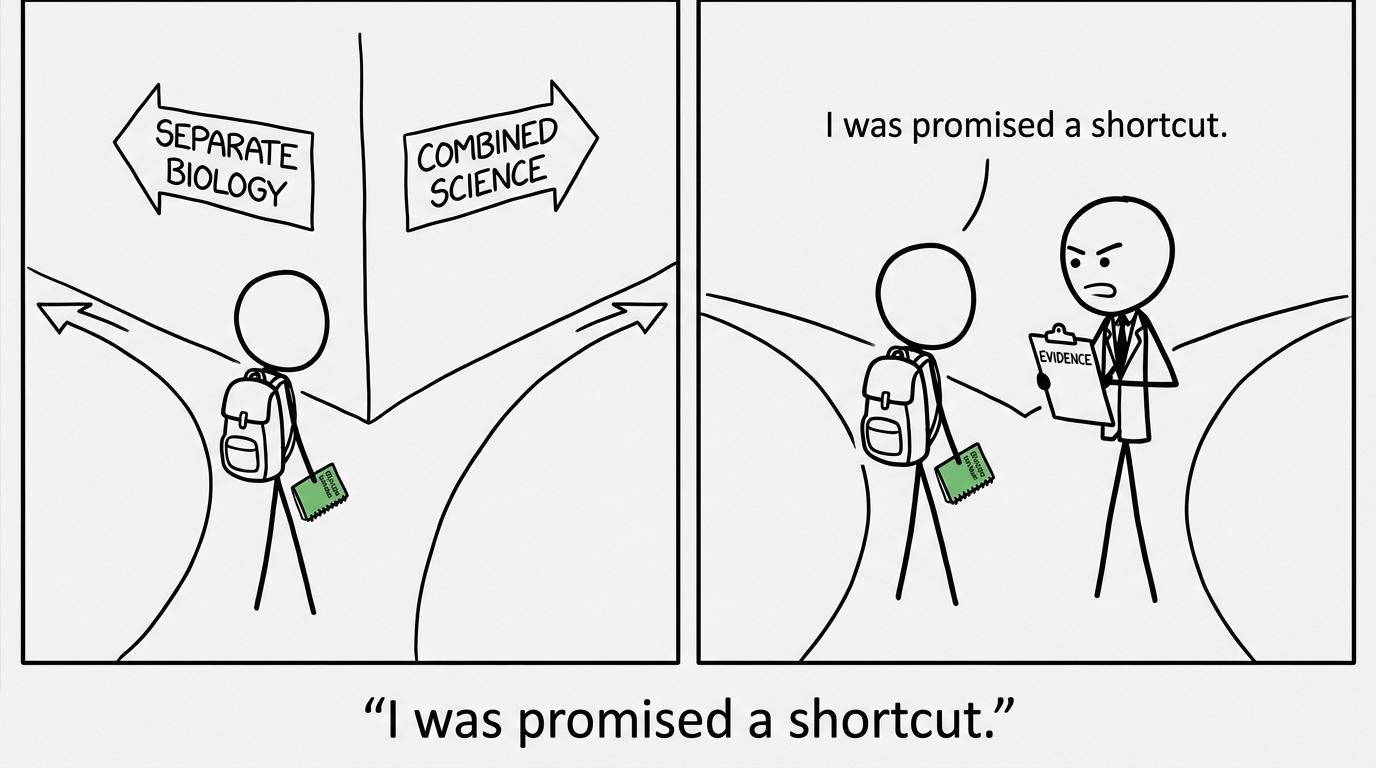 A student discovers that both science routes still lead to an examiner
Separate Biology and Combined Science are not equivalent qualifications
Separate science students receive individual GCSE grades for Biology, Chemistry and Physics. Their Biology result depends on their marks across the complete Biology qualification.
Combined Science is worth two GCSEs and produces a double grade, such as $7$-$7$, $6$-$5$ or $4$-$4$. Marks from biology, chemistry and physics contribute to the overall result. There is no separate certificated Biology grade within Combined Science.
This distinction changes the meaning of the boundary. A separate Biology grade 777 measures performance across Biology papers. A Combined Science grade $7$-$7$ reflects performance across all three sciences.
Separate Biology also contains additional subject content. For example, AQA identifies material in its Biology specification as “biology only”, while much of the course remains common with Combined Science. More content can mean more revision, but it may also suit a student who enjoys Biology and performs more strongly in it than in Chemistry or Physics.
Combined Science creates a different trade-off: stronger marks in one science can compensate for weaker marks elsewhere, but weak performance in another science can also pull down the double grade.
What the June 2025 boundaries show
Raw marks should first be converted into percentages:
Boundary percentage=boundary markmaximum mark×100\text{Boundary percentage}=\frac{\text{boundary mark}}{\text{maximum mark}}\times 100Boundary percentage=maximum markboundary mark×100This does not make the qualifications identical. It simply avoids comparing totals with different maximum marks.
AQA higher-tier comparison
The June 2025 AQA Biology qualification had a maximum of 200200200 marks. AQA Combined Science: Trilogy had a maximum of 420420420 marks.
| Target | Separate Biology boundary | Boundary percentage | Combined Science boundary | Boundary percentage |
|---|---|---|---|---|
Grade 999 or $9$-$9$ | 141141141 out of 200200200 | 70.5%70.5\%70.5% | 299299299 out of 420420420 | 71.2%71.2\%71.2% |
Grade 777 or $7$-$7$ | 113113113 out of 200200200 | 56.5%56.5\%56.5% | 228228228 out of 420420420 | 54.3%54.3\%54.3% |
Grade 444 or $4$-$4$ | 565656 out of 200200200 | 28.0%28.0\%28.0% | 969696 out of 420420420 | 22.9%22.9\%22.9% |
At the grade 777 and grade 444 reference points, the Combined Science percentage was lower. At the very top, however, separate Biology required a slightly lower percentage than Combined Science $9$-$9$.
That is already enough to challenge the idea that one route always has more generous boundaries. The answer changes with the target grade.
For the full data, see the AQA Combined Science grade boundaries and MathsGenie’s AQA Biology results-day guide.
Pearson Edexcel higher-tier comparison
Pearson Edexcel’s June 2025 separate Biology total was 200200200 marks, while Combined Science was worth 360360360 marks.
| Target | Separate Biology boundary | Boundary percentage | Combined Science boundary | Boundary percentage |
|---|---|---|---|---|
Grade 999 or $9$-$9$ | 167167167 out of 200200200 | 83.5%83.5\%83.5% | 284284284 out of 360360360 | 78.9%78.9\%78.9% |
Grade 777 or $7$-$7$ | 144144144 out of 200200200 | 72.0%72.0\%72.0% | 227227227 out of 360360360 | 63.1%63.1\%63.1% |
Grade 444 or $4$-$4$ | 848484 out of 200200200 | 42.0%42.0\%42.0% | 107107107 out of 360360360 | 29.7%29.7\%29.7% |
For these Edexcel reference grades, Combined Science had the lower percentage threshold. Yet “lower” still does not mean “easier”. The papers, content and candidates were different, and Combined Science performance had to be sustained across all three sciences.
MathsGenie keeps the original figures together on its Edexcel GCSE Biology grade boundaries and Edexcel GCSE Combined Science grade boundaries pages.
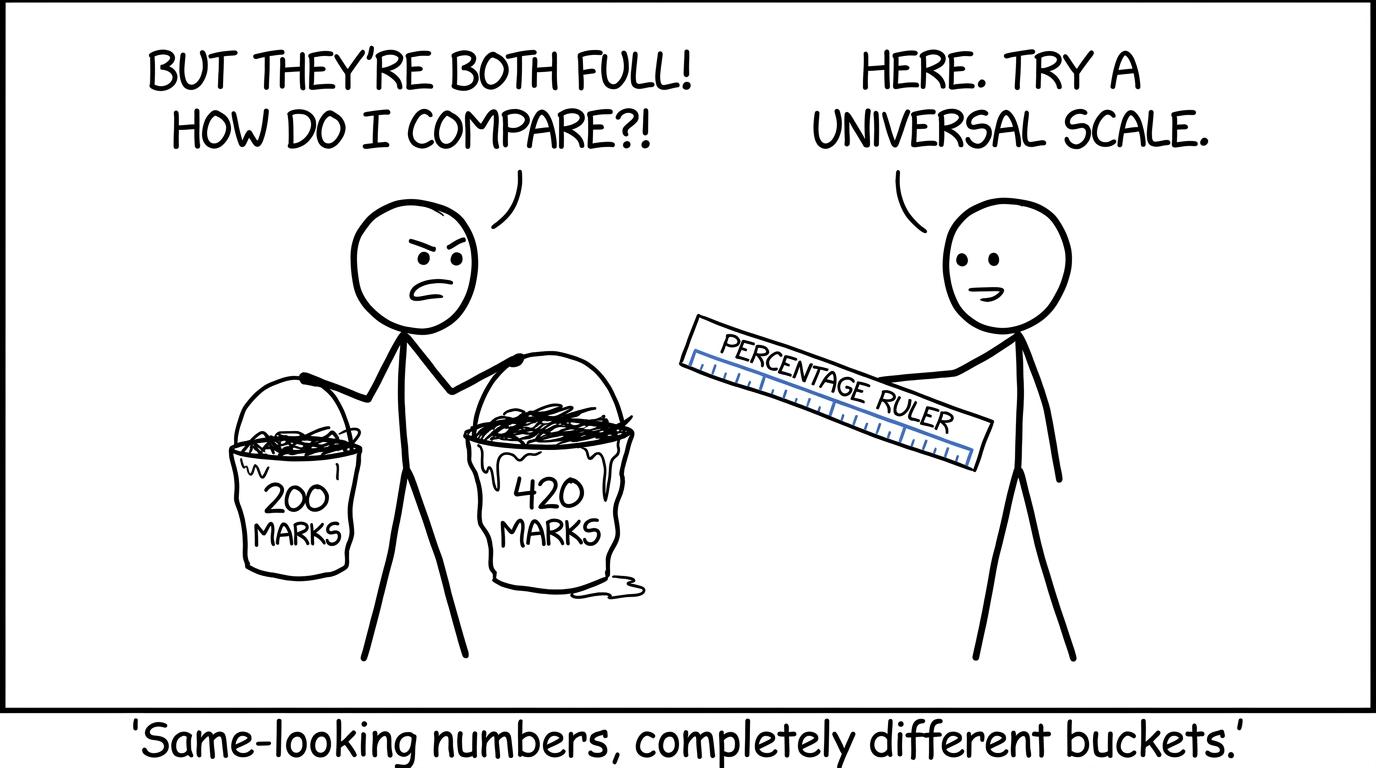 Two students attempt to compare grade boundaries measured using different-sized buckets
Does Combined Science have more generous boundaries?
In raw percentage terms, the June 2025 figures above often make Combined Science look more generous, particularly around middle grades. That is the most direct answer the historical data allows.
But Ofqual’s grading principle matters: a lower boundary usually reflects a more demanding paper or qualification assessment, not an easier route to the grade. Boundaries are adjusted so that the standard of work represented by a grade remains comparable over time. A higher boundary can simply mean students found that paper more accessible.
There are three further reasons to be cautious.
The candidate groups differ
Students entered for separate sciences are not necessarily the same type of cohort as students entered for Combined Science. Their prior attainment, teaching time and subject preferences may differ. Boundary percentages therefore describe an outcome, not the cause of that outcome.
Combined Science averages performance across subjects
Suppose Biology is comfortably your strongest science. Separate Biology allows that strength to appear as its own grade. In Combined Science, Biology contributes to a double grade alongside Chemistry and Physics.
The opposite is also true. If Biology is weaker but Chemistry and Physics are secure, Combined Science may give you useful compensation across the qualification.
Boundaries move every year
MathsGenie’s AQA Biology boundary history shows that thresholds have changed between exam series. Historical figures are helpful for setting practice ranges, but they are not a promise about the next paper.
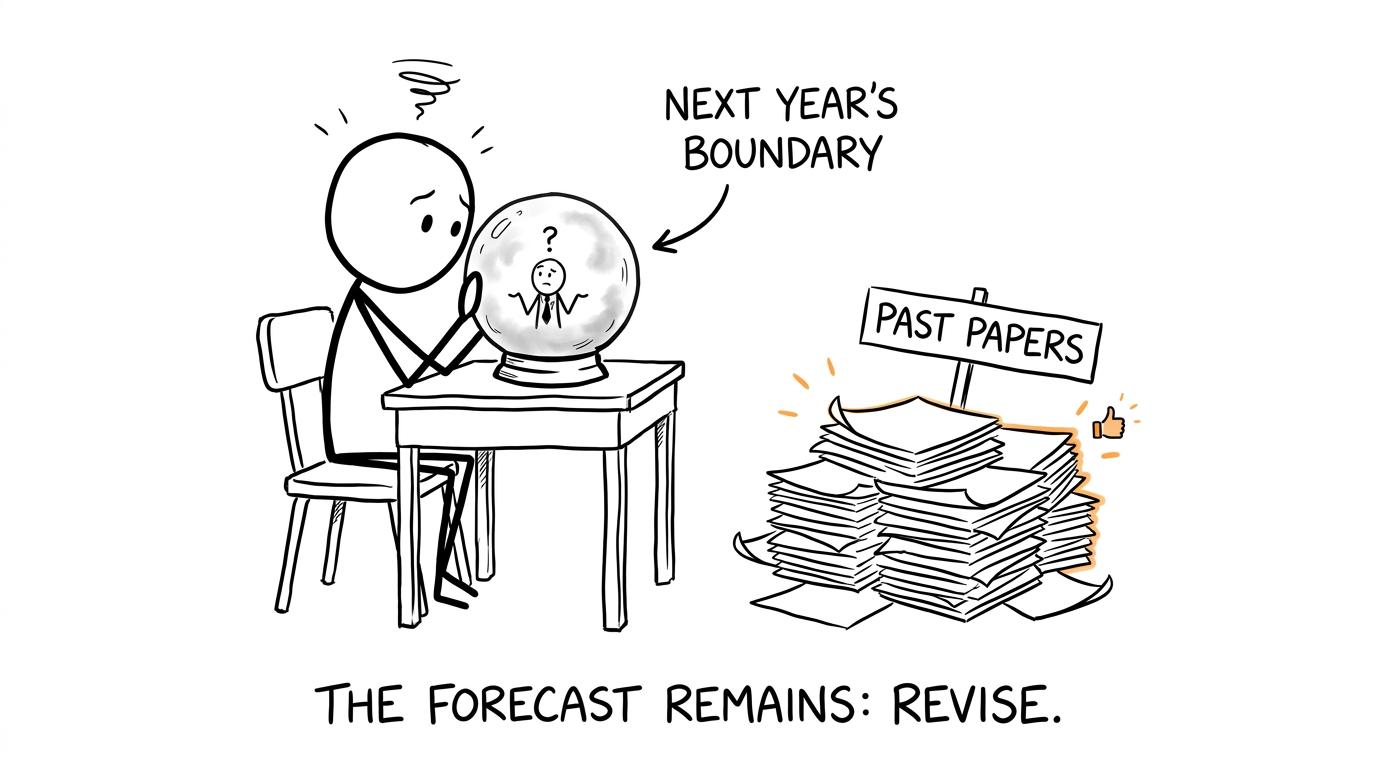 A crystal ball fails to predict next year's boundary while the past-paper pile waits patiently
What the comparison means for your target grade
Treat the published boundary as a reference point, not as the score you should aim to scrape.
If a historical boundary is bbb marks, choose a safety margin of sss marks and use:
practice target=b+s\text{practice target}=b+spractice target=b+sThe right margin depends on the length of the qualification and the consistency of your scores. Rather than trusting one unusually strong paper, record several attempts and look at your typical result.
If your target is grades 777 to 999
You need higher-tier access and reliable performance on demanding questions. Separate Biology may suit you if Biology is a clear strength and you are willing to learn its additional content. Combined Science may suit you if your results are balanced across all three sciences.
Do not choose solely because a previous $7$-$7$ percentage was lower than the separate Biology grade 777 percentage. Your grade will come from the standard of your answers on your own papers.
If your target is grades 444 to 555
Tier decisions become especially important. Foundation tier usually makes grades up to 555 available, while higher tier offers access to the top grades but has different lower-grade rules. Your school should use evidence from assessments when deciding the appropriate tier.
For a secure target, practise well above one historical threshold and pay attention to recurring losses: command words, practical methods, calculations, units and extended explanations.
Use your maths skills to interpret progress
Science grade data rewards the same habits that improve GCSE maths: percentages, averages, proportional reasoning and honest error analysis. Keep your maths preparation moving alongside science with GCSE Maths past papers and mark schemes. Nearer the exams, Edexcel GCSE Maths predicted papers can provide fresh timed practice, but they should never replace official past papers.
Common mistakes when comparing the options
Comparing raw totals directly
A boundary of 228228228 may look much higher than 113113113, but the maximum marks are also different. Convert both to percentages before drawing even a cautious comparison.
Treating $7$-$7$ as a Biology grade 777
A Combined Science double grade covers biology, chemistry and physics. It is not a separate statement of Biology attainment.
Mixing exam boards or specifications
AQA, Edexcel, OCR and Eduqas papers are constructed and marked differently. Even OCR Biology A and Biology B require the correct specification table. Check the subject code as well as the board name.
Using one paper’s notional boundary as the final boundary
Individual-paper boundaries may be published for illustration, but the certificated result normally depends on the total qualification mark. Add the correct components and use the overall subject boundary.
Predicting the next boundary exactly
No revision website, teacher or social-media post can know a future boundary before awarding takes place. Use past thresholds as broad planning information, then aim for the highest mark you can produce.
Choose evidence over the illusion of an easy route
The June 2025 data suggests that Combined Science often had lower percentage boundaries at comparable grade labels, although not at every reference point. That makes it look more generous on paper. It does not prove that Combined Science is easier to pass or the better choice for you.
Your stronger route depends on your performance profile, your interest in Biology, your results across Chemistry and Physics, and the grades you need for sixth form, college or future study. Ask your school which course and tier you are entered for, then build a target from several properly marked papers rather than one boundary table.
MathsGenie can help you apply the same disciplined approach to maths. Start with revision lessons and focused practice questions, check understanding through mini tests, then move into timed past papers. Use mark schemes and video solutions to diagnose lost marks, add predicted papers when you need fresh exam-style practice, and organise the process with a clear revision plan. Boundaries move. Well-practised methods travel with you.











