

GCSE Biology: No Background Knowledge?
GCSE biology no background knowledge? It can be realistic if your school permits it. Learn what to catch up, which maths matters, and how to revise quickly.

Starting a subject late can feel like arriving halfway through a film. Everyone else seems to know the characters, the vocabulary and why mitochondria matter. You are still trying to find your seat.
The reassuring answer for anyone searching GCSE biology no background knowledge is that starting without the usual foundation can be realistic, if your school permits it and you have enough time to cover the specification properly. You do not normally need a previous biology qualification, but GCSE Biology builds on ideas usually taught at Key Stage 3. You must therefore replace that missing foundation deliberately rather than hoping it will appear along the way.
Your first step should be to speak to your science teacher or examinations officer. Schools decide which courses students can join, and a late entry may depend on timetabling, practical work, available teaching and the exam board being used.
The short answer and your starting checklist
Before committing, check the following:
- School permission: confirm that your school will teach and enter you for the qualification.
- Qualification route: find out whether you would take separate GCSE Biology or biology as part of Combined Science.
- Exam board: ask whether the specification is AQA, Edexcel, OCR or Eduqas.
- Time available: list the topics already taught and the practical work you have missed.
- Maths readiness: check percentages, ratios, averages, graphs, standard form, units and simple algebra.
- Support: identify where you will get lessons, questions, feedback and practical guidance.
Do not begin by reading a textbook from cover to cover. Start with the specification, identify the gaps and build a manageable recovery plan.
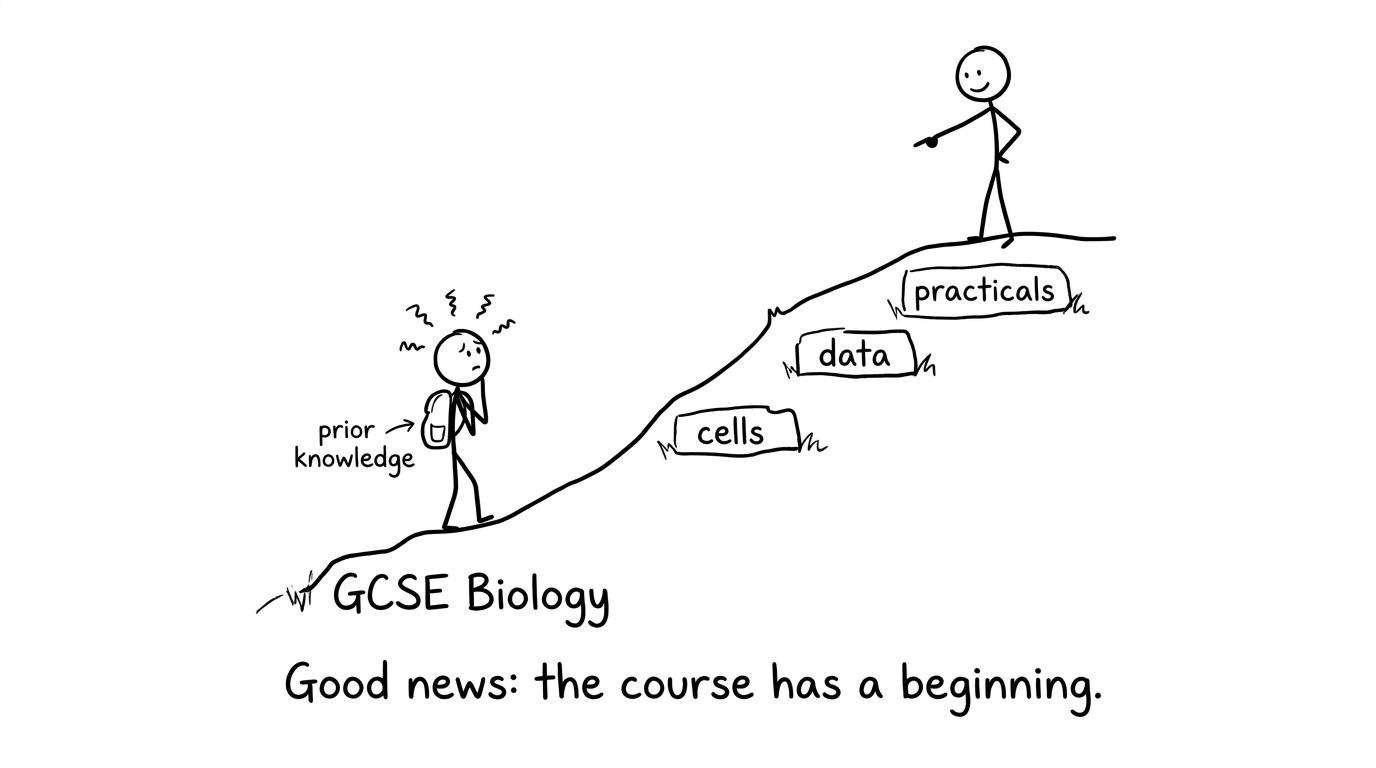 A student discovers that GCSE Biology has a beginning
Is GCSE Biology designed for complete beginners?
Not exactly, but neither is it reserved for students who already know the course.
Current specifications are designed to develop the biology normally encountered at Key Stage 3. Some exam-board specifications explicitly state that there are no previous qualification or learning requirements, while also explaining that schools and colleges may set their own entry conditions. Pearson Edexcel similarly describes its qualification as building on Key Stage 3 subject content.
This distinction matters. A formal prerequisite is not the same as useful prior knowledge. You may be allowed to begin without an earlier qualification, but familiarity with cells, organisms, reproduction, ecosystems and basic scientific investigation will make the transition easier.
If you are starting at the beginning of the GCSE course, catching up is usually much more realistic than joining shortly before the exams. A late starter must cover content while also learning how to apply it, analyse data and answer practical questions.
Separate Biology or Combined Science?
Ask which route your school offers. Separate Biology leads to an individual GCSE grade and contains more biology content. Combined Science includes biology, chemistry and physics and produces two GCSE grades.
Neither route should be chosen merely because one sounds more impressive. The right route is the one your school can support and that gives you enough teaching time to understand the complete specification.
What background knowledge should you rebuild first?
Biology becomes easier when its central ideas are connected. Facts that seem unrelated begin to form a system.
Prioritise these foundations:
- cell structures and the functions of important organelles;
- movement of substances by diffusion, osmosis and active transport;
- organisation from cells to tissues, organs and organ systems;
- enzymes and the factors affecting their activity;
- photosynthesis and respiration;
- reproduction, inheritance and variation;
- ecosystems, food relationships and nutrient cycles;
- variables, controls, sampling, accuracy and repeatability.
The precise organisation and wording vary by exam board, so use your own specification as the master checklist. Do not revise from a general list and assume every detail matches your paper.
A useful sequence is cells first, processes second, whole organisms third, inheritance and ecology afterwards. Cells underpin much of the course, while practical and data skills should be practised throughout rather than left until the end.
Why your GCSE maths preparation helps
Maths is not a side issue in Biology. Under the regulatory requirements for single-science GCSE Biology, at least 10%10\%10% of the marks assess mathematical skills. Practical knowledge and understanding account for at least 15%15\%15% of the marks across the assessments.
The mathematical demand includes decimals, ratios, fractions, percentages, estimation, significant figures, averages, probability, standard form, graphs, simple equations, area and volume. Foundation-tier mathematical questions are not set below the expected Key Stage 3 level, while higher-tier questions may use mathematics at least as demanding as foundation-tier GCSE Maths.
This is good news for students already preparing for maths exams. Much of the machinery is familiar; only the biological context changes.
Percentages, ratios and rates
Percentage change can appear when comparing mass, population size or experimental results:
percentage change=new value−original valueoriginal value×100\text{percentage change}=\frac{\text{new value}-\text{original value}}{\text{original value}}\times 100percentage change=original valuenew value−original value×100Ratios may be used in genetics, microscopy and comparisons between groups. Rates connect a measured change to time:
rate=change in quantitytime\text{rate}=\frac{\text{change in quantity}}{\text{time}}rate=timechange in quantityStrengthen these skills with MathsGenie's percentages revision guide and ratio revision guide. Focus on understanding what each number represents, not simply pressing calculator buttons.
Averages, graphs and experimental data
Biology papers frequently present information in tables, charts and graphs. You may need to identify a trend, calculate a mean, compare groups, recognise an anomaly or evaluate whether evidence supports a conclusion.
The arithmetic mean is:
mean=sum of valuesnumber of values\text{mean}=\frac{\text{sum of values}}{\text{number of values}}mean=number of valuessum of valuesUse the averages from frequency tables resources to improve data handling. When reading any scientific graph, check the axis labels, scale and units before interpreting its shape. Correlation can indicate a relationship, but it does not by itself prove that one variable caused the other.
Standard form, units and scale
Microscopy involves very small measurements, so standard form and unit conversion matter. A number in standard form is written as:
a×10nwhere 1≤a<10a\times 10^n \quad \text{where } 1\leq a<10a×10nwhere 1≤a<10Review standard form lessons and practice if negative powers or very small decimals feel unfamiliar. Always carry units through a calculation and check whether a conversion is required before substituting values.
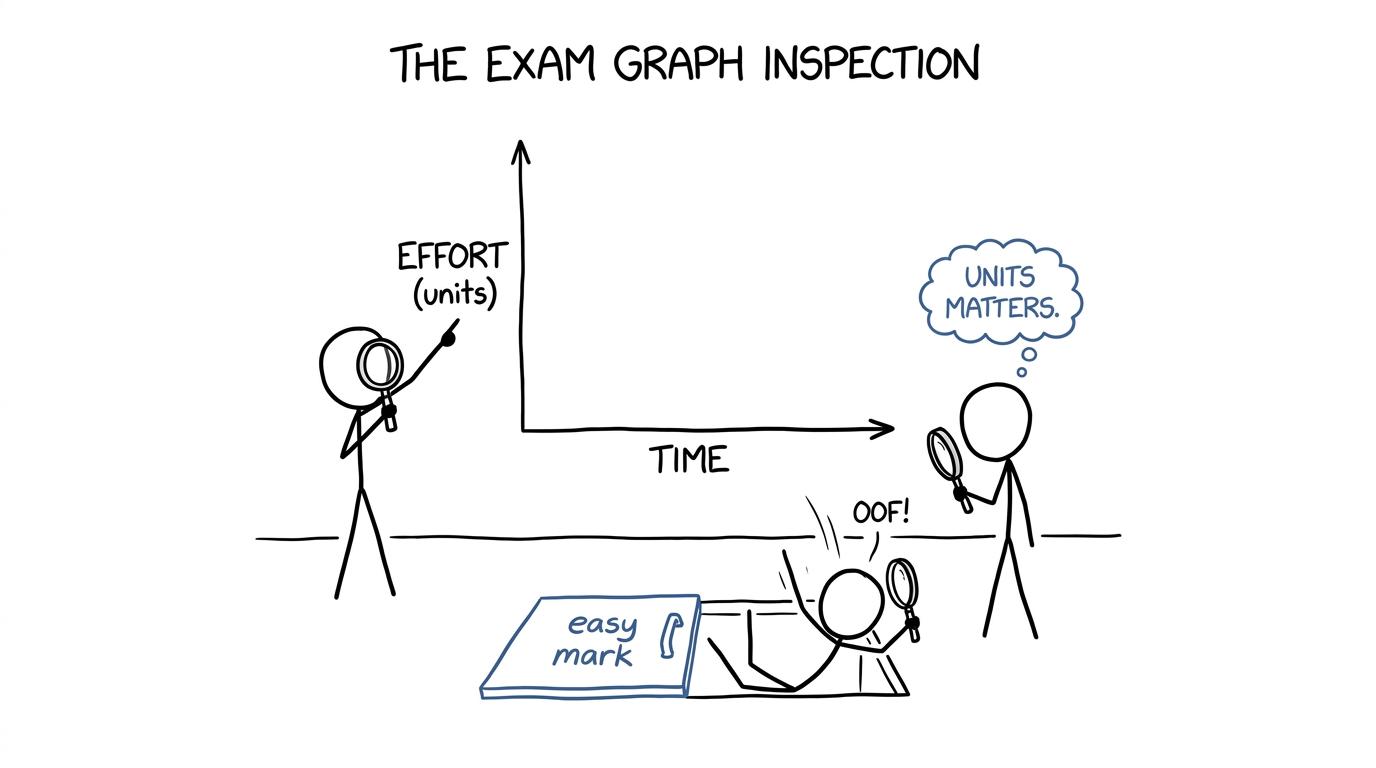 A forgotten graph unit claims another easy mark
How to catch up quickly without rushing badly
Speed does not mean trying to learn everything at once. It means shortening the distance between finding a weakness and fixing it.
Build a specification gap list
Print or save the specification for your board. Mark each statement as:
- secure;
- partly understood;
- unfamiliar.
Ask your teacher which sections have already been covered and which practical activities you need to address. For single GCSE Biology, awarding organisations require students to complete or observe at least eight specified practical activities. Written examinations assess knowledge and understanding of practical work, so watching a generic experiment online is not a complete substitute for the opportunities your school must provide.
Use short learn, recall, question cycles
For each small topic:
- learn the core idea from a lesson or concise source;
- close the source and recall the process from memory;
- answer specification-matched questions;
- mark the answers immediately;
- record one precise correction for each error;
- return to the same idea later without notes.
This is more useful than producing beautiful notes that never test whether you can retrieve or apply the knowledge.
 A student accidentally turns Biology revision into habitat construction
Protect your maths revision time
If you are preparing for both GCSE Maths and Biology, do not allow the new subject to consume every evening. Instead, use overlapping skills efficiently. A MathsGenie session on percentages, graphs or standard form can support both qualifications.
Use the GCSE Maths revision hub to choose the correct exam board and tier. Revision lessons rebuild methods, topic questions reveal weak spots, and video solutions help you see exactly where your reasoning changed direction.
The article on the best order for learning GCSE maths topics can also help if your numerical foundation needs wider repair. Keep the plan narrow enough to follow consistently.
Common mistakes when starting Biology late
Treating the course as a vocabulary test
Definitions matter, but examinations also assess application and analysis. Current single-science assessment objectives give substantial weight to applying knowledge and interpreting evidence, not only recalling facts. Practise unfamiliar contexts as soon as you know the underlying idea.
Ignoring practical work until the final weeks
Practical questions can test variables, apparatus, measurements, risks, errors and improvements. Keep a concise record of each required practical, including its purpose, variables, method, expected pattern and limitations.
Revising from the wrong specification
AQA, Edexcel, OCR and Eduqas cover nationally required content, but their organisation, terminology and practical requirements are not identical. Confirm your board and qualification code before downloading resources.
Copying the mark scheme instead of diagnosing the error
A correction should explain why your answer lost marks. Was the biology wrong, was the command word missed, or did a calculation use the wrong denominator? This turns feedback into a future decision.
Attempting full papers too early
A paper filled with untouched topics tells you little beyond the fact that you have not learnt them yet. Begin with topic questions and shorter tests. Move to full papers once most of the specification is familiar. Maths students can use the same principle when deciding when to start GCSE past papers.
A realistic decision
Taking GCSE Biology without the usual background is possible for many students, but permission and feasibility are separate questions. Your school must be able to support the correct course, practical opportunities and examination entry. You must have enough time to learn the content, retrieve it accurately and apply it to unfamiliar evidence.
Ask for an honest gap assessment. Then complete a short block of cells, practical skills and biological maths. If you can follow the routine consistently and obtain teaching support, the missing background becomes a list of learnable topics rather than a permanent disadvantage.
MathsGenie can strengthen the numerical side of that journey. Begin with the free GCSE Maths revision resources, practise weak skills through topic questions and mini tests, then use past papers, predicted papers, mark schemes and video solutions to make your progress visible. Background knowledge helps, but a clear sequence and honest feedback are what turn catching up into moving forward.










