

GCSE Biology Last-Minute Revision Plan: 3 Days
GCSE biology last minute revision plan for three calm, focused days. Prioritise key topics, practical skills, recall and exam questions without panic.
The exam has not moved. But somehow it feels as though it has sprinted towards you.
If that is where you are, this GCSE biology last minute revision plan gives you a calm answer: spend the next three days diagnosing gaps, retrieving essential knowledge, practising exam questions and correcting mistakes. Do not attempt to rewrite the textbook. Your job is to make the knowledge you already have easier to recall and apply.
Three days cannot replace a full revision programme. They can still be used intelligently. Panic encourages motion without direction; a short plan gives every session a purpose.
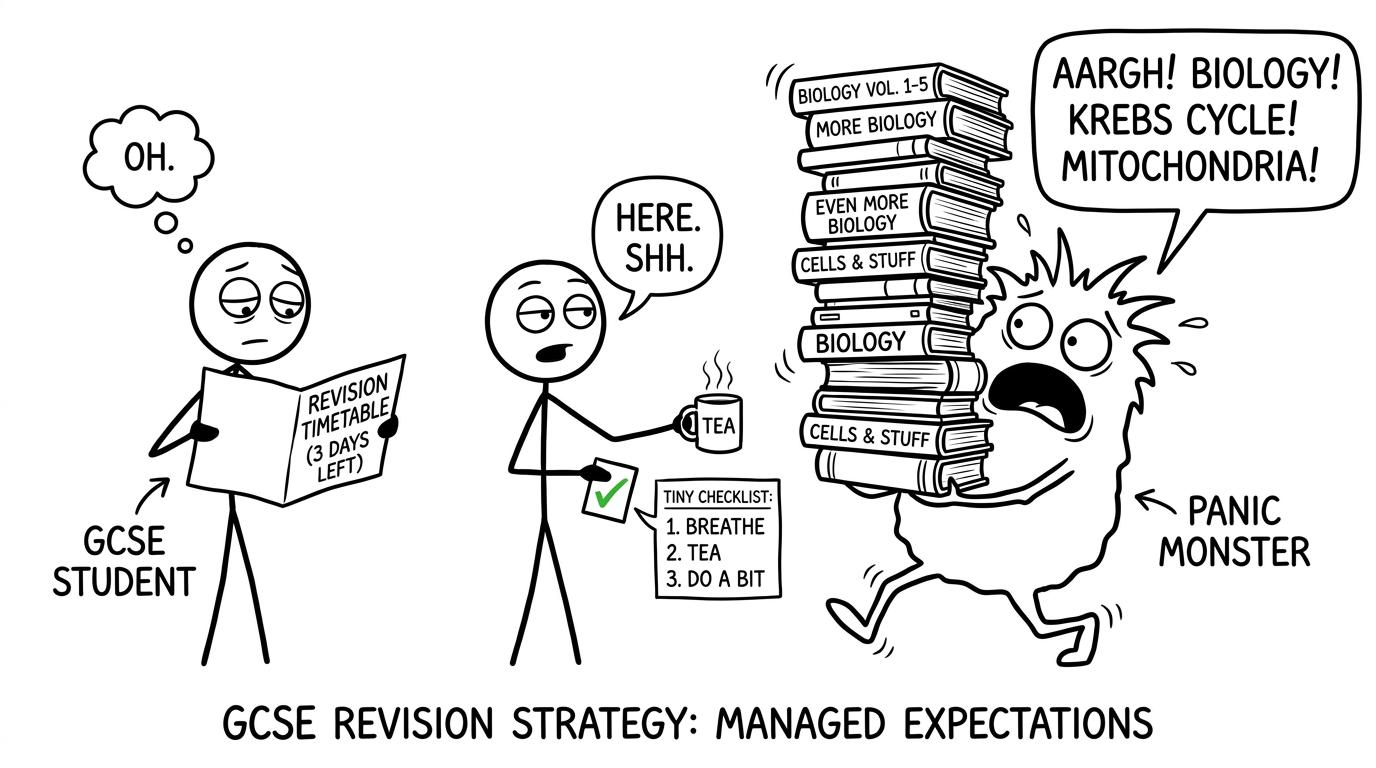 A student calming the revision panic monster with a checklist
Your three-day biology revision checklist
Use this as the shape of the plan:
- Day one: check the correct paper content, diagnose weak areas and rebuild the highest-priority knowledge.
- Day two: revise practical methods, calculations and application questions.
- Day three: complete timed questions, repair final gaps and prepare for the exam.
- Work in focused blocks of roughly 404040 to 505050 minutes, followed by a proper break.
- Retrieve information before checking notes.
- Mark every question and record why marks were lost.
- Protect your sleep on all three nights.
Before starting, confirm whether you take separate Biology or Combined Science, your exam board, your tier and the paper you are sitting. AQA, Edexcel, OCR and Eduqas organise content differently. A beautifully revised topic is little help if it is not on tomorrow's paper.
Day one: find the gaps before filling them
The temptation on day one is to begin at page one of a revision guide. That feels orderly, but it treats familiar and unfamiliar material equally. With limited time, diagnosis must come first.
Check the specification and paper content
Open your exam board's current specification or a topic list supplied by your school. Mark each relevant topic:
- green if you can explain it without notes;
- amber if you recognise it but cannot explain it precisely;
- red if you cannot confidently answer a basic question.
For AQA separate Biology, for example, Paper 1 covers cell biology, organisation, infection and response, and bioenergetics, while Paper 2 covers homeostasis and response, inheritance, variation and evolution, and ecology. Do not transfer that split blindly to another board.
Choose approximately three red topics and two amber topics. This is triage, not surrender. Narrow priorities give you a realistic chance to improve recall before the exam.
Use active recall, not decorative notes
For each priority topic, spend a short period learning or reviewing it. Then close the resource and write everything you can remember on blank paper. Include key terms, sequences, labelled structures and cause-and-effect relationships.
Check your answer in a different colour. The missing material becomes your next revision target.
This matters because GCSE Biology papers do not assess recall alone. Across regulated specifications, questions also require students to apply knowledge and analyse information. Official assessment objectives broadly allocate 40%40\%40% to knowledge, 40%40\%40% to application and 20%20\%20% to analysis, evaluation and conclusions. Knowing a definition is useful; recognising when it explains unfamiliar evidence is better.
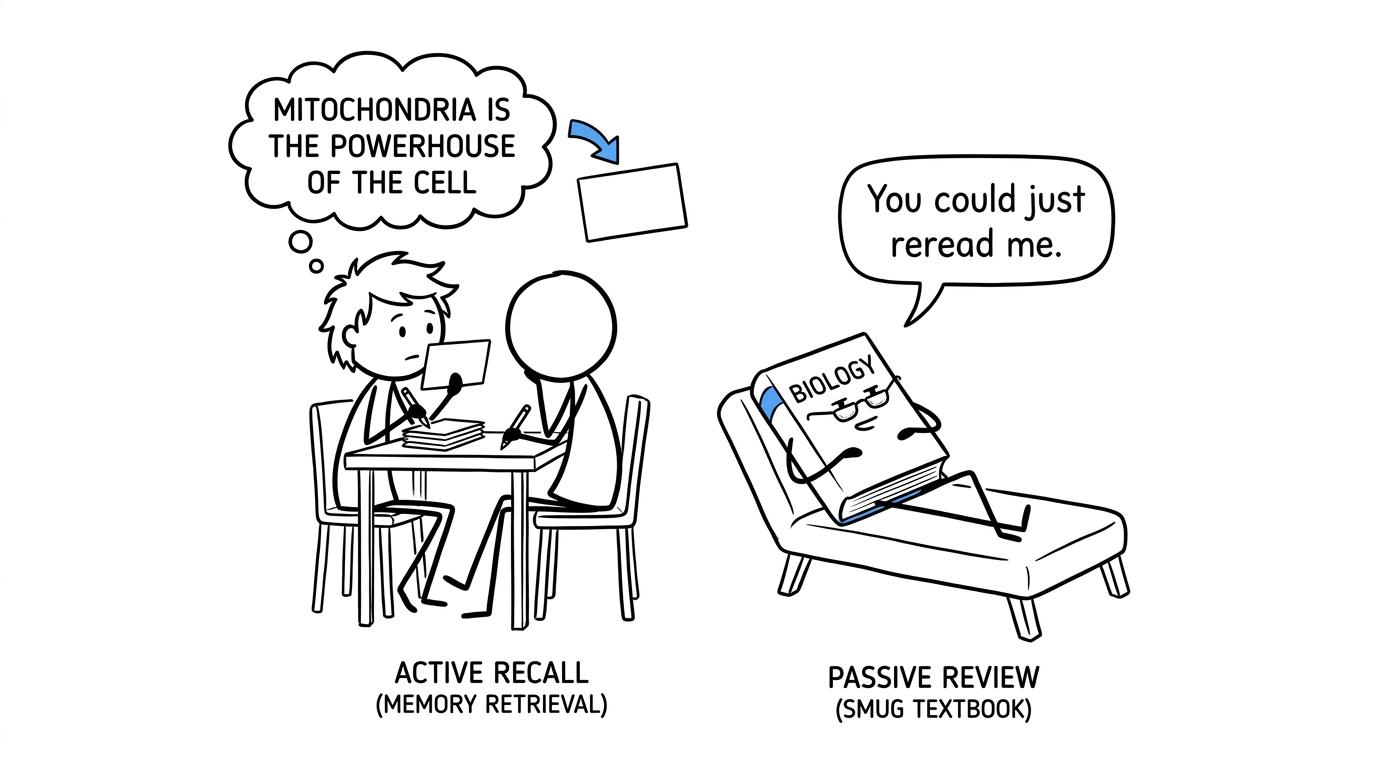 A textbook tries to tempt a student away from active recall
Build short answer chains
Biology answers often lose marks because they jump from a cause to a final effect. Practise building connected chains:
- identify the biological change;
- explain the mechanism;
- state the resulting effect;
- connect it to the context in the question.
Use precise vocabulary from the specification. Words such as diffusion, enzyme, concentration gradient, allele and selection pressure have specific meanings. Vague phrases such as “it works better” rarely explain enough.
Finish day one with a small set of exam questions on your priority topics. Mark them immediately. Write each lost mark as a specific instruction, such as “state the direction of diffusion” rather than “revise cells”. This mirrors the mistake-log method in MathsGenie's guide to revising efficiently without wasting time.
Day two: practical skills, data and biology maths
Day two turns knowledge into marks. Required or core practical work is not an optional side chapter: practical skills are assessed through written questions, and exam-board materials allocate at least 15%15\%15% of GCSE science marks to practical-related assessment.
Revise practicals as investigations
The names and exact set of practicals vary by qualification, so use your specification. Common areas include microscopy, osmosis, enzymes, food tests, photosynthesis, microorganisms and ecological sampling.
For every practical relevant to your paper, retrieve:
- the independent, dependent and control variables;
- the essential method and apparatus;
- measurements and suitable units;
- risks and ways to reduce them;
- how reliability could be improved;
- the expected pattern in the results;
- possible sources of error.
Do not memorise a paragraph without understanding the design. The exam may place a familiar technique in an unfamiliar situation. Ask why each control variable must remain constant and how repeats, means or a wider range of values would improve the evidence.
Secure the calculations hiding inside biology
At least 10%10\%10% of the marks in separate GCSE Biology assess mathematical skills. These may involve percentages, ratios, means, graphs, rates, area, sampling, unit conversions and standard form.
Key relationships can include magnification:
magnification=image sizeactual size\text{magnification}=\frac{\text{image size}}{\text{actual size}}magnification=actual sizeimage sizeand rate:
rate=change in quantitytime\text{rate}=\frac{\text{change in quantity}}{\text{time}}rate=timechange in quantityDo not merely recognise these relationships. Practise rearranging them, checking units and deciding whether an answer is sensible. Separate GCSE Biology does not receive the GCSE Maths formulae sheet, so revise the relationships listed by your own specification rather than assuming everything will be supplied.
If unit conversion or powers of ten feel uncertain, use MathsGenie's free standard form revision resources. For proportions and percentage-based data, the wider GCSE Maths revision hub provides lessons, questions, worksheets and videos. These skills transfer directly to biological calculations without consuming an entire maths revision session.
Practise graphs as evidence
When given biological data, check:
- whether the graph needs continuous or categorical data;
- whether both axes have labels and units;
- whether the scale uses the available space sensibly;
- whether a trend should be described before it is explained;
- whether anomalous values affect the conclusion;
- whether the evidence supports correlation rather than causation.
Read the command word carefully. Describe asks what the data show. Explain asks why the pattern occurs. Evaluate requires strengths, limitations and a reasoned judgement.
End day two with mixed practical and data questions. Mark them using the official mark scheme. A question is not finished when you write an answer; it is finished when you understand the difference between your answer and the credited one. MathsGenie's guide to using GCSE past papers properly explains the same mark-and-repair cycle for maths.
Day three: rehearse, repair and stop on time
The final day is not the moment to discover every obscure detail in the specification. It is for making your existing knowledge dependable under pressure.
Complete a timed paper or selected sections
Use a paper for your exact exam board, qualification and tier. If there is not enough time for a full paper, choose sections covering several topics, practical skills and calculations.
Work without notes. Keep moving if a question stalls you, then return later. Afterwards, mark carefully and divide errors into four types:
- missing biological knowledge;
- weak application to the context;
- calculation or graph error;
- misreading the command word.
Repair the largest recurring category first. One pattern repeated across several questions is more valuable than five unrelated facts.
The principle is identical to the phased approach in when to start GCSE past papers: the paper is a diagnostic tool, not a verdict on your ability.
Make a final one-page retrieval sheet
From memory, produce one page containing only information you repeatedly forgot. It might include:
- easily confused terms;
- practical variables and controls;
- calculation relationships and units;
- biological processes that require an ordered sequence;
- command words that changed how you answered.
Check it, correct it and retrieve it once more later. Do not turn it into microscopic handwriting covering the whole course. A final sheet should reduce noise, not compress the noise into a smaller space.
Protect the evening
Prepare your equipment, confirm the exam time and stop intensive revision early enough to wind down. Avoid beginning a full paper late at night. Tired revision can create the illusion of commitment while weakening attention the next morning.
If you also have a maths paper approaching, keep its preparation contained rather than abandoning it. A short GCSE mini-test or topic session can maintain fluency without derailing biology revision. MathsGenie's guide to the best order for GCSE maths topics can help you choose one focused skill rather than revising randomly.
 A phone attempts to sneak back into the bedroom before an exam
Common last-minute revision mistakes
Trying to cover everything equally
Three days require priorities. Use the specification and your diagnostic questions to identify gaps that are both important and repairable.
Rereading without retrieval
Familiar pages feel reassuring, but familiarity is not recall. Close the book, produce an answer, check it and try again.
Ignoring required practicals
Practical questions can test methods, variables, safety, graphs, calculations and evaluation. Revise the reasoning behind each investigation, not only its title.
Completing questions without marking them
Unmarked work confirms effort, not accuracy. Use mark schemes to identify missing terminology and incomplete explanation chains.
Treating predicted content as guaranteed
Predicted papers can provide fresh practice, but no prediction can promise what will appear. Give priority to the official specification and genuine past-paper styles.
Sacrificing sleep for one more chapter
An extra late-night chapter is rarely worth arriving unable to read data or sustain attention. Set a finishing time and keep it.
Go into the exam with a simple method
When the paper opens, begin with what is actually on the page rather than what you feared might appear. Underline command words, inspect units, show calculation stages and use evidence when a question provides data. For longer responses, pause briefly to order your explanation before writing.
Three calm days will not make the course smaller. They will make your next action clearer. That is enough to move from panic towards useful work.
Then keep the same disciplined approach for your maths exams. Start with MathsGenie's free GCSE Maths revision hub, choose a targeted revision lesson, complete practice questions and check the mark scheme. Use mini tests to expose gaps, past papers to rehearse the real assessment and predicted papers to sharpen your final preparation. Revision becomes calmer when every mistake tells you exactly what to do next.










