

GCSE Biology Coursework Weighting: Is It 0%?
GCSE biology coursework weighting is 0% for current English GCSEs. Learn how written exams, required practicals and practical questions affect your grade.
You can spend months writing up experiments, drawing tables and recording conclusions, so it is reasonable to assume that some of this work must count directly towards your GCSE Biology grade. For current GCSEs in England, however, the answer is simple: the GCSE biology coursework weighting is 0%0\%0%. Your final grade comes entirely from written examinations.
That does not make practical work unimportant. Questions assessing practical knowledge account for at least 15%15\%15% of the examination marks, while mathematical skills account for at least 10%10\%10%. Your experiment book is not awarded marks as coursework, but what you learn from those experiments can earn marks when you sit the papers.
This article explains the distinction, compares the main English exam boards and shows maths students which numerical skills deserve attention.
The short answer
For current GCSE Biology qualifications offered in England by AQA, Pearson Edexcel, OCR and Eduqas:
- coursework contributes 0%0\%0% of the final grade;
- written examinations contribute 100%100\%100%;
- practical work is completed during the course but is assessed through questions in those examinations;
- at least 15%15\%15% of the qualification's marks assess practical knowledge and skills;
- at least 10%10\%10% of the marks assess mathematical skills;
- foundation and higher tier students follow the assessment structure specified by their board.
The crucial distinction is between coursework marks and exam questions about practical work. They are not the same thing.
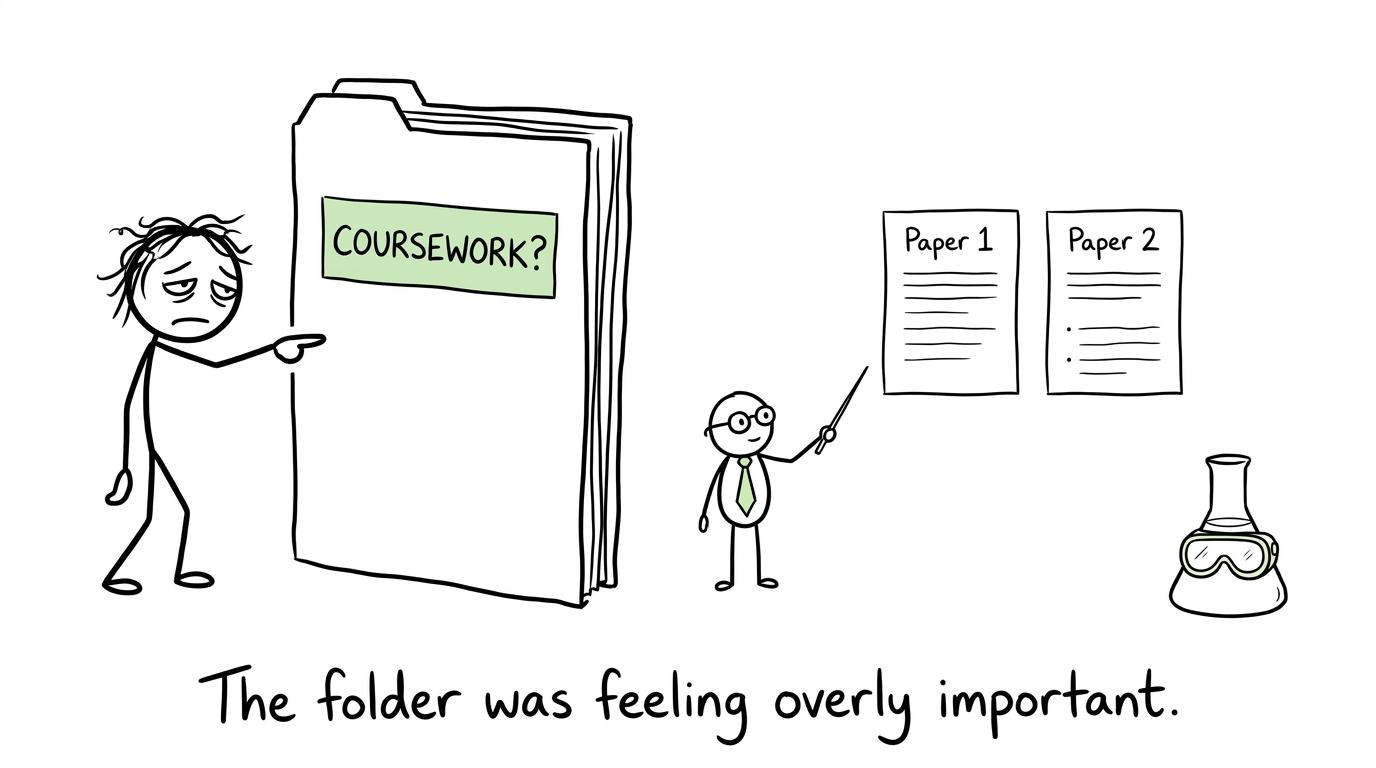 A student discovers that the coursework folder is less important than the written papers
GCSE biology coursework weighting by exam board
The major English specifications all use external written assessment, although they divide the qualification differently.
| Exam board | Coursework weighting | Written assessment | Practical assessment |
|---|---|---|---|
| AQA GCSE Biology 846184618461 | 0%0\%0% | Two papers, each worth 50%50\%50% | Practical knowledge is tested in the papers; practical-related questions account for at least 15%15\%15% overall |
| Pearson Edexcel GCSE Biology 1BI01\mathrm{BI}01BI0 | 0%0\%0% | Two papers, each worth 50%50\%50% | Knowledge of mandatory core practicals is assessed through written questions |
| OCR Biology A J247\mathrm{J}247J247 | 0%0\%0% | Two papers for the chosen tier, each worth 50%50\%50% | Practical skills topic B7\mathrm{B}7B7 is assessed across the written papers |
| Eduqas GCSE Biology | 0%0\%0% | Component 111 is worth 75%75\%75% and Component 222 is worth 25%25\%25% | Practical skills make up at least 15%15\%15% of the qualification's marks |
For AQA, each paper lasts 111 hour 454545 minutes and carries 100100100 marks. Edexcel also uses two 111 hour 454545 minute papers worth 100100100 marks each. OCR's selected foundation or higher route consists of two 111 hour 454545 minute papers worth 909090 marks each. Eduqas divides its written assessment into a 222 hour 151515 minute component and a 111 hour 151515 minute applications component.
These details come from the current specifications published by the respective awarding organisations. Always check the specification code on your school materials because similarly named qualifications can have different arrangements.
A note for students outside England
Do not automatically apply the English answer to every UK qualification. WJEC qualifications used in Wales can have different assessment structures, including separately assessed practical components, and arrangements may change between specifications. Northern Ireland also has its own qualifications.
If your school uses WJEC rather than Eduqas, ask your teacher for the exact specification code and assessment year. The statement that coursework is worth 0%0\%0% applies specifically to the current English GCSE Biology qualifications discussed above.
Why practical work still matters
Calling the coursework weighting 0%0\%0% can create the wrong impression. Practical experience is not an optional extra. It has simply moved from teacher-marked coursework into external assessment.
Ofqual's rules for English single-science GCSEs require at least eight specified practical activities. Exam boards may organise and name them differently: AQA refers to required practicals, Edexcel to core practicals and OCR to Practical Activity Groups.
Schools must provide appropriate opportunities for students to complete and record the required work. The record itself is not marked to produce a coursework score. Instead, written questions can ask you to:
- identify independent, dependent and control variables;
- select suitable apparatus;
- describe or evaluate a method;
- explain how reliability or accuracy could be improved;
- recognise hazards and sensible precautions;
- process results using calculations;
- interpret tables and graphs;
- identify anomalies and draw justified conclusions.
This is why merely memorising the title of each practical is not enough. You need to understand why the method works, what is measured and what the results can reasonably show.
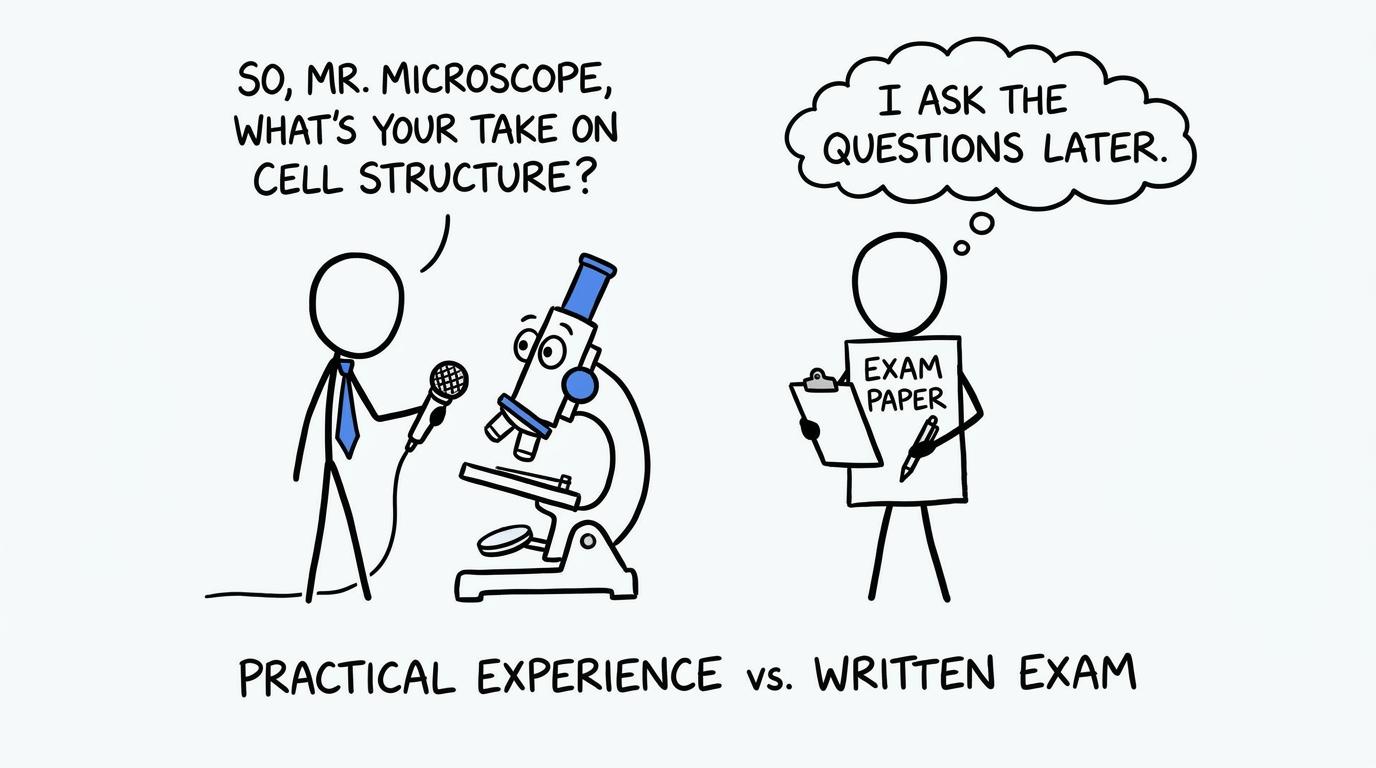 A microscope explains that practical experience will be questioned later
The difference between 0%0\%0% coursework and 15%15\%15% practical questions
Two percentages often become tangled together:
- coursework weighting: 0%0\%0%;
- minimum practical assessment within the written exams: 15%15\%15%.
The practical percentage is not a separate grade. Those marks sit inside the written papers and contribute to the same total as questions about cells, genetics, ecology and other biological content.
For a qualification with 200200200 raw marks, 15%15\%15% would correspond to 303030 marks if the percentage were applied directly across that paper set:
200×15100=30200 \times \frac{15}{100}=30200×10015=30This equation explains the scale of the weighting rather than predicting the precise location or format of questions in a particular series. Practical understanding may appear in short calculations, method questions, data analysis or extended responses.
If percentages feel less familiar than they should, MathsGenie's free GCSE percentages revision resources can help you rebuild the underlying skill. The fractions, decimals and percentages guide is useful when results must be converted between different forms.
How maths appears in GCSE Biology
The minimum mathematical weighting for GCSE Biology in England is 10%10\%10%. This is lower than the corresponding requirement in chemistry or physics, but it remains large enough to influence a grade.
Biology questions may require you to use:
- percentages and percentage change;
- ratios and proportions;
- means and ranges;
- rates of reaction or change;
- probability in genetics;
- standard form;
- magnification and scale;
- areas, volumes and surface-area-to-volume relationships;
- graphs, gradients and lines of best fit.
The standard percentage-change relationship is:
percentage change=new value−original valueoriginal value×100\text{percentage change}=\frac{\text{new value}-\text{original value}}{\text{original value}}\times 100percentage change=original valuenew value−original value×100A mean is calculated using:
mean=sum of the valuesnumber of values\text{mean}=\frac{\text{sum of the values}}{\text{number of values}}mean=number of valuessum of the valuesKnowing a formula is only the beginning. Marks are often lost through incorrect substitution, missing units, premature rounding or an answer that is not interpreted in its biological context.
MathsGenie's standard form revision page supports work involving very large populations or very small cells. For experimental relationships, use the scatter graphs revision guide and its accompanying scatter graph practice questions.
A practical revision checklist
A calm revision plan starts by separating what must be remembered from what must be applied.
Confirm your qualification
Write down your board, specification code and tier. Do not revise from a random practical list found under the broad label “GCSE Biology”. AQA, Edexcel, OCR and Eduqas cover comparable skills, but their named practicals and paper structures are not identical.
Build a one-page record for each practical
For every required or core practical, summarise:
- the purpose of the investigation;
- the independent and dependent variables;
- important control variables;
- apparatus and measurement units;
- the broad method;
- hazards and precautions;
- expected presentation of results;
- limitations and realistic improvements.
The aim is not to reproduce a memorised script. It is to understand the decisions behind the experiment.
Practise with unfamiliar data
Examiners can place familiar skills in unfamiliar contexts. A graph about enzyme activity may look different from the graph in your exercise book, but the underlying habits remain the same: read both axes, check units, describe the overall trend, use numerical evidence and notice anomalies.
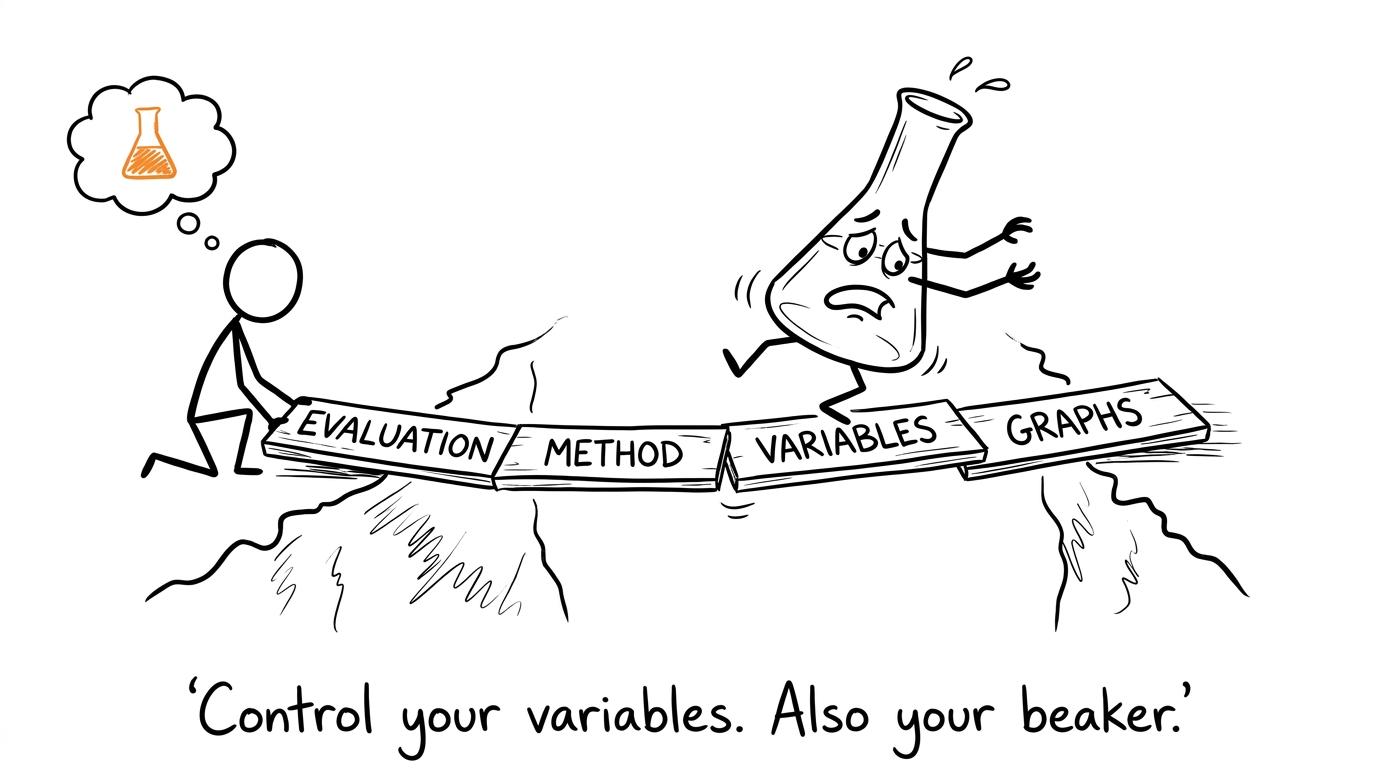 A student constructs a revision bridge from practical skills
Strengthen transferable maths
If calculations are costing you biology marks, treat the underlying maths as its own revision target. MathsGenie's GCSE Maths revision hub provides free lessons, question banks, worksheets, revision guides and past-paper practice across exam boards.
Use short topic sessions first. Later, test whether the skills survive under pressure with Edexcel GCSE Maths predicted papers. Predicted papers cannot tell you exactly what will appear, but they are valuable for practising mixed questions, timing and disciplined checking.
Common mistakes about Biology coursework
Assuming the practical book earns marks
Your record supports learning and helps your school demonstrate that practical opportunities were provided. It is not marked as a portfolio contributing a percentage to the final English GCSE grade.
Believing 0%0\%0% means practicals can be ignored
At least 15%15\%15% of the exam marks assess practical knowledge. Ignoring experimental methods, variables and data analysis leaves a significant part of the qualification uncovered.
Treating practical questions as pure recall
Questions can ask you to apply a familiar technique to a new investigation. Understanding validity, repeatability, accuracy and control variables is more useful than memorising isolated sentences.
Confusing Eduqas with WJEC
The names are related, but the qualifications are not automatically interchangeable. Check the specification code and country in which your qualification is being taken before relying on a weighting.
Revising calculations without units
A correct numerical process can still produce an incomplete answer. Record the unit, respect the requested degree of accuracy and check whether the final value is biologically plausible.
Turn the weighting into a revision decision
The useful answer is not merely that GCSE Biology coursework contributes 0%0\%0% in England. It is that practical understanding still earns marks through the papers, alongside a meaningful mathematical component.
Revise accordingly. Learn the biology, understand the practical methods and make numerical work dependable. Use MathsGenie's free AQA GCSE Maths revision resources or the relevant board hub to sharpen percentages, graphs, averages and standard form. Then move from revision lessons to practice questions, mini tests, past papers and predicted papers, checking each attempt with mark schemes and video solutions.
Your experiment book may not carry a coursework score. The understanding inside it can still shape the grade you receive.











