GCSE Biblical Hebrew Time Pressure Mistakes
GCSE Biblical Hebrew time pressure mistakes explained, with practical ways to protect marks in comprehension, translation, grammar and literature exams.
The clock changes how you think. A word you recognised yesterday suddenly looks unfamiliar. You spend too long perfecting one translation, then discover a page of unanswered questions near the end. Most GCSE Biblical Hebrew time pressure mistakes are not caused by a complete lack of knowledge. They happen when students stop matching their effort to the marks available.
The solution is practical: use the mark allocation to control your time, answer the precise question being asked, preserve the overall meaning when one word is uncertain, and leave enough time to check choices, omissions and written responses. These habits are valuable for students balancing Biblical Hebrew with GCSE maths because both subjects reward accurate decisions under pressure.
The current Pearson Edexcel GCSE Biblical Hebrew qualification is untiered and graded 999-111. It has two externally examined components: Language and Literature. Each lasts 222 hours, carries 100100100 marks and contributes 50%50\%50% of the qualification. That makes timing part of the assessment, even though it is not listed as a separate topic.
Your quick exam-pressure checklist
Before exploring the mistakes in detail, remember this short routine:
- Read the front-page instructions and every choice carefully.
- Use the marks beside each question to guide your time.
- Bank short, secure responses before wrestling with difficult passages.
- Translate meaning rather than producing disconnected vocabulary.
- Identify subjects, verbs and objects before polishing English.
- Give the number of details requested in comprehension questions.
- Support literature comments with precise textual evidence.
- Leave space, move on and return if a question stalls.
- Reserve a final check for omissions and unanswered questions.
Start your subject planning from the Edexcel GCSE Biblical Hebrew revision page, then place timed practice alongside your other subjects with the MathsGenie revision planner.
Why time pressure causes avoidable mistakes
Pressure narrows attention. A student may become absorbed by one difficult form and forget that easier marks remain elsewhere. Another may write quickly but stop checking whether an answer actually addresses the command word. Speed is not the same as efficiency.
Pearson tells candidates that the marks shown beside questions should guide how much time they spend. Across a 120120120-minute, 100100100-mark paper, the broad average is:
120100=1.2\frac{120}{100}=1.2100120=1.2That is about 1.21.21.2 minutes per mark. It is not a rigid stopwatch rule: reading a source passage takes time, while some short responses can be completed quickly. It is best treated as a warning system. Spending 121212 minutes on a 222-mark response should trigger a decision to move on.
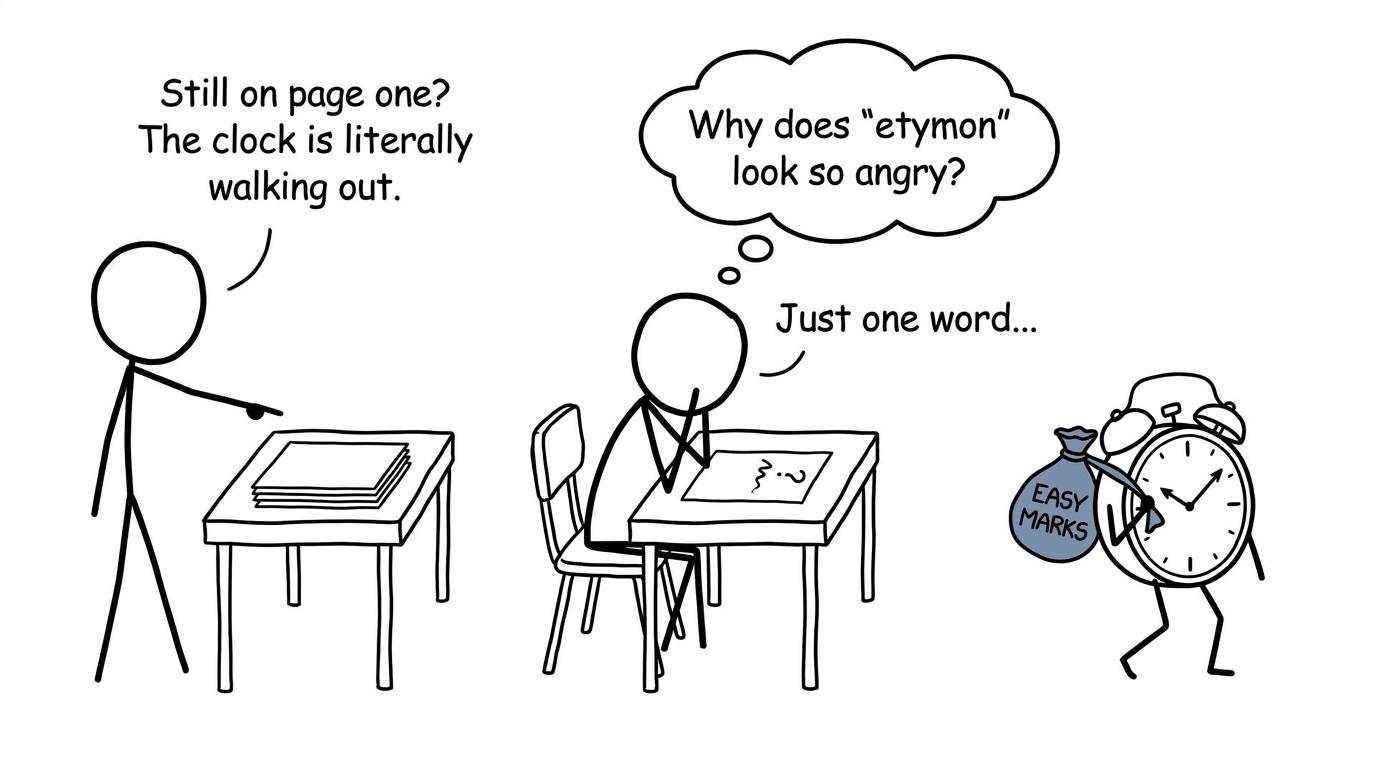 A cartoon exam clock escaping with easy marks while a student remains stuck on one word
Language paper mistakes under time pressure
Component 111 tests comprehension and translation from unseen Biblical Hebrew. In the comprehension section, students also make the specified choice between grammar questions and translating English sentences into pointed Biblical Hebrew. The paper instructions matter because answering the wrong option or overlooking a compulsory question can cost marks before subject knowledge is considered.
Translating one word at a time
The most common translation trap is treating the passage as a vocabulary list. Students recognise several words, write their separate meanings and hope that the sentence will assemble itself. Under pressure, it rarely does.
First identify the structure:
- Who or what is acting?
- What is the main verb?
- Who receives the action?
- Which words introduce sequence, contrast, speech or consequence?
- Which suffixes or attached elements change the relationships?
Then write natural English that preserves the sense. Pearson's published translation guidance distinguishes between isolated vocabulary and a translation that communicates the overall meaning. A response can therefore lose substantial credit even when it contains several correct individual words but no coherent sentence.
Freezing over unfamiliar vocabulary
One unknown word should not be allowed to consume an entire sentence. Use the grammar and context around it. Decide whether it is likely to be a person, object, action or description, leave a small gap if necessary, and continue.
Later clauses may clarify the unknown word. Continuing also protects the marks available for everything you do understand. A sensible incomplete attempt is usually more useful than several blank lines.
Losing track of who did what
Time pressure makes small grammatical signals easy to overlook. A student may reverse subject and object, miss a suffix or carry the subject of one clause incorrectly into the next. The resulting English may sound fluent while communicating the wrong event.
Use a brief structural check before finalising each sentence: subject, action, recipient. Pronouns should have clear referents. If your English suggests that a character suddenly acts without any textual reason, reread the relevant verb and attached forms.
Making the English too literal or too inventive
Two opposite errors appear. One translation follows Hebrew word order so rigidly that the English becomes unclear. The other expands into a polished paraphrase containing details that are not supported by the passage.
Aim for accurate, readable English. Preserve relationships, tense or aspect as the context requires, negatives, names and important connective words. Do not add motives or explanations simply because they make the story sound smoother.
Mishandling the grammar or composition choice
A decision made in panic can be expensive. Students sometimes begin one option, lose confidence and switch after spending valuable time. Others overlook requirements for pointed Biblical Hebrew or make several avoidable pointing errors while rushing.
Decide your preferred route during revision, based on marked evidence rather than mood. Practise the weaker route enough that it remains a genuine backup. In the examination, read the choice instructions before writing and commit unless there is a strong reason to change.
Comprehension errors that lose easy marks
Comprehension questions often feel safer than extended translation, but they produce their own time-pressure mistakes.
Giving too few details
The number of marks often signals the likely amount of relevant information. A response worth several marks normally needs more than one brief point. Students working quickly may write the first correct detail they notice and move on too soon.
Underline words such as “two”, “reasons”, “ways” or “details”. After answering, compare the number of distinct points you supplied with the demand of the question.
Copying without answering
Lifting a phrase from the source does not necessarily show understanding, particularly when the question expects an answer in English. Current paper instructions specify which limited items may be given in Biblical Hebrew, such as roots or individual letters. Follow those instructions rather than assuming copied text will receive credit.
Ignoring small command words
“Give”, “explain”, “identify” and “translate” require different responses. An explanation needs a reason or relationship, not merely a label. A translation needs the meaning of the stated material, not a comment about its grammar.
Circle or underline the command word. This takes seconds and prevents a correct piece of knowledge being presented in the wrong form.
Literature paper mistakes under pressure
Component 222 assesses knowledge and understanding of the set texts, translation, literary or grammatical features, analysis and extended responses. Its two set-text sections are followed by a synoptic question. Students must answer all required sections, so sacrificing the final response to over-polish earlier work is a poor trade.
Retelling instead of analysing
A literature answer can accurately recount what happened while failing to explain how the passage creates meaning. When analysis is required, connect each observation to its effect or significance.
A useful mental structure is:
- make a direct point;
- identify precise evidence;
- explain what that evidence shows;
- connect it to the question.
This is not about writing the longest paragraph. It is about ensuring that each paragraph earns its place.
Referring vaguely to the text
Phrases such as “this shows power” or “the language is effective” are too general on their own. Where the question requires textual illustration, provide the exact Hebrew feature or wording and its English meaning as required. Pearson's sample marking materials make clear that some literature responses need both the Biblical Hebrew illustration and its meaning to gain the available credit.
Forgetting the comparative demand
The synoptic response requires students to bring material together. Under pressure, a student may write two separate mini-essays without making the relationship explicit.
Use comparative language throughout: similarly, differently, whereas, in both passages and by contrast. Decide your main comparison before writing so that the response has a direction rather than becoming a memory dump.
Common mistakes across both papers
These are the easiest patterns to diagnose in timed practice:
Spending equal time on unequal questions
A low-mark question should not receive the same attention as an extended response. Write your planned finish time for each major section and check it occasionally.
Leaving blanks without returning
If you move on, mark the question clearly on the front or beside its number. Blank answers sometimes survive to the end simply because the student forgets them.
Checking only spelling
Your final check should prioritise marks. Look for missed negatives, reversed subjects and objects, untranslated clauses, incomplete choices, missing evidence and unanswered subparts. Cosmetic editing comes afterwards.
Changing correct answers through panic
Change an answer when you can identify a specific error, not merely because the first answer suddenly feels suspicious. Pressure often weakens confidence before it weakens knowledge.
Practising knowledge without practising timing
Knowing vocabulary and set texts is essential, but it does not automatically produce a well-managed paper. Timed sections should become a normal part of revision. The process described in how to use GCSE past papers properly transfers well across subjects: attempt, mark, diagnose, fix and retest.
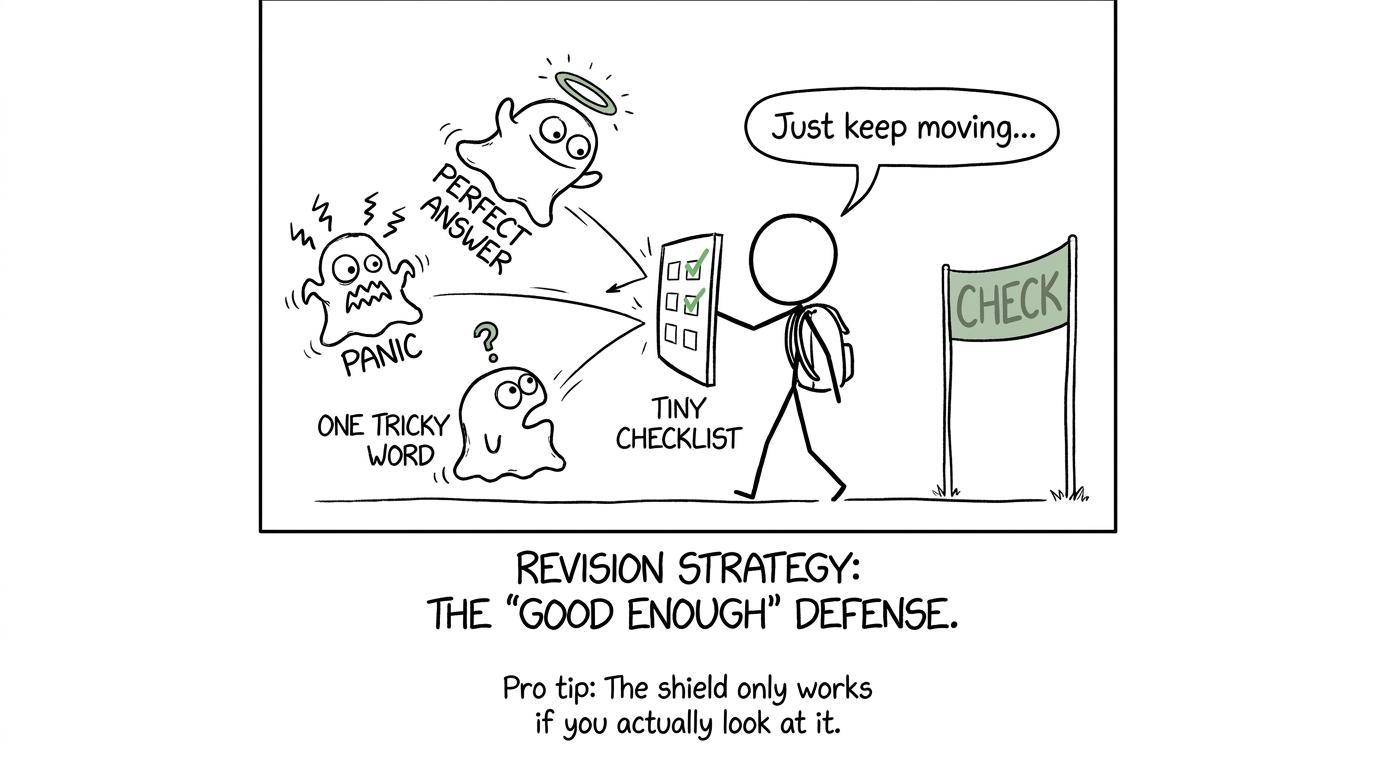 A calm student using a checklist as a shield against panic and perfectionism
How to train calm accuracy before the exam
Do not begin by forcing yourself through full papers every evening. Train pressure in manageable doses.
Complete one comprehension set, translation passage or literature response with a realistic limit. Mark it using the official mark scheme, then record each lost mark under one of four headings: knowledge, interpretation, instruction or timing. That distinction matters. Learning more vocabulary will not fix a habit of missing compulsory questions.
A short routine is easier to repeat. Maths students can use the structure in the 20-minute GCSE revision routine: retrieve knowledge, answer exam-style questions, mark immediately and record one correction. Apply the same cycle to vocabulary, morphology, unseen translation and set-text evidence.
Keep a pressure log containing:
- the question or section;
- the mark available;
- the time used;
- the mistake made;
- the rule you will follow next time.
For instance, the rule might be “identify the subject before translating”, “check how many details are requested” or “move on after two minutes without progress”. Specific rules survive pressure better than vague promises to be more careful.
MathsGenie's guide to finding your weakest GCSE topics explains the same evidence-led approach. For maths preparation alongside Biblical Hebrew, use GCSE mini tests to train short bursts of accuracy, Edexcel GCSE Maths past papers for full exam conditions and Edexcel predicted papers for focused final preparation. Predicted papers are not a substitute for complete specification revision, but they can provide further timed practice.
A calmer final approach
The aim is not to become the fastest person in the examination room. It is to stop spending valuable minutes where they cannot earn proportionate marks.
Read the instructions. Follow the choices. Translate coherent meaning. Match the detail of your answer to the marks. Use precise evidence in literature responses. Move on deliberately, not desperately, and return with a clear list of unfinished questions.
Then build those habits across your whole GCSE timetable. MathsGenie gives you free revision lessons, practice questions, mini tests, past papers, predicted papers, mark schemes and video solutions for maths, while the revision planner helps you balance that work with Biblical Hebrew and your other subjects. Choose one timed task today, mark it honestly and turn every lost mark into a rule you can use when the clock is running.