GCSE Biblical Hebrew Paper 2 Exam Date 2026
GCSE Biblical Hebrew Paper 2 exam date 2026: confirm the date, afternoon session, duration, set texts and what you should have ready.
An exam date looks like a small piece of information. Then it becomes the fixed point around which every other subject, revision session and evening has to move.
The official GCSE Biblical Hebrew Paper 2 exam date 2026 was Tuesday 19 May 2026, in the afternoon. Pearson Edexcel listed Component 2: Literature, examination code 1BH0/02, as a 222-hour examination. Your school or examination centre determines your precise arrival and start arrangements, so its candidate timetable remains the document to follow on the day.
This guide explains what the paper covers, what to prepare and how maths students can organise both subjects without allowing one examination to crowd out the other.
GCSE Biblical Hebrew Paper 2 date at a glance
| Detail | Official timetable information |
|---|---|
| Exam board | Pearson Edexcel |
| Qualification | GCSE Biblical Hebrew |
| Examination code | 1BH0/02 |
| Component | Component 2: Literature |
| Date | Tuesday 19 May 2026 |
| Session | Afternoon |
| Duration | 222 hours |
| Total marks | 100100100 marks |
| Qualification weighting | 50%50\%50% |
Pearson published this information in its final Summer 2026 GCSE examination timetable. Paper 1: Language, code 1BH0/01, was scheduled separately for the morning of Thursday 7 May 2026.
Before relying on any online countdown or copied timetable, compare it with the individual candidate timetable supplied by your school. That document confirms your centre, candidate details and local reporting time. If anything appears inconsistent, speak to your examinations officer rather than trying to resolve it through guesswork.
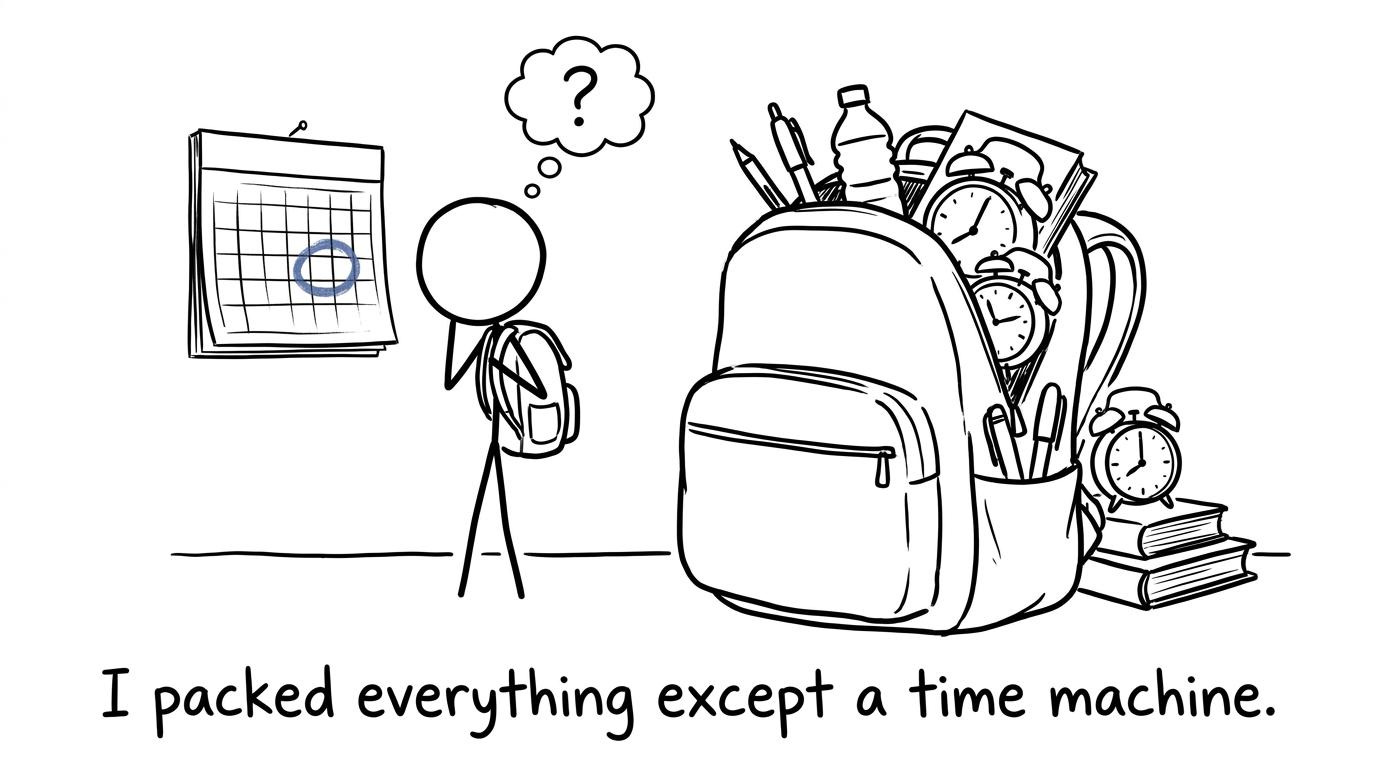 A student beside an extremely overprepared exam bag and a circled calendar date
Your essential Paper 2 checklist
The date matters, but preparation becomes useful only when it leads to clear actions. Before the examination, make sure you have:
- checked that Tuesday 19 May and the afternoon session appear on your candidate timetable;
- confirmed your school's required arrival time and examination room arrangements;
- checked that your name, candidate number and centre details are correct;
- revised the prescribed set texts for the 2026 examination;
- practised short responses, translation and extended literary analysis;
- reviewed the instructions on permitted and prohibited materials;
- packed at least two working black pens and any other equipment requested by your centre;
- arranged travel with enough spare time for an avoidable delay;
- told the examinations officer promptly about an access arrangement or timetable concern.
Do not assume that an afternoon session means you can arrive whenever you like after lunch. Centres set reporting times so candidates can be seated, identified and given instructions before the examination begins.
What is assessed in GCSE Biblical Hebrew Paper 2?
Component 2 is the Literature paper. It lasts 222 hours, carries 100100100 marks and contributes 50%50\%50% of the GCSE. The Pearson specification divides it into three sections:
- Section A: questions on set text 1;
- Section B: questions on set text 2;
- Section C: a synoptic question drawing ideas together.
The assessment includes short-response questions, translation passages and extended responses. It tests more than recall. You need to understand the prescribed passages, translate accurately and explain literary or contextual features with relevant textual support.
Pearson's specification identifies the prescribed texts for examinations from 2026 to 2028 as:
- Set text 1: Genesis, Joseph's rise to power, Chapters 41, 42 and 43;
- Set text 2: Kings, the miracles of Elisha, Chapters 4, 5, 6 and 7.
Use the current specification and instructions supplied by your teacher. Do not revise from an old set-text list merely because the book or notes still look familiar. Likewise, never assume that a dictionary, annotated text or revision notes can enter the examination room. Check the paper requirements and your centre's instructions in advance.
What to have ready before the exam
Your administrative information
Have your candidate timetable somewhere easy to find. Know your candidate number, centre number, examination room and required arrival time. Some centres provide this information on a desk card, but knowing where to report is still your responsibility.
If you are unsure about a clash, access arrangement or absence procedure, contact your school before the examination day. Administrative uncertainty consumes attention that should be available for the paper itself.
Your permitted equipment
Bring working black pens, including a spare. A transparent pencil case may be required by your centre. If you take water into the room, follow the centre's rules, which commonly require a clear bottle without a label.
Only bring materials that are expressly permitted. Keep your mobile phone, smartwatch, notes and other unauthorised items outside the examination room or stored exactly as your centre directs. The safest rule is simple: read the official candidate instructions rather than copying what somebody did in a different subject.
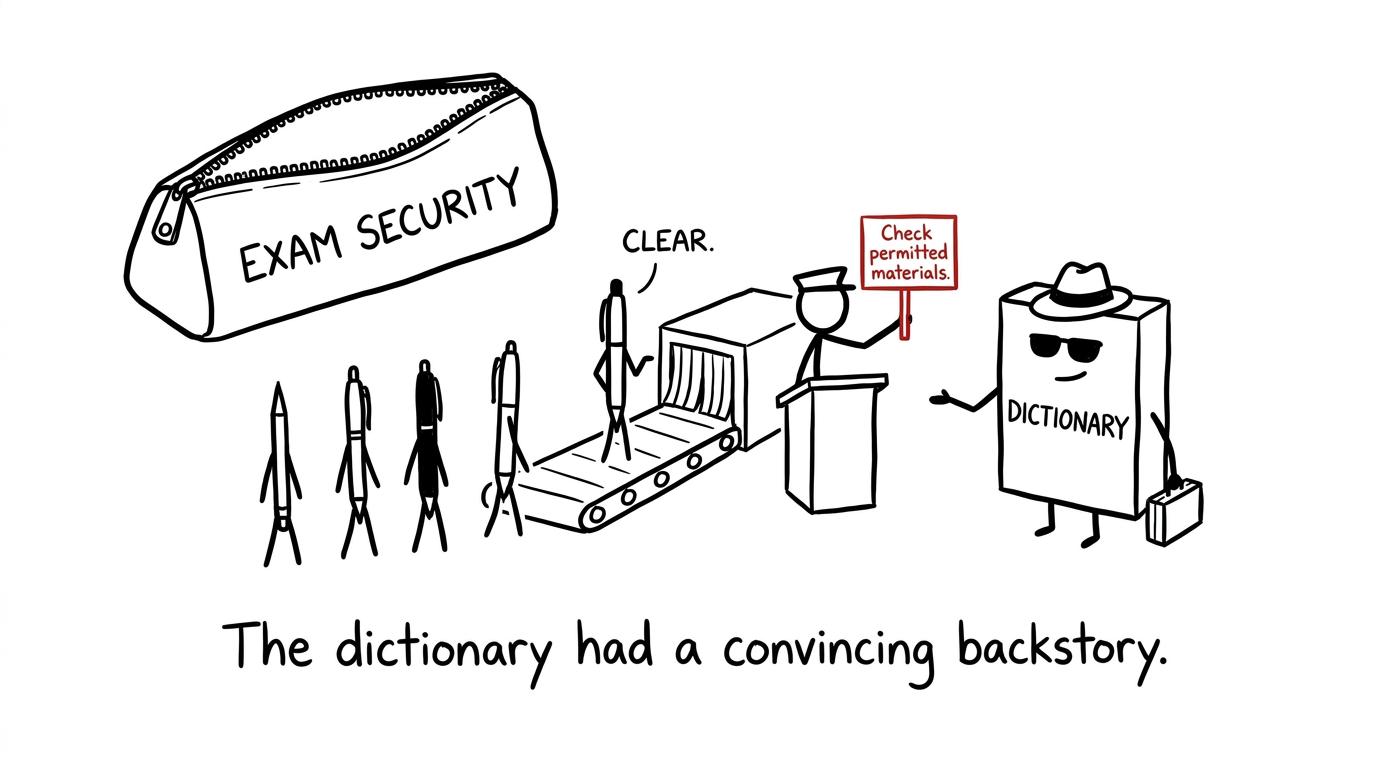 A dictionary in sunglasses being turned away from an exam pencil-case security queue
Your knowledge of the paper
Preparation should match the assessment rather than becoming a vague project called “revise Hebrew”. Before Paper 2, check whether you can:
- locate key events and developments across each prescribed chapter;
- recognise important vocabulary, forms and constructions within the set passages;
- translate selected passages precisely;
- explain characterisation, themes, context and literary techniques;
- choose concise textual evidence for an extended response;
- manage all three sections within the available 222 hours.
A useful final check is to look at the mark scheme after completing a past question. Ask what the examiner rewards: accurate knowledge, direct explanation, textual support or a developed judgement. Reading notes can create familiarity. Answering and marking questions reveals whether that familiarity can earn marks.
Balancing Biblical Hebrew with GCSE maths revision
A timetable collision is not always two examinations at the same time. Sometimes it is two subjects competing for the same evening.
Maths needs repeated practice, while a literature paper benefits from retrieval, translation and structured written responses. The sensible answer is not to abandon one subject for a week. It is to give each subject a different kind of session.
Use the free MathsGenie GCSE and A Level revision hub to identify one maths weakness at a time. A focused lesson and a short set of practice questions can preserve fluency without taking over the evening. The GCSE one-week maths revision plan offers a useful framework for keeping sessions finite and purposeful.
A balanced revision block might contain:
- one short Biblical Hebrew retrieval or translation task;
- one timed Paper 2 response followed by careful marking;
- one targeted maths lesson and question set;
- a brief review of mistakes from both subjects.
The important distinction is between learning and testing. Notes and videos can rebuild knowledge. Past papers, mini tests and timed responses test whether that knowledge survives pressure.
For maths, revision advice for efficient Edexcel preparation explains how to move from a weak topic to practice questions and then retest it. If you are deciding which maths areas deserve attention, the guide to GCSE predicted topics and sensible revision priorities helps you avoid treating predictions as guarantees.
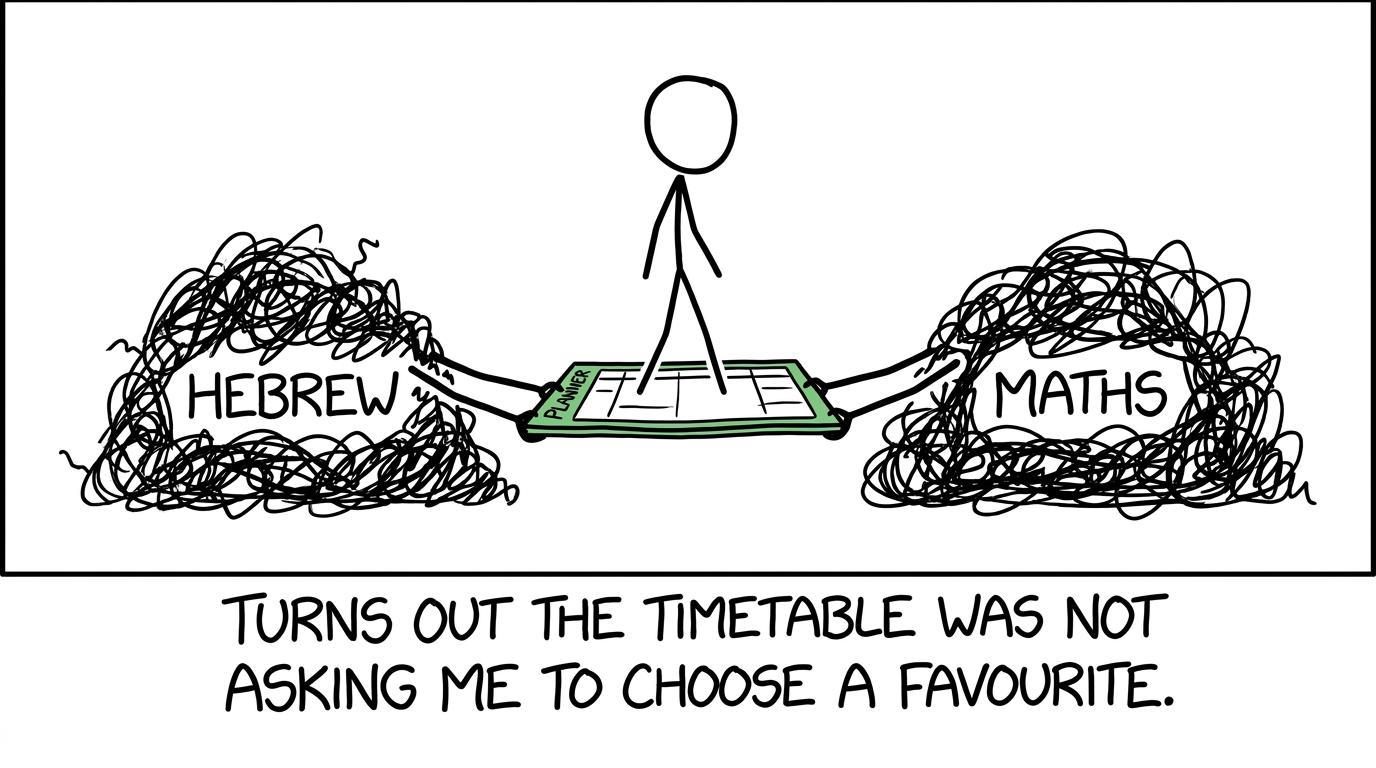 Hebrew and maths revision piles connected by a calm student's weekly planner
A calm plan for the final days
Several days before
Complete a timed selection of Paper 2 questions and mark it against the relevant mark scheme or teacher guidance. Turn every lost mark into a specific action, such as revisiting one chapter, improving translation precision or planning stronger textual evidence.
At the same time, keep maths active through short topic sessions. MathsGenie's Edexcel GCSE Maths predicted papers are useful for unseen mixed practice, but they work best after you have repaired the weaknesses revealed by past papers.
The day before
Check the examination date, session, reporting time and room. Pack your permitted equipment. Review a short list of high-value reminders rather than attempting to reread every set text from beginning to end.
Keep any maths session controlled. The GCSE maths night-before revision plan is built around targeted practice, checking mistakes and stopping at a sensible time. Even when Biblical Hebrew is the next examination, that principle still applies: preparation should reduce uncertainty, not manufacture exhaustion.
On the day
Eat, travel early and follow your centre's instructions. Before writing, read the paper directions carefully and note how the sections and marks are distributed. Keep enough time for the synoptic element and extended responses rather than allowing early short questions to expand indefinitely.
If one question feels difficult, avoid treating that moment as a judgement on the entire paper. Move methodically, use the evidence you know and return if time permits.
Common mistakes to avoid
Confusing Biblical Hebrew with Modern Hebrew
These are different qualifications with different assessment structures. The date in this guide is for Pearson Edexcel GCSE Biblical Hebrew Component 2: Literature, 1BH0/02. It is not an AQA Modern Hebrew speaking, reading, listening or writing assessment.
Using the wrong year's set texts
The prescribed passages can change between examination cycles. For 2026, use the set texts identified for the 2026-2028 examinations and compare your materials with the current Pearson specification.
Treating “afternoon” as the complete start time
The awarding body's timetable gives the session. Your centre tells you exactly when to arrive and where to report. Follow the local candidate timetable.
Revising content without practising responses
Recognition is not the same as recall, and recall is not the same as an exam answer. Practise translation, short responses and extended analysis under time pressure, then use marking guidance to improve them.
Letting one exam erase the rest of the timetable
Biblical Hebrew deserves focused preparation, but maths fluency can fade when practice stops completely. Use brief revision lessons, practice questions and mini tests to keep methods active. After Paper 2, return to fuller paper practice through MathsGenie's past papers, mark schemes and video solutions.
Turn the date into a plan
The essential information is clear: Pearson Edexcel GCSE Biblical Hebrew Component 2: Literature was scheduled for Tuesday 19 May 2026, in the afternoon, with a duration of 222 hours.
A date cannot improve a grade by itself. Its value is that it removes one uncertainty. Once the date, session and paper format are known, your remaining decisions become smaller: what to revise today, what to test tomorrow and what to pack the night before.
Use MathsGenie as your free maths revision base alongside that preparation. Start with revision lessons and practice questions, diagnose gaps with mini tests, then build examination stamina using past papers, predicted papers, mark schemes and video solutions. The aim is not to make every subject feel easy. It is to arrive knowing what comes next.