GCSE Biblical Hebrew Grade and Sixth Form Entry
GCSE biblical Hebrew grade sixth form entry explained: learn when the result counts, what matters more, and how to protect your maths options at college.
A single result can feel strangely powerful when you are waiting for GCSE grades. Perhaps Biblical Hebrew is not the subject you plan to continue, yet you are wondering whether one disappointing number could close the door to sixth form.
The short answer to gcse biblical hebrew grade sixth form entry concerns is reassuring: sixth forms and colleges can count Biblical Hebrew as a valid GCSE, but they rarely give that result special weight unless it affects an overall entry threshold, a GCSE average or a relevant course requirement. For A Level Maths, your GCSE Maths grade will normally matter far more.
Admissions policies differ, so the institution's published requirements remain the final authority. Still, most decisions follow a recognisable pattern. Understanding that pattern lets you direct revision towards the grades that protect your options.
The quick admissions checklist
Before worrying about one subject, check these questions in order:
- Does the institution require a particular number of GCSEs at grades 444, 555 or above?
- Does it calculate an average across all GCSEs or the best 888?
- What grades does it require in GCSE Maths and English?
- Are there separate requirements for your chosen A Levels or vocational courses?
- Will Biblical Hebrew be included among the GCSEs used for the general threshold?
- What happens if you miss one requirement narrowly?
That last question must be answered by the sixth form or college itself. Published requirements can be precise, and decisions on near-misses depend on the admissions policy, available places and your complete results profile.
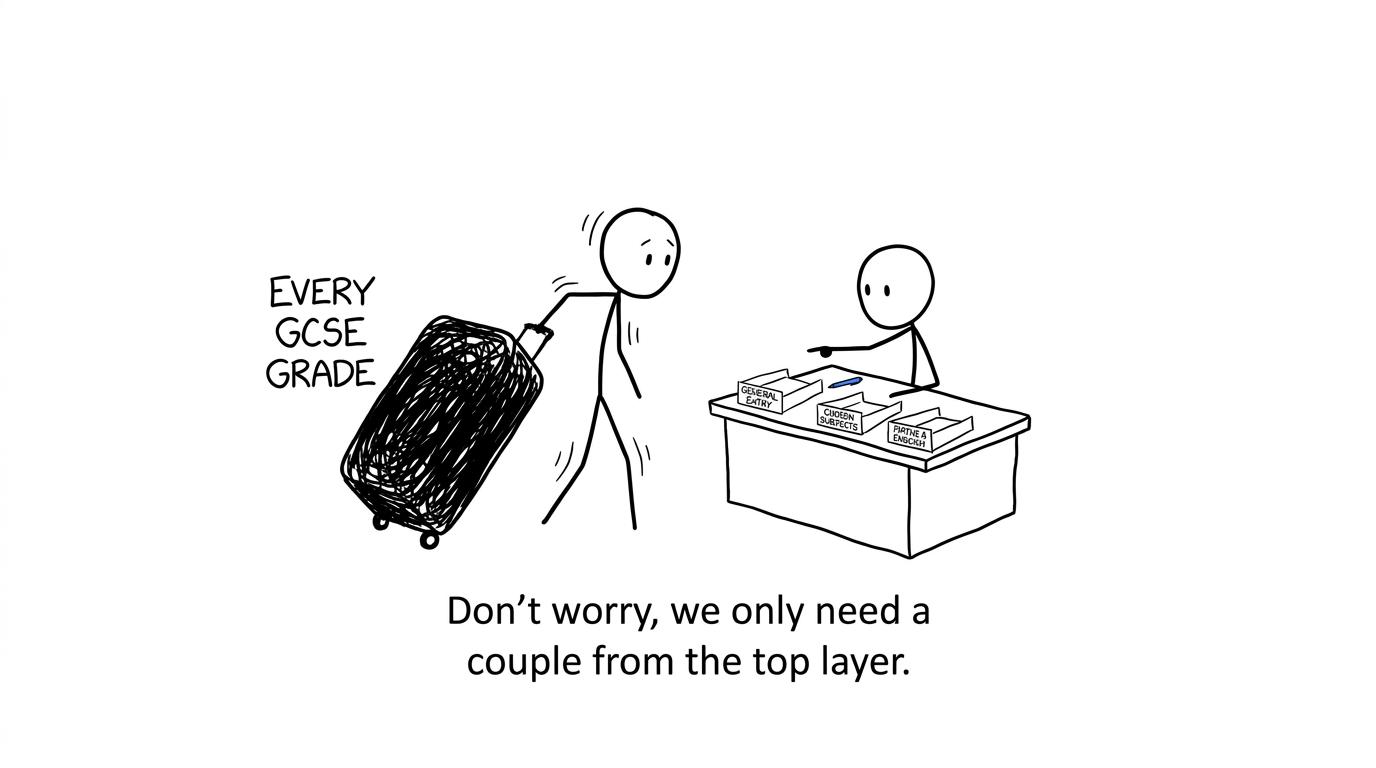 A student bringing every GCSE grade to a sixth-form admissions desk
How much does a GCSE Biblical Hebrew grade matter?
In most applications, it has supporting weight rather than decisive weight. It is one recognised qualification within your GCSE profile, not a separate admissions category that automatically receives more or less value because the subject is unusual.
The current Pearson Edexcel Biblical Hebrew qualification is an approved GCSE graded from 999 to 111. It is untiered and assessed through two externally examined components. The language component accounts for half of the qualification, while the remaining assessment covers literature and responses to ancient sources. You can inspect previous Edexcel GCSE Biblical Hebrew grade boundaries, remembering that boundaries change between exam series.
Its importance depends on how an institution processes results.
| Admissions method | Possible effect of Biblical Hebrew |
|---|---|
| A minimum number of GCSE passes | It may count as one of the required qualifications |
| A minimum number of grades at 555 or 666 | A strong grade may help you reach the total |
| An average across all GCSEs | The grade may raise or lower that average |
| An average based on the best 888 results | It matters if it falls within those best 888 |
| Subject-specific A Level entry | It usually has limited relevance unless the department accepts it as evidence for a related language or essay-based course |
| Entry to A Level Maths | GCSE Maths is normally the central subject grade |
This distinction is important. A grade can count without being especially influential. An admissions team may include Biblical Hebrew when checking whether you have five suitable GCSEs, for instance, while still paying much closer attention to Maths, English and the subjects you intend to continue.
What sixth forms and colleges usually prioritise
There is no single national sixth-form admissions threshold. Schools and colleges publish their own general and subject-specific requirements, and these vary considerably.
Current published policies illustrate several common models. Some ask for five GCSEs at grade 444 or 555 and above. Others require several grades at 666, an average grade across the best 888 subjects, or particular results in Maths and English. Selective sixth forms may set higher overall averages.
General entry requirements
Biblical Hebrew can be useful here. If a college asks for five GCSEs at grade 555 or above, a grade 555 or higher in Biblical Hebrew may help complete that set. If the requirement is based on an average, it becomes one component of a wider calculation.
This also means one lower grade is not necessarily fatal. If the policy uses your best results and Biblical Hebrew sits outside that group, it may have little direct effect. If the policy includes every GCSE, it could affect the average, but it remains only one part of the profile.
Maths and English requirements
Maths and English often occupy a different category. In England, students aged 161616 to 181818 on relevant programmes who have not achieved grade 444 or above in GCSE Maths or English are generally required to continue working towards approved qualifications in those subjects under the post-16 funding rules.
That policy does not apply to Biblical Hebrew. Consequently, a grade 333 in Maths can affect your post-16 programme in a way that a grade 333 in Biblical Hebrew usually does not.
This is why students preparing for their next step should keep GCSE Maths revision near the centre of their plan. It is not because every other GCSE is unimportant. It is because different grades have different jobs.
Requirements for your chosen subjects
Subject-specific conditions may be stricter than the general entry threshold. A sixth form might accept you into Year 121212 overall but decline a particular A Level combination if you have not met the relevant grades.
For A Level Maths, current published requirements often ask for a high GCSE Maths grade, commonly grade 666 or 777, although the precise threshold varies. Further Maths frequently carries a still higher requirement, often grade 777 or 888. These are institutional choices, not universal national rules.
If you are considering that route, compare your current performance with the demands of higher tier using the GCSE Foundation versus Higher guide. You can also review the GCSE Maths topics by exam board and tier so that your revision matches Edexcel, AQA, OCR or Eduqas accurately.
 A prospectus detective finding subject-specific requirements
When Biblical Hebrew could carry more weight
Although it is seldom the central requirement for a maths pathway, there are situations in which the result becomes more significant.
It completes your required GCSE total
Suppose an institution needs a stated number of GCSEs above a certain grade. Biblical Hebrew may count towards that number in the same way as another approved GCSE, subject to the institution's policy. Losing that qualifying grade could therefore leave you below the overall threshold.
It appears in an average-grade calculation
Some selective sixth forms calculate an average across all results or a specified group such as the best 888. In that system, every included result contributes. A high Biblical Hebrew grade can strengthen the average; a lower one can reduce it.
Do not try to guess the formula from a prospectus summary. Ask whether the calculation includes all qualifications, only GCSEs, the best 888, or specified subjects.
You apply for a related course
A language or humanities department may view Biblical Hebrew as useful evidence of linguistic analysis, close reading and disciplined written interpretation. However, you should not assume that it automatically substitutes for a named GCSE requirement such as French, Spanish, History or Religious Studies. Only the receiving institution can confirm accepted alternatives.
The institution is oversubscribed
Meeting minimum grades does not always guarantee a place. Where an admissions policy uses GCSE performance to rank applicants, an additional strong grade may support the application. The exact method should be stated in the policy rather than inferred from how prestigious or uncommon a subject seems.
What to do if the grade is lower than expected
First, compare your result with the actual policy, not with a general impression of what a sixth form “probably wants”. Look separately at:
- the general entry threshold;
- the requirements for each chosen course;
- any average-grade calculation;
- Maths and English conditions;
- instructions for applicants who narrowly miss an offer.
Then contact the admissions team promptly if anything is unclear. Give them the complete grade profile and your intended courses. Asking “Will you accept a grade 444 in Biblical Hebrew?” may produce an incomplete answer if the real decision depends on your best 888 average or GCSE Maths result.
Meanwhile, protect the grades with the greatest direct relevance. A focused routine using MathsGenie's one-month GCSE revision plan can help you organise topic learning, short tests and paper practice without allowing one anxious thought to consume every revision session.
Prioritising maths without neglecting other GCSEs
Revision time is limited. The sensible response is not to abandon Biblical Hebrew, but to allocate time according to the consequences of each grade.
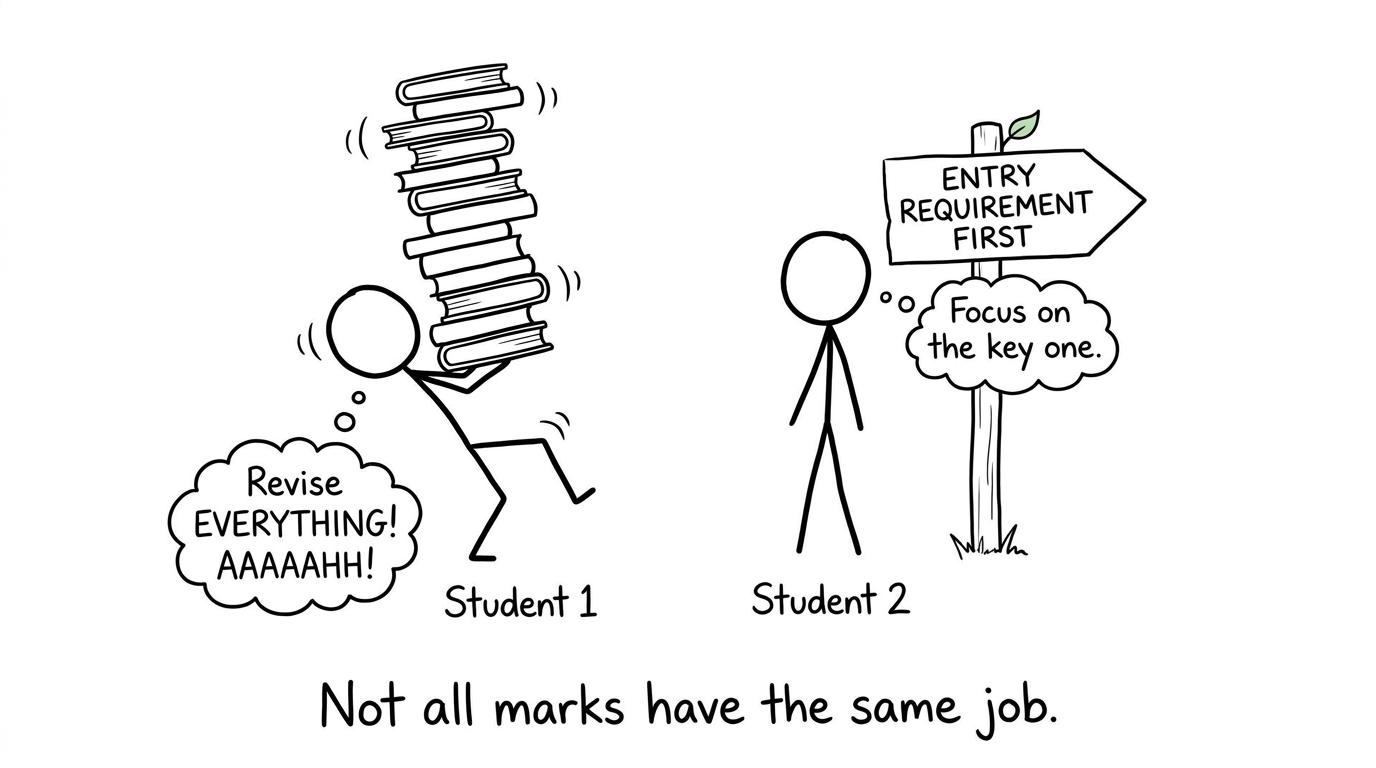 Two students choosing between chaotic revision and clear entry priorities
Start by identifying your non-negotiable requirements. If A Level Maths needs grade 777, that target deserves sustained attention. Use topic lessons and practice questions to repair weaknesses, then move into timed Edexcel GCSE Maths past papers if Edexcel is your board. Students following another specification should select the matching board from the main GCSE hub.
Mark schemes matter because a paper score alone tells you what happened, not why. Separate missing knowledge from misreading, weak working and time pressure. Near the examination period, GCSE predicted papers can provide extra rehearsal, but they should supplement specification-wide revision rather than replace it.
If A Level Maths remains your aim, it is also worth looking ahead at the Edexcel A Level Maths revision hub. The purpose is not to start the whole course early. It is to understand why algebraic fluency and accurate GCSE methods matter after Year 111111.
Common mistakes when judging sixth-form entry
Treating every GCSE as equally decisive
Every result contributes to your academic record, but institutions often give particular weight to Maths, English and subjects linked to your proposed courses. Equal effort is not always the same as intelligent prioritisation.
Assuming an unusual subject will be ignored
Biblical Hebrew is a recognised GCSE. It may count towards a total or average. Do not omit it when checking whether you meet an offer.
Assuming it will replace a named subject requirement
An approved GCSE is not automatically interchangeable with every other GCSE. A department asking for a particular language, science or essay-based subject may define exactly which alternatives it accepts.
Reading only the general admissions headline
Being eligible for sixth form does not necessarily make you eligible for every course. Always read the subject-specific requirements beneath the overall threshold.
Predicting future grade boundaries from last year
Historical boundaries provide context, not a guaranteed target. Exam boards set boundaries for each series after considering the performance evidence. Use previous figures carefully and focus revision on earning as many marks as possible.
Your grade is part of a profile, not the whole story
A GCSE Biblical Hebrew result can matter, especially when it contributes to a minimum number of passes or an average-grade calculation. But for most students applying to study Maths, sciences, economics or other numerate subjects, it is unlikely to outweigh the grades named explicitly in the entry requirements.
Read the policy. Check the course conditions. Ask the institution when the wording is unclear. Then return to the work that remains under your control.
MathsGenie gives you that practical next step: free revision lessons, exam-style practice questions, mini tests, past papers, predicted papers, mark schemes and video solutions. Start with the GCSE Maths hub, identify the topics currently costing you marks, and build the grade your next course actually requires.